
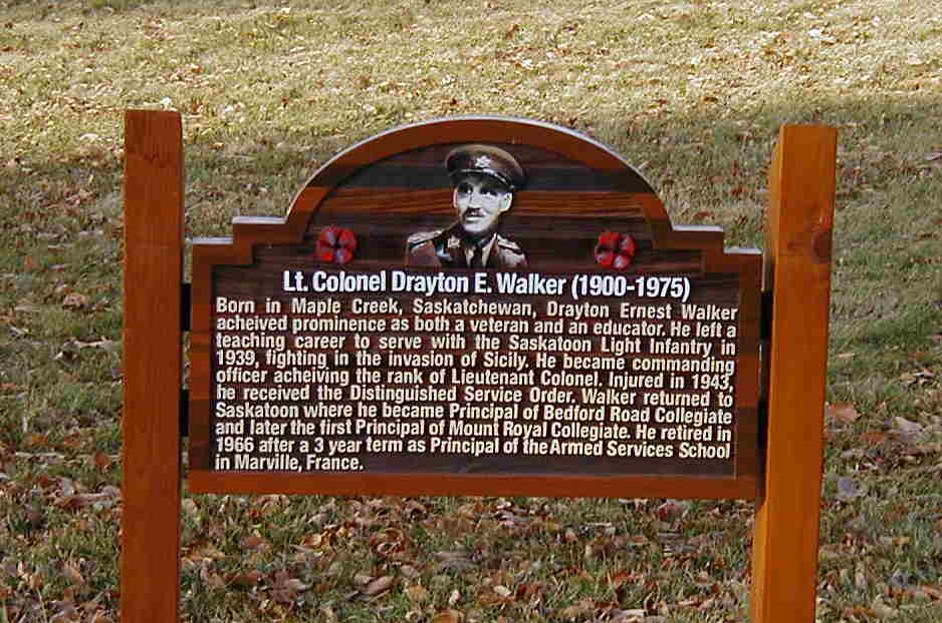
This park is named in honour of Lieutenant-Colonel Drayton Ernest Walker, DSO, Commanding Officer of the Saskatoon Light Infantry during the Second World War. It is located in Montgomery Place, an area developed in 1946 to house returning Second World War Veterans and their families. Most streets and parks in the area are named for prominent military members, famous battles, and military units. Lieutenant-Colonel D. Walker Park was named by the City of Saskatoon in the mid to late 1960s.
Drayton Walker and his wife Margaret had three sons — Peter, Phil and Teddy. The oldest was nine when their dad headed into the Second World War in 1939. He left behind a wide array of students, kids he educated and coached since taking his first teaching job in Prince Albert in 1922. He was teaching at City Park Collegiate when he left for the war.
Drayton was a former University of Saskatchewan track star, which would prove beneficial overseas. Ten days before Christmas in 1943, a Quebec battalion was pinned down at the town of Casa Berardi, Italy. Drayton commanded a Saskatoon Light Infantry machine-gun support group that rolled in to help during the vicious, eight-day Battle of Ortona. He chose to personally co-ordinate the defensive tasks of his unit, occupied observation posts in the most forward infantry positions, and moved skillfully from post to post under heavy enemy fire. Under his direction, mortars and machine guns engaged the enemy with devastating results. Hit by shrapnel to the knee and hand, he continued to direct the fire of his weapons until the retention of the position was assured. Still on foot, he threaded his way back to brigade headquarters across ground swept by enemy fire and provided crucial information. His actions contributed greatly to the success not just of that operation, but of the ones that soon followed and he was awarded a Distinguished Service Order.
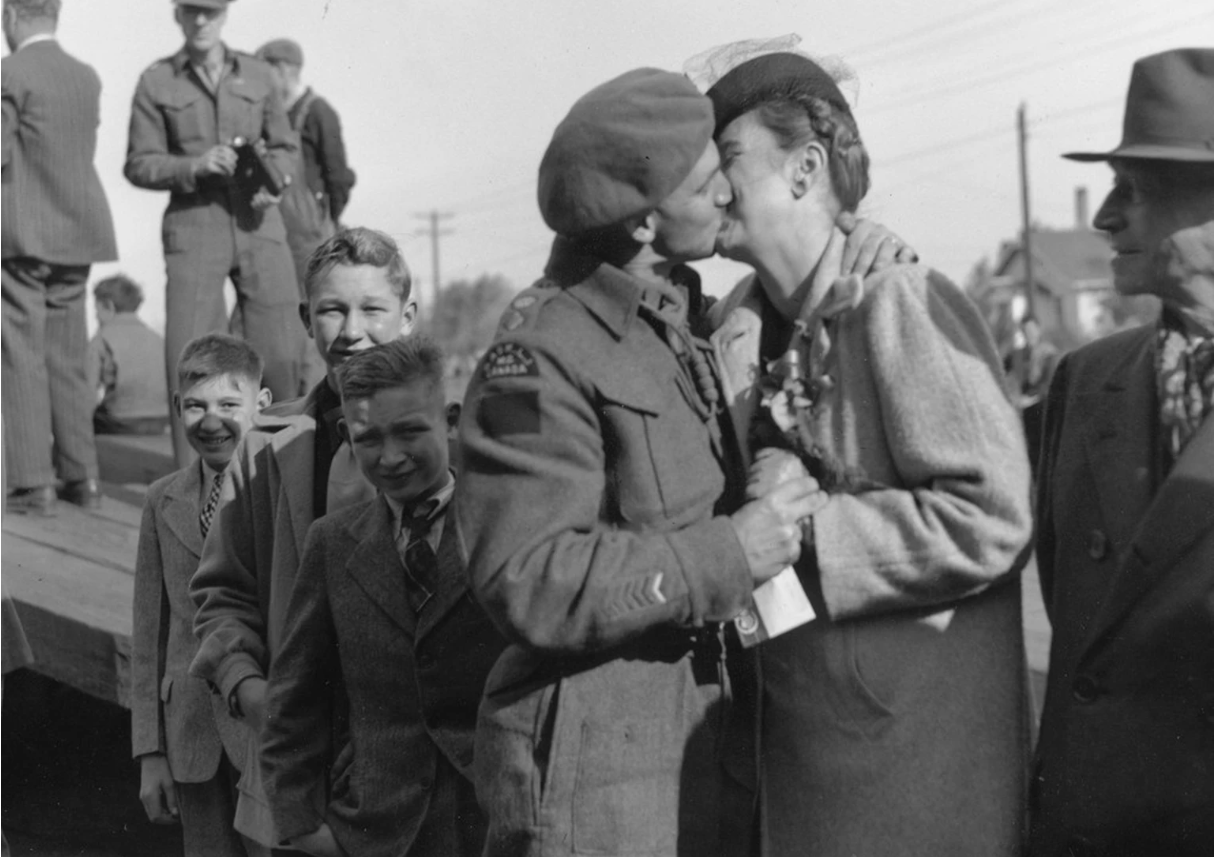
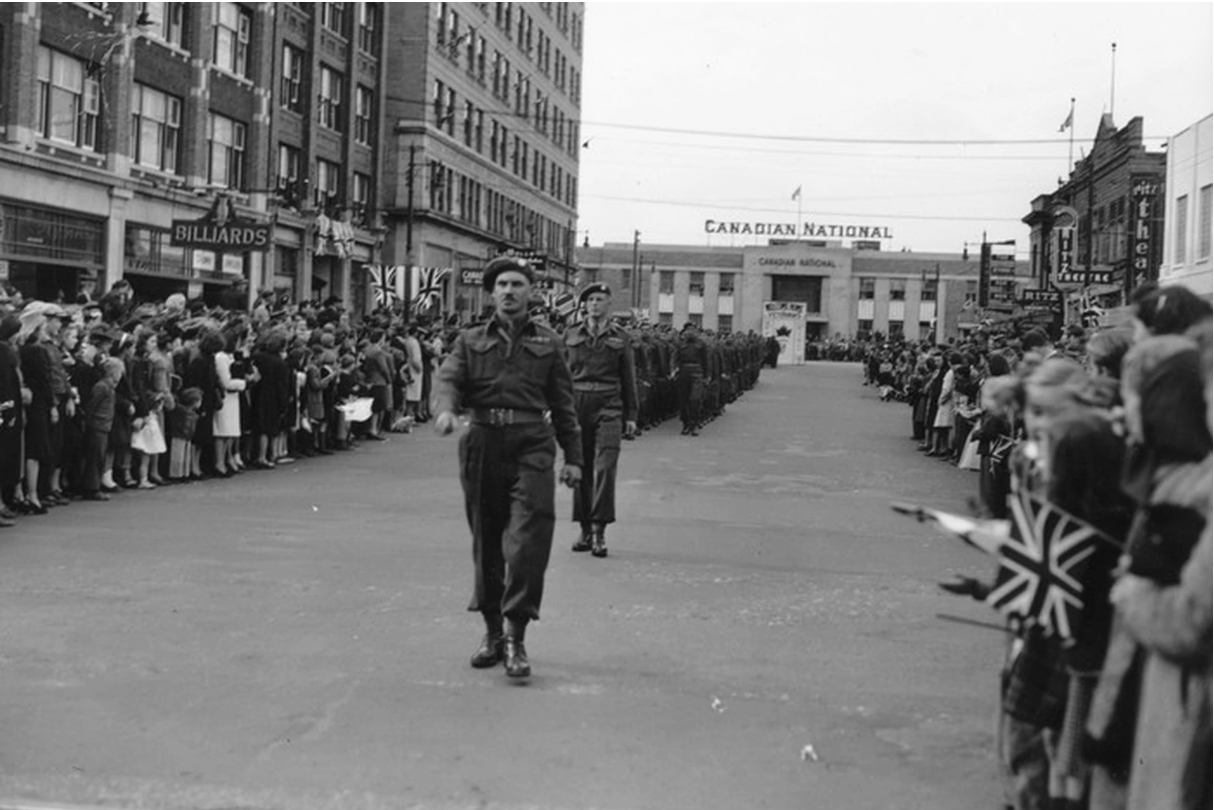
Shortly after Ortona, he was promoted to Lieutenant-Colonel and took over the battalion command in January 1945. In October 1945, he returned home to his family and sealed it with a kiss to his wife, while their three sons stood in the background. His homecoming was photographed and ran on page 5 of the Saskatoon Star Phoenix. The boys hadn’t seen their father since he returned to Canada in 1942 for an instructional tour. After the kiss, soldiers paraded through Saskatoon’s downtown with Drayton at the front, leading his troops one last time.
Margaret experienced grievous loss during the war. She’d raised three boys, mostly on her own, in the six years since Drayton left to fight, and she’d also lost a brother. Her brother, William Campbell, was the commanding officer of HMCS Louisburg in 1943 when it was sunk by enemy dive bombers and torpedo planes in the Mediterranean. He received a posthumous citation for saving many lives, due to his prompt action. His bravery cost him his life.
Drayton was the principal at Bedford Road Collegiate starting in 1954, moving over from his job teaching history at Nutana Collegiate, before becoming Mount Royal Collegiate's first principal when it opened in 1960. The school’s motto, “Truth, Honour and Wisdom” was taken from Drayton’s wartime regiment. He later spent three years in France, serving as the principal of the Canadian Armed Services School. Drayton died on November 15, 1975, at the age of 75.
In 2004, the Montgomery Place Community Association embarked on a project to explain the choice of names for Montgomery Place streets. The research and writing were undertaken by Kevin Gooding who was the Finance Director at the time, with help from President Jim Earle.
The signs were produced at Abe’s Sign Design Group of Saskatoon, with owner Gerry Tunicliffe giving the Association his whole-hearted support. Gerry even offered the Cassino Avenue sign free-of-charge, since his father had fought at the Battle of Monte Cassino. With interest and dedication, Gerry was also a great help to Kevin tracking down photos for the signs.
On September 22, 2007, Kevin, Jim and Vice-President Dave Price, along with Secretary Larry Rempel, Communications Director Gary Berg and resident Don Janzen, rented an auger and then dug, filled, tamped and installed the first 16 signs. Three more signs were installed later.