
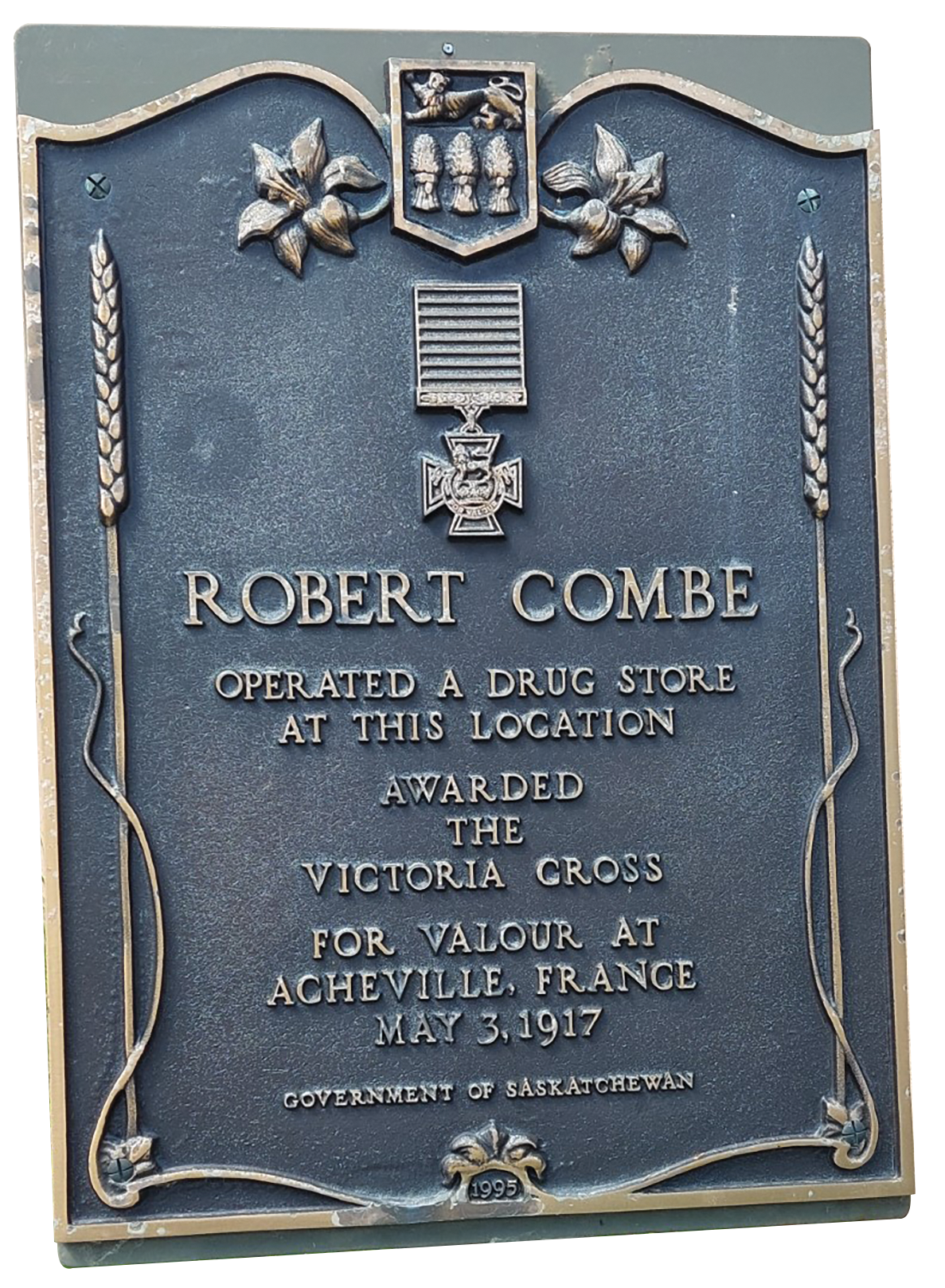
The Lieutenant Robert Combe Plaque was erected by the Saskatchewan Heritage Foundation, Government of Saskatchewan in 1995.
Robert Combe was awarded the Victoria Cross, for his actions at Acheville, France, on May 3, 1917. Although the Battle of Vimy Ridge is considered to have ended in mid-April of 1917, fighting carried on at the edges of the ridge for weeks afterward. On May 3, 1917, Lieutenant Robert Grierson Combe was leading a small force on the right side of the Canadian Line, near the town of Acheville, France, about four kilometres from Vimy village. The artillery from the opposing positions was fierce, and soon the entire Canadian line began to stagger as men sought shelter from the cannon fire. They gathered their strength and continued the advance only to be bombarded by their own artillery. The Canadian line halted, all except for Combe, who had gathered a handful of survivors from his company, and was attacking an enemy position. This force of six men captured two hundred and fifty yards of trench and eighty prisoners. Lieutenant Combe was constantly in the lead in repeated charges. As he was leading the final charge to capture the entire emplacement Combe was fatally wounded. The site of his grave is unknown.
Robert Combe was born in Aberdeen, Scotland, in 1880. After grammar school he embarked on a pharmaceutical career, apprenticing in Aberdeen and London, England. He emigrated to Canada around 1906 and moved to Moosomin. Two years later he opened his own drug store in Melville. Soon he and his business partner opened another pharmacy in Dubuc. Mr. Combe and his wife Jean settled into the community of Melville, where he became a local leaded in business and sport circles. When war was declared in 1914 Combe volunteered, and after a training period was posted to England as a Major, in charge of physical training. He wanted to be part of the fighting in France, so accepted a reduction in rank to Lieutenant and an assignment to the front. His health rapidly declined, and he returned to England on sick leave. Recovering, he returned to his unit in north east France.
Jean Combe, who served as a nurse in Britain during the war, was twice invited to Buckingham Palace to accept her deceased husband’s Victoria Cross. She declined because of ill health. In 1919 the Prince of Wales presented Lieutenant Combe’s Victoria Cross to his widow at the Legislative Building in Regina. Robert Combe’s portrait now hangs in the Peace Tower in Ottawa, Ontario and in the museum in Melville. The Government of Saskatchewan named a northern lake in Combe’s honour, and the Melville Branch of the Royal Canadian Legion is named for him.