
In 1944, Lieutenant-Colonel C.N. Mitchell VC, MC, Officer Commanding of A6 Canadian Engineer Training Centre, was inspired with the idea of creating a monument to all Sappers. It would be designed and crafted by Sappers. He directed Major Williams to design the cenotaph, and Major Davies to select a site and prepare a memorial park. Major N.B. Gillies, a geologist, was to select the site from which a suitable piece of rock could be quarried in one piece. Transporting the piece was designated to Major T. A.V. Tremblay, OC of the Bridging Wing, and for setting out the quarrying camp.
Major Williams presented his first design in 1945. It was to be a twelve-sided shaft set on a square base, with a grenade at each of the four corners. Three steps would take you up to the cenotaph. The over-all height of the monument was 16 feet, 6 inches and the base, 4 feet, 10 inches square. On January 24, an expedition of Lieutenant Colonel Mitchell, Major Gillies and several others, located and decided on the quarry site, the face of a cliff on Harrison Lake, approximately 22 miles from the site selected for the cenotaph.
The rock chosen was Monzonite, an aggregate of plagloclase feldspar and hornblende, resembling granite. Within a few hours of their return to camp, an order was issued for "Operation Granite" and a quarrying camp was set up the next day. Lieutenant T.H.E. Copps, an experienced miner and prospector started the quarrying. By the end of March, the most difficult task of quarrying was completed.
The 42 tons stone had to be moved to the park area for final cutting and shaping. It was decided to bring the massive block on a Bailey Pontoon raft to Cannor Bay, a point on the Fraser near Chilliwack, and then by low-loader to its destination. Under the direction of QMS Ozmun, an obsolete Valentine Tank was converted into a low-loader. The Bridging Wing constructed a five pontoon Bailey raft, while loading ramps were built at the quarry site and Cannor Bay with Lieutenant D.R. Young in charge. On the morning of 16 May 1945, with Major Tremblay in charge, the massive stone made its way down the Harrison and Fraser Rivers in the heavy rain. Normally, Engineers revel when gravel is found, not so in this case. Within just a few miles of the offloading point, the raft ran aground on a gravel bar in midstream. All efforts to free the raft failed. Mooring it for the night, Major Tremblay reported to Lieutenant-Colonel Mitchell. Mitchell and Major Davies sought out a very powerful tug, and with Davies on board, the tug came to the rescue. In freeing the raft, it nearly swamped. Upon arriving at the offloading point, it was found that most pontoons were half full of water.
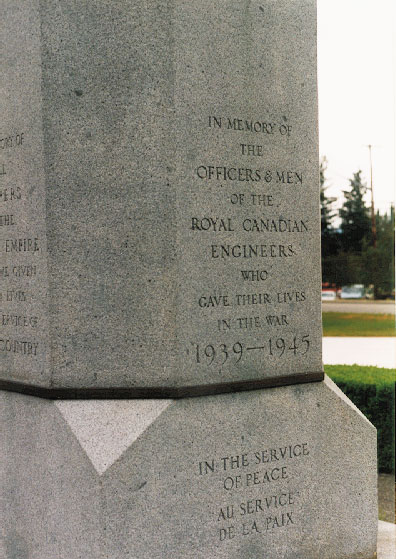
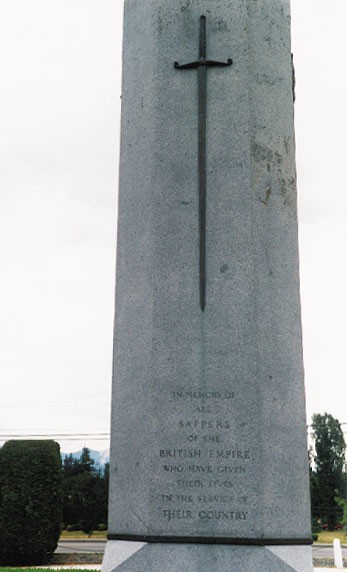
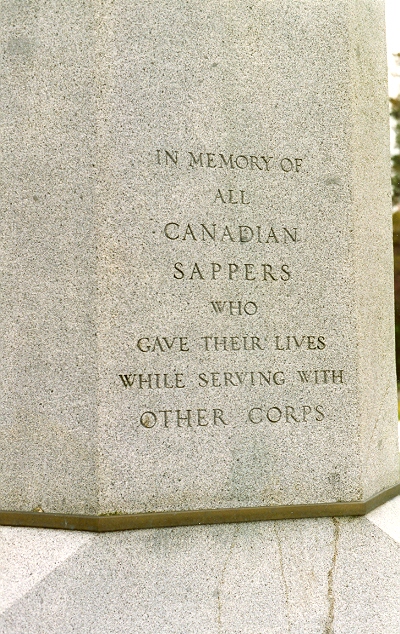
Once unloaded in the center of the Memorial Park on 18 May 1945, the cutting process began. Experienced stone masons, SSgt Crowe, Corporal Bloomfield, Corporal Thatcher and Sapper Forster comprised the expertise that would cut and shape the raw material into the final shape. The design was twice changed due to faults in the stone. It went from a twelve to an eight sided shaft, and finally because of further faults, to the shape you now see. The base was considerably reduced, but the height did not change.
These men worked in all weather until early the next year and were very proud of their work. By the end of February 1946, the steps were in place, the base stone and cap stone completed, and the main shaft was approaching the final phase. There still remained the fashioning of the swords and grenades, the lettering and the all important task of raising the main shaft into position. On April 13, the main shaft was ready to be raised into position. A diamond drill hole was made through the length of the stone. Through this hole, a steel rod with an eye was threaded, secured by two steel nuts at the bottom of the shaft. The stone, in a horizontal position, was then moved on rollers up a ramp to a platform built around the base stone. Over the platform were sheer-legs tackled with a fifteen ton chain block. Once on the platform, the stone was raised to a position approximately 35 degrees by jacks and from there on was brought up to perpendicular by the block and tackle. A movie camera recorded the happenings of that tense Saturday morning.
Mr. Booth, a well known landscape gardener of New Westminster and father of one of the Sappers, not only gave trees and shrubs, but devoted much time to landscaping.
By the time of unveiling, a long time dream of Lieutenant-Colonel Mitchell's came to pass. Chilliwack was named the Royal Canadian School of Military Engineering and he its Officer Commanding.
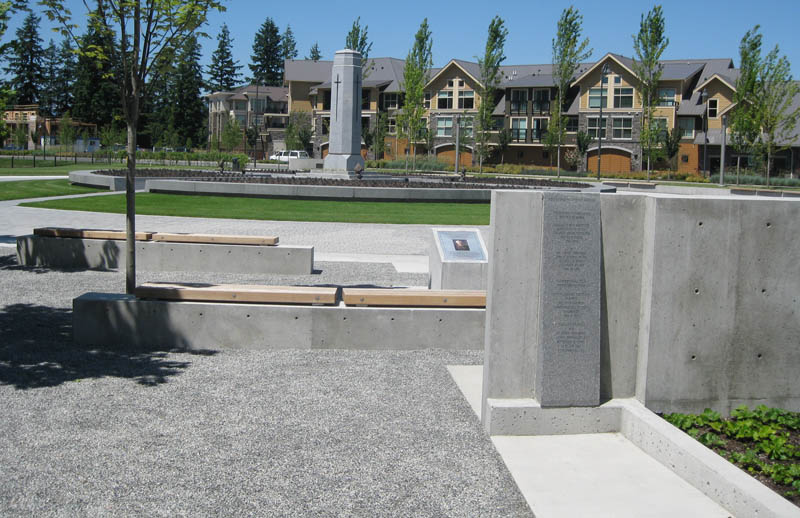
After the closure of Canadian Forces Base Chilliwack in 1998, the Department of National Defence retained ownership of All Sappers' Memorial Park and the cenotaph. Canada Lands Company had the responsibility of disposing of the Canadian Forces Base Chilliwack properties and wished, at the same time, to preserve the military heritage of the area. Their proposal was to not disturb the cenotaph, to increase the land area, to beautify the grounds, and to respect the soil where ashes have been spread. Canada Lands Company worked closely with Canadian Forces Base Chilliwack Historical Society and Retired Sappers to revitalize and refurbish the All Sappers Memorial Park. Mr. Greg Smallenberg was selected as the designer. Among his high-profile works, he was renowned for his work at the Vimy Monument in France.
Ground was broken in June 2009 with the intention to have the restored memorial ready for rededication for Remembrance Week 2009. The construction company GEMCO was given this trust of restoration. They stripped away the concealing hedge, elevated the center island, beautified the landscape, inserted soft lighting and signage, redirected sidewalks into the site and added numerous seats to invite visitors to sit and reflect.
Relatives of Lieutenant Colonel Mitchell participated at the rededication of All Sappers' Memorial Park and Cenotaph on 7 November 2009. Mrs. Frances Bailie (Mitchell’s daughter) and her son Philip Beck and Mitchell’s great-grandson, Liam Gleeson in his cadet uniform, did Lieutenant-Colonel Mitchell proudly. Mrs. Bailie’s speech held the spectators spellbound. The silence was maintained as the family laid a wreath in memory of their renowned relative.