
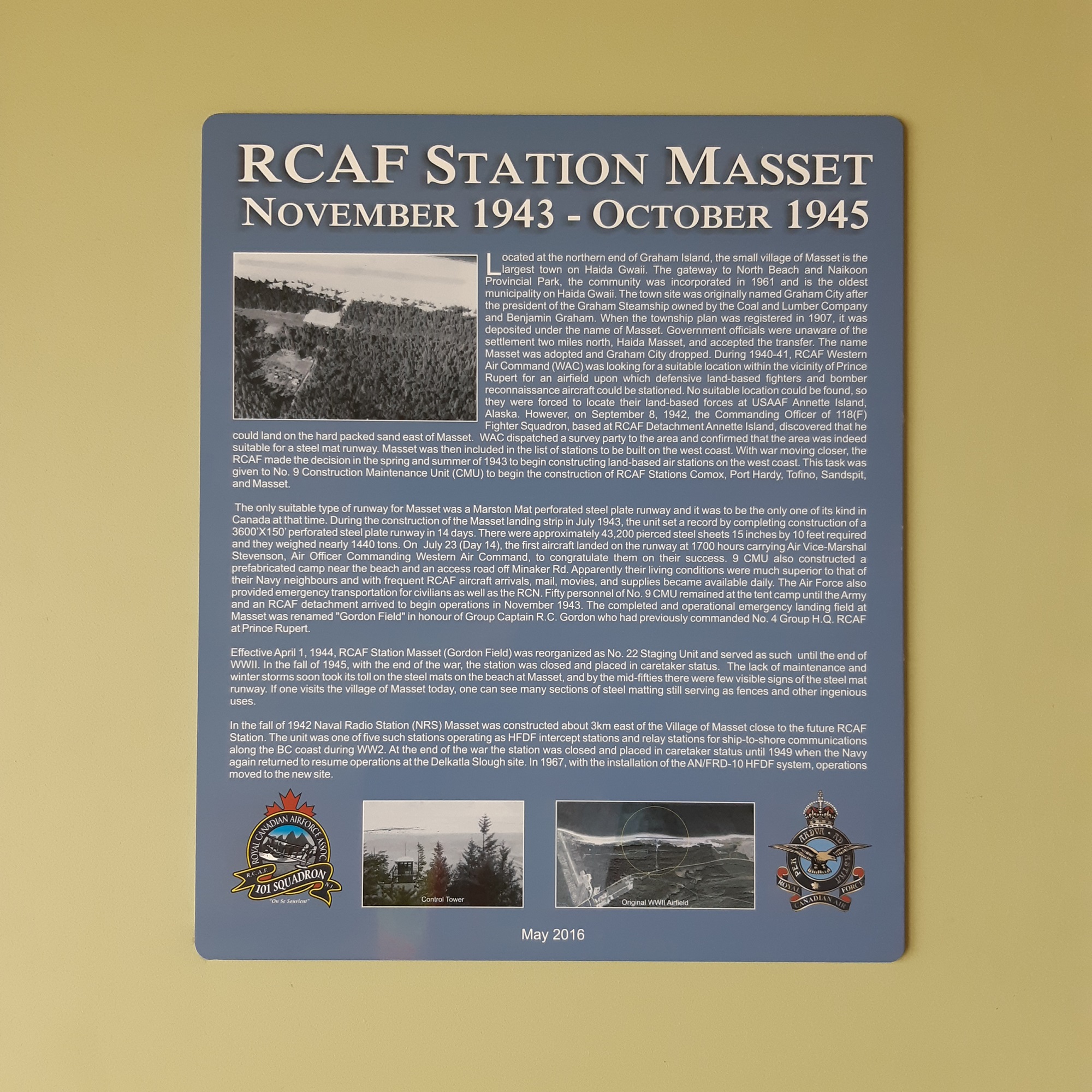
The RCAF Station Masset Plaque was dedicated on May 28, 2016, in memory of the Royal Canadian Air Force Station at Masset during the Second World War. It was erected as part of the Royal Canadian Airforce Association 101 Squadron's program of remembering Royal Canadian Air Force Stations on North Island, Central Coast, and Haida Gwaii.
RCAF Station Masset Plaque
Masset, British Columbia
Notice:
The National Inventory of Canadian Military Memorials is a public, crowd-sourced registry that helps Canadians learn about memorials in their communities. Inclusion in the Inventory does not imply VAC ownership or authority. Responsibility for the care, management, and any changes to a memorial rests with its owning or governing organization.
Inscription
RCAF STATION MASSET
NOVEMBER 1943-OCTOBER 1945
Located at the northern end of Graham Island, the small village of Masset is the largest town on Haida Gwaii. The gateway to North Beach and Naikoon Provincial Park, the community was incorporated in 1961 and is the oldest municipality on Haida Gwaii. The town site was originally named Graham City after the president of the Graham Steamship owned by the Coal and Lumber Company and Benjamin Graham. When the township plan was registered in 1907, it was deposited under the name of Masset. Government officials were unaware of the settlement two miles north, Haida Masset, and accepted the transfer. The name Masset was adopted and Graham City dropped. During 1940-41, RCAF Western Air Command (WAC) was looking for a suitable location within the vicinity of Prince Rupert for an airfield upon which defensive land-based fighters and bomber reconnaissance aircraft could be stationed. No suitable location could be found, so they were forced to locate their land-based forces at USAAF Annette Island, Alaska. However, on September 8, 1942, the Commanding Officer of 118(F) Fighter Squadron, based at RCAF Detachment Annette Island, discovered that he could land on the hard packed sand east of Masset. WAC dispatched a survey party to the area and confirmed that the area was indeed suitable for a steel mat runway. Masset was then included in the list of stations to be built on the west coast. With war moving closer, the RCAF made the decision in the spring and summer of 1943 to begin constructing land-based air stations on the west coast. This task was given to No. 9 Construction Maintenance Unit (CMU) to begin the construction of RCAF Stations Comox, Port Hardy, Tofino, Sandspit, and Masset.
The only suitable type of runway for Masset was a Marston Mat perforated steel plate runway and it was to the be the only one of its kind in Canada at the time. During the construction of the Masset landing strip in July 1943, the unit set a record by completing construction of a 3600’X15-‘ perforated steel plate runway in 14 days. There were approximately 43,200 pierced steel sheets 15 inches by 10 feet required and they weighed nearly 1140 tons. On July 23 (Day 14), the first aircraft landed on the runway at 1700 hours carrying Air Vice-Marshal Stevenson, Air Officer Commanding Western Air Command, to congratulate them on their success. 9 CMU also constructed a prefabricated camp near the beach and an access road of Minaker Rd. Apparently their living conditions were much superior to that of their Navy neighbours and with frequent RCAF aircraft arrivals, mail, movies, and supplies became available daily. The Air Force also provided emergency transportation for civilians as well as the RCN. Fifty personnel of No. 9 CMU remained at the tent camp until the Army and an RCAF detachment arrived to begin operations in November 1943. The completed and operational emergency landing field at Masset was renamed “Gordon Field” in honour of Group Captain R.C. Gordon who had previously commanded No. 4 Group H.W. RCAF at Prince Rupert.
Effective April 1, 1944, RCAF Station Masset (Gordon Field) was reorganized as No. 22 Staging Unit and served as such until the end of WWII. In the fall of 1945, with the end of the war, the station was closed and placed in caretaker status. The lack of maintenance and winter storms soon took its toll on the steel mats on the beach at Masset, and by the mid-fifties there were few visible signs of the steel mat runway. If one visits the village of Masset today, one can see many sections of steel matting still serving as fences and other ingenious uses.
In the fall of 1942 Naval Radio Station (NRS) Masset was constructed about 3km east of the Village of Masset close the future RCAF Station. The unit was one of five such stations operating as HFDF intercept stations and rely stations for ship-to-shore communications along the BC coast during WW2. At the end of the war the station was closed and placed in caretaker status until 1949 when the Navy again returned to resume operations at the Delkatla Slough site. In 1967, with the installation of the AN/FRD-10 HFDF system, operations moved to the new site.
May 2016
Location
RCAF Station Masset Plaque
1930 Dave Wanna Way
Masset
British Columbia
RCAF Station Masset Plaque
1930 Dave Wanna Way
Masset
British Columbia
GPS Coordinates
Lat. 54.0220326
Long. -132.1196441
Lat. 54.0220326
Long. -132.1196441