
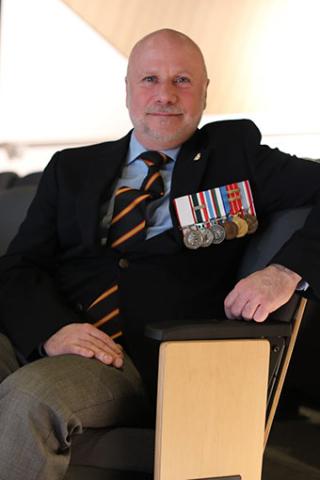

Joined
1988
Introduction
When the 1998 ice storm hit Quebec, Lieutenant-Colonel Louis-Benoît Dutil was living right in the middle of what became known as the Black Triangle—the hardest-hit zone of the disaster. His family was without power for 21 days. The basement flooded and his pregnant wife had to be evacuated to safety.
It was a personal crisis for Dutil, but it was also the start of an intense three-week mission that redefined his military career.
"Top Gun" dreams
In 1988, Dutil decided to join the Canadian Armed Forces (CAF). His dream was to become a naval pilot. You see, two years earlier the blockbuster movie “Top Gun” captured his imagination, setting in motion the next three decades of his life.
He discovered Canada had no naval aviation program—but decided to transfer to the Armoured Corps. For the next 32 years, he served in the 12th Canadian Armoured Regiment, commanded the Sherbrooke Hussars, deployed on humanitarian operations and rose through the ranks to Lieutenant-Colonel.
He’d already seen action in domestic operations, fighting forest fires in Baie-Comeau in 1992 and responding to the Saguenay floods in 1996. He also trained in Civil Affairs with U.S. Special Forces, bridging the gap between military forces and civilian authorities.
A storm without a frontline
On 4 January 1998, Dutil returned from Christmas leave to find his home dark, the sump pump dead and water rising. “We were truly devastated, it was a disaster at home,” he said.
By the next morning, his Commanding Officer asked if he’d serve as liaison officer to the municipal authorities of Saint-Jean-sur-Richelieu and Saint-Luc. “He said ‘we need people who know the region and who will be able to welcome the forces coming here as reinforcements.’ I told him, ‘Give me two hours,” Dutil said. “I took my wife to her aunt’s house and said, ‘We’ll see each other when the ice storm is over.’”
Soon he was working with municipal officials, coordinating reinforcements arriving from 3rd Battalion, Princess Patricia’s Canadian Light Infantry. First order of business was navigating the language barrier (civil authorities spoke little English, soldiers spoke little French) and Dutil had to translate between mayors and battalion commanders.
The soldiers worked in treacherous ice and had to remove endless debris. Civil authorities had estimated a task would take ten soldiers five days; the troops often did it in one. That motivated them, Dutil said.
“They didn’t want to stop until the job was done. It was almost like a race to get an extra task.”
Montreal’s close call
On January 9, a full brigade was ready to take action as Montreal teetered on the brink of a total blackout which would have plunged more than 1.5 million people into the dark and cold.
“If Montreal had gone dark, it would have been disastrous,” Dutil said. The cold snap that followed stabilized the situation just enough to keep the lights on and allow forces to be redeployed to the hardest-hit areas.
Lessons that outlasted the ice
The storm forced the Canadian Forces to rethink how it conducted domestic operations. It was a crash course in the limits of military involvement—when to step in, when to step back and how to avoid competing with private sector recovery efforts.
“We are an organization of last resort,” Dutil explained. “Our job is to save lives and stabilize the situation so civilian authorities can take over.”
It also cemented in him the value of adaptive thinking.
“In war, you train to think like the enemy. In a disaster like this, you need to stop thinking like you were trained. You need to think differently to apply your skills to a situation completely outside of combat.”
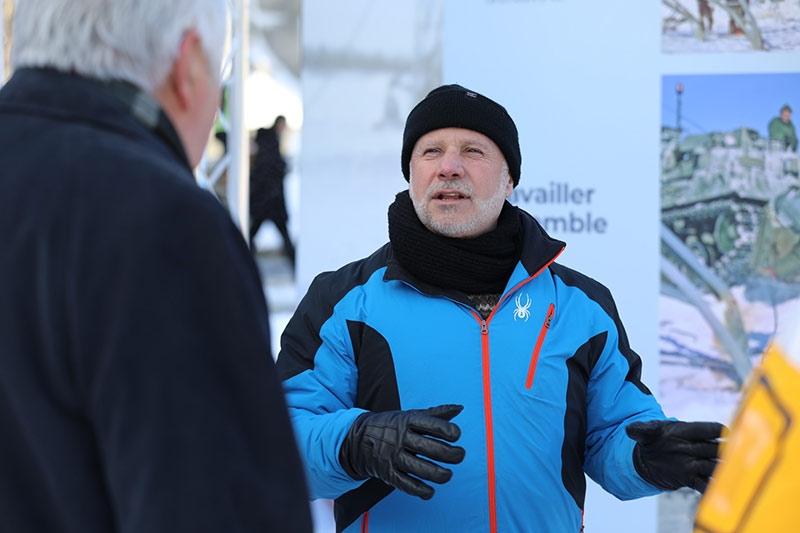
Dutil speaks to a fellow Veteran at a commemorative display for the Ice Storm in Ottawa.
A career redefined
The ice storm was a turning point in Dutil’s career. It led him to seek out humanitarian missions, from the Y2K operations centre with the Sûreté du Québec to post-earthquake Haiti.
And there was one more life-changing outcome: two months after the storm, his first son was born.
“For some, the ice storm is a bad memory,” he said. “For me, it’s a wonderful memory that shaped my career and my personal life. It showed me that the Forces aren’t just for waging war, they’re for helping people.”
With courage, integrity and loyalty, Louis- Benoît Dutil is leaving his mark. He is a Canadian Armed Forces Veteran. Discover more stories.
The well-being of Canadian Veterans is at the heart of everything we do. As part of this, we recognize, honour and commemorate the service of all Canadian Veterans. Learn more about the services and benefits that we offer.