Description
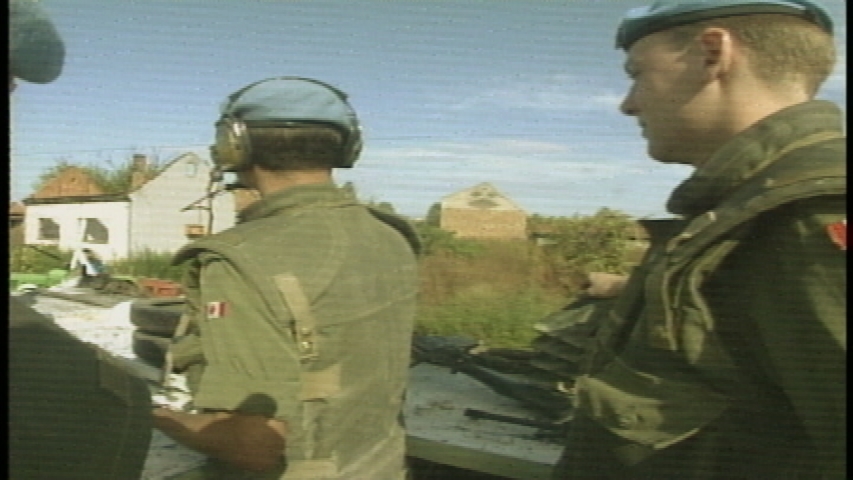
Collection of interviews with veterans of the Canadian Armed Forces recounting their experience of military service in Afghanistan. The veterans in the video are: Collin Fitzgerald, Robert McCue, Natacha Dupuis, Jo-Anne MacDonald, Vincent Moroz, Mike Reist and Jay Feyko.
Transcript
Collin Fitzgerald
January of 2006 we were on a flight headed over the pond to experience something like I never thought in any way that I would ever experience. I never thought that I would be encased in anything that I experienced over there. We landed in Kandahar airfield and I just remember getting off the plane and it was just that impact of that heat and getting off the plane on the tarmac and it was like wow! This is something else. I had never been to a desert type environment so that in itself was just a shock.
Robert McCue
And the Hercules would come in and you’d land and the ramp would drop and it was like someone punched you in the gut with the heat. It was just this completely solid mass of heat that would hit you. It was 8:30 in the morning I think when I landed and I was overwhelmed by the heat and this was January and I’m thinking of dear God, this is going to be crazy! Most soldiers lost about twenty pounds of weight in water alone; everybody, just in water because of the heat over there. You’re wearing a ballistic vest with ceramic plates in it so you’re carrying an additional fifty pounds of protective equipment plus your helmet. You’ve then got your ammunition vest on with all of your ammo and grenades and all your water bottles and all your equipment. You know by the time you are done, ballistic goggles on and you wore gloves because you didn’t want to touch bare metal with your hands because it was so hot you’d burn your hands on your own weapon or the vehicle.
Natacha Dupuis
My first Roto we were living in a big open tent on little cots and we were all one beside each other so there is no privacy or anything like that. It gets really hot in a tent in Afghanistan. I was the only female within that troop but you get used to it, you know, and they get used to you too so there’s, I just act like them. I don’t go around the corner to change, I change and they look away and that’s it.
Jo-Anne MacDonald
One of my things that I would do every Sunday morning is I would walk around the airfield and it was like a seven-mile walk. And it was so, filled all of your senses from the smells and the dust and you'd walk by these different compounds. Folks driving by, the Afghans walking often with no footwear but they were workers on the base let's say and it was such a vibrant community and yet so dusty and so smelly but you just, it was like a city in effect because when I left there were 14,000 people there.
Robert McCue
The neat part was children. The children over there, you would see them running towards the convoy when you were miles away. And you are working with these, you know, the convoy you’re stopped at whatever spot to have a village outreach or a where we would CIMIC - our civilian military cooperation would come out and give out supplies and food and wheat and feed and different things to help the village. You would see what looked like old men running towards you but they looked like midgets. It would strike you very odd but the kids had the look of being 90. They were, a lot of times they were thinner, they were emaciated from lack of proper nutrition. The eyes would look like someone that was in their 90’s and you thought it looked like someone had shrunk a grandpa down and it was very disturbing but you could feel the age these kids had lived in the short time they had been there and then you know you could tell they had suffered and that was hard for us.
Vincent Moroz
The kids would either come out or they wouldn’t. And if the kids were coming out and trying to give you the, you know, a wave or whatever you could pretty much figure that was maybe not such a bad spot. And the places where people were giving you one of those you weren’t really sure, yah maybe a little more cautious.
Mike Reist
2007 everybody compares it to… it was like the Wild West. As soon as you leave the camp you were ramped up and then even when we got to a place called Patrol Base Wilson. We were there for I think probably three months and we went over to Ma Sum Ghar was another camp. Every time you walk out you’re hyped up and you’re at a 100%. Pretty much that tour you’re at 100% all the time.
Collin Fitzgerald
I remember everybody talking before we headed out about these golden arches and IED alley and you just start hearing stories and, you know, it creates this initial feeling of anxiety which I couldn’t relate with before. I didn’t understand what anxiety was, I took it as like sort of like an adrenalin, keeping myself aware.
Mike Reist
As soon as you drive out the gate you got your roadside bombers. Even in your camp we had a guy called Rocket man. For about three weeks every night he’d come and shoot rockets in the camp and at the same time every night, it would be around the same time and everything, you know, we were down in the Taliban’s homeland in Kandahar and nobody wanted us there. And with the IED’s, you know, IED’s are everywhere. Roadside bombers are just waiting for you.
Vincent Moroz
But it was just a busy city and people were going about their lives. You never really knew where things were going to come from. They told us in our pre-mission training that you had to watch out for the white Toyota Corolla station wagons but as I mentioned before, every other vehicle was a white Toyota Corolla station wagon. Watch out for piles of dirt, there could be an IED in that. Well, there’s so many piles of dirt in a country like that especially as they are building things, you could drive yourself nuts worrying about the white Toyota Corolla station wagons. What we tried to just focus on was keeping vehicles far enough away from us that no matter what colour they were, they weren’t right close to the convoy itself. And we adopted some tactics to keep us away from the edges of the road. Every foot you are away from a blast, it gets exponentially better for the outcome of the vehicle so we just drove down the middle of the road most of the time and kept away from the shoulders.
Mike Reist
We were driving back and it was the vehicle behind us got hit with a suicide bomber. Things go pretty hectic pretty quick. As soon as you hear the boom, like I was saying before you just go back into your training where there’s an outside perimeter, you know, an inside perimeter and then, you know, if there’s casualties you sort out the casualties and then you just carry on. There’s not really too much time to think because something else could be coming down.
Natacha Dupuis
As you go, you’re thinking, “Gee, you know, is it my turn? ” So I know for myself as the tour went on and on I got a bit scarier and scarier because of all the events you get exposed to you are thinking, “I am not an exception. It can be me anytime.”
Jay Feyko
We were about nine days from coming home so we were at the end of the tour and we were driving to our last mayor meeting within that district that we were patrolling and we were going down, it was called Green Route, it was a few kilometres from the camp where we stayed. And we slowed down to take this bump where a bus stop was, a big bump in the road and a suicide bomber came out of the crowd, we didn’t know. He just had his hands in his pocket and detonated about four feet from the right side of my jeep instantly killing my signaler, Corporal Jamie Murphy who was in the back seat on rear security and wounding the three other people that were in the vehicle. I sustained wounds to the right side of my body. Very fortunate I wasn’t sitting a centimetre to the right or I wouldn’t be doing this interview here today
Robert McCue
The first real thing that always stands out in my mind was the ambush in May where Nichola Goddard was killed. She was the forward observation officer for the Royal Canadian Horse Artillery. She stood out amongst the different officers. She was very friendly, very outgoing, got to know everybody within the company and Nichola would treat you as an equal and that was really welcoming with her. A lot of times at night we would spend the last two hours at night between two and four. I was on radio watch, Nichola was on radio watch as well. So I would sit in her LAV, Gulf 13, the call sign, and I would sit in the gunner’s chair and she would sit in the commander’s chair. She would monitor the radios I would look through the thermos camera and we would watch our arcs and you have two hours every night to talk to each other so you learn a lot about someone.
Collin Fitzgerald
I remember Captain Goddard coming down the convoy before we mounted up and I just remember her smile. She left that impact on me as such a genuinely good person.
Robert McCue
In May, we were on operations, one of the companies had come in contact and Nichola was calling in artillery strikes and was the first Canadian officer to call in artillery in combat since the Korean War and that was May 17th, that was the day she did that. So it was a real big first for the Canadian Army and it had been a long time since we actually called in fire. We were all getting itchy to leave. We all wanted to leave that spot because we were feeling very vulnerable, we’d been there too long. We could see people moving on our flanks and on our sides and we could see the locals starting to bug out. And so we finally got the word to mount up and leave and just as we were getting onto the vehicles the Taliban initiated their ambush and they hit us from three sides. They were well coordinated, well-armed. They figured there was about seventy five of them hit our patrol which was maybe thirty five guys. I think there was like sixteen or seventeen RPG rockets fired from the same volley from different spots. And only one of those rockets went off. The rest hit the armoured vehicles and deflected because they were fired from so close the Taliban couldn’t get a standoff distance. The RPG is designed to be fired from a shoulder launcher and it has to rotate through the air so many times in order to arm the warhead. That way if you fired it at something too close it wouldn’t explode and injure the firer. And the Taliban couldn’t get any standoff from our vehicles and so they were firing them from where they were which was too close and that kept them from detonating and that’s really I think what saved a lot of us that day was the fact that they were too close. So the terrain worked against them as well not only us. The side alley is where the rocket came from and hit the wall and it detonated and that is the rocket that the shrapnel struck Nichola and she passed.
Collin Fitzgerald
And I just remember them rolling back into the camp and, you know, the initial sight and the smell of those rounds and the burnt and the blood, it was a real gut check to say, you know, like wow this is really happening. I think more or less it really opened my eyes as to what it was that I put my name on the line for.
Jo-Anne MacDonald
Well, I went to many ramp ceremonies and it was sad, very sad. I always made sure I didn't stand in the front row because I would inevitably cry. Tremendous loss of life but I don't necessarily think it was in vain. So I think positively upon the Canadian Forces and the contribution that they are making abroad and I guess pride of service really. Pride of service on behalf of myself and my husband and the sacrifices that we have collectively made.
Collin Fitzgerald
The one thing that I know that I was good at was my job in that environment. I’m not by any stretch of the imagination going to sit here and say that I am any type of super soldier but I truly thrived in that environment. I wanted to make sure that the guys that I was working with closely above and below me, beside me, around me, I wanted to make sure that we all did our jobs properly and that we all came home.
Natacha Dupuis
We are very fortunate to have everything that we have and being able to go wherever we want to go without me thinking am I going to get killed today or stuff like that, going to school. You know countries like Afghanistan, little girls they go to school but they’re always in danger because of the insurgents and stuff like that so that’s the message I like to pass on is enjoy it because we’re lucky.
Jo-Anne MacDonald
It’s not just the person in uniform who’s actually serving, I think it’s the families who make as many sacrifices for Canadians and for the Canadian Armed Forces as it is for the members. Sometimes, we forget that. I think there are a lot of families who have suffered, not just the loss of a family member, but losses of opportunities and losses of those special occasions. When we remember, I think we need to remember the member, but also the families who made that sacrifice and the ultimate sacrifice.
1_Larter_Afghanistan_EN 3:42 (HR# 12084)
First and foremost I think in 2006, we kind of didn’t know what we were really getting into and you can say oh you’re going to a desert and it’s going to be hot. Until that plane door opens and you actually feel the heat hit you and then look at all your gear on the ground and pick all that up and walk along, you know. You can train for so many things but until you actually kind of get on the ground and have a sense, oh this is the climate that I am going to be working in. And the different colours of brown on top of brown, on top of brown. Dust everywhere, various smells. You kind of went back in time. So when we got our kit and settled and I went out to Kandahar, I lived at the PRT downtown in Kandahar city. By the time we got out there we lived in g-wagons at that point. It was like a jeep, we could look out the windows. You went back in time. I felt like I was in biblical times. You know growing up we had running water and a roof over our head and lights that turned on, you know, you didn’t think about those things. And seeing many children with garbage strewn along the ditches and walking a donkey barefoot where a six year old is holding the one year old and the five year old has the two year old and then the brother is herding a couple of sheep across the street. Nothing can prepare you for that. Where am I? Living in mud houses and huts and what am I doing here? How are we going to do anything here? What are we even, how do we fix this? You start to think about what we are actually going to do over here. As part of the reconstruction team at PRT we are supposed to go hearts and minds, see how we could implement, check out in schools, wells for villages, interact. I went to the women’s prison as well to see what their living conditions were like. When a woman goes to prison she has to take all her children with her. So the prisons again are run down courtyard. The only way to really explain it is it’s almost like horse stalls around a courtyard and there’s a mat in there and the woman and her children live in there. Some of them are co-located with another woman and her kids and they kind of have this dirt schoolyard that they play in and that’s it. It’s overwhelming. I am 22 or 23 at the time and I am like trying to get your head around this. What you learn after weeks of living there, what I learned anyway is you don’t actually need very much to get by. So very quickly ten extra pair of socks that I would carry in my ruck went down to one. There was no taking a second set of combats. You learned very quickly how long you can carry so much gear so you are walking around and some days we would just walk and sleep on the ground or driving our vehicles, a little convoy. You know we will prove this road today, we will see how far we get, if we get any contact, you know, enemy activity then we’ll deal with that when it comes. Our goal maybe we will get to point B by Tuesday or something, I don’t know. And you learn very quickly what you are willing to carry and not carry so months into it your toothbrush is gone, you don’t care about underwear, you haven’t showered in a week and there was no shampoo, you got rid of that very quickly so you learned to go with very little because it became very unnecessary very quickly actually.
2_Hennessey_Aghanistan_EN 1:47 (HR#10363)
Their food, everything is different than ours. In fact, some of the food here in Canada we eat it even the same as what they eat there. You eat curry, we eat curry. They eat spices the same as we eat the different spices. You know, they put their pants on the same way we do. It's just that they have a different lifestyle and culture. And I think they deserve, the children deserve the right to make their choices and not be pushed down to think that the rest of the society in the world is trying to make them something that they're not. Children loved you. I mean, like I say, the hardest thing is you are not allowed to give the children candy, give them rations or any food whatsoever because a bigger child would always take it from the little children and so it was just no. As much as you want to, you can't. So you have to get tough quick and even if you don't have children or you may have nieces and nephews and some of the soldiers, or smaller children of brothers and sisters at home you can't, there's no, you just can't do it because all you're going to do is create a big headache because the little ones are the ones that are going to get beat up by the bigger ones and in turn, it just escalates so you don't want to do anything. But the kids are great kids. I mean, they are no different than the kids here, they're curious. They haven't seen the big green guy standing there before. They ask questions. Some of them can speak perfect English, some of them are better English than us believe it or not. Some of them can speak French. They speak, of course, their own language. But they are just kids.
3_MacEachern_Afghanistan_EN 3:06 (HR#11969)
It got to them near the end. Day in day out for seven months it really got to them and when we’d get our orders in the evening or whenever you could just see their faces. They were just like when is this going to end? I just want to go home, you know. Their anxiety was just like hardly, you had a hard time sleeping, everybody had a hard time sleeping because your nerves are just shot. We were rocket attacked every night. We stayed outside the wire. So we had Kandahar airfield and then the four operating bases. So we stayed in the four operating base called Masum Ghar, MSG for short and we were rockets every night. So you know you lay down and try and get some sleep and all of a sudden the alarm goes off. So you are always amped and then it takes its toll on you and guys just had a hard time at the end dealing with it. One of my closest friends, so one of my roles was in our vehicle, the LAV III vehicle. I was the crew commander so I commanded the mobility of the vehicle. I command the weapons platform and the crew. So one of my closest friends was my gunner and I mean it got to me too. I’m not superman so some evenings me and Mike, we would just sit down and we would, you know, I would talk to him about it because I was in a leadership role so I couldn’t go to anybody else and show them that okay now I am struggling here but with Mike we could talk to each other. And he got me through it and got me through a lot of the hard stuff that we had to face. I think it’s because of him I was able to hold it together and help our team, our section get home safely. So we all came home. That’s what did it for me. You know you’re living with these guys’ day in and day out. You don’t get no freedom unless you go to the shower or even then you’re not. So you just develop this thing and this friendship and you get on each other’s nerves and you fight like brothers and sisters and cats and dogs. But it’s there because you know outside of that wire you don’t trust a soul so those 8-10 guys that you live with constantly you trust them with your life. You have to and in return they do the same thing. So it builds that camaraderie up and after it’s over you could go a couple of years without speaking to these guys right because they are gone separate ways but then you will see them one day and it's like you were talking to them five minutes ago. I mean it’s always there, it’s there for the rest of your life.
4_Morrison_Afghanistan_EN 1:12 (HR#10183)
Nothing, nothing like I had expected and it was scary from the moment I got into Kabul. The smell, it was horrible. If I close my eyes, I can almost still smell it, just disgusting, garbage everywhere. They skin their meat right on the middle of the road and it was an eye opener. And when I first arrived they have what's called air sentry so the majority of the people are in the armoured vehicle, but I was nominated to take my weapon and stand outside or stand probably waist high above the hatch and just I was told don't let any vehicles pass us or anybody to come near us and if they tried then I was to point my weapon at them and if need be shoot at them. It was different and that's pretty much when war or a non-peacekeeping duty hit me. It still took a while to sink in but I knew that I wasn't in Canada anymore, that's for sure.
5_Streppa_Afghanistan_EN 1:51 (HR# 6287)
I never went outside the wire. However, I was able to see a positive effect through the parents or the brothers, cousins, uncles. If we had a child come in, we had a lot of children that were part of, we had to care for, and you could see by the interaction we had with these male members. At first they were afraid of us, didn’t want to touch us, didn’t want to talk to us, then when they realized that we weren’t there to harm their children because the Taliban tell them that we’re there to kill all the children, that the white people are not nice people. Then they realize that we’re actually taking care of them. We’re giving the best that we can for their child. You can see it in their faces. They tell us that I can’t wait to go back to my village. I can’t wait to tell them that women took care of my child who nursed my child back to health. That women can actually do something. We did have a lot of male nurses with us, but they saw it as something completely different than what they see in their country. And they would shake our hands and that’s something that doesn’t happen in Afghanistan, but they noticed that other people were shaking our hands, like males to women. So they would shake our hands and thank us. They’d realize that was our way of communicating with one another. They mimicked a lot of our things. It was cute, some of it was. Some of it was, oh, wow, maybe I’m making a change, maybe that little child who got hurt who remembers seeing me or another nurse take care of them or a doctor will think somewhere down the line that I can do whatever I want to do. I can be whatever I want to be.
6_Feyko_Afghanistan_EN 2:02 (HR# 11630)
Going to Afghanistan as a platoon commander was a fantastic experience for me. There was some peaks and valleys to it obviously but overall that was one of the highlights of my career for sure. We were the first rotation in there in 2003/2004, Roto 0. We were in the city of Kabul and you could tell the change from when we first got there til the end of the tour, you know, you could tell that kids weren’t going to school, you know, there was no music. The streets were kind of quieter but by the end of the tour you could see more people on the streets, more businesses opening, schools were opening. It was an experience really cherishing what we have here in Canada knowing that those Afghanistan people and what they have to deal with on a day to day basis. It was incredible and to be part of that and making that difference and helping them avoid conflict and get on and live their normal life was really a rewarding experience. So we were busy patrolling and helping the police services patrol and the military patrol their certain districts. We had lots of meetings with mayors and the elders in the communities about how we can work together to secure that area. The platoon was very busy. We did a lot in that six months. They were very long days and long weeks but, you know, I had a great group of men under my command and they were fantastic individuals.
January of 2006 we were on a flight headed over the pond to experience something like I never thought in any way that I would ever experience. I never thought that I would be encased in anything that I experienced over there. We landed in Kandahar airfield and I just remember getting off the plane and it was just that impact of that heat and getting off the plane on the tarmac and it was like wow! This is something else. I had never been to a desert type environment so that in itself was just a shock.
Robert McCue
And the Hercules would come in and you’d land and the ramp would drop and it was like someone punched you in the gut with the heat. It was just this completely solid mass of heat that would hit you. It was 8:30 in the morning I think when I landed and I was overwhelmed by the heat and this was January and I’m thinking of dear God, this is going to be crazy! Most soldiers lost about twenty pounds of weight in water alone; everybody, just in water because of the heat over there. You’re wearing a ballistic vest with ceramic plates in it so you’re carrying an additional fifty pounds of protective equipment plus your helmet. You’ve then got your ammunition vest on with all of your ammo and grenades and all your water bottles and all your equipment. You know by the time you are done, ballistic goggles on and you wore gloves because you didn’t want to touch bare metal with your hands because it was so hot you’d burn your hands on your own weapon or the vehicle.
Natacha Dupuis
My first Roto we were living in a big open tent on little cots and we were all one beside each other so there is no privacy or anything like that. It gets really hot in a tent in Afghanistan. I was the only female within that troop but you get used to it, you know, and they get used to you too so there’s, I just act like them. I don’t go around the corner to change, I change and they look away and that’s it.
Jo-Anne MacDonald
One of my things that I would do every Sunday morning is I would walk around the airfield and it was like a seven-mile walk. And it was so, filled all of your senses from the smells and the dust and you'd walk by these different compounds. Folks driving by, the Afghans walking often with no footwear but they were workers on the base let's say and it was such a vibrant community and yet so dusty and so smelly but you just, it was like a city in effect because when I left there were 14,000 people there.
Robert McCue
The neat part was children. The children over there, you would see them running towards the convoy when you were miles away. And you are working with these, you know, the convoy you’re stopped at whatever spot to have a village outreach or a where we would CIMIC - our civilian military cooperation would come out and give out supplies and food and wheat and feed and different things to help the village. You would see what looked like old men running towards you but they looked like midgets. It would strike you very odd but the kids had the look of being 90. They were, a lot of times they were thinner, they were emaciated from lack of proper nutrition. The eyes would look like someone that was in their 90’s and you thought it looked like someone had shrunk a grandpa down and it was very disturbing but you could feel the age these kids had lived in the short time they had been there and then you know you could tell they had suffered and that was hard for us.
Vincent Moroz
The kids would either come out or they wouldn’t. And if the kids were coming out and trying to give you the, you know, a wave or whatever you could pretty much figure that was maybe not such a bad spot. And the places where people were giving you one of those you weren’t really sure, yah maybe a little more cautious.
Mike Reist
2007 everybody compares it to… it was like the Wild West. As soon as you leave the camp you were ramped up and then even when we got to a place called Patrol Base Wilson. We were there for I think probably three months and we went over to Ma Sum Ghar was another camp. Every time you walk out you’re hyped up and you’re at a 100%. Pretty much that tour you’re at 100% all the time.
Collin Fitzgerald
I remember everybody talking before we headed out about these golden arches and IED alley and you just start hearing stories and, you know, it creates this initial feeling of anxiety which I couldn’t relate with before. I didn’t understand what anxiety was, I took it as like sort of like an adrenalin, keeping myself aware.
Mike Reist
As soon as you drive out the gate you got your roadside bombers. Even in your camp we had a guy called Rocket man. For about three weeks every night he’d come and shoot rockets in the camp and at the same time every night, it would be around the same time and everything, you know, we were down in the Taliban’s homeland in Kandahar and nobody wanted us there. And with the IED’s, you know, IED’s are everywhere. Roadside bombers are just waiting for you.
Vincent Moroz
But it was just a busy city and people were going about their lives. You never really knew where things were going to come from. They told us in our pre-mission training that you had to watch out for the white Toyota Corolla station wagons but as I mentioned before, every other vehicle was a white Toyota Corolla station wagon. Watch out for piles of dirt, there could be an IED in that. Well, there’s so many piles of dirt in a country like that especially as they are building things, you could drive yourself nuts worrying about the white Toyota Corolla station wagons. What we tried to just focus on was keeping vehicles far enough away from us that no matter what colour they were, they weren’t right close to the convoy itself. And we adopted some tactics to keep us away from the edges of the road. Every foot you are away from a blast, it gets exponentially better for the outcome of the vehicle so we just drove down the middle of the road most of the time and kept away from the shoulders.
Mike Reist
We were driving back and it was the vehicle behind us got hit with a suicide bomber. Things go pretty hectic pretty quick. As soon as you hear the boom, like I was saying before you just go back into your training where there’s an outside perimeter, you know, an inside perimeter and then, you know, if there’s casualties you sort out the casualties and then you just carry on. There’s not really too much time to think because something else could be coming down.
Natacha Dupuis
As you go, you’re thinking, “Gee, you know, is it my turn? ” So I know for myself as the tour went on and on I got a bit scarier and scarier because of all the events you get exposed to you are thinking, “I am not an exception. It can be me anytime.”
Jay Feyko
We were about nine days from coming home so we were at the end of the tour and we were driving to our last mayor meeting within that district that we were patrolling and we were going down, it was called Green Route, it was a few kilometres from the camp where we stayed. And we slowed down to take this bump where a bus stop was, a big bump in the road and a suicide bomber came out of the crowd, we didn’t know. He just had his hands in his pocket and detonated about four feet from the right side of my jeep instantly killing my signaler, Corporal Jamie Murphy who was in the back seat on rear security and wounding the three other people that were in the vehicle. I sustained wounds to the right side of my body. Very fortunate I wasn’t sitting a centimetre to the right or I wouldn’t be doing this interview here today
Robert McCue
The first real thing that always stands out in my mind was the ambush in May where Nichola Goddard was killed. She was the forward observation officer for the Royal Canadian Horse Artillery. She stood out amongst the different officers. She was very friendly, very outgoing, got to know everybody within the company and Nichola would treat you as an equal and that was really welcoming with her. A lot of times at night we would spend the last two hours at night between two and four. I was on radio watch, Nichola was on radio watch as well. So I would sit in her LAV, Gulf 13, the call sign, and I would sit in the gunner’s chair and she would sit in the commander’s chair. She would monitor the radios I would look through the thermos camera and we would watch our arcs and you have two hours every night to talk to each other so you learn a lot about someone.
Collin Fitzgerald
I remember Captain Goddard coming down the convoy before we mounted up and I just remember her smile. She left that impact on me as such a genuinely good person.
Robert McCue
In May, we were on operations, one of the companies had come in contact and Nichola was calling in artillery strikes and was the first Canadian officer to call in artillery in combat since the Korean War and that was May 17th, that was the day she did that. So it was a real big first for the Canadian Army and it had been a long time since we actually called in fire. We were all getting itchy to leave. We all wanted to leave that spot because we were feeling very vulnerable, we’d been there too long. We could see people moving on our flanks and on our sides and we could see the locals starting to bug out. And so we finally got the word to mount up and leave and just as we were getting onto the vehicles the Taliban initiated their ambush and they hit us from three sides. They were well coordinated, well-armed. They figured there was about seventy five of them hit our patrol which was maybe thirty five guys. I think there was like sixteen or seventeen RPG rockets fired from the same volley from different spots. And only one of those rockets went off. The rest hit the armoured vehicles and deflected because they were fired from so close the Taliban couldn’t get a standoff distance. The RPG is designed to be fired from a shoulder launcher and it has to rotate through the air so many times in order to arm the warhead. That way if you fired it at something too close it wouldn’t explode and injure the firer. And the Taliban couldn’t get any standoff from our vehicles and so they were firing them from where they were which was too close and that kept them from detonating and that’s really I think what saved a lot of us that day was the fact that they were too close. So the terrain worked against them as well not only us. The side alley is where the rocket came from and hit the wall and it detonated and that is the rocket that the shrapnel struck Nichola and she passed.
Collin Fitzgerald
And I just remember them rolling back into the camp and, you know, the initial sight and the smell of those rounds and the burnt and the blood, it was a real gut check to say, you know, like wow this is really happening. I think more or less it really opened my eyes as to what it was that I put my name on the line for.
Jo-Anne MacDonald
Well, I went to many ramp ceremonies and it was sad, very sad. I always made sure I didn't stand in the front row because I would inevitably cry. Tremendous loss of life but I don't necessarily think it was in vain. So I think positively upon the Canadian Forces and the contribution that they are making abroad and I guess pride of service really. Pride of service on behalf of myself and my husband and the sacrifices that we have collectively made.
Collin Fitzgerald
The one thing that I know that I was good at was my job in that environment. I’m not by any stretch of the imagination going to sit here and say that I am any type of super soldier but I truly thrived in that environment. I wanted to make sure that the guys that I was working with closely above and below me, beside me, around me, I wanted to make sure that we all did our jobs properly and that we all came home.
Natacha Dupuis
We are very fortunate to have everything that we have and being able to go wherever we want to go without me thinking am I going to get killed today or stuff like that, going to school. You know countries like Afghanistan, little girls they go to school but they’re always in danger because of the insurgents and stuff like that so that’s the message I like to pass on is enjoy it because we’re lucky.
Jo-Anne MacDonald
It’s not just the person in uniform who’s actually serving, I think it’s the families who make as many sacrifices for Canadians and for the Canadian Armed Forces as it is for the members. Sometimes, we forget that. I think there are a lot of families who have suffered, not just the loss of a family member, but losses of opportunities and losses of those special occasions. When we remember, I think we need to remember the member, but also the families who made that sacrifice and the ultimate sacrifice.
1_Larter_Afghanistan_EN 3:42 (HR# 12084)
First and foremost I think in 2006, we kind of didn’t know what we were really getting into and you can say oh you’re going to a desert and it’s going to be hot. Until that plane door opens and you actually feel the heat hit you and then look at all your gear on the ground and pick all that up and walk along, you know. You can train for so many things but until you actually kind of get on the ground and have a sense, oh this is the climate that I am going to be working in. And the different colours of brown on top of brown, on top of brown. Dust everywhere, various smells. You kind of went back in time. So when we got our kit and settled and I went out to Kandahar, I lived at the PRT downtown in Kandahar city. By the time we got out there we lived in g-wagons at that point. It was like a jeep, we could look out the windows. You went back in time. I felt like I was in biblical times. You know growing up we had running water and a roof over our head and lights that turned on, you know, you didn’t think about those things. And seeing many children with garbage strewn along the ditches and walking a donkey barefoot where a six year old is holding the one year old and the five year old has the two year old and then the brother is herding a couple of sheep across the street. Nothing can prepare you for that. Where am I? Living in mud houses and huts and what am I doing here? How are we going to do anything here? What are we even, how do we fix this? You start to think about what we are actually going to do over here. As part of the reconstruction team at PRT we are supposed to go hearts and minds, see how we could implement, check out in schools, wells for villages, interact. I went to the women’s prison as well to see what their living conditions were like. When a woman goes to prison she has to take all her children with her. So the prisons again are run down courtyard. The only way to really explain it is it’s almost like horse stalls around a courtyard and there’s a mat in there and the woman and her children live in there. Some of them are co-located with another woman and her kids and they kind of have this dirt schoolyard that they play in and that’s it. It’s overwhelming. I am 22 or 23 at the time and I am like trying to get your head around this. What you learn after weeks of living there, what I learned anyway is you don’t actually need very much to get by. So very quickly ten extra pair of socks that I would carry in my ruck went down to one. There was no taking a second set of combats. You learned very quickly how long you can carry so much gear so you are walking around and some days we would just walk and sleep on the ground or driving our vehicles, a little convoy. You know we will prove this road today, we will see how far we get, if we get any contact, you know, enemy activity then we’ll deal with that when it comes. Our goal maybe we will get to point B by Tuesday or something, I don’t know. And you learn very quickly what you are willing to carry and not carry so months into it your toothbrush is gone, you don’t care about underwear, you haven’t showered in a week and there was no shampoo, you got rid of that very quickly so you learned to go with very little because it became very unnecessary very quickly actually.
2_Hennessey_Aghanistan_EN 1:47 (HR#10363)
Their food, everything is different than ours. In fact, some of the food here in Canada we eat it even the same as what they eat there. You eat curry, we eat curry. They eat spices the same as we eat the different spices. You know, they put their pants on the same way we do. It's just that they have a different lifestyle and culture. And I think they deserve, the children deserve the right to make their choices and not be pushed down to think that the rest of the society in the world is trying to make them something that they're not. Children loved you. I mean, like I say, the hardest thing is you are not allowed to give the children candy, give them rations or any food whatsoever because a bigger child would always take it from the little children and so it was just no. As much as you want to, you can't. So you have to get tough quick and even if you don't have children or you may have nieces and nephews and some of the soldiers, or smaller children of brothers and sisters at home you can't, there's no, you just can't do it because all you're going to do is create a big headache because the little ones are the ones that are going to get beat up by the bigger ones and in turn, it just escalates so you don't want to do anything. But the kids are great kids. I mean, they are no different than the kids here, they're curious. They haven't seen the big green guy standing there before. They ask questions. Some of them can speak perfect English, some of them are better English than us believe it or not. Some of them can speak French. They speak, of course, their own language. But they are just kids.
3_MacEachern_Afghanistan_EN 3:06 (HR#11969)
It got to them near the end. Day in day out for seven months it really got to them and when we’d get our orders in the evening or whenever you could just see their faces. They were just like when is this going to end? I just want to go home, you know. Their anxiety was just like hardly, you had a hard time sleeping, everybody had a hard time sleeping because your nerves are just shot. We were rocket attacked every night. We stayed outside the wire. So we had Kandahar airfield and then the four operating bases. So we stayed in the four operating base called Masum Ghar, MSG for short and we were rockets every night. So you know you lay down and try and get some sleep and all of a sudden the alarm goes off. So you are always amped and then it takes its toll on you and guys just had a hard time at the end dealing with it. One of my closest friends, so one of my roles was in our vehicle, the LAV III vehicle. I was the crew commander so I commanded the mobility of the vehicle. I command the weapons platform and the crew. So one of my closest friends was my gunner and I mean it got to me too. I’m not superman so some evenings me and Mike, we would just sit down and we would, you know, I would talk to him about it because I was in a leadership role so I couldn’t go to anybody else and show them that okay now I am struggling here but with Mike we could talk to each other. And he got me through it and got me through a lot of the hard stuff that we had to face. I think it’s because of him I was able to hold it together and help our team, our section get home safely. So we all came home. That’s what did it for me. You know you’re living with these guys’ day in and day out. You don’t get no freedom unless you go to the shower or even then you’re not. So you just develop this thing and this friendship and you get on each other’s nerves and you fight like brothers and sisters and cats and dogs. But it’s there because you know outside of that wire you don’t trust a soul so those 8-10 guys that you live with constantly you trust them with your life. You have to and in return they do the same thing. So it builds that camaraderie up and after it’s over you could go a couple of years without speaking to these guys right because they are gone separate ways but then you will see them one day and it's like you were talking to them five minutes ago. I mean it’s always there, it’s there for the rest of your life.
4_Morrison_Afghanistan_EN 1:12 (HR#10183)
Nothing, nothing like I had expected and it was scary from the moment I got into Kabul. The smell, it was horrible. If I close my eyes, I can almost still smell it, just disgusting, garbage everywhere. They skin their meat right on the middle of the road and it was an eye opener. And when I first arrived they have what's called air sentry so the majority of the people are in the armoured vehicle, but I was nominated to take my weapon and stand outside or stand probably waist high above the hatch and just I was told don't let any vehicles pass us or anybody to come near us and if they tried then I was to point my weapon at them and if need be shoot at them. It was different and that's pretty much when war or a non-peacekeeping duty hit me. It still took a while to sink in but I knew that I wasn't in Canada anymore, that's for sure.
5_Streppa_Afghanistan_EN 1:51 (HR# 6287)
I never went outside the wire. However, I was able to see a positive effect through the parents or the brothers, cousins, uncles. If we had a child come in, we had a lot of children that were part of, we had to care for, and you could see by the interaction we had with these male members. At first they were afraid of us, didn’t want to touch us, didn’t want to talk to us, then when they realized that we weren’t there to harm their children because the Taliban tell them that we’re there to kill all the children, that the white people are not nice people. Then they realize that we’re actually taking care of them. We’re giving the best that we can for their child. You can see it in their faces. They tell us that I can’t wait to go back to my village. I can’t wait to tell them that women took care of my child who nursed my child back to health. That women can actually do something. We did have a lot of male nurses with us, but they saw it as something completely different than what they see in their country. And they would shake our hands and that’s something that doesn’t happen in Afghanistan, but they noticed that other people were shaking our hands, like males to women. So they would shake our hands and thank us. They’d realize that was our way of communicating with one another. They mimicked a lot of our things. It was cute, some of it was. Some of it was, oh, wow, maybe I’m making a change, maybe that little child who got hurt who remembers seeing me or another nurse take care of them or a doctor will think somewhere down the line that I can do whatever I want to do. I can be whatever I want to be.
6_Feyko_Afghanistan_EN 2:02 (HR# 11630)
Going to Afghanistan as a platoon commander was a fantastic experience for me. There was some peaks and valleys to it obviously but overall that was one of the highlights of my career for sure. We were the first rotation in there in 2003/2004, Roto 0. We were in the city of Kabul and you could tell the change from when we first got there til the end of the tour, you know, you could tell that kids weren’t going to school, you know, there was no music. The streets were kind of quieter but by the end of the tour you could see more people on the streets, more businesses opening, schools were opening. It was an experience really cherishing what we have here in Canada knowing that those Afghanistan people and what they have to deal with on a day to day basis. It was incredible and to be part of that and making that difference and helping them avoid conflict and get on and live their normal life was really a rewarding experience. So we were busy patrolling and helping the police services patrol and the military patrol their certain districts. We had lots of meetings with mayors and the elders in the communities about how we can work together to secure that area. The platoon was very busy. We did a lot in that six months. They were very long days and long weeks but, you know, I had a great group of men under my command and they were fantastic individuals.
Metadata
Afghanistan - The Canadian Armed Forces in Afghanistan
Medium
Video
Owner
Veterans Affairs Canada
War or Conflict Term
Afghanistan
Location/Theatre
Afghanistan
Campaign
Afghanistan
Recorded
Duration
17:46