


Joined
2002
Introduction
With 23 years of service in the Canadian Rangers, one could be forgiven for thinking Master Corporal Ella Archie might want to hang up her rifle soon. But the thought hasn’t crossed her mind. And really, why would it, when it was that very rifle that drew her into the Rangers in the first place.
A rifle and a calling
Born in Aklavik, Northwest Territories, Ella Archie is a proud Inuvialuit, the Inuit of the Western Canadian Arctic. She grew up on the land, learning traditional skills and knowledge from her grandmothers and other family members who taught her how to move with the seasons, harvest respectfully and take care of what the land provides—lessons that continue to guide Ella every time she drapes the red Ranger sweater over her shoulders.
It was while talking with her then-husband in 2002 that Ella first considered becoming a Canadian Ranger. At that point, he had been in the program for six months. “Just the way he described how he was out on the land, having fun, doing shooting competitions.
He said ‘you’ll just do 10 shots in the tightest grouping possible with your .303, and then you’ll have bragging rights for a year.’ That sold me right there.”
True to form, Ella would go on to win one of those competitions in 2008. Then in 2017 and 2018, she participated in the Canadian Armed Forces Small Arms Concentration, an international high-profile marksmanship event organized by the Canadian Army on behalf of the Chief of Defence Staff.
“That was pretty cool,” she said. “We shot against military, international shooters and other CRPGs (Canadian Ranger Patrol Groups) across Canada. I enjoyed myself there.”
Video
Serving the North
If shooting is what convinced Ella to become a Canadian Ranger, a deep sense of duty to her community and land is what has kept her there.
“We are the eyes, ears and voice of the north. We have a perimeter of 300 km around our community that we patrol two to three times a year.”
When the Instructor comes to town, typical activities for a Ranger involve taking some classes, updating paperwork and preparing to go out on the land by reviewing some vital questions: where are we going, who is bringing what, when are we leaving, what are we doing and how will we accomplish our goal?
After that, training begins.
“We set up our camp, do our GSAR (ground search and rescue) or scenarios where somebody gets hurt or lost, then we have the shooting competition and the traditional day. We enhance our skills.”
Lessons from the land
When asked to describe her most memorable experience, Ella thinks back to Iqaluit and York Sound, Nunavut, in 2014. There, she was involved in Operation Nanook, the Canadian Armed Forces’ signature northern operation comprised of a series of comprehensive activities designed to exercise the defence of Canada and to secure our northern regions.
For an Inuit from the Northwest Territories, going so far east meant having to adapt to geographical challenges and overcome language barriers.
Out west, Ella was accustomed to using trees to secure her shelter and to having ample firewood to keep from getting too cold. Not so out east, where there are few trees to be found.
“I had to learn how to set up a tent. Then I asked them how to stay warm and they said, ‘Coleman stove.’ I thought to myself ‘I’m going to freeze’ because we use a wood stove for heat.”
Then there was the language. Across Canada, approximately 5,000 Canadian Rangers live in more than 200 communities and speak 26 different languages and dialects. At first, Ella had no idea what her hosts were saying. But within weeks, she understood enough to not even need an interpreter anymore.
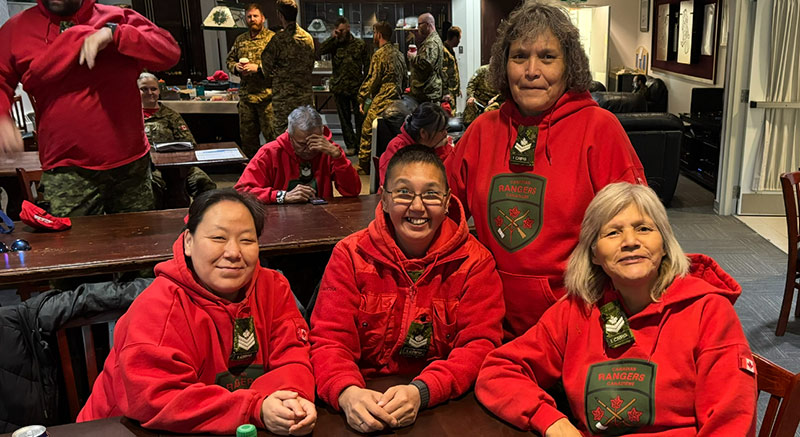
Ella Archie (middle) enjoying spending time with other women Canadian Rangers.
“It was a learning experience for me.”
Mentoring the next generation
For the past 21 years, Ella has sought to pass on some of that experience to the next generation through the Junior Canadian Ranger program. As a mentor and role model, she spends time teaching young Rangers about survival skills, marksmanship and the importance of respecting the land and taking pride in their northern heritage.
“For me, Junior Rangers is like my extended family. Some of them still call me mom and sis! It makes me proud to see them strive in life.”
In 2022, Ella was rewarded for her service when she was appointed a Member of the Order of Military Merit, the highest recognition a Canadian Ranger can receive. Pointing to the medal on her chest, she says: “I was shocked. It’s an honour to receive it, with all the hard work that we put into it with the Seniors and the Junior Ranger Program.”
While such recognition is important to Ella, it is not what drives her. What matters most are the fellow Rangers with whom she has trained, the youth she has mentored and the Elders who continue to share their knowledge. The connection to the land and her community are what keep Ella motivated.
“It’s been a pretty good twenty-three and a half years, and I’m still going. I love working with the kids and going on the land with the seniors so I don’t think the end is coming any time soon,” she says with a laugh.
With courage, integrity and loyalty, Ella is leaving her mark. She is a Canadian Ranger. Discover more stories.