
Table of Contents
- Introduction
- Veterans Affairs Organization Structure
- Delegation Orders
- Performance under Part I of the Access to Information Act, 2025–26
- Training and Awareness
- Policies, Guidelines, and Procedures
- Initiatives and Projects to Improve Access to Information
- Summary of Key Issues and Actions Taken on Complaints
- Proactive Publication under Part II of the Act
- Monitoring Compliance
- Closing Remarks
- Annex A – Delegation Order
- Annex B – Office of the Veterans Ombud
This publication is available upon request in alternate formats.
PDF Version
Introduction
Veterans Affairs Canada (VAC) is pleased to present its annual report on the administration of the Access to Information Act (the Act) for the period from April 1, 2025, to March 31, 2026.
This report is prepared in accordance with section 94 of the Act, which requires the head of every federal institution to submit an annual report to Parliament on the administration of the Act during each fiscal year.
VAC remains committed to openness, transparency, and accountability. These principles reflect both legislative obligations and the Department’s broader commitment to honouring the service and sacrifices of Veterans. In recognizing the significant role Veterans have played in shaping Canada, VAC strives to uphold the values they defended by recognizing the right to access information in government records and making every reasonable effort to assist those seeking access.
Purpose of the Act
The Act provides Canadian citizens, permanent residents, and all individuals and corporations present in Canada with a right of access to records under the control of government institutions. The Act includes limited and specific exceptions and provides for an independent review of decisions made by government institutions on the disclosure of information under Part I of the Act. Part II of the Act requires government institutions to proactively publish information that is of public interest.
VAC’s Mandate
VAC’s mandate is to support the well-being of Veterans and their families, and to promote recognition and remembrance of the achievements and sacrifices of those who served Canada in times of war, military conflict, and peace. To achieve this mandate, the Department focuses on its four main roles:
- Provide leadership as a champion of Veterans, and administer and coordinate needed benefits and services, whether through the Government of Canada or in partnership with provincial and community programs and non-governmental organizations.
- Help Veterans access the supports and services they need, from all levels of government and the community at large, and maintain a leadership role in the care and support of all Veterans and their families.
- Listen to the suggestions of Veterans, their representatives, and stakeholders to guide work and research, and strive to design and deliver programs that meet the modern and changing needs of Veterans and their families.
- Engage Canadians of all ages in paying tribute to Veterans and those who died in service, ensuring that the legacy of their tremendous contributions to peace and freedom is preserved for generations to come.
VAC fulfills its mandate and role through the delivery of programs such as disability benefits, financial benefits, rehabilitation, pension advocacy, education, and training supports. The Department also works to commemorate the achievements and sacrifices of Canadians during periods of war, military conflict, and peace.
Non-operational subsidiaries
VAC did not have any non-operational subsidiaries during this reporting period.
Veterans Affairs Organization Structure
The Veterans Affairs Portfolio consists of:
- the Department of Veterans Affairs, which reports to the Minister of Veterans Affairs;
- the Veterans Review and Appeal Board, which reports to Parliament through the Minister of Veterans Affairs; and
- the Office of the Veterans Ombud, which reports directly to and is accountable to the Minister of Veterans Affairs.
The Veterans Review and Appeal Board has its own ATIP Office and prepares a separate annual report on the administration of the Act. The report of the Office of the Veterans Ombud (OVO) on its administration of the Act is included in this report as Annex B.
Administration of the Act
Within VAC, responsibility for administering the Act rests with the Access to Information and Privacy (ATIP) Office, which is part of the Chief Financial Officer and Corporate Services Branch within the Privacy and Information Management Directorate.
The ATIP Office:
- Processes access requests
- Provides advice and guidance on the Act and related instruments
- Coordinates compliance with legislative and policy requirements
Responsibility for proactive publication under Part II of the Act is shared across the Department. Details on roles and responsibilities are provided in the section “Proactive publication under Part II of the Act" below.
The ATIP Office
The ATIP Office is responsible for administering both the Access to Information Act and the Privacy Act. The Director of Privacy and Information Management serves as the Department’s ATIP Coordinator and leads the ATIP Office.
Privacy and Information Management includes four units whose work relates to information management (IM) and access to information and privacy:
- ATIP Operations
- Privacy and IM Policy
- IM Operations
- IM Projects
The Privacy and IM Policy Unit provides training, guidance, and recommendations on privacy and IM. It is responsible for coordinating privacy impact assessments, investigating privacy breaches, and collaborating with all areas of the Department to ensure privacy and IM considerations are integrated into new programs and initiatives.
The ATIP Operations unit is responsible for the processing of access to information and privacy requests and providing relevant guidance to departmental branches. The unit consists of five teams, led by the ATIP Operations Manager, as follows:
- The Client Service Team
- The Access Request Processing Team
- The Privacy Request Processing Team
- ATIP Operations Special Projects Team
- The Strategic Analyst
For the 2025-26 reporting period, the administration of the Access to Information Act was supported by the equivalent of 4.018 full-time indeterminate employees (FTEs), while the administration of the Privacy Act was supported by the equivalent of 13.4375 full-time indeterminate FTEs.
The ATIP Office did not employ any consultants or contractors during the reporting period, nor were there any ATIP employees working in VAC’s regional offices.
VAC was not party to any agreements under section 96 of the Act during this reporting period.
Delegation Orders
In accordance with section 95(1) of the Access to Information Act, the Minister of Veterans Affairs has delegated the power, duties, and functions for the administration of the Access to Information Act to VAC positions through a delegation order.
These delegation orders ensure that appropriate administrative authorities are delegated to positions within the ATIP Office which are responsible for effectively and efficiently administering the Act. The delegation order was signed March 25, 2021 and is included as Annex A of this report.
Performance under Part I of the Access to Information Act, 2025–26
VAC received 153 new formal requests under the Act during the reporting period. There were 12 requests outstanding from previous reporting periods, bringing the total number of active formal requests to 165. VAC closed 86.7% (117) of requests made under the Act within the legislated timelines, representing a 17.7% increase over the previous year (69%). This improvement was achieved despite a 56.1% increase in incoming requests. These results reflect the Department's continued focus on process improvements, workload management, and timely service delivery.
The following table provides an overview of the formal requests received from 2020-21 to 2025-26.
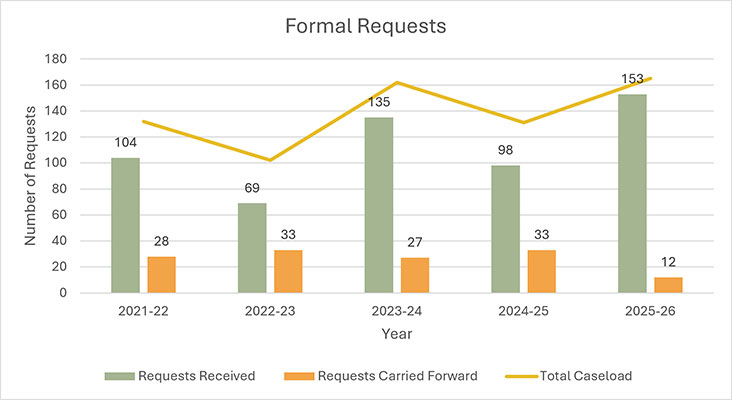
Formal request volumes from fiscal years 2021-22 to 2025-26.
Completion times
The following table outlines the number of completed formal requests broken down by completion time for the 2025-26 reporting period:
| Completion time | Number of Requests |
|---|---|
| 0 to 15 days | 16 |
| 16 to 30 days | 73 |
| 31-60 days | 25 |
| 61 to 120 days | 11 |
| 121 to 180 days | 3 |
| 181 to 365 days | 5 |
| More than 365 days | 2 |
Active Requests and Complaints
Of the 165 formal requests that were active during the reporting period, 135 were closed, 22 were carried forward within legislated timelines, and 8 were carried forward beyond legislated timelines, for a total of 30 requests carried into the next reporting period. Of the 30 requests carried forward, 29 were received in 2025-26 and 1 was received in 2024-25.
VAC had 2 active complaints at the end of the reporting period. Both complaints were received during the 2024-25 reporting period.
Extensions
During the reporting period it was necessary to extend 22 requests beyond the 30-day timeline, this represents 14.4% of requests. Of these extensions, 14 were taken under section 9(1)(a) due to interference with operations and 8 were taken under section 9(1)(b) for consultation.
The following chart breaks down the number of extensions taken by length and reason:
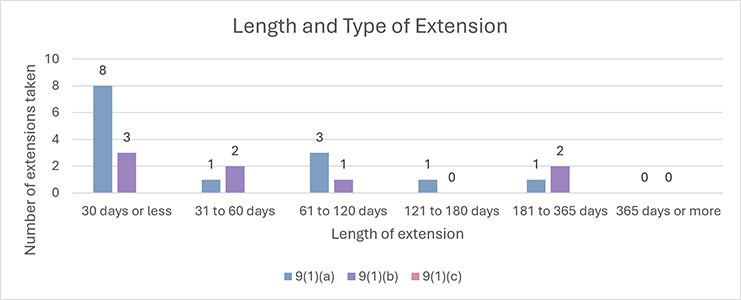
Length and type of extensions taken by length and legislative provision under the Access to Information Act.
Consultations
During the reporting period VAC received 15 requests for consultation from other Government of Canada Institutions, representing 898 pages requiring review.
Completion times for consultations received from other Government of Canada institutions were as follows:
- 4 within 15 days or less (26.7%)
- 8 within 16 to 30 days (53.3%)
- 3 within 31 to 60 days (20%)
Disposition
Of the 135 formal requests closed during the reporting period, the majority resulted in either full or partial disclosure of records. Specifically, 101 requests (74.8%) were disclosed in whole or in part, demonstrating VAC's commitment to providing access to information while balancing its obligations under the Act.
| Disposition of Requests | Total | Percentage |
|---|---|---|
| All Disclosed | 49 | 36.3% |
| Disclosed in part | 52 | 38.5% |
| All exempted | 1 | 0.7% |
| All excluded | 0 | 0.0% |
| No records exist | 31 | 23.0% |
| Request transferred | 0 | 0.0% |
| Request abandoned | 2 | 1.5% |
| Neither confirmed nor denied | 0 | 0.0% |
| Declined to act | 0 | 0.0% |
| Total | 135 | 100.00% |
Informal Requests
During the reporting period, VAC received 101 informal requests and carried forward 9 requests from the previous reporting period, resulting in a total caseload of 110 informal requests. The Department closed 97 informal requests and carried forward 13 to the next reporting period. The processing of these requests resulted in the informal release of 86,380 pages.
Training and Awareness
During the 2025–26 fiscal year, the Privacy and Information Management Directorate delivered virtual and in-person training sessions to approximately 3,400 participants. Training focused on legislative requirements, employee responsibilities, and effective information management practices that support timely access to information.
The Directorate also promoted awareness through departmental communications, including weekly learning messages and articles recognizing Right to Know Week, Data Privacy Week, and Information Management Week. These activities contributed to a stronger understanding of access, privacy, and information management requirements across the Department.
Policies, Guidelines, and Procedures
VAC continued to modernize its processes and guidelines throughout the 2025-26 reporting period. Guidance materials were updated and developed to support ATIP Operations staff and departmental employees, ensuring departmental guidance remained aligned with Treasury Board of Canada Secretariat instruments. These enhancements promoted an improved understanding of ATIP requirements across the Department.
Initiatives and Projects to Improve Access to Information
Supporting internal clients
ATIP Operations supported internal clients by reviewing records for release to ensure compliance with the Act. During the reporting period, the team completed three internal consultation requests and reviewed records for proactive publication and parliamentary orders for the production of papers.
Advancing Technologies
In May 2025, ATIP Operations completed the transition to the ATIPXpress platform. The Special Projects Team developed guidance materials and delivered training to support staff in adapting to and effectively utilizing the new system.
ATIP Operations also promoted the electronic delivery through the ATIP Online Request Service and Canada Post Connect, enabling requesters to receive response packages more quickly and securely, particularly those residing in remote or rural areas.
Improving Information Management
VAC continued its transition from the GCdocs platform to SharePoint as its corporate information repository. Throughout this transition, ATIP Operations worked with program areas to support record retrieval and maintain timely responses to access requests.
Summary of Key Issues and Actions Taken on Complaints
Complaints received during the 2025-26 reporting period
VAC received 5 complaints from the Office of the Information Commissioner (OIC) during the reporting period. This represents a decrease of 44% from the previous reporting period, during which 9 complaints were received.
Of the complaints received, 2 related to time limits, 2 related to exemptions and 1 related to an extension.
At the end of the reporting period, VAC had 2 active complaints and continued to work with the OIC toward their resolution.
Complaints closed during the 2025-26 reporting period
VAC closed 11 complaints related to 9 requests during the reporting period. Of the complaints closed, 4 were determined to be not well-founded, 2 were discontinued and 5 were found to be well-founded.
VAC received orders from the Information Commissioner in relation to 2 of the well-founded complaints. The first order concerned the length of an extension taken under the Act, while the second related to compliance with statutory time limits. VAC complied with both orders and released the requested information by the deadlines established by the OIC.
Proactive Publication under Part II of the Act
VAC remains committed to transparency and accountability through the proactive release of information required under Part 2 of the Act. During the reporting period, the Department successfully published all required information within the prescribed timelines, achieving 100% compliance with proactive publication requirements.
| Legislative Requirement | Section of the Act | Publication Timeline | Does the requirement apply to your institution? (Y/N) | Internal group(s) or positions(s) responsible for fulfilling requirement | Percentage of proactive publication requirements published within legislated timelines | Link to web page where published |
|---|---|---|---|---|---|---|
| Travel Expenses | 82 | Within 30 days after the end of the month of reimbursement | Yes | Finance | 100% | Government Travel Expenses |
| Hospitality Expenses | 83 | Within 30 days after the end of the month of reimbursement | Yes | Finance | 100% | Hospitality Expenses |
| Reports tabled in Parliament | 84 | Within 30 days after tabling | Yes | Parliamentary Affairs | 100% | Departmental reports | Veterans Affairs Canada |
| Legislative Requirement | Section of the Act | Publication Timeline | Does the requirement apply to your institution? (Y/N) | Internal group(s) or positions(s) responsible for fulfilling requirement | Percentage of proactive publication requirements published within legislated timelines | Link to web page where published |
|---|---|---|---|---|---|---|
| Contracts over $10,000 | 86 | Q1-3: Within 30 days after the quarter Q4: Within 60 days after the quarter | Yes | Finance | 100% | Search Government Contracts over $10,000 |
| Grants & Contributions over $25,000 | 87 | Within 30 days after the quarter | Yes | Finance | 100% | Grants and Contributions |
| Packages of briefing materials prepared for new or incoming deputy heads or equivalent | 88(a) | Within 120 days after appointment | Yes | Parliamentary Affairs | 100% | Briefing materials for the Deputy Minister | Veterans Affairs Canada |
| Titles and reference numbers of memoranda prepared for a deputy head or equivalent, that is received by their office | 88(b) | Within 30 days after the end of the month received | Yes | ATIP | 100% | Briefing Note Titles and Numbers |
| Packages of briefing materials prepared for a deputy head or equivalent’s appearance before a committee of Parliament | 88(c) | Within 120 days after appearance | Yes | Parliamentary Affairs | 100% | Open Government Portal |
| Legislative Requirement | Section of the Act | Publication Timeline | Does the requirement apply to your institution? (Y/N) | Internal group(s) or positions(s) responsible for fulfilling requirement | Percentage of proactive publication requirements published within legislated timelines | Link to web page where published |
|---|---|---|---|---|---|---|
| Reclassification of positions | 85 | Within 30 days after the quarter | Yes | Human Resources | 100% | Position Reclassification |
| Legislative Requirement | Section of the Act | Publication Timeline | Does the requirement apply to your institution? (Y/N) | Internal group(s) or positions(s) responsible for fulfilling requirement | Percentage of proactive publication requirements published within legislated timelines | Link to web page where published |
|---|---|---|---|---|---|---|
| Packages of briefing materials prepared by a government institution for new or incoming ministers | 74(a) | Within 120 days after appointment | Yes | Parliamentary Affairs | 100% | Briefing materials for the Minister | Veterans Affairs Canada |
| Titles and reference numbers of memoranda prepared by a government institution for the minister, received by their office | 74(b) | Within 30 days after the end of the month received | Yes | ATIP | 100% | Briefing Note Titles and Numbers |
| Package of question period notes prepared by a government institution for the minister and in use on the last sitting day of the House of Commons in June and December | 74(c) | Within 30 days after last sitting day of the House of Common in June and December | Yes | Parliamentary Affairs | 100% | Question Period Notes |
| Packages of briefing materials prepared by a government institution for a minister’s appearance before a committee of Parliament | 74(d) | Within 120 days after appearance | Yes | Parliamentary Affairs | 100% | Open Government Portal |
| Travel Expenses | 75 | Within 30 days after the end of the month of reimbursement | Yes | Finance | 100% | Government Travel Expenses |
| Hospitality Expenses | 76 | Within 30 days after the end of the month of reimbursement | Yes | Finance | 100% | Hospitality Expenses |
| Contracts over $10,000 | 77 | Q1-3: Within 30 days after the quarter Q4: Within 60 days after the quarter | Yes | Finance | 100% | Search Government Contracts over $10,000 |
| Ministers’ Offices Expenses Note: This consolidated report is currently published by TBS on behalf of all institutions. | 78 | Within 120 days after the fiscal year | Yes | Finance | 100% | Expenditures of Ministers' Offices | Open Government - Government of Canada |
Monitoring Compliance
VAC continues to monitor compliance with the Act through oversight and regular performance reporting. ATIP Officers are expected to consult with their team leader or manager before applying lengthy extensions to explore opportunities to reduce processing times. Consultation requirements are assessed on a case-by-case basis to ensure they are necessary and proportionate.
ATIP Operations also supports compliance through the review of records intended for proactive publication. These reviews prevent the release of information that may be exempt from disclosure under Part 1 of the Act. Proactive publication requirements are centrally tracked, with reporting areas receiving advance reminders of upcoming deadlines and being responsible for monitoring their progress and submissions. In 2025-26, all materials were published within legislated timelines and in both official languages.
The ATIP Office produces and distributes a variety of reports to monitor compliance, track performance, and identify emerging trends. Ongoing use of data supports operational efficiencies and informed decision-making. Reporting includes weekly updates to senior management on requests received and closed, complaints, and extensions applied.
Closing Remarks
VAC remains committed to upholding the principles of openness, transparency, and accountability. Throughout the reporting period, ATIP Operations continued to support timely access to information while adapting to evolving operational demands and increasing complexity.
Through ongoing monitoring, collaboration with program areas, and a focus on continuous improvement, the Department strengthened its ability to meet its legislative obligations and respond to the information needs of Veterans and Canadians. VAC will continue to leverage data-driven approaches and enhance processes to support effective access to information and ensure continued compliance with the Act.
Annex A – Delegation Order
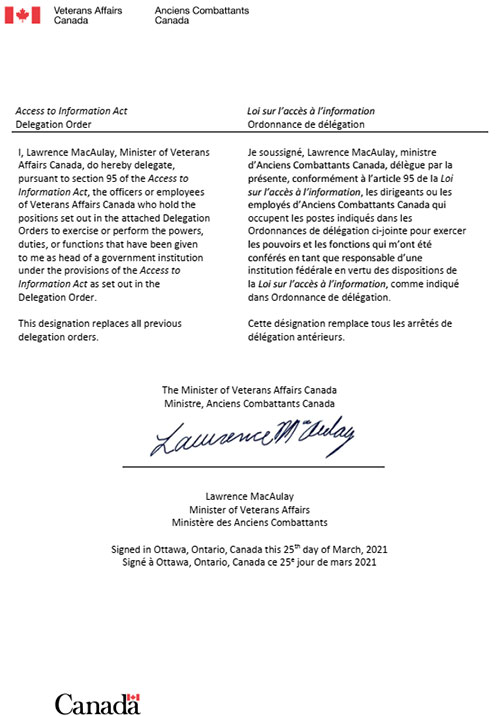
Text version
Access to Information Act
Delegation Order
I, Lawrence MacAulay, Minister of Veterans Affairs Canada, do hereby delegate, pursuant to section 95 of the Access to Information Act, the officers or employees of Veterans Affairs Canada who hold the positions set out in the attached Delegation Orders to exercise or perform the powers, duties, or functions that have been given to me as head of a government institution under the provisions of the Access to Information Act as set out in the Delegation Order.
This designation replaces all previous delegation orders.
The Minister of Veterans Affairs Canada, Lawrence MacAulay.
Signed in Ottawa, Ontario, Canada this 25th day of March, 2021
Delegation Order - Access to Information Act and Regulations
The Minister of Veterans Affairs, pursuant to section 95 of the Access to Information Act (the Act), hereby delegates the persons holding the positions set out in the schedule hereto, or the persons occupying on an acting basis those positions, to exercise the powers, duties and functions of the Minister as the head of Veterans Affairs Canada, under the provisions of the Act and the Access to Information Act Regulations (the Regulations) set out in the schedule opposite each position. This designation replaces all previous delegation orders.
All powers, duties, and functions under the Access to Information Act, R.S.C. 1985, c. A-1 (prior to and following June 21, 2019) and related regulations (prior to and following June 21, 2019)
| Description | Section | Delegated Authority |
|---|---|---|
| Responsibility of government institutions | 4(2.1) |
|
| Reasons for declining to act on request | 6.1(1) |
|
| Notice - suspension | 6.1(1.3) |
|
| Notice – end of suspension | 6.1(1.4) |
|
| Notice (written notice for declining to act on a request) | 6.1(2) |
|
| Notice where access requested / Giving access to record | 7 |
|
| Transfer of request to another government institution | 8(1) |
|
| Extension of time limits | 9 |
|
| Notice where access refused | 10 |
|
| Application fee waiver | 11(2) |
|
| Language of access | 12(2)(a) |
|
| Access in an alternative format | 12(3)(b) |
|
| Information obtained in confidence | 13 |
|
| Refuse access – Federal-provincial affairs | 14 |
|
| Refuse access – International affairs and defence | 15 |
|
| Refuse access – Law enforcement and investigations | 16 |
|
| Refuse access – Public Servants Disclosure Protection Act | 16.5 |
|
| Refuse access – Safety of individuals | 17 |
|
| Refuse access – Economic interests of Canada | 18 |
|
| Refuse access – Economic interest of certain government institutions | 18.1 |
|
| Refuse access – Personal information | 19 |
|
| Refuse access – Third party information | 20 |
|
| Refuse access – Operations of Government | 21 |
|
| Refuse access – Testing procedures, tests and audits | 22 |
|
| Refuse access – Internal audits | 22.1 |
|
| Refuse access – Protected information – solicitors, advocates, and notaries | 23 |
|
| Refuse access – Protected information- patents and trademarks | 23.1 |
|
| Refuse access – Statutory prohibitions against disclosure | 24 |
|
| Severability | 25 |
|
| Refusal of access if information to be published | 26 |
|
| Notice to third parties | 27(1) |
|
| Third party notification – Extension of time limit | 27(4) |
|
| Third party notification – Notice of decision | 28(1)(b) |
|
| Third party notification – Waive representations in writing | 28(2) |
|
| Third party notification – Disclosure of record | 28(4) |
|
| Advising Information Commissioner of third-party involvement | 33 |
|
| Right to make representations | 35(2)(b) |
|
| Access to be given to complainant | 37(4) |
|
| Review by Federal Court – government institution | 41(2) |
|
| Service or notice | 43(2) |
|
| Notice to person who requested record | 44(2) |
|
| Special rules for hearings | 52(2) |
|
| Ex parte representations (Federal Court) | 52(3) |
|
| Annual report to Parliament | 94(1), (4) |
|
| Provision of services related to access to information | 96(3), (4), (5) |
|
| Description | Section | Delegated authority |
|---|---|---|
| Transfer of request | 6(1) |
|
| Search and preparation of fees | 7(2) |
|
| Production and programming | 7(3) |
|
| Providing access to records | 8 |
|
| Limitations in respect of format | 8.1 |
|
Annex B – Office of the Veterans Ombud
Annual Report on the Administration of the Access to Information Act
Office of the Veterans Ombud Access to Information and Privacy Unit
Introduction:
Accessing information is an essential element of our system of democracy, and a means for the Government of Canada to be open and transparent. The Access to Information Act is an important tool for Canadians to obtain information held by the Government of Canada. The Act provides the right of access to records under the control of a government institution, subject to some exceptions. The Act complements other methods for obtaining government information and does not limit in any way the access to government information that is normally available to the public upon request.
This annual report on the administration to the Access to Information Act describes how the Office of the Veterans Ombud fulfilled their responsibilities under the Access to Information Act during the fiscal year April 1, 2025, to March 31, 2026. This report is being prepared to be tabled in Parliament in accordance with section 94(1) of the Access to Information Act.
The mandate of the OVO, found in the Order in Council P.C. 2007-530, shall be:
- to review and address complaints by clients [of Veterans Affairs Canada] and their representatives arising from the application of the provisions of the Veterans Bill of Rights;
- to identify and review emerging and systemic issues related to programs and services provided or administered by the Department or by third parties on the Department's behalf that impact negatively on clients;
- to review and address complaints by clients [of Veterans Affairs Canada] and their representatives related to programs and services provided or administered by the Department or by third parties on the Department's behalf, including individual decisions related to the programs and services for which there is no right of appeal to the (Veterans Review and Appeal) Board;
- to review systemic issues related to the (Veterans Review and Appeal) Board; and
- to facilitate access by stakeholders to programs and services by providing them with information and referrals.
Organizational Structure:
The Veterans Ombud, the Deputy Ombud, and Director – Veterans Intervention Services have full authority for the OVO to exercise the powers, duties, and functions of the Minister as the Head of Veterans Affairs under the provisions of the Acts and related regulations. Although these positions have been delegated full authority, the Director – Veterans Intervention Services, is responsible for management of the Access to Information and Privacy (ATIP) Unit function within the OVO.
The OVO’s Access to Information and Privacy Unit in Charlottetown, Prince Edward Island ensures that the Office’s responsibilities under both acts are met. Processing of requests is centralized within the unit. The Unit consists of the Director - Veterans Intervention Services, and the Knowledge Management Coordinator. These staff members were assigned to the administration of both acts on a part-time (as required) basis during the 2025-2026 reporting period, which represents 0.525 of an FTE.
The main activities of the OVO ATIP Unit include:
- Processing OVO requests for information submitted under the Access to Information Act and The Privacy Act, including consulting with other federal departments and third parties with respect to ATIP requests received;
- Developing OVO policies, procedures, guidelines and processes in support of Access to Information and Privacy and central agency requirements;
- Monitoring legislative and regulatory changes that impact ATIP;
- Providing awareness and training on ATIP to ensure that OVO employees understand their roles and responsibilities;
- Monitoring OVO compliance with both acts, regulations and central agency requirements;
- Preparing and providing information specific to the OVO to VAC for inclusion in annual reports to Parliament on the administration of the Acts;
- Leading the development of Privacy Impact Assessments (PIAs) for the OVO;
- Working closely with VAC for the resolution of any complaints against OVO which have been submitted to the Information Commissioner of Canada and the Privacy Commissioner of Canada;
- Providing centralized management of privacy breaches within the OVO;
- Providing advice, guidance and training to OVO staff on ATIP issues;
- Analyzing and responding to OVO privacy and access to information policy issues;
- Reviewing new and amended OVO forms and processes that impact the collection of personal information
- Developing appropriate Privacy Notice Statements for the OVO; and,
- Evaluating OVO contracts and Memoranda of Understanding.
Delegation Order:
The responsibilities associated with the administration of the Access to Information Act are delegated to departmental and OVO officials through a delegation order.
Performance under Part 1 of the Access to Information Act, 2025–2026
- Two requests were closed, within 16 – 30 days
- One request was carried over to the next reporting period
- There were no active complaints received during the reporting period
- One completed record (50%) was “All Disclosed”, and one record (50%) was “No Records Exist”
Training and Awareness:
OVO staff took part in Departmental ATIP training and OVO ATIP Refresher training.
Policies, Guidelines, Procedures and Initiatives
The OVO continues to work on an Open Government action plan and will continue the transition to having more information available on the Open Government portal. The OVO is part of ATIP Online Request Services (AORS) where users can submit ATIP requests online and view past ATI requests by subject.
The OVO also maintained and monitored current Access to Information policies, guidelines and procedures during the 2025-2026 reporting period.
Initiatives and Projects to Improve Access to Information
The OVO did not undertake any initiatives or projects outside of the training and awareness sessions for the 2025-2026 reporting period.
Summary of Key Issues and Actions Taken on Complaints or Audits:
In the 2025-2026 reporting period, OVO received no complaints in relation to Access to Information requests. No complaints were carried over from 2024-2025. The OVO had no audits or investigations concluded during the reporting period.
Proactive Publication under Part 2 of the ATIA
| Legislative Requirement | Section of ATIA | Publication Timeline | Does requirement apply to your institution? (Y/N) | Internal group(s) or positions(s) responsible for fulfilling requirement | Percent of proactive publication requirements published within legislated timelines* | Link to web page where published** |
|---|---|---|---|---|---|---|
| Travel Expenses | 82 | Within 30 days after the end of the month of reimbursement | Y | VAC Finance on behalf of OVO | 100% | Government Travel Expenses |
| Hospitality Expenses | 83 | Within 30 days after the end of the month of reimbursement | Y | VAC Finance on behalf of OVO | 100% | Hospitality Expenses |
| Reports tabled in Parliament | 84 | Within 30 days after tabling | N | - | - | - |
| Legislative Requirement | Section of ATIA | Publication Timeline | Does requirement apply to your institution? (Y/N) | Internal group(s) or positions(s) responsible for fulfilling requirement | Percent of proactive publication requirements published within legislated timelines* | Link to web page where published** |
|---|---|---|---|---|---|---|
| Contracts over $10,000 | 86 | Q1-3: Within 30 days after the quarter Q4: Within 60 days after the quarter | N | - | - | - |
| Grants & Contributions over $25,000 | 87 | Within 30 days after the quarter | N | - | - | - |
| Packages of briefing materials prepared for new or incoming deputy heads or equivalent | 88(a) | Within 120 days after appointment | N | - | - | - |
| Titles and reference numbers of memoranda prepared for a deputy head or equivalent, that is received by their office | 88(b) | Within 30 days after the end of the month received | Y | OVO Knowledge Management | 100% | Briefing Note Titles and Numbers |
| Packages of briefing materials prepared for a deputy head or equivalent’s appearance before a committee of Parliament | 88(c) | Within 120 days after appearance | N | - | - | - |
| Legislative Requirement | Section of ATIA | Publication Timeline | Does requirement apply to your institution? (Y/N) | Internal group(s) or positions(s) responsible for fulfilling requirement | Percent of proactive publication requirements published within legislated timelines* | Link to web page where published** |
|---|---|---|---|---|---|---|
| Reclassification of positions | 85 | Within 30 days after the quarter | Y | VAC HR on behalf of OVO | 100% | Position Reclassification |
| Legislative Requirement | Section of ATIA | Publication Timeline | Does requirement apply to your institution? (Y/N) | Internal group(s) or positions(s) responsible for fulfilling requirement | Percent of proactive publication requirements published within legislated timelines* | Link to web page where published** |
|---|---|---|---|---|---|---|
| Packages of briefing materials prepared by a government institution for new or incoming ministers | 74(a) | Within 120 days after appointment | N | - | - | - |
| Titles and reference numbers of memoranda prepared by a government institution for the minister, that is received by their office | 74(b) | Within 30 days after the end of the month received | N | - | - | - |
| Package of question period notes prepared by a government institution for the minister and in use on the last sitting day of the House of Commons in June and December | 74(c) | Within 30 days after last sitting day of the House of Common in June and December | N | - | - | - |
| Packages of briefing materials prepared by a government institution for a minister’s appearance before a committee of Parliament | 74(d) | Within 120 days after appearance | N | - | - | - |
| Travel Expenses | 75 | Within 30 days after the end of the month of reimbursement | N | - | - | - |
| Hospitality Expenses | 76 | Within 30 days after the end of the month of reimbursement | N | - | - | - |
| Contracts over $10,000 | 77 | Q1-3: Within 30 days after the quarter Q4: Within 60 days after the quarter | N | - | - | - |
| Ministers’ Offices Expenses Note: This consolidated report is currently published by TBS on behalf of all institutions. | 78 | Within 120 days after the fiscal year | N | - | - | - |
Monitoring Compliance:
The OVO uses a tracking spreadsheet to monitor the processing of requests for access to information on a weekly basis when requests are being processed. This tracking spreadsheet is maintained by the Knowledge Management Coordinator. Any anticipated issues with processing are escalated to the Director – Veterans Intervention Services.