
This publication is available upon request in alternate formats.
PDF Version
Introduction
Every November during Veterans’ Week, schools and community groups across Canada hold ceremonies to remember the sacrifices and achievements of those who have served our country in uniform. Events like these that pass on the traditions of remembrance are also important ways to show our appreciation to Veterans and their families. This resource offers some ideas on how commemorative ceremonies can be organized, but may be modified according to the resources available.
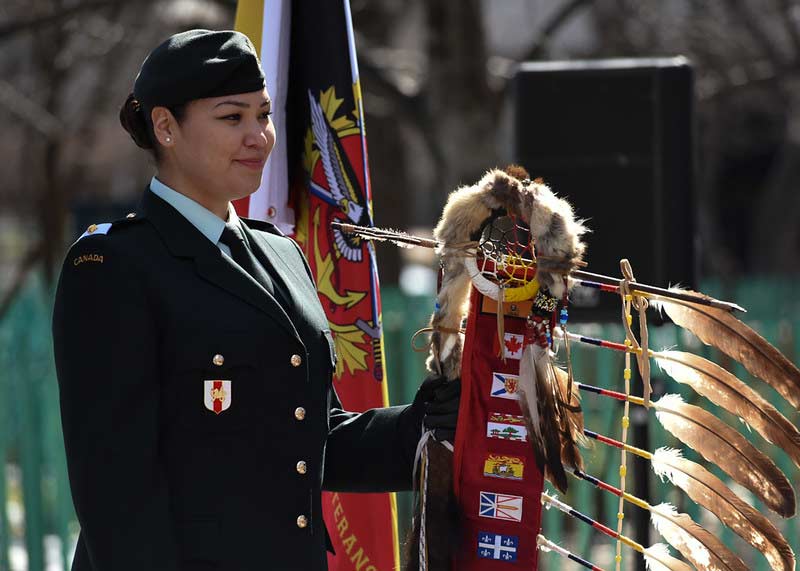
A member of the Canadian Armed Forces holds the Eagle Staff during a ceremony on Indigenous Veterans Day, November 8, 2017. Photo: VAC
Suggested sequence of events
- Vigil sentries take position
- Military parade and/or entry of Colour Party
- Arrival of special guests/dignitaries
- National anthem
- Opening remarks
- Last Post, two minutes of silence, and Rouse
- Act of Remembrance
- Commitment to Remember
- Prayers and/or sacred traditions
- Recitation of poems and/or special presentation
- Laying of wreaths
- Conclusion
Vigil sentries take position
Your school or community group may wish to include vigil sentries to stand at the four corners of a memorial or other appropriate display. In traditional ceremonies, these sentries take their posts before the start of the ceremony. Likewise, they remain in place until its conclusion and any dignitaries or the military parade have departed. At the National Remembrance Day Ceremony in Ottawa, these sentries are Canadian Armed Forces members and RCMP officers. Some schools and community groups choose to have Sea, Army and Air Cadets–or even Scouts and Girl Guides in uniform–stand as sentries.
Military parade and/or entry of Colour Party
In traditional ceremonies, the Colour Party (flag bearers) is accompanied by a military marching band. A school or community group may wish to have students carry flags while the school choir or band performs an appropriate song. Although the Canadian flag is lowered during the National Remembrance Day ceremony in Ottawa at 11 am, people often choose to lower the Canadian flag to half-mast from sunrise to sunset on November 11.
Arrival of special guests/dignitaries
If you have invited special guests such as Veterans, Canadian Armed Forces (CAF) members or local politicians, you may wish to have a Master of Ceremonies (MC) announce their arrival and have someone guide them to a designated seating area, usually at the front facing the ceremony area.
National anthem
The MC invites everyone to stand for the singing of O Canada.
Opening remarks
Commemorative ceremonies are solemn in nature. The opening remarks are a time to set the tone of the event. It is also a good time for the MC to welcome everyone and introduce special guests and dignitaries.
Last Post, two minutes of silence, and Rouse
The Last Post, two minutes of silence and the Rouse take place one after the other, without interruption. The MC may want to explain this prior to the playing of the Last Post, especially if the audience is younger and this is their first commemorative ceremony. The National Remembrance Day Ceremony is timed with precision so that the Canadian flag is lowered and the Last Post is finished at exactly 11 am, marking the beginning of the two minutes of silent reflection and the 21-gun salute. This timing–the eleventh hour of the eleventh day of the eleventh month–has great symbolic significance. This was when the armistice ending the fighting of the First World War went into effect on 11 November 1918.
The Last Post is a bugle call that was traditionally used to tell the troops at an army camp that the last guard post had been inspected and the rest of the soldiers could go to sleep for the night. As it marked the end of the day, it came to also symbolize those who had died in service and calls us into remembrance during the two minutes of silence (symbolizing the night). In contrast, the Rouse is a morning wake-up bugle call and came to symbolize the awakening to a better world. Sometimes, a bagpipe lament will be played after the two minutes of silence, prior to the Rouse.
You may wish to have a trumpeter or bugler from your school or group play these songs, but there are also many recordings available.
Act of Remembrance
The Act of Remembrance is normally recited by a Veteran (if one is present) in English, French and an Indigenous language, if possible. You may also wish to add another language commonly used in the community.
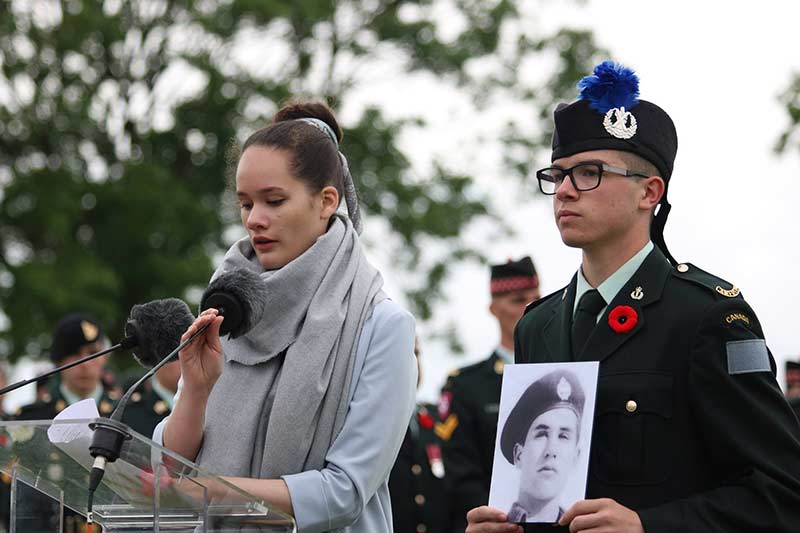
A Canadian youth delivers a presentation on a fallen soldier during a ceremony at Bretteville-sur-Laize Canadian War Cemetery in Normandy, France. Photo: VAC.
They shall grow not old, as we that are left grow old;
Age shall not weary them, nor the years condemn.
At the going down of the sun and in the morning
We will remember them.
All respond: We will remember them.
Commitment to Remember
The Commitment to Remember is normally recited by a young person in English, French and an Indigenous language, if possible. Again, you may also wish to add another language common in your community.
They were young, as we are young.
They served, giving freely of themselves.
To them, we pledge, amid the winds of time,
To carry their torch and never forget.
We will remember them.
All respond: We will remember them.
Ceremonial readings
Explore the Act of Remembrance and the Commitment to Remember in different languages.
Prayers or sacred traditions
Depending on the faith beliefs of your school or community, a prayer, blessing or sacred tradition such as an Indigenous smudging ceremony may be incorporated at this point in the ceremony.
Recitation of poems or special presentations
Schools and community ceremonies will often feature young people reciting a remembrance poem, such as In Flanders Fields. They may also share poems they have written themselves. Sometimes, a Veteran or other special guest will speak about the importance of remembrance, or an appropriate video will be shown.
Laying of wreaths
If wreaths are going to be laid during the service, appropriate music such as In Flanders Fields may be performed by a band or choir.
In traditional ceremonies, the wreath is usually carried by a member of the military walking alongside the person who is to lay the wreath. The two approach, briefly pause, exchange the wreath, place it (often on a stand), step back, pause for a moment (military personnel will salute), turn to the right and walk off. If you have dignitaries present, wreaths are usually laid following the Table of Precedence for Canada. For a less formal ceremony, youth representatives could lay wreaths on behalf of their classes or certain groups.
Ceremony conclusion
The MC may wish to thank everyone for their attendance, especially the special guests and the organizers. In traditional ceremonies, the MC will invite everyone to sing God Save the King prior to the departure of the dignitaries and the marching out of the Colour Party and military parade.