
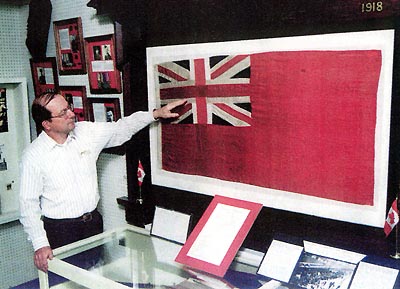
Known as "the battle flag of the orchards," the Red Ensign was flown by Lieutenant-Colonel P.E. Coleman of Penticton during almost every major campaign in which the Canadians took part in France during the First World War. It has been on display in Penticton since 1921. Source: The Report, April 24, 2000
The faded red silk ensign, simple and unadorned, was presented to Lieutenant P.E. Coleman on the summer evening of August 11, 1914, when 38 of the first British Columbia volunteers, still in their civilian clothes, paraded at the corner of Nanaimo and Martin Streets in Penticton, then a small fruit farming community in the Okanagan Valley. It was to acquire the most remarkable record of any flag flown during the Great War. With one exception, Penticton's Red Ensign accompanied the Canadians through every action in France in which they took part. It missed the battle of Passchendaele because the soldier in charge was in hospital. But it went into No Man's Land on night patrol, right up to the German trenches, wrapped under a soldier's battle dress. It went over the top and through the wire. It went through gas and shrapnel that ate regiments whole. It escaped the disaster at Sanctuary Wood, on June 2, 1916, when almost the whole company under Lieutenant-Colonel Coleman was annihilated. It was carried through the battles at Amiens, Arras, Canal du Nord, Douai, Vimy and Valenciennes and Hill 70. It flew at Ypres and Dickebusch, Ploegsteert and Messines. It was present when tanks were first used at Cambrai and later at Poziere during the bloody attack on Regina Trench. It was flying at Mons when Armistice was declared. And then it had one last adventure. On Nov. 11, 1918, Lieutenant-Colonel Coleman carried the Penticton flag through a cavalry screen still guarding the Belgian frontier and went on into Germany, two days before the authorized crossing of the border. At 1:10 p.m., passing through the village of Maldinger, the tattered rectangle of silk from Penticton became the first Allied flag to fly in victory inside the Kaiser's empire. Years later, almost as an after-thought, Lieutenant-Colonel Coleman returned to the community - by mail - the flag that was given to him when he mustered those ill-clad troops at the dusty corner of Nanaimo and Marin in August of 1914. Source: The Vancouver Sun, Tuesday, March 21, 2000
This flag is encased in a wooden frame and is mounted on acid-free cloth and backing and covered in U.V. protected glass. The Archives has the original signed letter of Lieutenant-Colonel Coleman giving the flag's history.