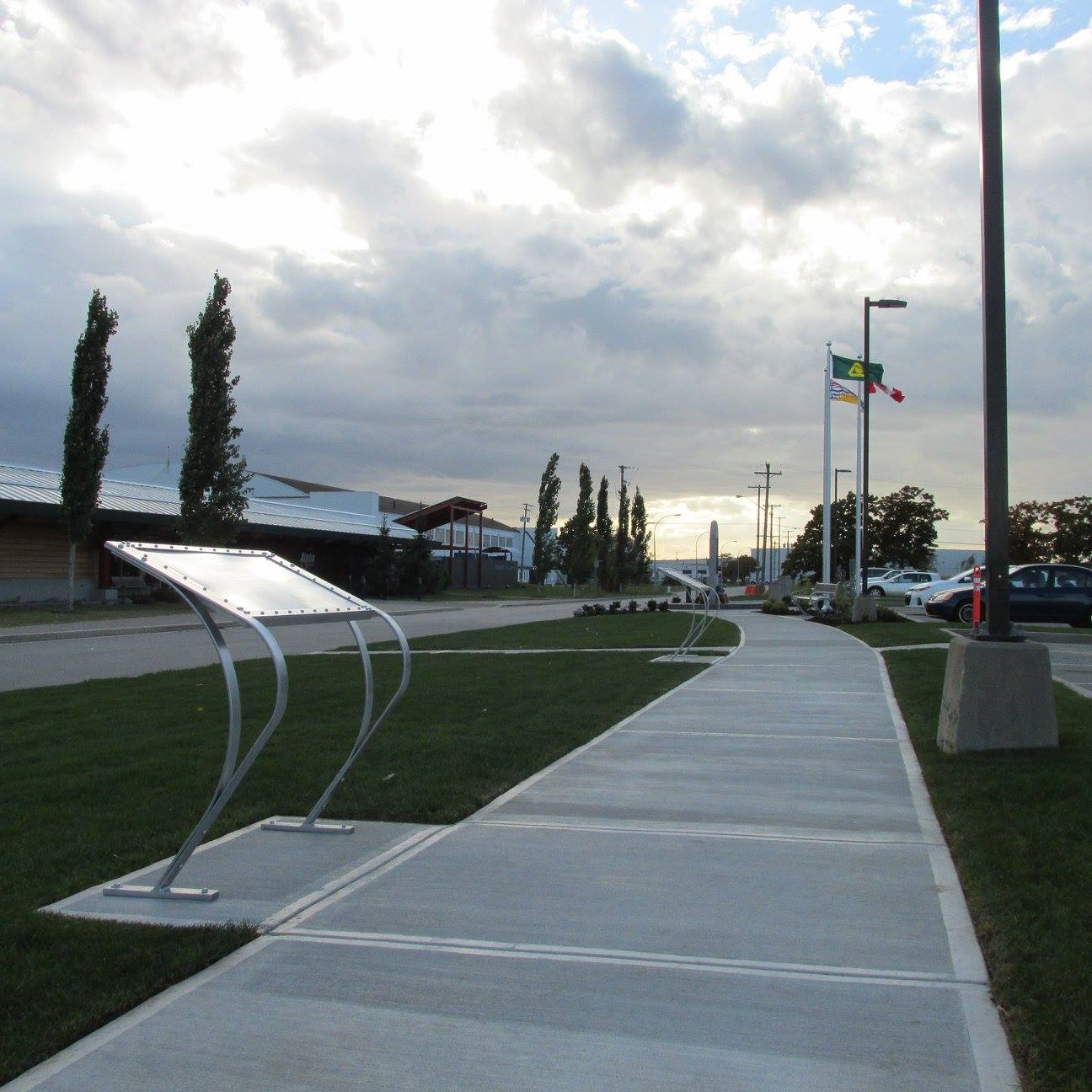
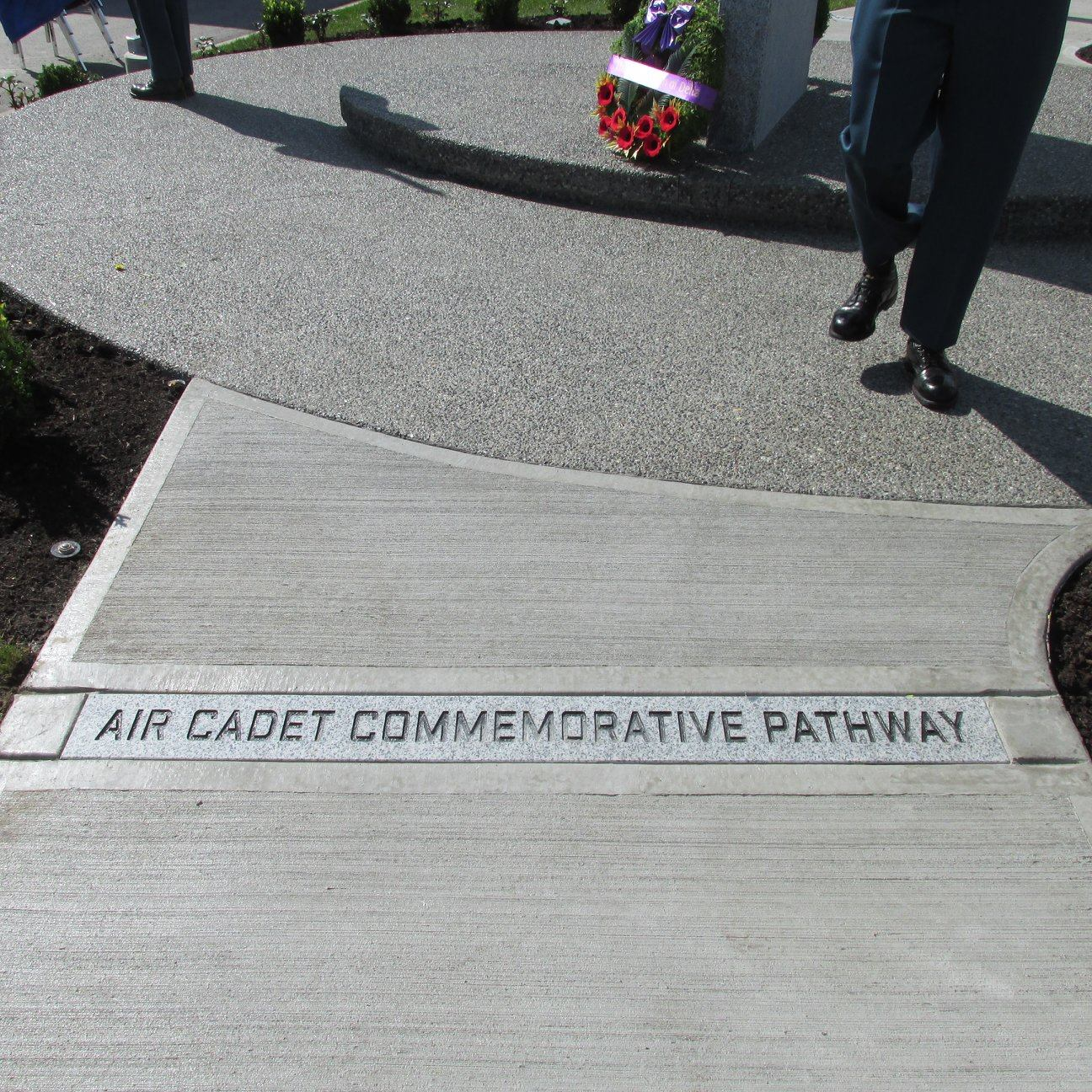
AIR CADET COMMEMORATIVE PATHWAY
[interpretive sign/panneau d’interprétation]
Boundary Bay Airport Turns 75
British Commonwealth Air Training Plan
In 1939, four British Commonwealth countries — United Kingdom, Australia, New Zealand, Canada — launched the British Commonwealth Air Training Plan to train Commonwealth aircrews for war. Canada was chosen as the primary location for "The Plan" because of its ideal weather, wide open spaces suitable for flight and navigation training — sometimes on a large scale, ample supplies of fuel, industrial facilities for the production of trainer aircraft, parts and supplies, the lack of any threat from either the Luftwaffe or Japanese fighter aircraft and its relative proximity to both the European and Pacific theatres. Prime Minister William Lyon Mackenzie King supported the plan and absorbed its costs so long as the British acknowledged that air training would be Canada’s primary war effort. Once the plan’s agreement was signed, the Royal Canadian Air Force (RCAF) began establishing airfields across the country for aircrew training schools. In late 1940, the federal government expropriated 480 acres of farmland from three Delta farmers (Patterson, Loney, Fisher) for $69,200 to construct RCAF Station Boundary Bay.
RCAF Station Boundary Bay Construction Gets Underway
The construction of RCAF Station Boundary Bay began on 6 December 1940. Large quantities of rock and gravel ballast were needed to provide a firm base for construction, and hundreds of trucks were used to haul loads of aggregate from the W.A. Kirkland gravel pit near the USA International Border and from a Fraser River barge depot site in Ladner. By 10 April 1941, two runways and a series of gravel roads were operational and civilian flight training was ready to commence. Prime Minister William Lyon Mackenzie King visited RCAF Station Boundary Bay three months later for its official opening on 2 July 1941.
Playing a Dynamic Role during WWII (1941-1945)
Over the course of the war, the airport played a dynamic role — it served as the No. 18 Elementary Flight Training School from 1941-42 where civilians instructors trained RCAF and RAF aircrews; a Home War Aerodrome Unit from 1942-44, charged with defending the West Coast; and as the No. 5 Operational Training Unit from 1944-45, tasked with training aircrews in heavy bomber operations.
Vancouver Wireless Station (1949-1971)
After WWII, the airport was left inactive until it was transferred to the Royal Canadian Corps of Signals in 1949 and re-established as the Vancouver Wireless Station. The site was used to operate radio equipment for communications and signals-intelligence gathering. Staff working at the Vancouver Wireless Station resided with their families on the lands directly north of the airfield — what is now referred to as the North 40 Park Reserve. In 1968, the Canadian Forces unified and the Vancouver Wireless Station site was renamed Canadian Forces Station Ladner. The Ladner Station was permanently closed in 1971.
In 2010, the Corporation of Delta developed a series of information signs for the Vancouver Wireless Station. The project team encourages visitors to explore the North 40 to learn more about its history.
The Corporation of Delta purchases Boundary Bay Airport
In 1972, Transport Canada assumed responsibility for Boundary Bay Airport from the Department of National Defence. Over the next few years, the airfield was leased to a variety of organizations including car-racing clubs, construction companies, driver-training schools, radio-controlled flying clubs, and for wildlife research and agricultural purposes. In 1976, Transport Canada undertook an environmental assessment to determine whether the airport could be reactivated for general aviation. Boundary Bay Airport was reopened five years later on 1 June 1983. Several companies would lease the airport lands from Transport Canada over the next 14 years. On 5 December 1997, Transport Canada transferred ownership of the Boundary Bay Airport to the Corporation of Delta.
Alpha Aviation Inc. Assumes Long-term Airport Lease
On 1 December 2004, Alpha Aviation Inc. assumed a long-term lease of Boundary Bay Airport. Under direction from its Chairman and CEO Fred Kaiser, Alpha Aviation Inc. has made a significant financial investment in the airport, including a $5 million airport terminal, an expanded fuel farm, runway extensions, apron improvements, and runway lighting upgrades. In 12 short years, Alpha Aviation Inc. has turned the airport into a hub of transportation activity. True to its roots, Boundary Bay Airport remains a flight training centre – home to five flight schools – tasked with training a new generation of Canadian pilots.
[interpretive sign/panneau d’interprétation]
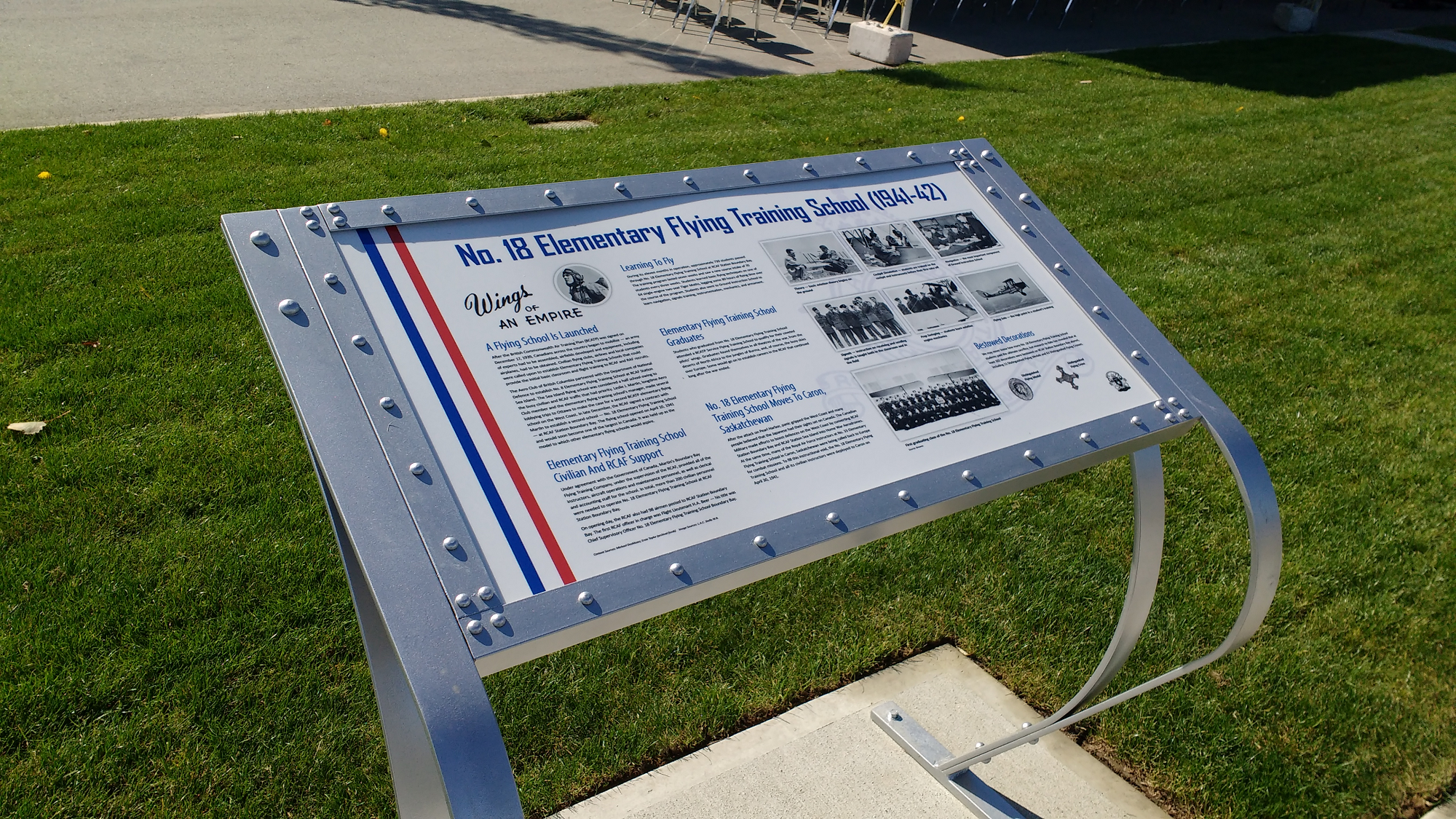
No. 18 Elementary Flying Training School (1941-42)
A Flying School Is Launched
After the British Commonwealth Air Training Plan (BCATP) was signed on December 17, 1939, Canadians across the country began to mobilize — an army of experts had to be assembled, airfields developed and equipment, including airplanes, had to be obtained. Civilian flying clubs, airlines and local companies were called upon to establish Elementary Flying Training Schools that could provide the initial basic classroom and flight training to RCAF and RAF recruits. The Aero Club of British Columbia partnered with the Department of National Defence to establish No. 8 Elementary Flying Training School at RCAF Station Sea Island. The Sea Island flying school was considered a half school owing to the busy civilian and RCAF traffic that had priority. Leslie J. Martin, longtime Aero Club member and the elementary flying training school’s manager, made several lobbying trips to Ottawa to make the case for a second BCATP elementary flying school on the West Coast. In late December, the RCAF signed a contract with Martin to establish a second school — No. 18 Elementary Flying Training School — at RCAF Station Boundary Bay. The flying school opened on April 10, 1941 and would soon become one of the largest in Canada. It was held up as the model to which other elementary flying schools would aspire.
Elementary Flying Training School Civilian And RCAF Support
Under agreement with the Government of Canada, Martin’s Boundary Bay Flying Training Company, under the supervision of the RCAF, provided all of the instructors, aircraft operations and maintenance personnel, as well as clerical and accounting staff for the school. In total, more than 200 civilian personnel were needed to operate No. 18 Elementary Flying Training School at RCAF Station Boundary Bay. On opening day, the RCAF also had 98 airmen posted to RCAF Station Boundary Bay. The first RCAF officer in charge was Flight Lieutenant H.A. Beer — his title was Chief Supervisory Officer No. 18 Elementary Flying Training School Boundary Bay.
Learning To Fly
During its eleven months in operation, approximately 730 students passed through No. 18 Elementary Flying Training School at RCAF Station Boundary Bay. The training program lasted seven weeks and saw a new course intake of 70 students every three weeks. Students learned basic flying techniques on one of 64 single-engine two-seat Tiger Moths, logging some 80 hours of flying time over the course of the program. Students also went to Ground Instruction School to learn navigation, signals training, instrumentation, mechanics, and armament.
Elementary Flying Training School Graduates
Students who graduated from No. 18 Elementary Flying Training School attended a BCATP Service Flying Training School to qualify for their coveted pilots’ wings. Graduates found themselves in all theatres of the war, from the deserts of North Africa to the jungles of Burma, and, of course, the busy skies over Europe. Some would go on to establish careers in the RCAF that continued long after the war ended.
No. 18 Elementary Flying Training School Moves To Caron, Saskatchewan
After the attack on Pearl Harbor, panic gripped the West Coast and many people believed that the Japanese had their sights set on Canada. The Canadian Military made efforts to boost defences on the West Coast by converting RCAF Station Boundary Bay and RCAF Station Sea Island into Home War Aerodromes. At the same time, many of the Royal Air Force instructors at No. 33 Elementary Flying Training School in Caron, Saskatchewan were being called back to Europe for combat missions. To fill this instructional void, the No. 18 Elementary Flying Training School and all its civilian instructors were deployed to Caron on April 30, 1941.
Bestowed Decorations
We may never know how many No. 18 Elementary Flying Training School students paid the ultimate sacrifice, but research to date has revealed that at least 102 decorations were bestowed on RCAF Station Boundary Bay alumni, including 11 Distinguished Flying Medals and 63 Distinguished Flying Crosses.
[interpretive sign/panneau d’interprétation]
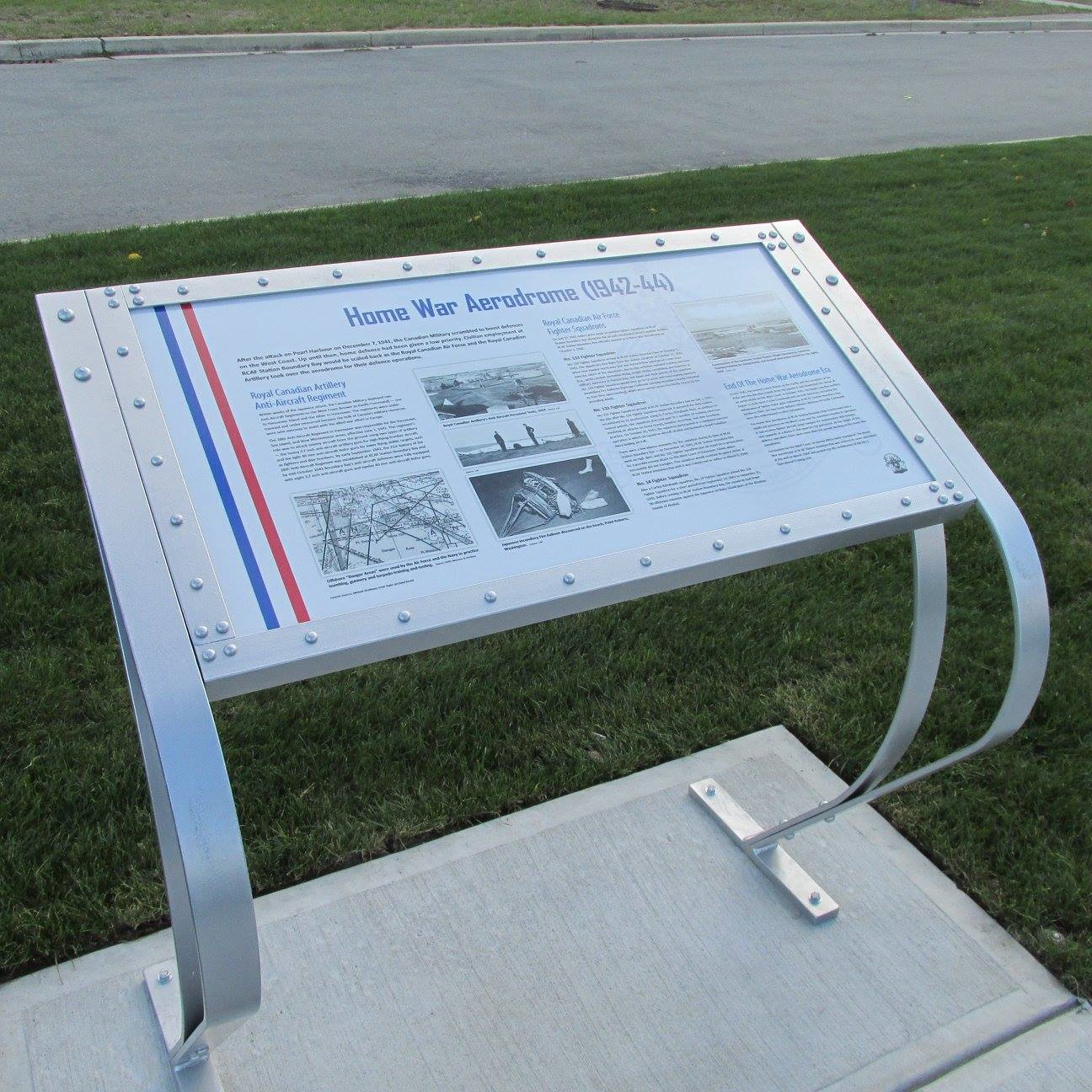
Home War Aerodrome (1942-44)
After the attack on Pearl Harbour on December 7, 1941, the Canadian Military scrambled to boost defences on the West Coast. Up until then, home defence had been given a low priority. Civilian employment at RCAF Station Boundary Bay would be scaled back as the Royal Canadian Air Force and the Royal Canadian Artillery took over the aerodrome for their defence operations.
Royal Canadian Artillery Anti-Aircraft Regiment
Within weeks of the Japanese attack, the Canadian Military deployed two Anti-Aircraft Regiments to the West Coast (known as Pacific Command) — one to Vancouver Island and the other to Vancouver. The regiments were undermanned and under-resourced because the bulk of Canada’s military resources were sent overseas to assist with the allied war effort in Europe. The 28th Anti-Aircraft Regiment in Vancouver was responsible for the Vancouver, Sea Island, and New Westminster areas, effective June 1, 1942. The regiment’s role was to attack enemy aircraft from the ground using two types of artillery — the heavy 3.7 inch anti-aircraft artillery guns for high-flying bomber aircraft, and the light 40 mm anti-aircraft Bofor guns for lower flying visible targets, such as fighters and dive bombers. By early September 1942, the 21st Battery of the 28th Anti-Aircraft Regiment was established at RCAF Station Boundary Bay and by mid-October 1942 Boundary Bay’s anti-aircraft defences were fully equipped with eight 3.7 inch anti-aircraft guns and twelve 40 mm anti-aircraft Bofor guns.
Royal Canadian Air Force Fighter Squadrons
On July 27, 1942 orders were made to position fighter squadrons at RCAF Station Boundary Bay alongside the already established Royal Canadian Artillery. RCAF Station Boundary Bay officially opened as a Home War Aerodrome on October 1, 1942.
No. 133 Fighter Squadron
No. 133 Fighter Squadron arrived at RCAF Station Boundary Bay on October 5, 1942. The squadron’s first flight from the station occurred on October 11, 1942, when nine Hawker Hurricanes and one Harvard flew together on a two-hour exercise. Much of the squadron’s day-to-day activities included training exercises (e.g., aerial combat, formation flying, height climbs, scrambles), participation in military exercises at Patricia Bay, and dawn and dusk patrols of the coastline. No. 133 Fighter Squadron would later go on to assist with intercepting Japanese Incendiary Fire Balloons (hydrogen balloons carrying incendiary bombs intended to start fires upon landing), which were carried across the Pacific Ocean by the prevailing winds.
No. 132 Fighter Squadron
No. 132 Fighter Squadron arrived at RCAF Station Boundary Bay on July 1, 1943, the day after No. 133 Fighter Squadron departed. It assumed the duty routine established by its predecessor using its Curtiss Kittyhawk fleet. In addition to coastal patrols, the squadron also took part in a number of training exercises involving air attacks on Army troops, bomber escorting, and dive-bombing practice. On October 26, 1943, the squadron participated in a combined exercise operation in which six squadron aircraft strafed and bombed a Royal Canadian Navy landing aircraft.
There were a few intense moments for the squadron during its time at RCAF Station Boundary Bay — on December 18, 1943, RCAF Station Boundary Bay went on high alert, and No. 132 Fighter Squadron was on stand-by in preparation for a possible enemy attack on the West Coast of Vancouver Island, which fortunately did not transpire. The squadron would continue its patrol duties at RCAF Station Boundary Bay until it was transferred to Tofino on March 9, 1944.
No. 14 Fighter Squadron
Also a Curtiss Kittyhawk squadron, No. 14 Fighter Squadron joined No. 132 Fighter Squadron for a short period from September 24, 1943 to December 23, 1943. Before coming to RCAF Station Boundary Bay, the squadron had flown 30 offensive missions against the Japanese on Kiska Island (part of the Aleutian Islands of Alaska).
End Of The Home War Aerodrome Era
In late 1943, the enemy’s naval defeats in the Pacific and the recapture of the Kiska and Attu Aleutian Islands from the Japanese had diminished the threat of an aerial attack on the West Coast. In October 1943, the Royal Canadian Artillery began to scale back Pacific Command anti-aircraft defences, including the withdrawal of twelve Bofor guns remaining at RCAF Station Boundary Bay. By March 1944, the two home defence infantry divisions of Pacific Command were also redistributed to other formations.
The Home War Aerodrome at RCAF Station Boundary Bay transformed into a significant presence on the West Coast over its seventeen months in operation. It had modern fighter aircraft, large hangars for maintenance and storage, and upwards of a dozen H-Hut quarters for personnel. At the height of the defence operation, there were more than 650 people working at the Home War Aerodrome.
Fortunately for the West Coast, an enemy attack never transpired. The Home War Aerodrome at RCAF Station Boundary Bay was ordered to cease operations at the end on March 1944 and prepare for the mobilization of the No. 5 Operational Training Unit.
[interpretive sign/panneau d’interprétation]
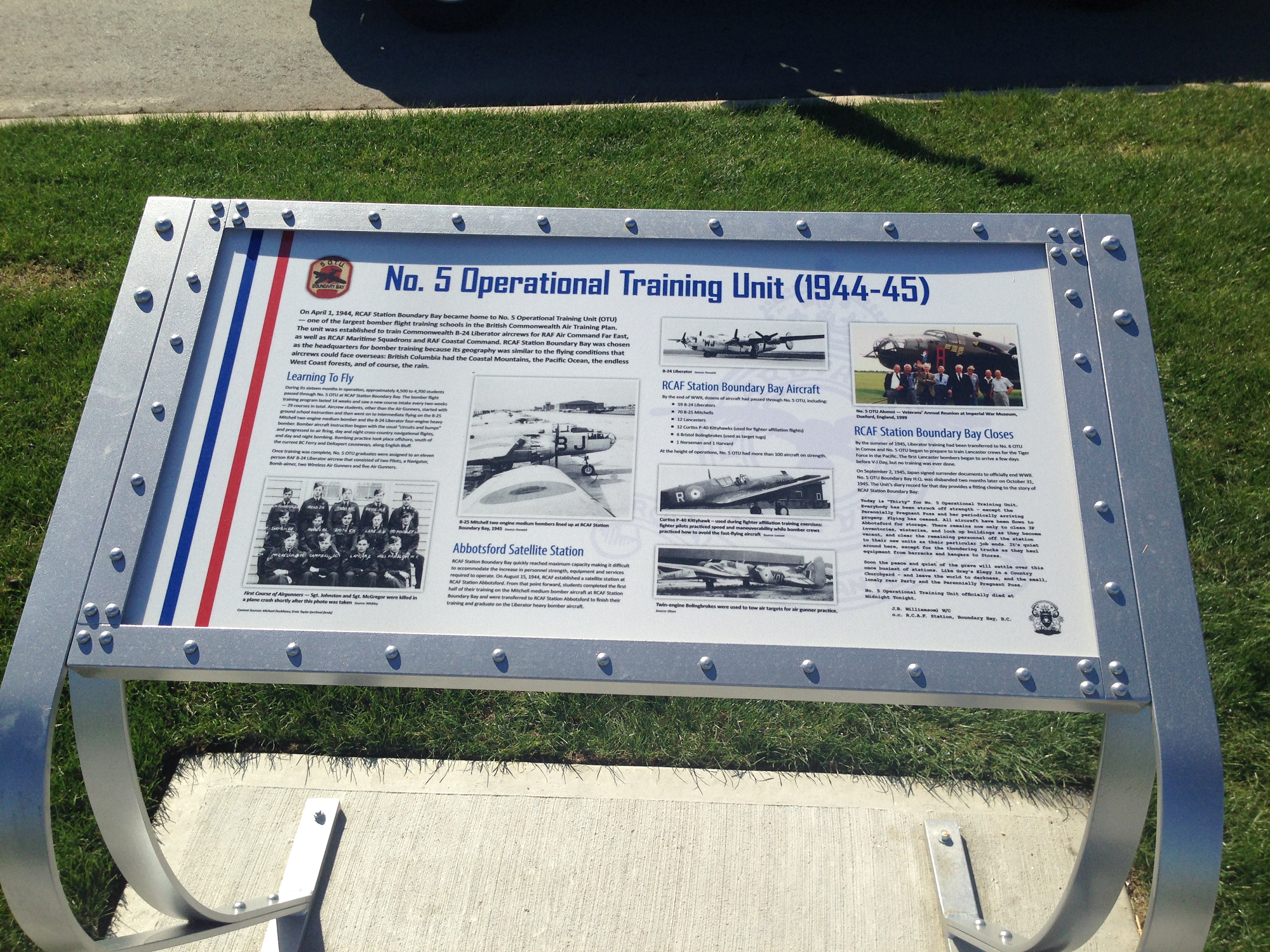
No. 5 Operational Training Unit (1944-45)
On April 1, 1944, RCAF Station Boundary Bay became home to No. 5 Operational Training Unit (OTU) — one of the largest bomber flight training schools in the British Commonwealth Air Training Plan. The unit was established to train Commonwealth B-24 Liberator aircrews for RAF Air Command Far East, as well as RCAF Maritime Squadrons and RAF Coastal Command. RCAF Station Boundary Bay was chosen as the headquarters for bomber training because its geography was similar to the flying conditions that aircrews could face overseas: British Columbia had the Coastal Mountains, the Pacific Ocean, the endless West Coast forests, and of course, the rain.
Learning To Fly
During its sixteen months in operation, approximately 4,500 to 4,700 students passed through No. 5 OTU at RCAF Station Boundary Bay. The bomber flight training program lasted 14 weeks and saw a new course intake every two-weeks — 29 courses in total. Aircrew students, other than the Air Gunners, started with ground school instruction and then went on to intermediate flying on the B-25 Mitchell two-engine medium bomber and the B-24 Liberator four-engine heavy bomber. Bomber aircraft instruction began with the usual “circuits and bumps” and progressed to air firing, day and night cross-country navigational flights, and day and night bombing. Bombing practice took place offshore, south of the current BC Ferry and Deltaport causeways, along English Bluff. Once training was complete, No. 5 OTU graduates were assigned to an eleven person RAF B-24 Liberator aircrew that consisted of two Pilots, a Navigator, Bomb-aimer, two Wireless Air Gunners and five Air Gunners.
Abbotsford Satellite Station
RCAF Station Boundary Bay quickly reached maximum capacity making it difficult to accommodate the increase in personnel strength, equipment and services required to operate. On August 15, 1944, RCAF established a satellite station at RCAF Station Abbotsford. From that point forward, students completed the first half of their training on the Mitchell medium bomber aircraft at RCAF Station Boundary Bay and were transferred to RCAF Station Abbotsford to finish their training and graduate on the Liberator heavy bomber aircraft.
RCAF Station Boundary Bay Aircraft
By the end of WWII, dozens of aircraft had passed through No. 5 OTU, including:
• 59 B-24 Liberators
• 70 B-25 Mitchells
• 12 Lancasters
• 12 Curtiss P-40 Kittyhawks (used for fighter affiliation flights)
• 6 Bristol Bolingbrokes (used as target tugs)
• 1 Norseman and 1 Harvard
At the height of operations, No. 5 OTU had more than 100 aircraft on strength.
RCAF Station Boundary Bay Closes
By the summer of 1945, Liberator training had been transferred to No. 6 OTU in Comox and No. 5 OTU began to prepare to train Lancaster crews for the Tiger Force in the Pacific. The first Lancaster bombers began to arrive a few days before V-J Day, but no training was ever done. On September 2, 1945, Japan signed surrender documents to officially end WWII. No. 5 OTU Boundary Bay H.Q. was disbanded two months later on October 31, 1945. The Unit’s diary record for that day provides a fitting closing to the story of RCAF Station Boundary Bay:
Today is “Thirty” for No. 5 Operational Training Unit. Everybody has been struck off strength – except the Perennially Pregnant Puss and her periodically arriving progeny. Flying has ceased. All aircraft have been flown to Abbotsford for storage. There remains now only to clean 3P inventories, winterize, and lock up buildings as they become vacant, and clear the remaining personnel off the station to their new units as their particular job ends. It’s quiet around here, except for the thundering trucks as they haul equipment from barracks and hangars to Stores. Soon the peace and quiet of the grave will settle over this once busiest of stations. Like Gray’s Elegy in a Country Churchyard – and leave the world to darkness, and the small, lonely rear Party and the Perennially Pregnant Puss. No. 5 Operational Training Unit officially died at Midnight Tonight.
J.B. Williamsom) W/C
o.c. R.C.A.F. Station, Boundary Bay, B.C.
[interpretive sign]
Air Cadet League: Early Years
The Establishment Of Air Cadets in Canada
In 1939, the Government of Canada tasked Squadron Leader A.W. “Nick” Carter with establishing the first-ever Air Force Cadet Wing in Canada. The Air Cadet Wing was to be located in Vancouver, British Columbia and its goal was to train high school students to become Royal Canadian Air Force (RCAF) aircrew in preparation for war. A call for applications to join the RCAF Cadet Wing drew more than 1,100 applicants to the Stanley Park Armouries. Squadron Leader Carter handpicked 250 cadets to form the 1601 Wing, Canadian Air Force Cadets which later became 1 Wing and eventually 111 Pegasus Squadron which still parades in Vancouver today. These air cadets made their first public appearance for the Royal Visit of King George VI and Queen Elizabeth on 29 May 1939.
By all accounts, the ‘experimental’ RCAF Air Cadet Wing was a resounding success. On 11 November 1940, an Order-in-Council was passed by the Government of Canada authorizing the formation of the Air Cadet League of Canada. The newly established organization included a national Junior Air Cadet Corps (age 12-14) and Senior Air Cadet Corps (age 15 –18). On 9 April 1941, the Air Cadet League of Canada received its Letters Patent by Dominion Charter from the Government of Canada authorizing it to operate as a charitable, non-profit corporation. A civilian/military partnership was formed to oversee the corporation and a framework was established for nine Air Cadet League of Canada Provincial Committees across Canada.
Shortly after the formation of the BC Provincial Committee, discussions took place with the BC Provincial Department of Education and it was agreed that school boards across the province would deliver the Air Cadet program. In 1941, school district principals and vice principals spent the last two weeks of August receiving intensive training from the RCAF – many of these administrators received their training at RCAF Station Boundary. After passing an examination, administrators became Cadet Civilian Instructors with an officer rank and assumed the position of Commanding Officer for their school’s squadron. As an incentive to students, any air cadet who completed two years of training (288 hours/year), passed all of their courses and achieved a mark of 60% or higher would be given an additional five credits towards graduation.
The Rise of Air Cadet Squadrons
On 25 October 1941, 22 Powell River Squadron became the first British Columbian air cadet squadron to receive its Charter. By the end of December 1941, there were nine active air cadet squadrons in British Columbia. Within a year, this number had tripled to 27. A number of these squadrons were independent squadrons not attached to high schools but sponsored by service clubs such as Royal Canadian Legions, Rotary and Kiwanis. In July 1942, a summer training camp was introduced to the Air Cadet Program. The camp became an intensive study in all areas of interest to the RCAF including meteorology, aero-engine maintenance, navigation, aircraft recognition and range. This spurred continued growth in the Air Cadet program; by the start of the 1944-1945 training year, there were 29,000 Air Cadets enrolled nationally across 374 squadrons, 46 squadrons in British Columbia alone.
[interpretive sign]
Air Cadet League: An Evolving Program
Air Cadettes
Although women were not officially allowed to enter the Air Cadet program until 1975, many photographs taken during WWII show young women in unofficial Squadron or Wing uniforms. These young women, or Air Cadettes, were trained in administration, but pushed for more responsibility and were soon participating in drill first aid and, in some cases, range training.
In 1950, Squadron CO, F/Lt Vince Forbes, lobbied the Royal Canadian Air Force to send Air Cadettes Pat McDowell, Marian Kenmuir and Isobel Pittendreigh from 22 Power River Squadron through the RCAF flight training program. After two years of petitioning, the Royal Canadian Air Force agreed to allow these women to enter the Power Pilot Scholarship Course at Sea Island Airport. All three women completed the course and proudly accepted their Wings at the intake’s Graduation Parade.
On 30 July 1975, the Government of Canada amended the National Defence Act to authorize the provision of support to female cadets by the Department of National Defence. By the end of 1975, there were approximately 4,000 young women enrolled in the Air Cadet Program and 800 of these attended the Air Cadet summer training camp. A total of 60 young women obtained their glider wings that year.
Shifting Focus
When WWII ended, many high school squadrons began to stand down. By the end of the 1945-46 school year, there were only 11,000 Air Cadets enrolled nationally across 155 Squadrons. On 3 July 1946, His Majesty King George VI decreed that the Canadian Air Cadets become the Royal Canadian Air Cadets. The name change created a groundswell of support from ex-cadets, parents, Royal Canadian Air Force personnel and the Air Cadet League of Canada.
The Air Cadets began to shift their focus from providing major ground and aircrew support for the RCAF to providing support to the growing Canadian civil aviation industry. Air Cadet enrollment received another boost when Newfoundland & Labrador joined Confederation – this added another seven squadrons to the Air Cadet League of Canada. By 1950, the number of squadrons in British Columbia stood at 30.
Today, across Canada, the Air Cadet League of Canada continues its partnership with the Department of National Defence to deliver one of the country’s top youth development program to Canadians between the ages of 12-18. Guided by the motto of “To Learn, To Serve, and To Advance” the Air Cadet Program aims to develop leadership, citizenship and physical fitness in an environment that stimulates an interest in the field of aviation and air activities of the Canadian Armed Forces.
Air Cadet Gliding Program
During the summer of 1965, the western Air Cadet squadrons established an experimental gliding program in Penhold, Alberta. The program flourished and received an enormous boost in late 1972 when the Air Cadet League was authorized to purchase, at a nominal price, 17 surplus Cessna L-19 Bird Dog aircraft and 4 surplus Cessna L-182 Skylanes from the Canadian Forces. These were obtained through the Crown Assets Disposal Corporation and continue to play a major role, alongside the League’s other aircraft, in what is now the largest gliding program in the world.
Celebrating 75 Years (1941-2016)
Over the last 75 years, more than one million young Canadians have participated in the Air Cadet program. One in five private pilots in Canada are ex-Air Cadet and 67% of commercial and airline pilots began as Air Cadets. Today, there are 25,890 Air Cadets enrolled nationally across 453 squadrons. Every September, upwards of 16 BC Air Cadet squadrons, approximately 1,000 Air Cadets, participate in the Battle of Britain Commemorative Parade at Boundary Bay Airport to commemorate the day when the Royal Air Force Fighter Command held a decisive victory over the German Luftwaffe – this was a turning point during WWII and a battle fought solely in the air. More than 400 Canadian air and ground crew, including more than 100 pilots fought alongside their Allies to defend England and prevent a planned Nazi invasion.