[sign/enseigne]
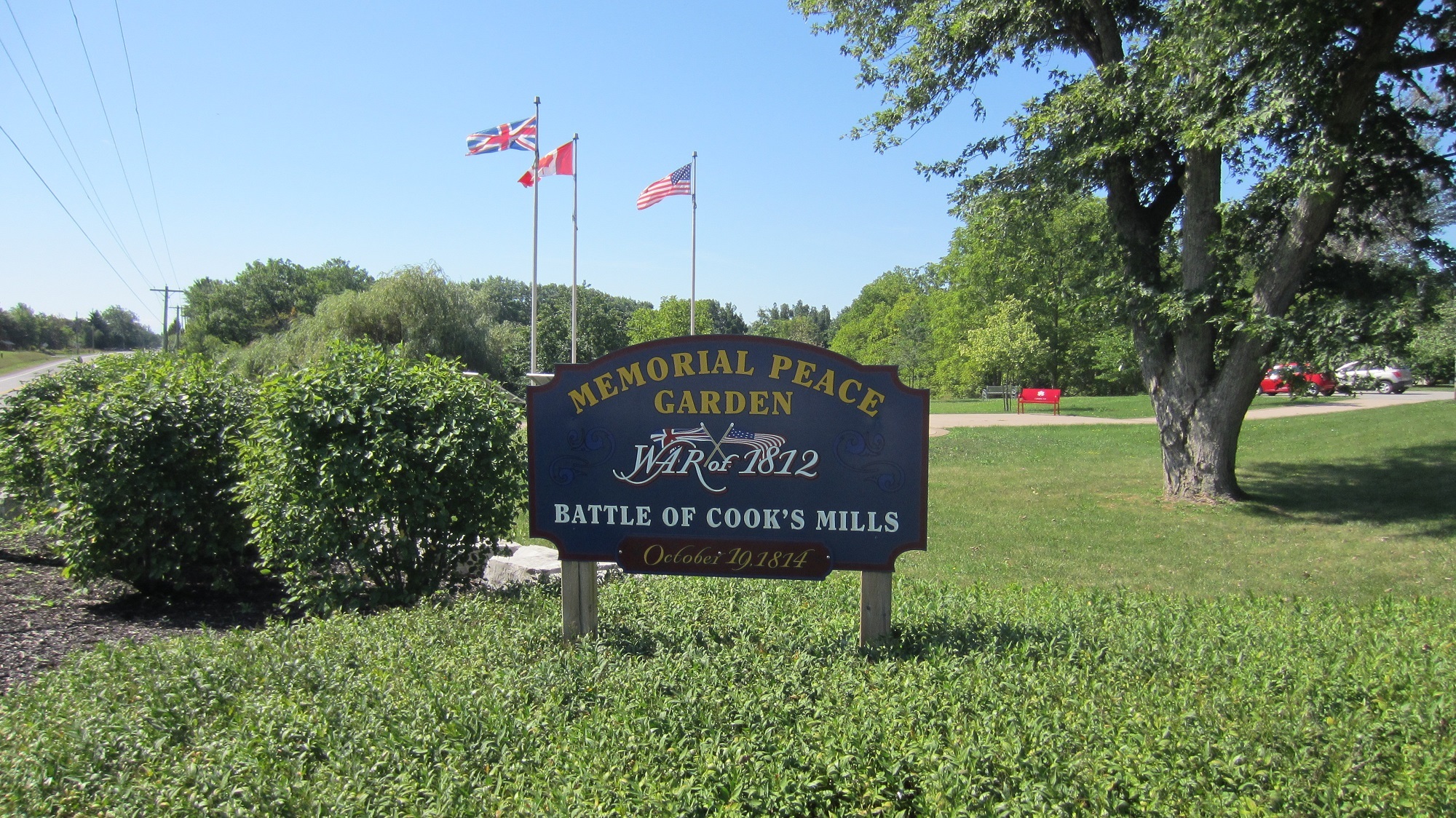
MEMORIAL PEACE GARDEN
WAR of 1812
BATTLE OF COOK'S MILLS
October 19, 1814
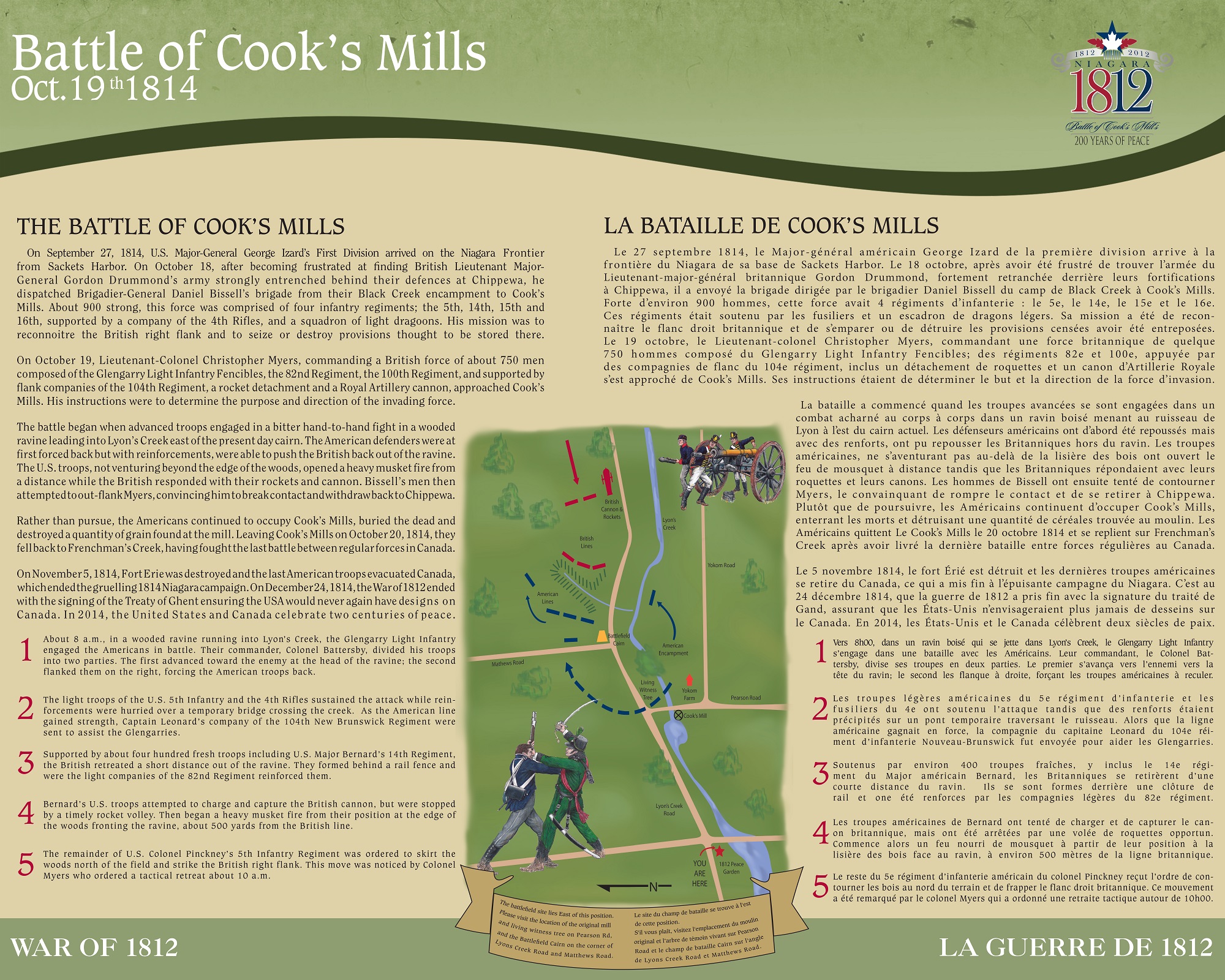
[Battle of Cook's Mills interpretive panel/panneau d’interprétation de la Bataille-de-Cook’s Mills]
Battle of Cook’s Mills
Oct.19 1814
THE BATTLE OF COOK’S MILLS
On September 27, 1814, U.S. Major-General George Izard’s First Division arrived on the Niagara Frontier from Sackets Harbor. On October 18, after becoming frustrated at finding British Lieutenant Major-General Gordon Drummond’s army strongly entrenched behind their defences at Chippewa, he dispatched Brigadier-General Daniel Bissell’s brigade from their Black Creek encampment to Cook’s Mills. About 900 strong, this force was comprised of four infantry regiments; the 5th, 14th, 15th and 16th, supported by a company of the 4th Rifles, and a squadron of light dragoons. His mission was to reconnoitre the British right flank and to seize or destroy provisions thought to be stored there.
On October 19, Lieutenant-Colonel Christopher Myers, commanding a British force of about 750 men composed of the Glengarry Light Infantry Fencibles, the 82nd Regiment, the 100th Regiment, and supported by flank companies of the 104th Regiment, a rocket detachment and a Royal Artillery cannon, approached Cook’s Mills. His instructions were to determine the purpose and direction of the invading force.
The battle began when advanced troops engaged in a bitter hand-to-hand fight in a wooded ravine leading into Lyon’s Creek east of the present day cairn. The American defenders were at first forced back but with reinforcements, were able to push the British back out of the ravine. The U.S. troops, not venturing beyond the edge of the woods, opened a heavy musket fire from a distance while the British responded with their rockets and cannon. Bissell’s men then attempted to out-flank Myers, convincing him to break contact and withdraw back to Chippewa.
Rather than pursue, the Americans continued to occupy Cook’s Mills, buried the dead and destroyed a quantity of grain found at the mill. Leaving Cook’s Mills on October 20, 1814, they fell back to Frenchman’s Creek, having fought the last battle between regular forces in Canada.
On November 5, 1814, Fort Erie was destroyed and the last American troops evacuated Canada, which ended the gruelling 1814 Niagara campaign. On December 24, 1814, the War of 1812 ended with the signing of the Treaty of Ghent ensuring the USA would never again have designs on Canada. In 2014, the United States and Canada celebrate two centuries of peace.
1 About 8 a.m., in a wooded ravine running into Lyon’s Creek, the Glengarry Light Infantry engaged the Americans in battle. Their commander, Colonel Battersby, divided his troops into two parties. The first advanced toward the enemy at the head of the ravine; the second flanked them on the right, forcing the American troops back.
2 The light troops of the U.S. 5th Infantry and the 4th Rifles sustained the attack while reinforcements were hurried over a temporary bridge crossing the creek. As the American line gained strength, Captain Leonard’s company of the 104th New Brunswick Regiment were sent to assist the Glengarries.
3 Supported by about four hundred fresh troops including U.S. Major Bernard’s 14th Regiment, the British retreated a short distance out of the ravine. They formed behind a rail fence and were the light companies of the 82nd Regiment reinforced them.
4 Bernard’s U.S. troops attempted to charge and capture the British cannon, but were stopped by a timely rocket volley. Then began a heavy musket fire from their position at the edge of the woods fronting the ravine, about 500 yards from the British line.
5 The remainder of U.S. Colonel Pinckney’s 5th Infantry Regiment was ordered to skirt the woods north of the field and strike the British right flank. This move was noticed by Colonel Myers who ordered a tactical retreat about 10 a.m.
WAR OF 1812
LA BATAILLE DE COOK’S MILLS
Le 27 septembre 1814, le major-général américain George Izard de la première division arrive à la frontière du Niagara de sa base de Sackets Harbor. Le 18 octobre, frustré de ne pas trouver l’armée du lieutenant-major-général britannique Gordon Drummond, fortement retranchée derrière les fortifications à Chippewa, il a envoyé la brigade dirigée par le brigadier Daniel Bissell du camp de Black Creek à Cook’s Mills. Avec un effectif de 900 hommes, il avait 4 régiments d’infanterie : le 5e, le 14e, le 15e et le 16e régiment, et était soutenu par les fusiliers et un escadron de dragons légers. Sa mission a été de reconnaître le flanc droit britannique et de s’emparer ou de détruire les provisions censées avoir été entreposées.
Le 19 octobre, le lieutenant-colonel Christopher Myers, commandant une force britannique de quelque 750 hommes composé du Glengarry Light Infantry Fencibles, du 82e régiment, du 100e régiment, et pris en charge par les compagnies de flanc du 104e régiment, a vu un détachement d'artillerie et un canon d’Artillerie Royale s’approcher de Cook’s Mills. Son principal objectif était de déterminer la direction et le but des forces d’invasion.
La bataille a commencé quand les troupes se sont engagées dans un combat au corps à corps dans un ravin boisé l'est de Lynon's Breek. Les défenseurs américains ont d’abord été obligés de reculer, mais avec des renforts, ont pu repousser les Britanniques. Les troupes américaines, non loin de la lisière du bois, ont ouvert le feu à distance, tandis que les Britanniques répondaient avec leurs fusils et leurs canons. Les hommes de Bissell ont ensuite tenté de convaincre Myers de rompre le contact et de se retirer à Chippewa.
Plutôt que de poursuivre, les Américains ont continué d’occuper Cook’s Mills, d'enterrer les morts et de détruire une quantité de grain trouvée à l'usine. Le 20 octobre 1814, ils partent de Cook's Mills et retournent au ruisseau Frenchman pour une dernière bataille entre forces régulières au Canada.
Le 5 novembre 1814, le fort Érié est détruit et les dernières troupes américaines se sont retirées du Canada, ce qui a mis fin en 1814 à la campagne exténuante dans la pénnisule du Niagara. Le 24 décembre 1814, la guerre de 1812 a pris fin avec la signature du traité de Gand, assurant que les États-Unis n’envisageraient plus jamais une invasion au Canada. En 2014, les États-Unis et le Canada célèbrent deux siècles de paix.
1 Aux environs de 8 h, dans un ravin boisé de Lyon’s Creek, le Glengarry Light Infantry s’engage dans une bataille avec les Américains. Leur commandant, le Colonel Battersby, divise ses troupes en deux parties. Le première troupe s’avance vers l’ennemi vers la tête du ravin tandis que le deuxième, sur la flanc droit, oblige le retour des troupes américaines.
2 Les troupes légères américaines du 5e régiment d’infanterie et les fusiliers subissent l’attaque alors que des renforts ont été dépêchés sur un pont temporaire traversant le ruisseau. Comme les forces américaines se renforcent, la compagnie du capitaine Leonard du 104e réiment d’infanterie Nouveau-Brunswick a été envoyée pour aider les membres du Glengarry.
3 Pris en charge par 400 troupes fraîches, y compris le 14e régiment du Major américain Bernard, les Britanniques se retirent non loin du ravin le long d'une clôture en lisse et one été renforces par le 82e régiment d'infanterie légère.
4 Les troupes américaines de Bernard ont tenté de charger et de capturer les canons britannique, mais ont été arrêtées par une réplique d'artillerie. Commence alors un tir au fusil à la lisière du bois, donnant sur le ravin, à environ 500 mètres de la ligne britannique.
5 Le reste du 5e régiment d’infanterie américain du colonel Pinckney a reçu l’ordre de contourner la foret vers le nord et d'attaquer le flanc droit britannique. Le colonel Myers ordonna donc une retraite tactique autour de 10 h.
LA GUERRE DE 1812
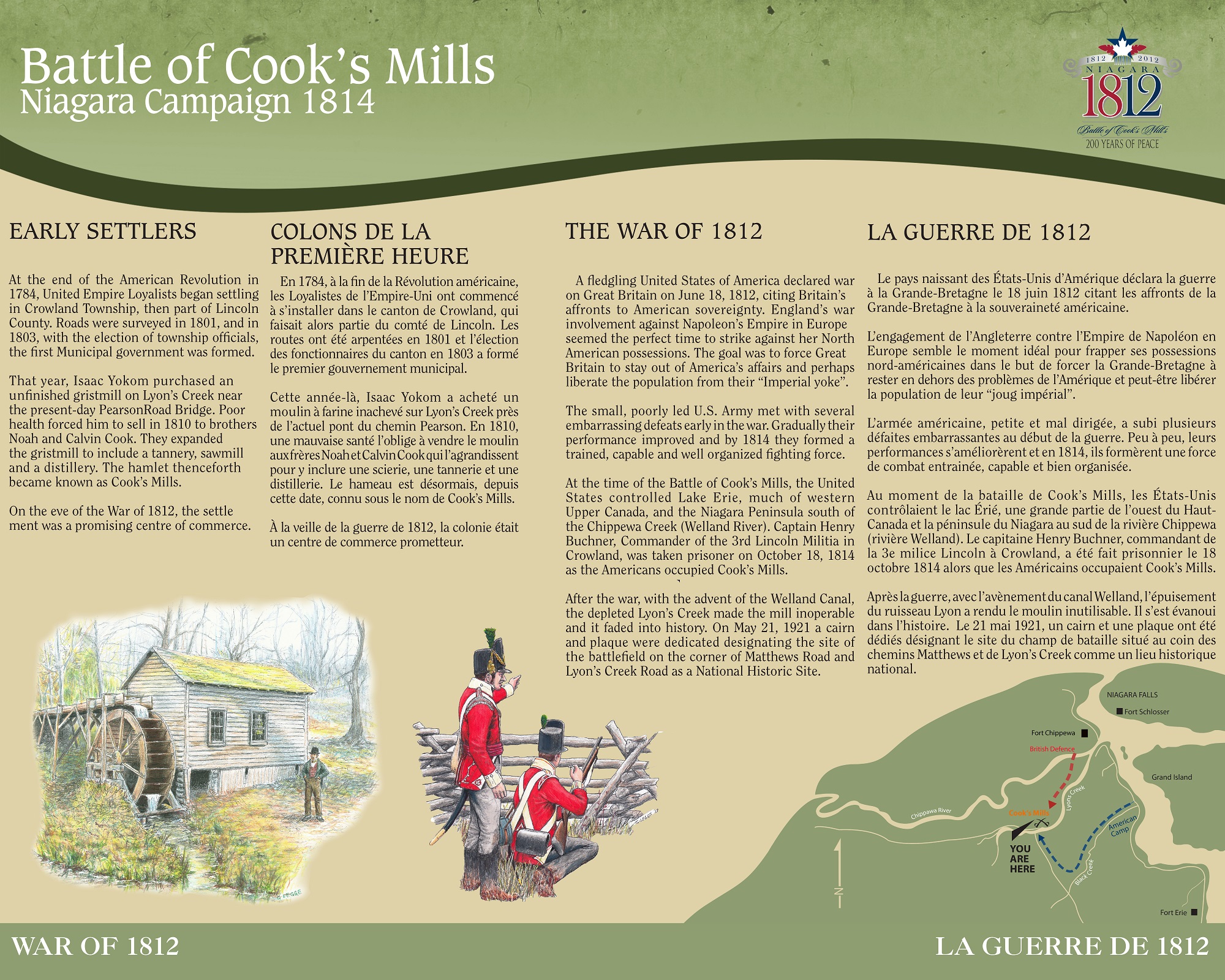
[Battle of Cook's Mills Niagara Campaign interpretive panel/panneau d’interprétation de la Bataille-de-Cook’s Mills, Campagne du Niagara]
Battle of Cook’s Mill
Niagara Campaign 1814
- EARLY SETTLERS
- At the end of the American Revolution in
1784, United Empire Loyalists began
settling in Crowland Township, then part
of Lincoln County. Roads were surveyed in
1801 and the election of township officials,
in 1803 formed the first Municipal government.
- That year, Isaac Yokom purchased
an unfinished grist mill on Lyon’s Creek
near the present-day Pearson Road Bridge.
In 1810, poor health forced him to sell the
mill to brothers Noah and Calvin Cook
who expanded it to include a saw mill
a tannery and a distillery. The hamlet
henceforth became known as Cook’s Mills.
- On the eve of the War of 1812, the settlement
was a promising centre of commerce.
- COLONS DE LA
PREMIÈRE HEURE
- En 1784, à la fin de la révolution américaine,
les Loyalistes de l’Empire-Unis installent
dans le canton de Crowland, dans le comté de
Lincoln. En 1801, les routes ont été arpentées
et en 1801, les fonctionnaires du canton
forment le premier gouvernement municipal.
- Cette même année, Isaac Yokom achète
un moulin inachevé, à broyer le grain à
côté du Lyon’s Creek près de l’actuel pont-route
de Pearson. En 1810, sa santé chancelante
l’oblige à vendre le moulin aux frères
Noé et Calvin Cook qui l’agrandissent
pour y inclure une scierie, une tannerie et
une distillerie. Le hameau est désor-
mais, connu sous le nom de Cook’s Mills.
- À la veille de la guerre de 1812, l'endroit devient
un centre de commerce très prometteur.
- THE WAR OF 1812
- A fledgling United States of America declared war
on Great Britain on June 18, 1812, citing Britain’s
affronts to American sovereignty. England’s war
involvement against Napoleon’s Empire in Europe
seemed the perfect time to strike against her North
American possessions with the goal of forcing Great
Britain to stay out of America’s affairs and perhaps
liberate the population from their “Imperial yoke”.
- The small, poorly led U.S. Army met with several
embarrassing defeats early in the war. Gradually their
performance improved and by 1814 they formed a
trained, capable and well organized fighting force.
- At the time of the Battle of Cook’s Mills, the
United States controlled Lake Erie, much of
western Upper Canada, and the Niagara Peninsula
south of the Chippewa Creek (Welland River). Captain
Henry Buchner commander of the 3rd Lincoln
Militia in Crowland, was taken prisoner on October
18, 1814 as the Americans occupied Cook’s Mills.
- After the war, with the advent of the Welland Canal,
the depleted Lyon’s Creek made the mill inoperable and it
faded into history. On July 25, 1923, a memorial cairn
and plaque were dedicated designating the site of
on the corner of Matthews Road and Lyon’s Creek Road
was dedicated to marke the location of the Battlefield.
- LA GUERRE DE 1812
- Le 18 juin 1812, le jeune pays des États-Unis d’Amérique
déclara la guerre à la Grande-Bretagne. La
partiicpation de l'Angleterre contre l’Empire de Napoléon
en Europe semble le moment idéal pour frapper contre ses
possessions nord-américaines dans le but de forcer la Grande-
Bretagne à rester en dehors des problèmes de l’Amérique
et peut-être libérer la population de leur “joug impérial”.
- L’armée américaine, petite et mal dirigée, a rencentré
plusieurs défaites embarrassantes au début de la guerre. Peu
à peu, leurs performances se sont améliorées et en 1814, ils
ont formé une force combattante efficace et bien organisée.
- Au moment de la bataille de Cook’s Mills, les États-Unis
contrôlaient le lac Erie, une grande partie du Haut-Canada et la
péninsule du Niagara, au sud de la rivière Chippewa (rivière
Welland). Le capitaine Henry Buchner, commandant de la
3e milice Lincoln à Crowland, fut fait prisonnier le 18 oct.
1814 pendant que les Américains occupaient Cook’s Mills.
- Après la guerre, avec l’avènement du canal Welland, le Lyons Creek
étant devenu inutilisable, Cook's Mills n'existe plus. Le 25 juillet
1923, un cairn commémoratif, au coin des rues Matthews et de Lyon’s
Creek a été érigé pour marquer l'emplacement du champ de bataille.
-
-