
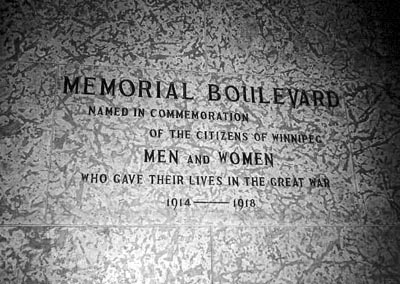
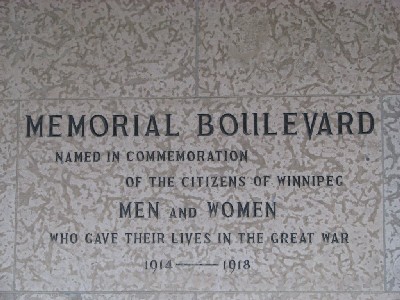
Memorial Boulevard has a broad median which features the Winnipeg Cenotaph. The beautiful treed boulevard was a more fitting symbol than a traditional stone monument.
In November 1918, Canadians turned to the duty of commemorating the dead. Some promoted practical memorials like Roads of Remembrance. These linear tree-lined avenues had trees that were typically a single species, regularly spaced along each side of the avenue that would grow tall and stately. American elms were chosen for many of these avenues. A small plaque was used to assign a particular tree to a specific fallen soldier. In some cases, the next-of-kin was involved in purchasing the tree and/or plaque for the deceased soldier.
Roads of Remembrance were based on two symbol-laden images. The first was France’s tree-lined country avenues: “long straight roads, with large elms on either side, beautiful and useful, and loved by the Canadians overseas.” The second symbol was a living memorial: trees represented the victory of life over death. Memorial trees became living symbols of the sacrifices made in France and Belgium.
Memorial Boulevard, in front of the Manitoba Legislature is the only provincially owned road in the City of Winnipeg. The boulevard was reconstructed and repaved in 2019 as part of improvements before the 2020 Manitoba 150 celebrations.