
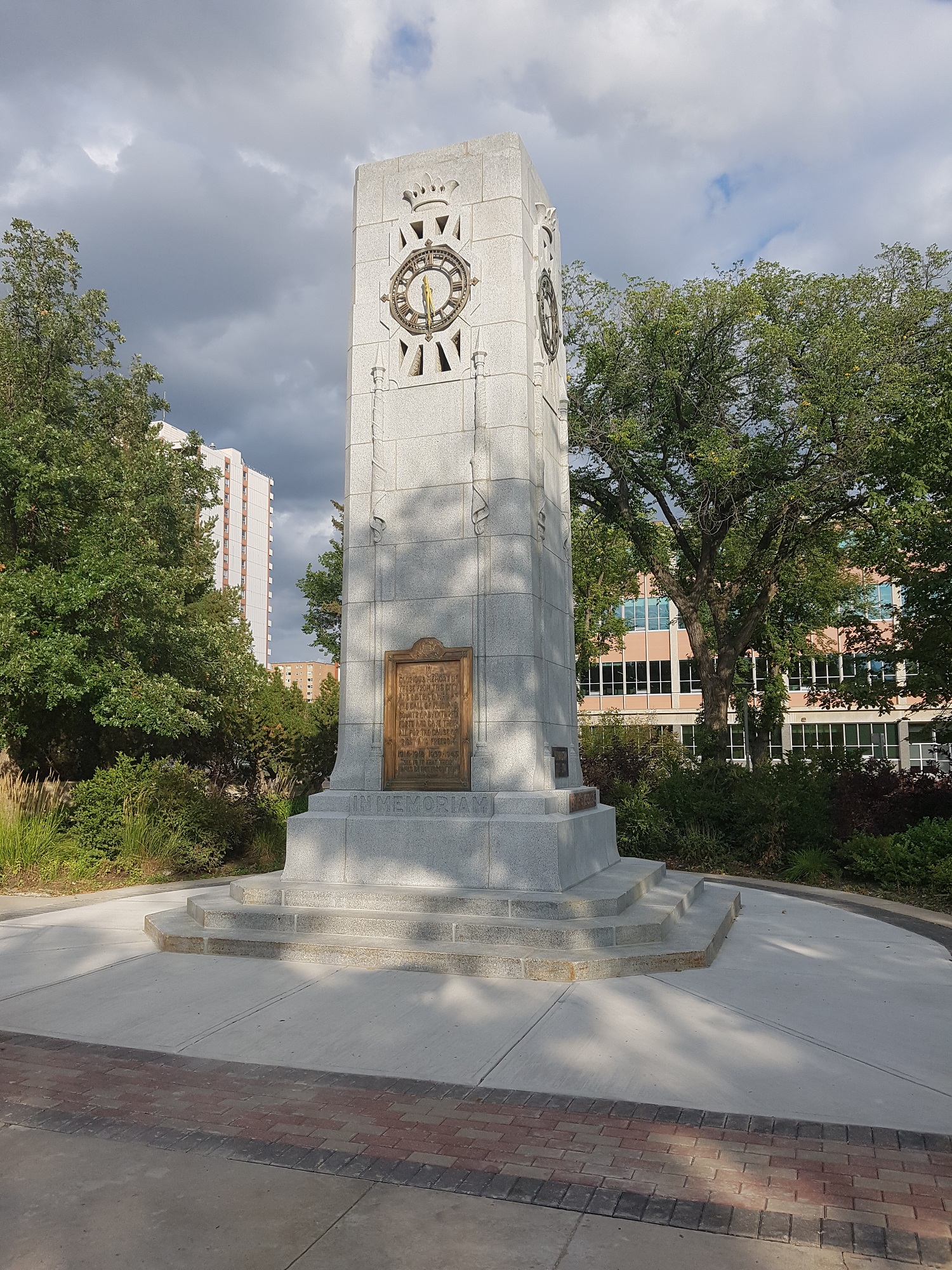
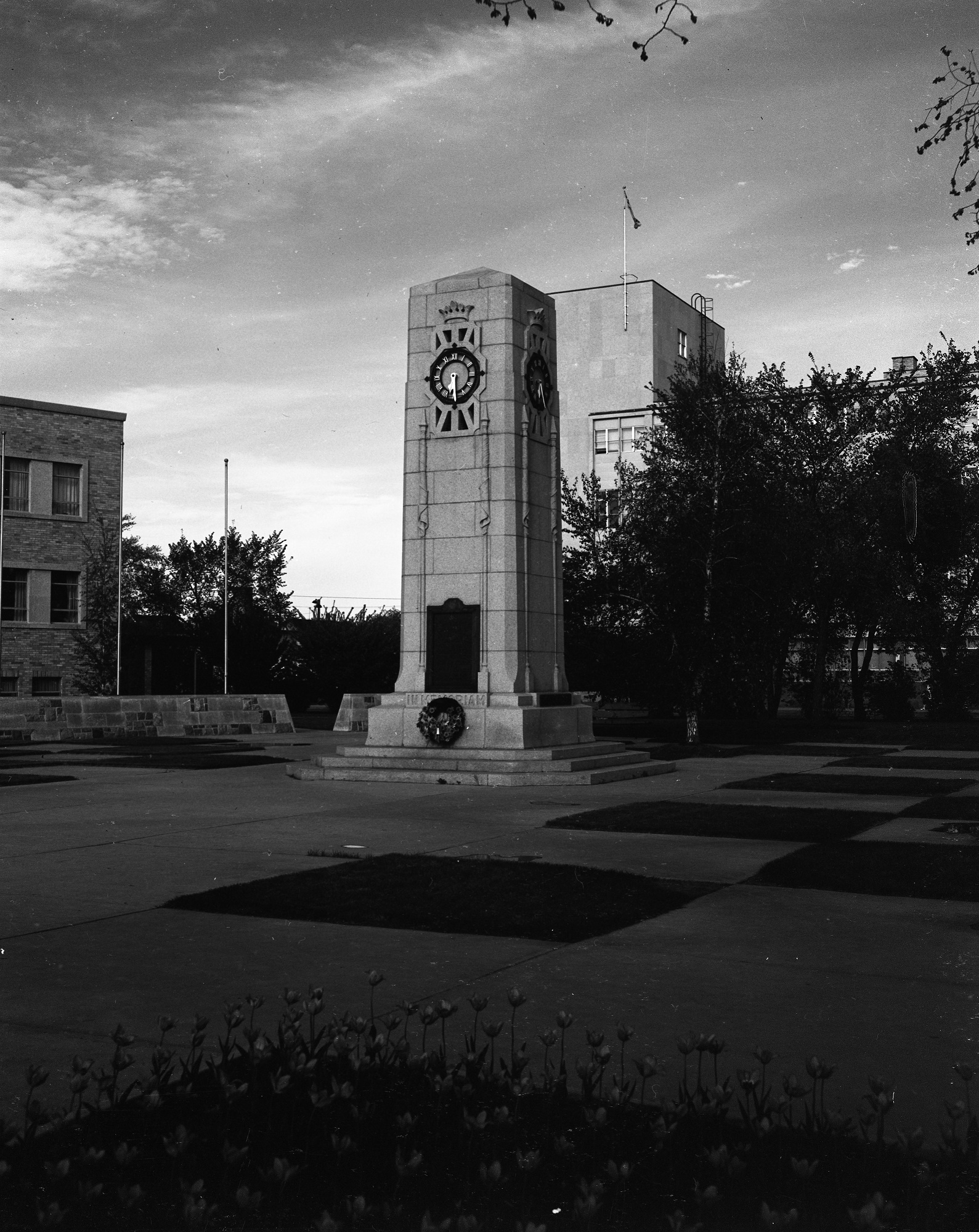
Plans for a war memorial were undertaken at the initiative of the Canadian Legion (Saskatchewan Command, Saskatoon Branch) and formally passed by a resolution of City Council on March 12, 1928. The cost would be jointly funded by the city and the Legion. By the end of April, City Council had appointed a Cenotaph Committee to work in coordination with the Legion’s committee. The Cenotaph Committee announced a contest with a $250 prize for the best design. City Council asked that the cenotaph have a chiming clock because it would serve a more useful and practical purpose than merely a memorial of stone with a plaque. On 8 August, F.H. Portnall, a Regina architect and Great War Veteran, was selected as the winner out of fifteen applicants.
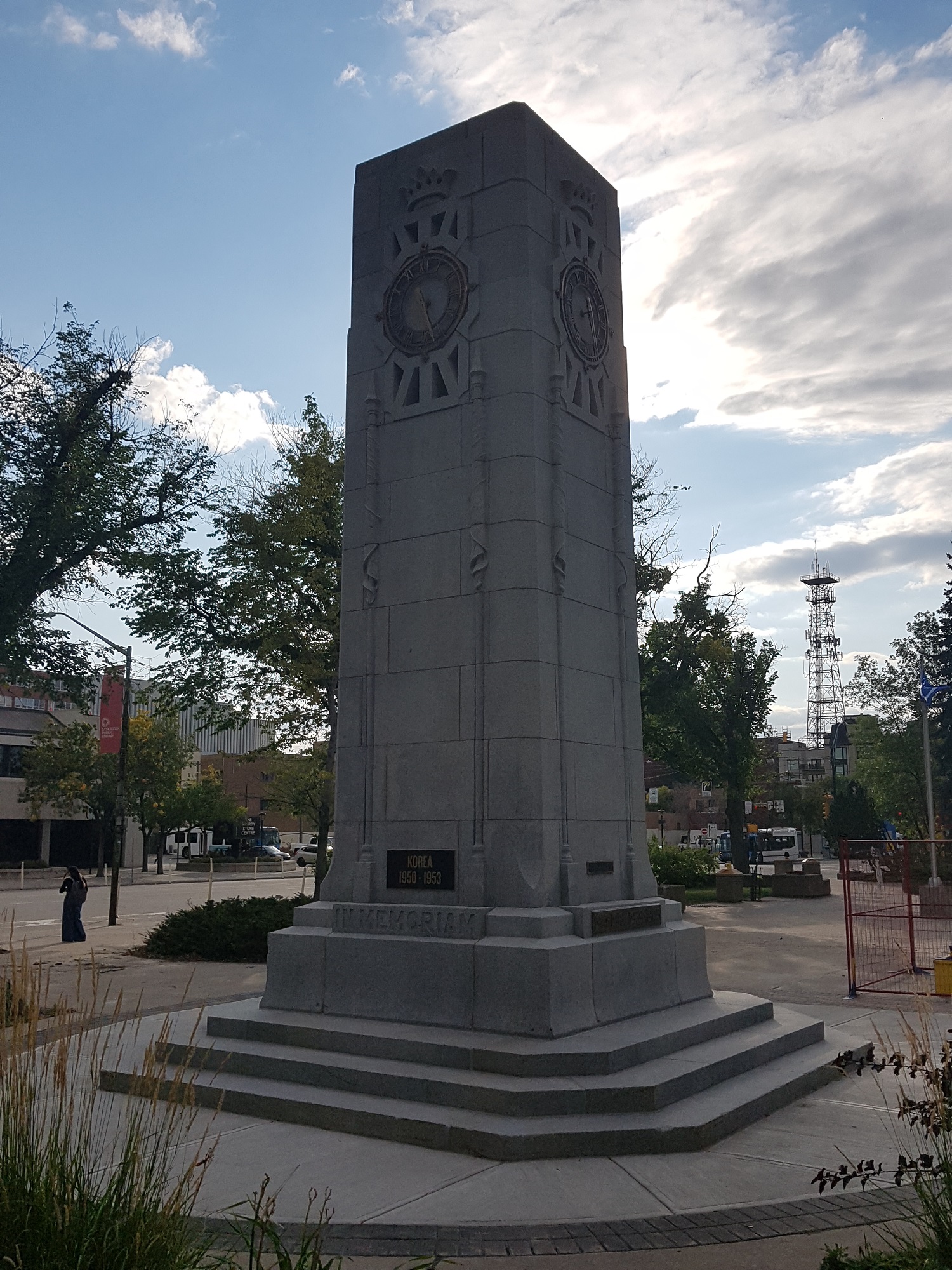
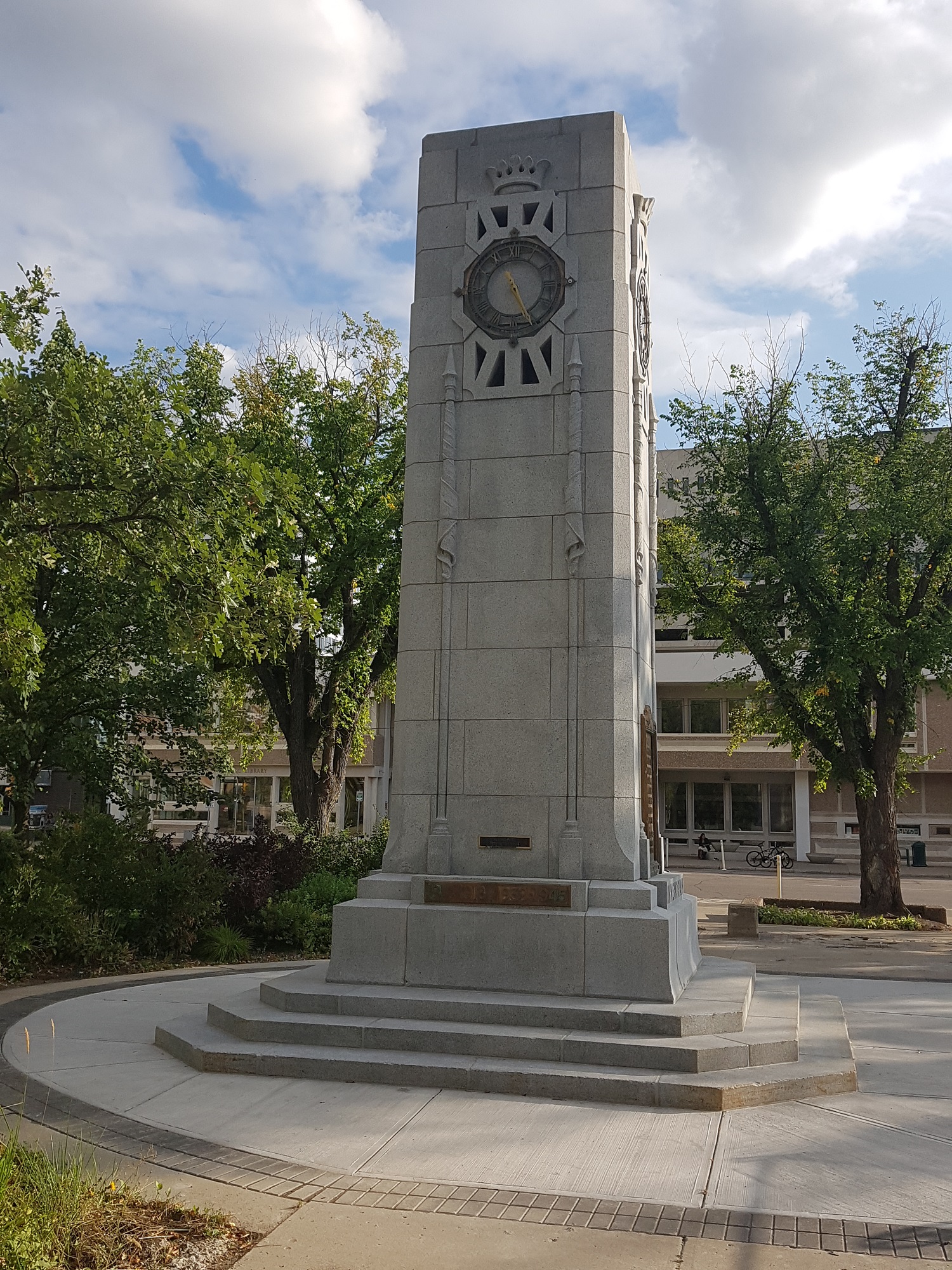
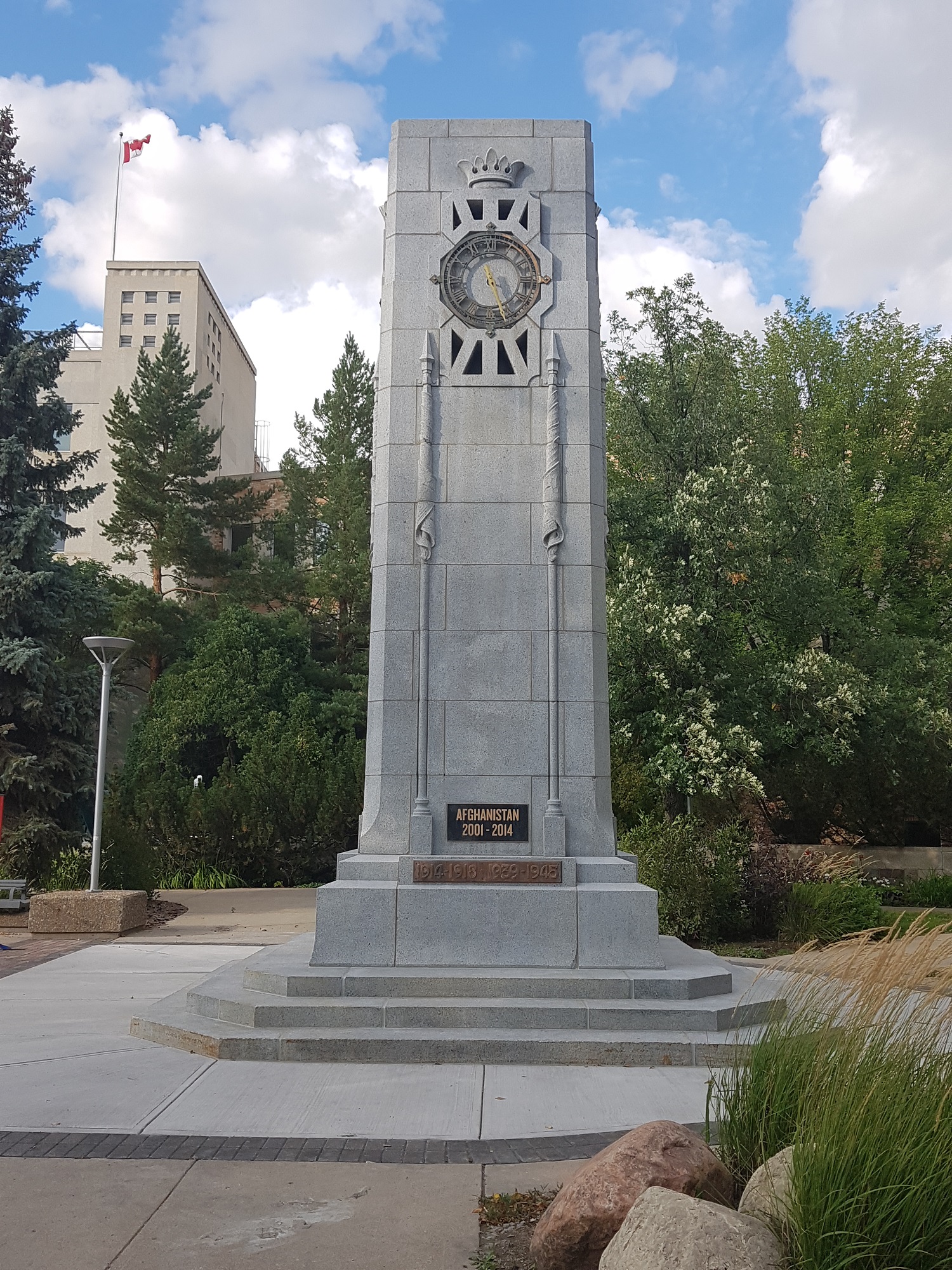
The almost 28 feet high, four-sided monument was constructed of Vancouver grey granite obtained by the Western Granite and Marble Co. The shaft is affixed to a base of reinforced concrete, built as a seven foot square, tapering to six square feet at the top and finished with a pyramidal cap. The main upper feature is a four-sided, bronze, electric clock, each face measuring thirty-six inches, specially ordered from Wm. Potts and Sons Ltd. in England. Surrounding each dial are fretted panels which allow the sound to pass, forming an outline of a Union Jack. Above the clock dial, a crown represented the war effort of the British Empire. The clock was illuminated at night and had four chiming bells to sound the time, ranging in weight from 400 pounds to 90 pounds.
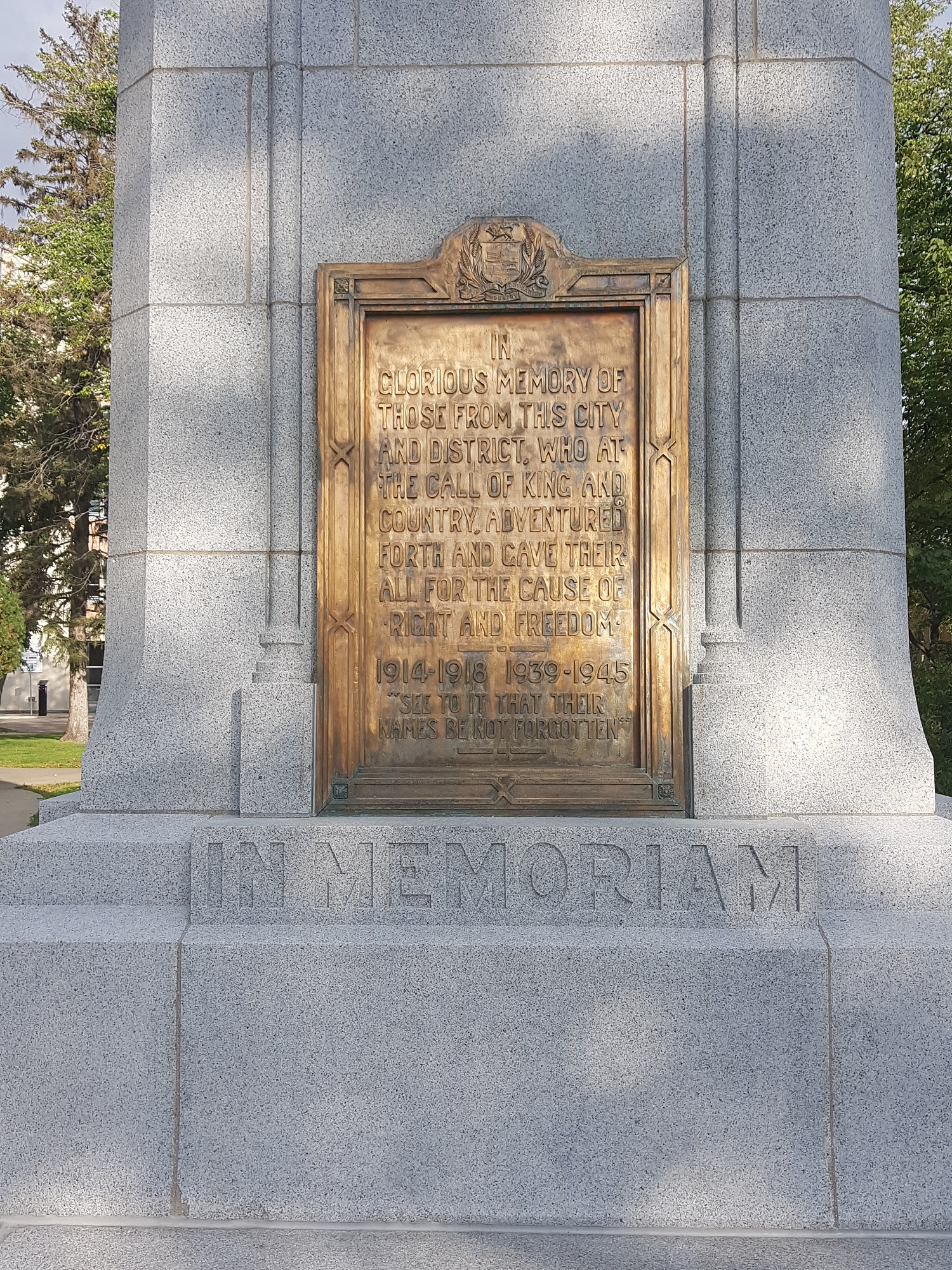
A granite Coat of Arms of the city is above the bronze dedication plaque. On either side of the plaque are draped flags carved in granite, the tops of which reach to the fretwork on either side of the clock face. A bronze door on one side of the clock accesses the interior of the cenotaph, particularly to the clock works for maintenance and repair.
There were delays in the shipping the clock, and it was not shipped until October 17. Further delays had the clock arrive only one day before the unveiling. Despite work virtually around the clock by Henry Birks and Sons on Sunday, November 10, there were still finishing touches remaining. The clock, although assembled, was not fully operational for the dedication ceremonies the following day.
The cenotaph was constructed by Saskatoon general contractor, James Priel. David Webster, a local architect, supervised the work locally on Portnall’s behalf. Built at a total cost of $18,769, the cenotaph was unveiled at a dedication ceremony on November 11, 1929, at its original location on 21st Street near 2nd Avenue. Nearly 3,000 attended, among them, many ex-servicemen and those representing all branches of active military service.
On the night of August 15, 1957, it was dismantled and moved by Smith Brothers and Wilson Co., and reassembled at its current location. At that time, a new clock mechanism was installed, synchronous clockworks purchased again from the English company, Wm. Potts and Sons Ltd., and the faces and hands regilted. It was rededicated on October 15, 1957, during a convention of the Canadian Legion (Saskatchewan Command), which brought together over two hundred Legionnaires. In total, approximately 1,500 Saskatoon citizens were on site for the rededication.
A ceremony for the Second World War plaque took place on November 11, 1947. The Korean War plaque was added sometime in the mid to late 1950s. A ceremony for the peacekeepers plaque took place on August 9, 2006. The Afghanistan plaque ceremony was held in May of 2018.