
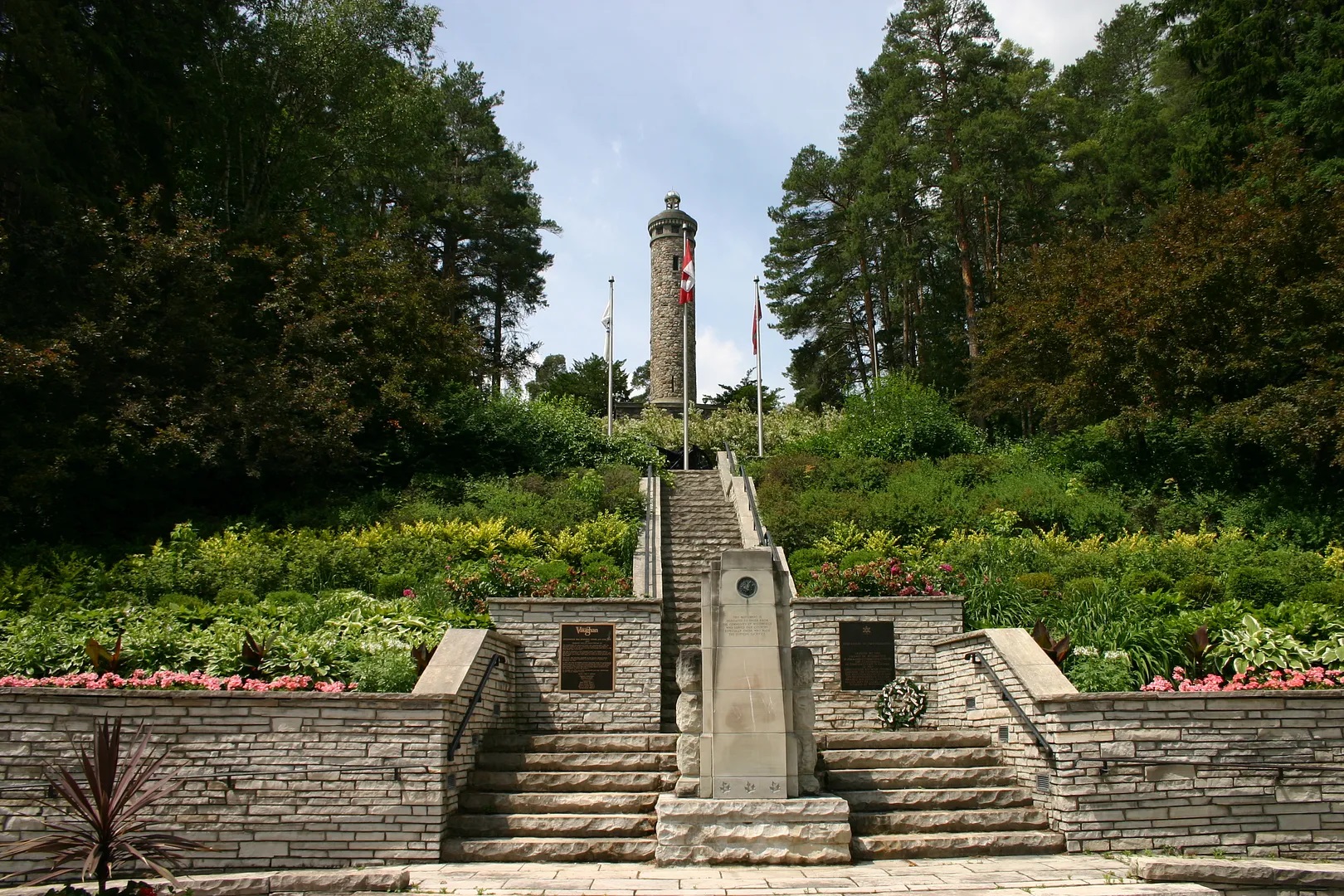
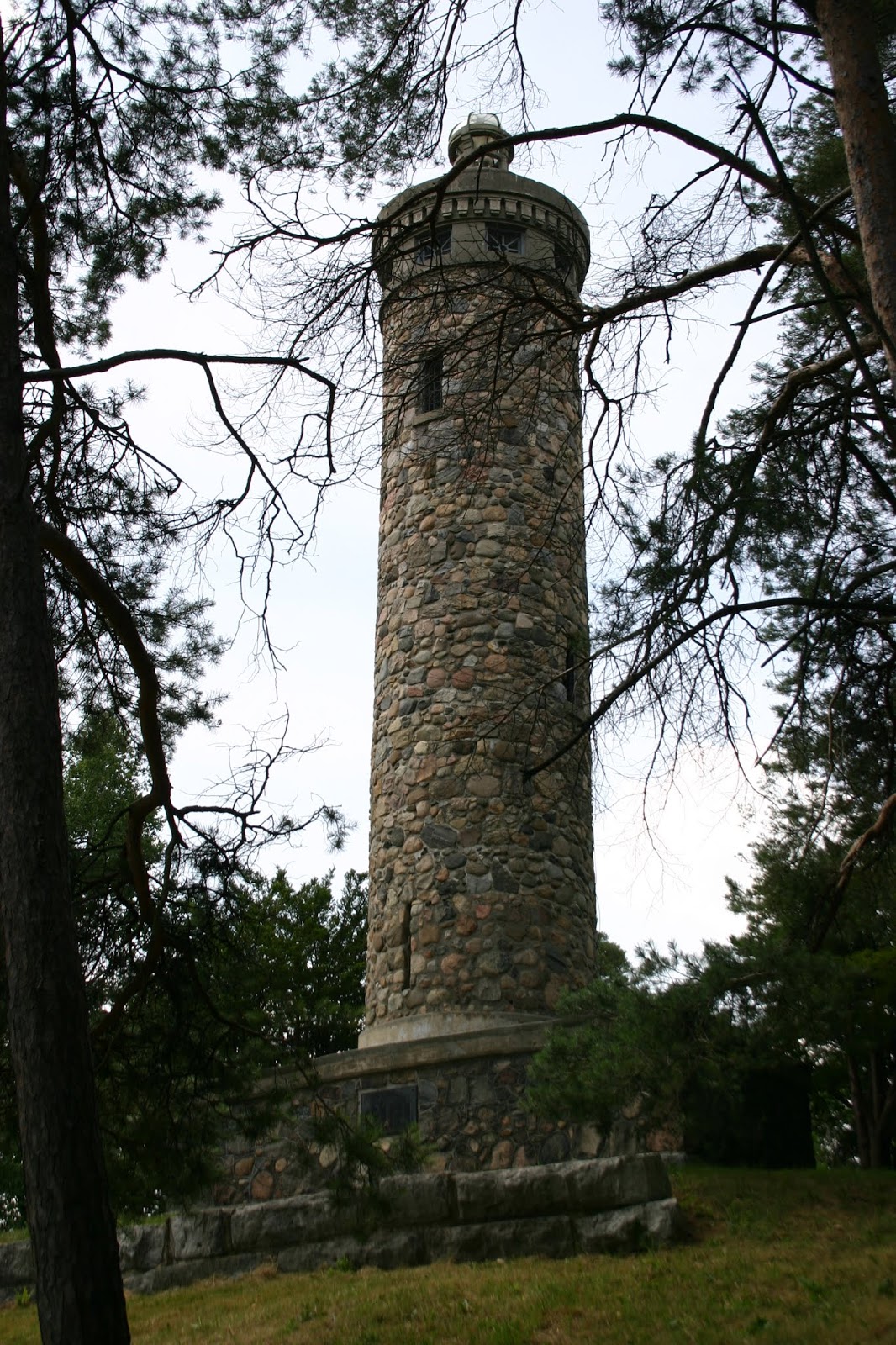
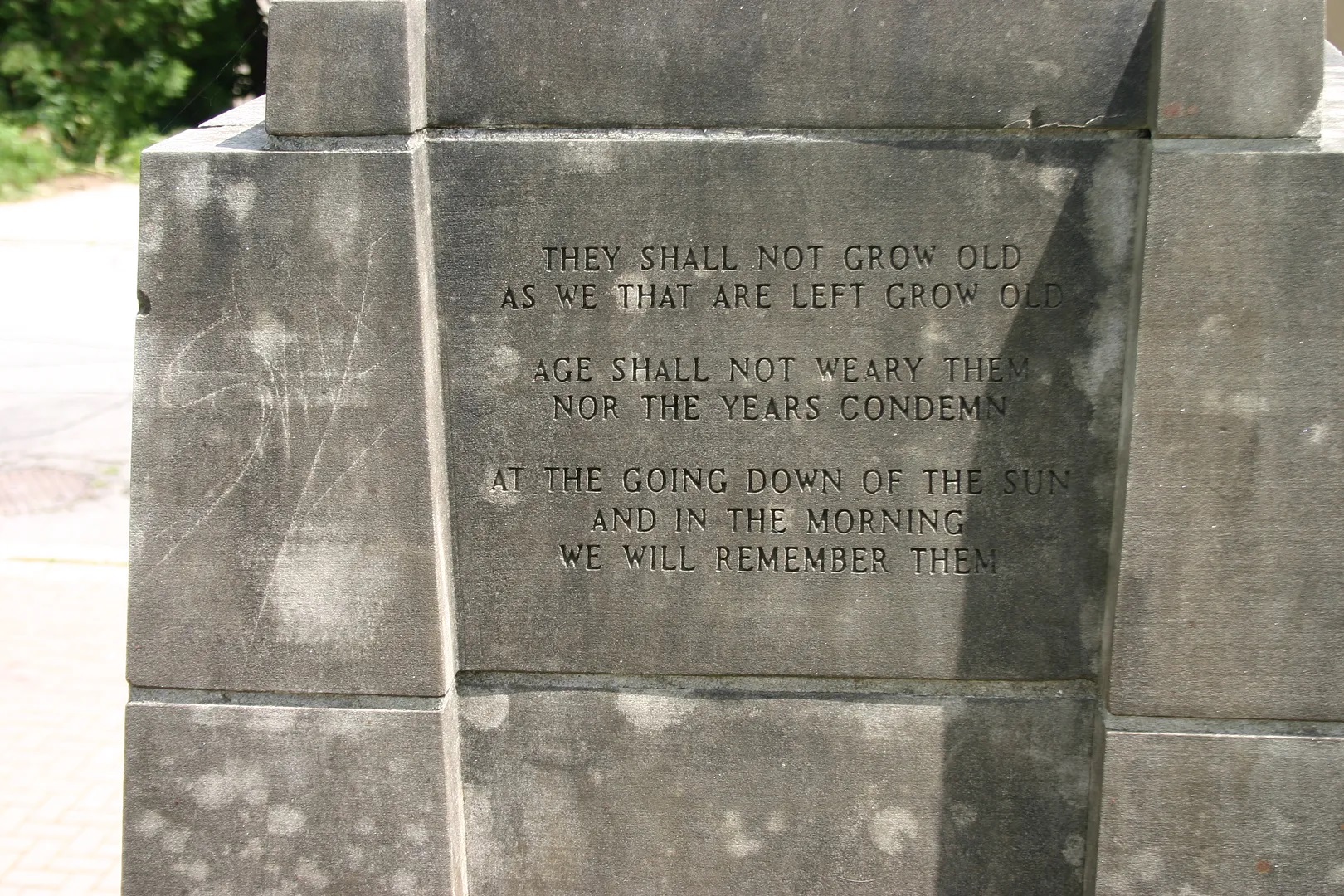

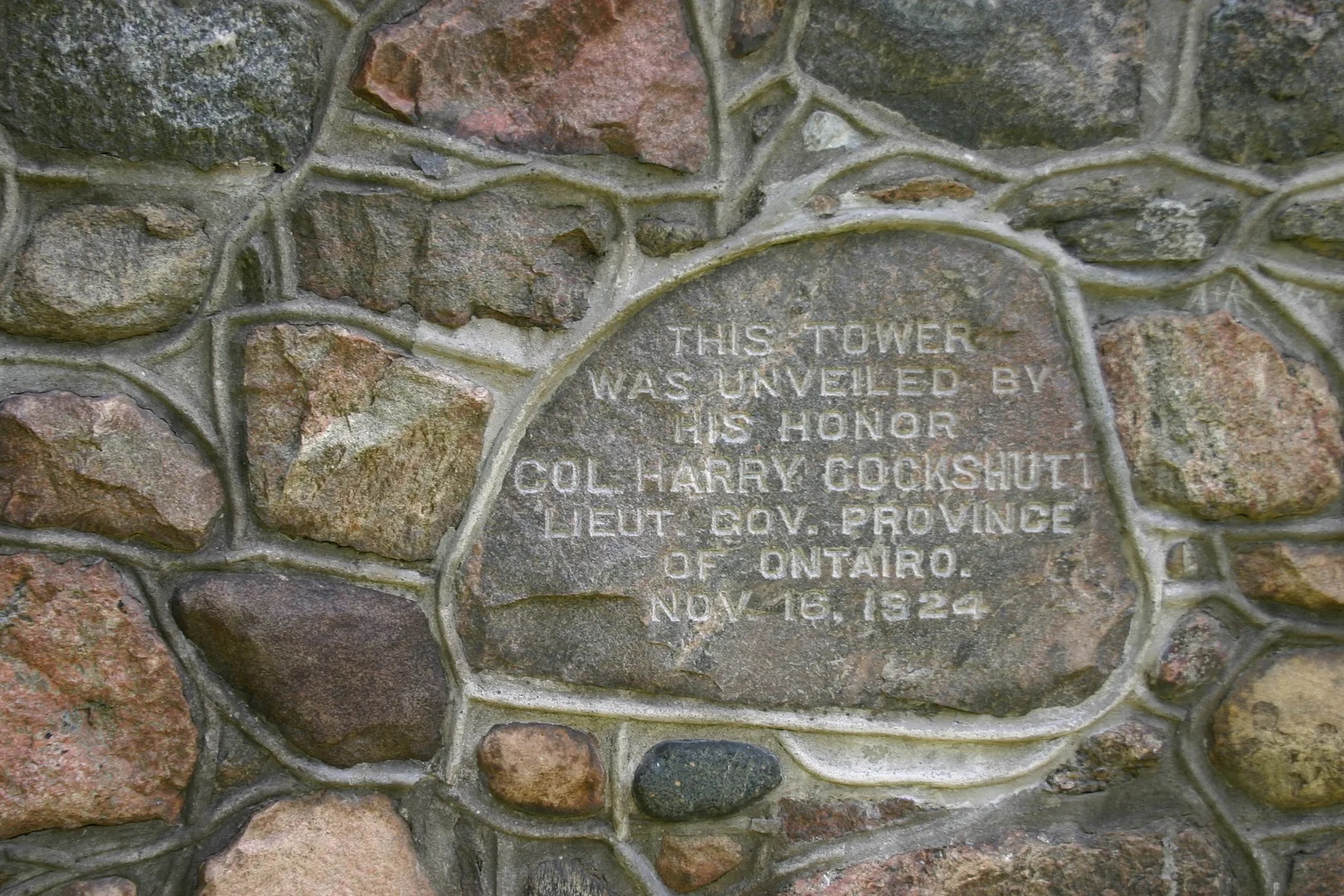

The Woodbridge War Memorial Tower was constructed in 1924 by volunteer members of the community in honour of the supreme sacrifice made by the 26 men from the Woodbridge area killed in the First World War. The Council of Woodbridge secured Major Gibson of The Queen's Own Rifles to design a watch tower. John Johnston of Woodbridge donated the fieldstone for the tower's construction and the gravel and sand was from Robert Huston's pit. Fred Barret, a stone mason from Humbervale, near Weston (south of Woodbridge), built the Tower. It was unveiled by Colonel Harry Cockshutt, the Lieutenant-Governor of Ontario on November 16, 1924.
The site is designed in four stepped levels; the highest level is occupied by the tower. At the apex of the Tower there is a domed beacon light decorated with crenellated stonework and small window openings encircling its base. The beacon light once illuminated the surrounding area at night and could be seen from Highway No. 7. Each level is supported by a retaining wall of cut stone. The cut stone found at the highest level was salvaged from what was known as the old Humber Bridge, demolished with the widening of Highway No. 7 in 1924. The base level consists of a stone gateway and staircase, featuring an engraved stele and two plaques added later, one to commemorate Canada's 1967 Centennial Year, and the other erected by the politicians of the City of Vaughan in 1996 for agreeing to spend the funds to update and landscape the park.
Three field guns are located at the site. Two guns flank the Tower on its north and south sides and the third gun sits on the second stepped-level, next to a flag pole. The Department of Defense donated the "German Whiz Bang." The City of Toronto donated the two 6' Field Guns. These guns were made by "Krupp" in 1901 as Naval Guns and, when the British Navy bottled up the German Navy, the guns were removed from the ships and converted to field use. The council negotiated with the Canadian Pacific Railway to transport these guns to Woodbridge and, with the assistance of Mr. Snider, a local house mover, and a number of local people, enough plank sand timbers were brought to the site to build a ramp for landing the guns. The railroad then hauled the guns to the village on two flat cars.
Mr. Snider erected a ramp at the tracks. The railway company sent an engine to the village and when the tracks were clear, moved the first car to the ramp and, with the aid of Mr. Snider's winch, landed the gun on the ramp. The gun was moved to the top of the cut to clear the ramp so the second gun could be unloaded. Three or four days later another engine arrived and the second gun was moved and installed.
The British Royal Family, to show their appreciation for the loyalty of the Canadian people, offered Oak saplings from The Green Forest. Major MacKenzie secured five of these Royal Oaks and they were carefully planted along the west boundary line.
Major Alexander A. MacKenzie was born on November 1, 1885, to Donald and Lydia Ann MacKenzie in an area of Woodbridge known as Brownsville. As a young man, Alexander enlisted in the Governor-General's Body Guards. When the war broke out in 1914, he transferred to the Fourth Canadian Rifles and, in 1915, he went overseas. In less than two years, he rose to the rank of Major because of the bravery and leadership he displayed in action at the Somme in 1916 and at the Battle of Vimy Ridge in 1917 where he was severely wounded. The Woodbridge Memorial Tower and the Woodbridge Memorial Arena, built in 1951, were two projects he felt very deeply about. His brother, Donald Ross, died in the First World War.