

Military service
Burial/memorial information
Enlisted with the Royal Hamilton Light Infantry, he served in Ontario, deployed to the 1st Battalion, Royal Rifles of Canada on 18 October 1941, he left for Hong Kong with Force C. He died and was buried at sea between Canada and Hawaii. He had 120 days of service, including 4 overseas.
War Medal 1939-1945, Canadian Volunteer Service Medal.
Digital gallery of Private David Morris Schrage
-

Biography
David Schrage is honoured on page 68 of the memorial book,<br> CANADIAN JEWS IN WORLD WAR II, Part II: Casualties,<br> compiled by David Rome for the Canadian Jewish Congress, Montreal, 1948. <br> This extract is provided courtesy of the Canadian Jewish Congress which holds the copyright for this volume. For additional information about these archival records, please contact:<p> The Canadian Jewish Congress National Archives <br> 1590 Ave. Docteur Penfield, Montreal, Que. H3G 1C5 (Canada)<br> telephone: 514-931-7531 ex. 2 <br> facsimile: 514-931-0548 <br> website: www.cjc.ca -
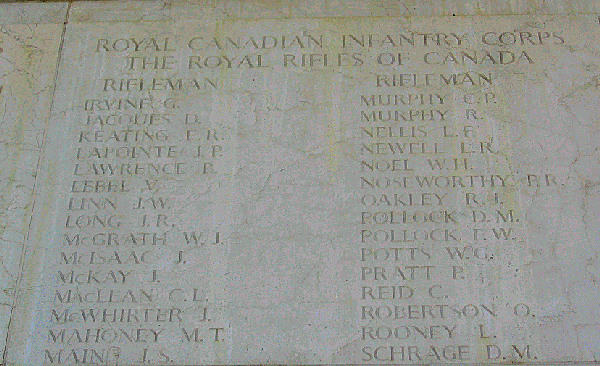
Memorial
Rifleman DAVID MORRIS SCHRAGE is one of 30 members of the Royal Rifles of Canada, Royal Canadian Infantry Corps who are commemorated on this panel of the Sai Wan Memorial. He was one of 1975 Canadian soldiers who left Vancouver on October 27, 1941 aboard the TSS Awatea, a passenger liner from New Zealand that had been converted into a troop transport. The soldiers were bound for Hong Kong to defend the Britisn Colony in the event of an invasion by the Japanese. Rifleman SCHRAGE died of a heart attack on October 31, 1941 and was buried at sea. -
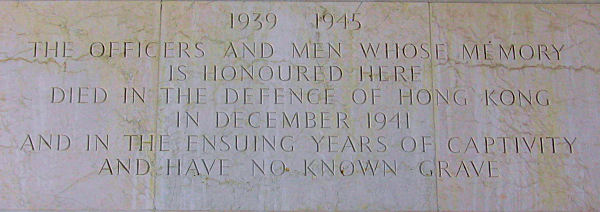
Inscription
Dedicatory inscription of the SAI WAN MEMORIAL. This memorial bears the names of more than 2,000 Commonwealth servicemen, including 228 Canadians. -

Newspaper clipping
Rifleman DAVID MORRIS SCHRAGE was reported to have died of a heart attack in the Canadian Army's 70th overseas casualty list of the war published in the Globe and Mail on November 7, 1941. -

TSS Awatea
The Canadian soldiers who took part in the defense of Hong Kong were transported there aboard the TSS Awatea a former passenger liner converted into a troop transport. Source: Cruiselinehistory.com -

Canada and the Defence of Hong Kong.
Source: Veterans Affairs Canada -

Canada and the Defence of Hong Kong.
Source: Veterans Affairs Canada
Digital gallery of
Private David Morris Schrage
Digital gallery of
Private David Morris Schrage
Digital gallery of
Private David Morris Schrage
Digital gallery of
Private David Morris Schrage
Digital gallery of
Private David Morris Schrage
Digital gallery of
Private David Morris Schrage
Digital gallery of
Private David Morris Schrage
In the Books of Remembrance
Commemorated on:
Page 43 of the Second World War Book of Remembrance.
Request this page
Download this page
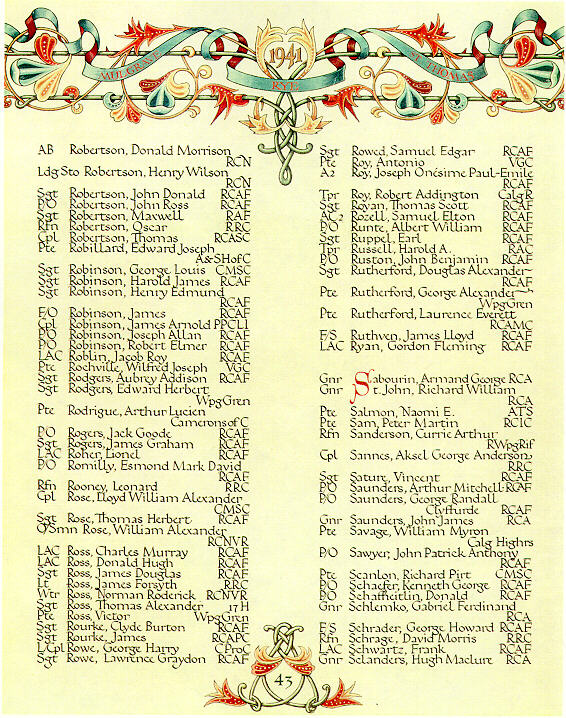
The Poppy Design is a trademark of The Royal Canadian Legion (Dominion Command) and is used with permission. Click here to learn more about the poppy.
Did we miss something?
Contribute information to this commemorative page
Do you have photographs, information or a correction relating to this individual’s virtual memorial? Learn more about the CVWM and the information we collect.