
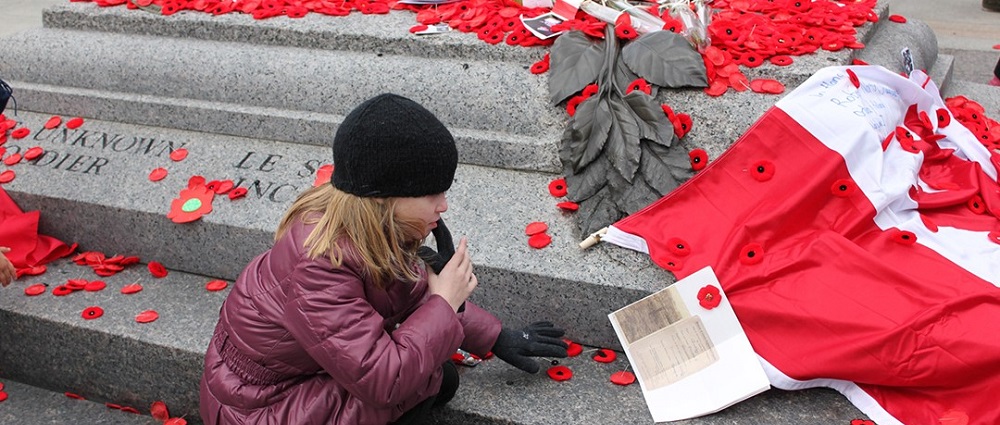
Today, the poppy is one of the most common symbols of remembrance.
In the First World War, these little red flowers would grow around soldiers’ graves due to the fact that soils in France and Belgium had become rich in limestone from the rubble and debris caused by the fighting.
In 1915, John McCrae, a doctor serving with Canadian Artillery, highlighted this phenomenon in his famous poem, In Flanders Fields.
The poppy campaign
The Poppy Campaign is one of the Royal Canadian Legion’s most important programs. The money raised from donations provides direct assistance for Veterans in financial distress, as well as funding for medical equipment, medical research, home services, long term care facilities and many other purposes.
The Poppy Campaign begins on the last Friday in October and continues until November 11.
Wearing your poppy
If possible, the poppy is worn on the left lapel of a garment. If you do not have a lapel, the Royal Canadian Legion recommends wearing it as close to your heart as possible.
The lapel poppy may be worn throughout the whole of the remembrance period and is removed at the end of Remembrance Day ceremony. Many people place their poppy at the base of the cenotaph, as a sign of respect at the end of the ceremony.
Although it is traditional for the poppy to be worn only during the annual remembrance period, a person may also wear one at certain other times. It is not unusual for poppies to be worn at commemorative events throughout the year, such as anniversaries of significant battles, a memorial service at a Royal Canadian Legion convention, and other similar occasions. For example, they are often worn during Veterans Affairs Canada overseas events. The poppy may also be worn by Colour parties when on parade and by Legion members attending funeral services for Veterans or ordinary members. The best approach is to follow the lead of the event organizers.
If you are organizing an event, you can seek advice from the Royal Canadian Legion, which oversees policy and procedures surrounding the use of the poppy.
Symbol of remembrance
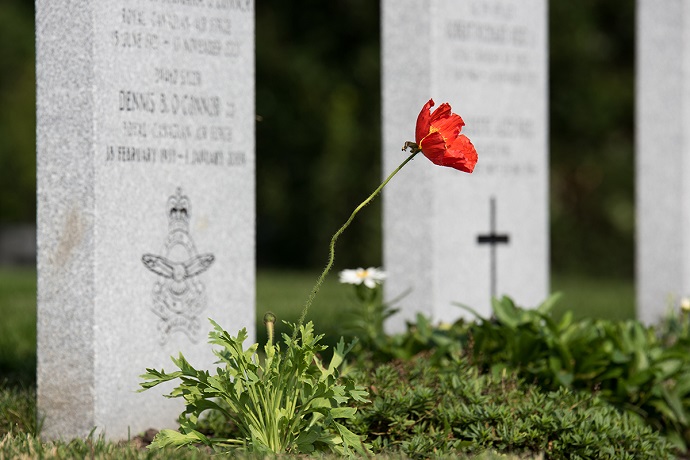
As far back as the Napoleonic Wars (1799 – 1815), the poppy first drew attention in Europe as the mysterious flower that bloomed over the graves of fallen soldiers.
Two days before the Armistice, on 9 November 1918, Moina Michael – an American woman living in Athens, Georgia – read In Flanders Fields for the first time and was inspired to wear a poppy year-round in memory of the war dead.
In 1920, Anna Guérin —the French Poppy Lady—attended the national American Legion convention as a representative of France’s YMCA Secretariat. She was inspired by Moina Michael’s idea of the poppy as a memorial flower and felt that the scope of the Memorial Poppy could be expanded to help the needy. She suggested that artificial poppies could be made and sold as a way of raising money for the benefit of orphaned children and others who had suffered greatly as a result of the war.
In 1921, Madame Guérin visited Canada and convinced the Great War Veterans Association of Canada (predecessor to the Royal Canadian Legion) to similarly adopt the poppy as a symbol of remembrance to aid its fundraising.
That same year, Field Marshall Earl Haig, the former commander-in-chief of the British Armies in France and Belgium and the principal founder of the British Legion, was inspired by Madame Guérin’s fundraising idea. He then approved the Legion’s British Poppy Day Appeal to raise money for poor and disabled Veterans.
Related information
The poppy and the poppy campaign (Royal Canadian Legion)