
About the memorial
This memorial is one of the eight battle sites for commemoration awarded to Canada by the governments of Belgium and France as a sign of gratitude for our sacrifice and support in liberating their countries.
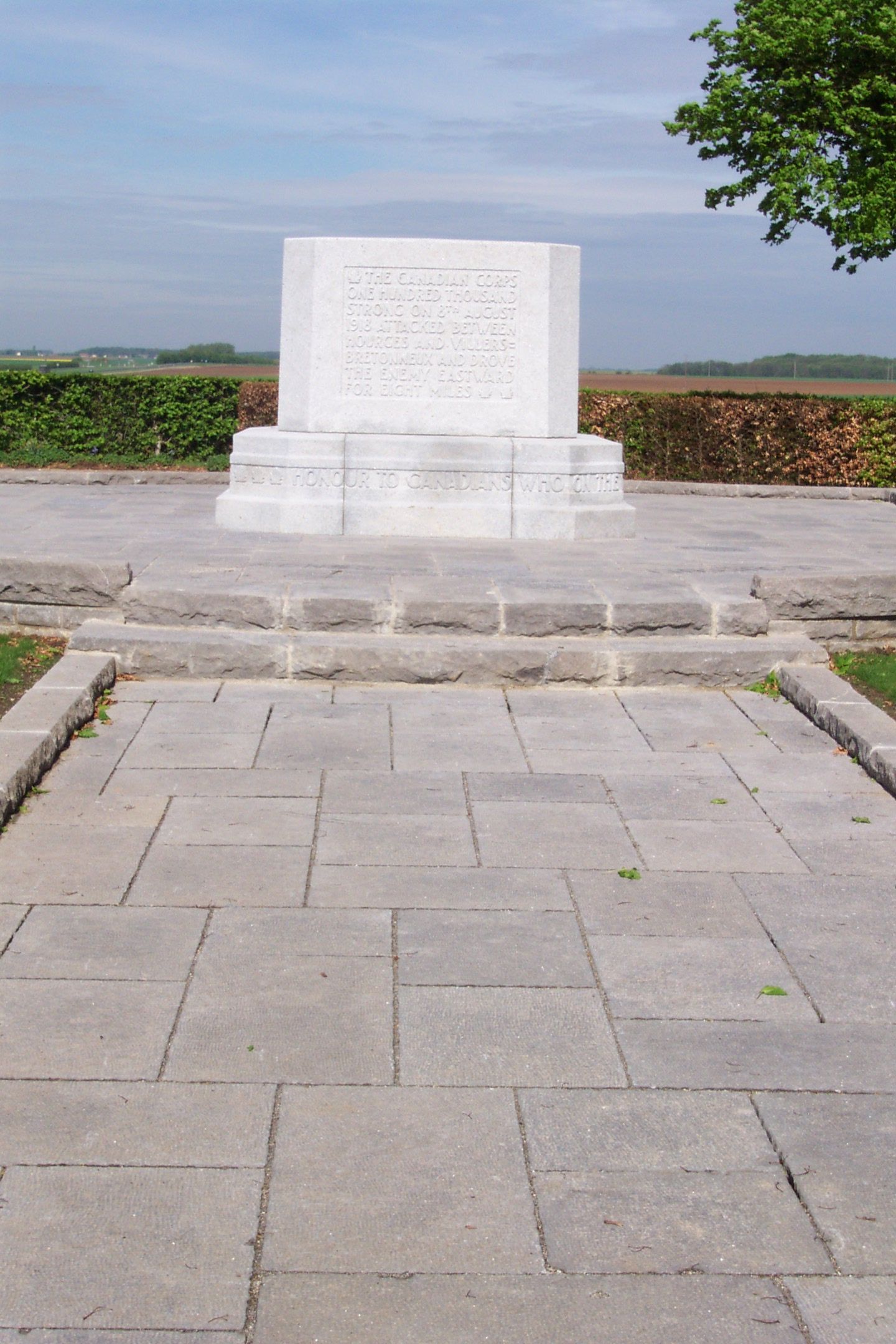
The Le Quesnel Canadian Memorial, made of Quebec granite, pays tribute to the achievements of the Canadian Corps in the Battle of Amiens, 8 - 11 August 1918. On its side, this message is inscribed:
THE CANADIAN CORPS ONE HUNDRED THOUSAND STRONG ON 8TH AUGUST 1918 ATTACKED BETWEEN HOURGES AND VILLERS-BRETONNEUX AND DROVE THE ENEMY EASTWARD FOR EIGHT MILES
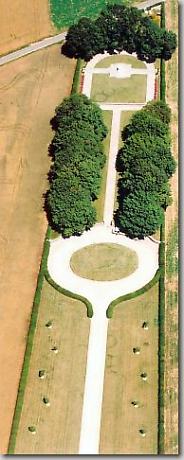
A maple-bordered avenue leads to this memorial, which is set in a bed of low growing conifers and is enclosed by a holly hedge. There are many variations of green provided by the fine specimens of shrubs and small trees that have been planted around the hedge. The effect is low-keyed, dignified and restrained.
The Battle of Amiens, 1918
On 21 March 1918, the Germans suddenly and unexpectedly struck at two British armies on the Western Front. That night they broke through the Fifth Army front. However, on April 5, they were held short of Amiens. The Canadian Cavalry Brigade, fighting both as cavalry and infantry (dismounted) helped bring this about.
Halted at Amiens, not having driven a wedge between the British and French, the Germans mounted offensives elsewhere on the Western Front. By now the Americans had arrived in force and the Allies had superior numbers. The time had come for a counterblow.
The Canadian Corps, as such, had not taken part in these offensives. Haig had ordered the Canadians, piecemeal by divisions, to shore up the crumbling British front. By the time the German offensives had ended, the Canadians fielded a strong, fresh, well-trained and well-organized corps, ready to play an important part in the fighting that lay ahead.
For Amiens it was more important to conceal from the enemy the intentions of the Canadian Corps than any other formation. "Regarding them as storm troops," wrote Sir Basil Liddell Hart, an eminent British military historian, "the enemy tended to greet their appearance as an omen of a coming attack." A mock attack was therefore launched on the Arras front to delude the enemy and then, at the last possible moment before the real attack that was scheduled for August 8, the Corps was moved south to Amiens by night. The front of the attack extended 22.5 kilometres with the French in the southern half; the Fourth Army named two corps for the assault, the Canadians on the right and the Australians on the left, with the British 3rd Corps acting as flank-guard on the extreme left.
An hour before dawn on August 8, the attack began and surprise was total. More than 2,000 guns suddenly flashed out in barrage, while 420 tanks, closely followed by the infantry, surged forward over ground that was heavily shrouded in mist. German machine-gunners found few targets as the tanks, accompanied by determined men, crashed through their positions. The enemy artillery, which might have been counted on to break up the attack despite the fog, had been effectively neutralized by counter-battery fire; batteries were quickly overrun, many of them without having fired a shot. In what was then open warfare, massed cavalry and light "whippet" tanks swept ahead to exploit success. On that first victorious day, "The Black Day of the German Army", as the enemy termed it, the Canadians gained 13 kilometres, the Australians 11, the French eight and the British three. The Germans lost 27,000 men and 400 guns as well as hundreds of mortars and machine-guns. The Canadian Corps alone captured 5,033 prisoners and 161 guns. Against this, Fourth Army's casualties totaled 9,000 - about 4,000 for the Corps. The Battle of Amiens continued until August 11.
Learn more about this and a stretch of other victories in the final three months of the First World War – often referred to as Canada’s Hundred Days.
Visit Canadian memorials in Europe
A profound experience awaits those who visit the monuments and cemeteries in Europe that honour Canada's contributions to defending peace and freedom.
Directions
The Le Quesnel Canadian Memorial is about 20 kms southeast of Amiens, 75 kms south of Arras and 105 kms north of Paris. You can reach Amiens by train or by bus and from there take a taxi to the Memorial.