
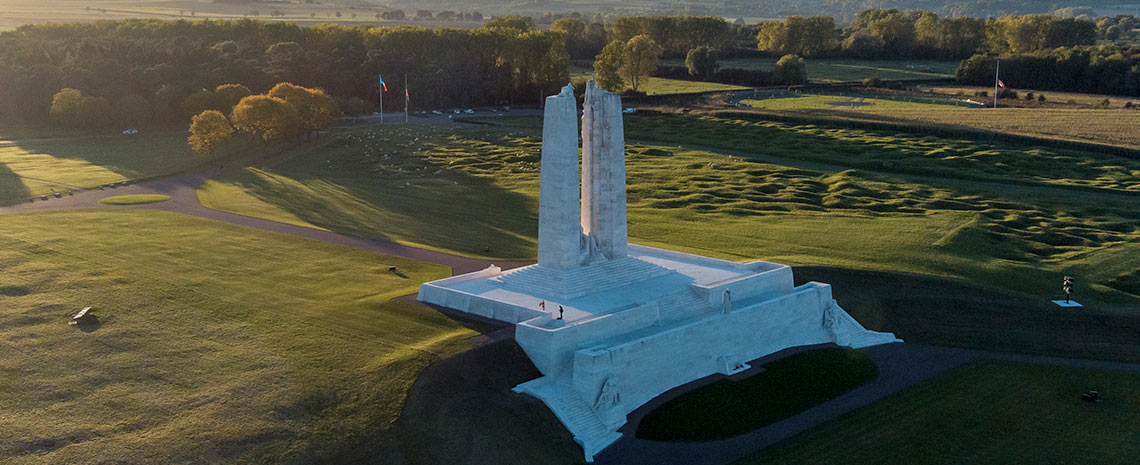
Canada's national war memorial in Europe stands as a tribute to all Canadians who served during the First World War, particularly for those whose final resting place was then unknown.
Canada mourns
The First World War had a profound impact on the young nation of Canada. Approximately 619,000 enlisted to serve in the Canadian Expeditionary Force from a population of less than 8 million. Among those who served, more than 66,000 never returned home and 172,000 had been wounded.
The scale of the Canadian service and sacrifice during the First World War was unprecedented and the end of the conflict was accompanied by a strong sentiment that it must never be forgotten. The public’s attention soon turned to finding ways to remember those who had served.
A tribute to sacrifice
After the war, the governments of Belgium and France awarded eight battle sites to Canada for commemoration in gratitude for our sacrifices in liberating their two countries. In 1920, the Canadian Battlefields Memorials Commission was established to oversee their creation.
In Belgium, memorials would be built at Hill 62 (Sanctuary Wood), St. Julien, and at Passchendaele.
In France, memorials would be built at Bourlon Wood, Courcelette, Dury, Le Quesnel, and at Vimy Ridge.
Did you know?
Newfoundland didn't join Canada until 1949. As a result, Newfoundlanders serving in the First World War did so on behalf of the Dominion of Newfoundland as part of the British Commonwealth. Learn about the “Trail of Caribou” memorials.
Choosing a design
In December 1920, the commission launched a national architectural and design competition. 160 submissions were evaluated and the jury narrowed it down to seventeen for final consideration. The original idea was to build identical monuments at each of the eight sites.
But, Walter Allward's entry was so striking and original that the jury quickly suggested it not as a model for each battlefield memorial, but as Canada's one and only national war memorial in Europe. The Commission and the Government of Canada agreed.

Construction begins

In 1924, the commission hired a structural engineer Dr. Oscar Faber to prepare plans and supervise the foundation work for the memorial. This was no easy task given the many tunnels, barb wires, unexploded shells and even bodies still in the ground.
Built into the side of the hill at the highest point of the ridge, the monument rests on a foundation consisting of about 15,000 tonnes of concrete, reinforced with hundreds of tonnes of steel.
This massive foundation was required because the base and the twin pylons contain almost 6,000 tonnes of a limestone (brought to the site from Croatia).
The twenty sculptured figures were carved where they stand from huge blocks of this limestone. The sculptors used half-size plaster models produced by Allward and an instrument called a pantograph to reproduce these huge figures.
All this work was carried out inside temporary studios built around each figure, including those at the top of the pylons, which tower 27 metres above the base of the monument.
Design and symbolism

Allward said his inspiration for the monument came to him in a dream and there is an abundance of symbolism found in its many sculptures.
At the front of the monument, one of its central figures - Canada Bereft – faces eastward toward the new day. Her eyes cast down and her chin resting on her hand. This saddened figure represents Canada - a young nation grieving her dead. Below her is a tomb, draped in laurel branches and bearing a helmet that represents all the soldiers whose final resting place was unknown.
At the centre of the monument, The Chorus contains eight sculptures to represent the universal virtues Canadians fought for during the war— Peace, Justice, Honour, Hope, Charity, Faith, Truth and Knowledge. Around them are shields of Canada, Britain and France.
At the base, the Spirit of Sacrifice throws a torch to his comrades – a reference to the line from the famous poem ‘In Flanders Fields’ by Lieutenant-Colonel John McCrae: “To you from failing hands we throw; the torch, be yours to hold it high.”
On the rear staircase is the Male Mourner and the Female Mourner.
On the front corners of the base are the Defenders – Breaking of the Sword and Sympathy for the Helpless.
Above them are cannons draped in laurel and olive branches; symbolic of both victory and peace.
The two large pylons represent Canada and France – two nations united in the common goal of peace and freedom.
This majestic monument is a lasting tribute to the sacrifices Canadians made in the First World War. Its design inspires a deep sense of obligation to never forget those who died so that we may secure a better life.
A place of honour
Carved on the walls of the monument are the names of 11,285 Canadian soldiers who died in France but whose bodies were unidentified or unrecovered at the time.
At the base of the memorial are these words:
TO THE VALOUR OF THEIR COUNTRYMEN IN THE GREAT WAR AND IN MEMORY OF THEIR SIXTY THOUSAND DEAD THIS MONUMENT IS RAISED BY THE PEOPLE OF CANADA
Preserved trenches
Canada and its allies built an extensive system of trenches, underground tunnels and dugouts. In preparation for the Battle of Vimy Ridge, five British tunneling companies excavated fourteen “subways” in the Canadian Corps’ sector, the longest of which was more than 1,700 metres in length.
The preserved trenches found at Vimy today – only a small portion of the network of trenches that ran the entire length of the Canadian sector at Vimy – were reconstructed while the memorial was being built. They are located in the same positions as the Canadian and German outpost lines in 1917. At some locations, these trenches are only 25 metres apart.
Unveiling and dedication
The Canadian National Vimy Memorial was now ready to serve its purpose – to be Canada’s national memorial to honour our nation’s sacrifice. On 26 July 1936, after eleven years of construction, the Canadian National Vimy Memorial was unveiled and dedicated by King Edward VIII. More than 3,000 Canadian Veterans were among the tens of thousands who came to France for this event.
Among the Canadians in attendance was Paul Wilson – whose father Don died in the First World War. View the mementos he kept from his journey.

National Historic Site
The memorial was declared a National Historic Site in 1997 and is one of only two historic sites outside of Canada. The second is the Beaumont-Hamel Newfoundland Memorial.
Cemeteries
As you stand on the monument's wide stone terrace and look out over the broad fields and rolling hills of France, you can see other places where Canadians fought and died. More than 7,000 are buried in thirty cemeteries within a 20-kilometre radius of this spot.
There are two cemeteries located on the memorial site.


There are nearly 3,000 Commonwealth soldiers buried here – including more than 450 Canadians.
Visit the memorial
In person
When you arrive, stop at the visitor centre. The staff can provide information on Canada and Newfoundland’s role in the First World War and the many features of this important National Historic Site of Canada. Check the hours of operation.
Visitor information

Location
Route D55, Chemin des Canadiens
62580 Givenchy-en-Gohelle
France
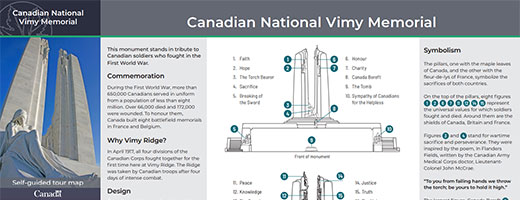
Brochures

Watch a tour
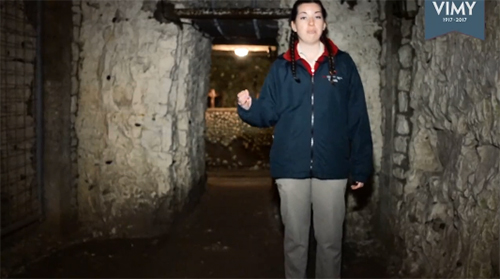
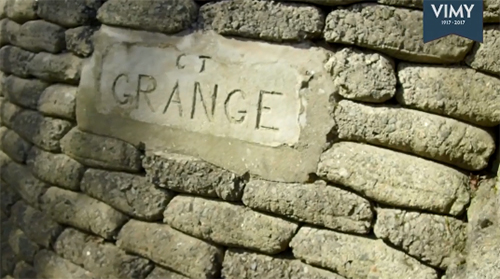
In these videos, a student guide takes you on a quick tour of the tunnels system and also of the trenches.
Virtual field trip
You can see the memorial up close thanks to Google Expeditions. The trip includes a view of the site and its surroundings from the top of the monument.
Google Street View
Explore the memorial one step at a time, just like you would if you were there. Using its Street View technology, Google has filmed this important national historical site.
Visit Canadian memorials in Europe
A profound experience awaits those who visit the monuments and cemeteries in Europe that honour Canada's contributions to defending peace and freedom.
Battle of Vimy Ridge
The Canadian assault at Vimy—part of the larger Battle of Arras in northern France—began on Easter Monday, April 9, 1917. All four divisions of the Canadian Corps, made up of soldiers from coast to coast, would fight together for the first time. Advancing behind a powerful “creeping barrage” laid down by Allied artillery, they captured most of the ridge by noon on the battle’s first day, with the last German resistance overcome by April 12. The Battle of Vimy Ridge was one of the most successful Allied operations of the First World War.
Photo galleries
View historic and current photos of Canada’s national memorial at Vimy Ridge.
Related information
Fast facts
Discover interesting facts about the Canadian National Vimy Memorial.
Forest conservation project
Learn more about this conservation project at Vimy and Beaumont-Hamel.
Visit memorials in Europe
Plan a visit to Canada's memorials in Europe.