
Order of events
16 August 1960
Cyprus gains independence from the United Kingdom
21 December 1963
Widespread violence erupts in Cyprus
4 March 1964
United Nations Peacekeeping force is sent to Cyprus
15 July 1974
A coup d'état from Greek Cypriots occurs
20 July 1974
Turkey invades and takes control of northern Cyprus
16 August 1974
Ceasefire is negotiated and the "Green Line" is established
15 June 1993
Large contingent of Canadian peacekeepers leaves Cyprus. A small Canadian Armed Forces (CAF) presence remains.
Cyprus
1960 – present

Background to the conflict
(1960 – 1964)
Tensions grew between the Greek and Turkish people. Violence and unrest spread across Cyprus.
Longstanding tensions
The small Mediterranean island of Cyprus has a very long history. The tensions between its Greek and Turkish people go back many hundreds of years. After being a part of the Ottoman Empire for centuries, the United Kingdom took control in 1878. Cyprus became a part of the British Empire in 1914 and was later made a crown colony in 1925. The Greek residents of Cyprus resisted British rule and wanted the island to be part of Greece. They rioted and burned the government house in the capital city of Nicosia. But the Turkish population did not want the island to join Greece. Instead they wanted Cyprus divided into Greek and Turkish portions.
The unrest builds
The British tried to keep the tensions under control. Greeks on the island tried harder to break away from British colonial rule. Turkish resistance also strengthened as public pressure grew for Cyprus to join Greece. Some Cypriot leaders pushed for violent revolution, while others preferred more diplomatic means.
In the late 1950s, the Greek resistance launched an armed campaign against British rule with attacks on strategic targets.
On the verge of civil war
The danger of civil war erupting in Cyprus was very real. Efforts to find a peaceful solution kept failing. Britain led negotiations for a compromise and suggested creating the Republic of Cyprus. This solution did not please most Cypriots, though. There was no political union with Greece as the Greek residents wanted. Nor was a Turkish section of Cyprus created, as the Turks sought.
Achieving independence
On 16 August 1960 Britain stepped away and Cyprus became an independent country. Its new constitution, elected representatives and special legislation were meant to balance the interests of Greek and Turkish citizens. Yet, the political situation was very complicated. Major disputes soon erupted over how the island was governed and the violence continued on both sides.
In December 1963, the Greek majority forced out Turkish members of the government and civil service. Major fighting broke out and unrest quickly spread across Cyprus.

Canada and the world responds
(1964 – present)
On 4 March 1964, the United Nations set up the United Nations Peacekeeping Force in Cyprus to help restore order. Canada has participated since the beginning.
Canada and the world responds
As the violence intensified, the United Nations tried to find a way to help. On 4 March 1964 the United Nations set up the United Nations Peacekeeping Force in Cyprus to help restore order. Canada was part of this effort from the beginning.
On 13 March 1964 the Royal Canadian Air Force began taking troops and supplies to Cyprus. The Canadians faced a great challenge there. It was difficult to keep the peace where many small groups of Turks lived in the larger Greek population. The United Nations forces needed their soldier skills, but also the ability to diffuse day-to-day disagreements between the two sides. Because of situations like this, it is often said "peacekeeping is not a soldier's job, but only a soldier can do it."
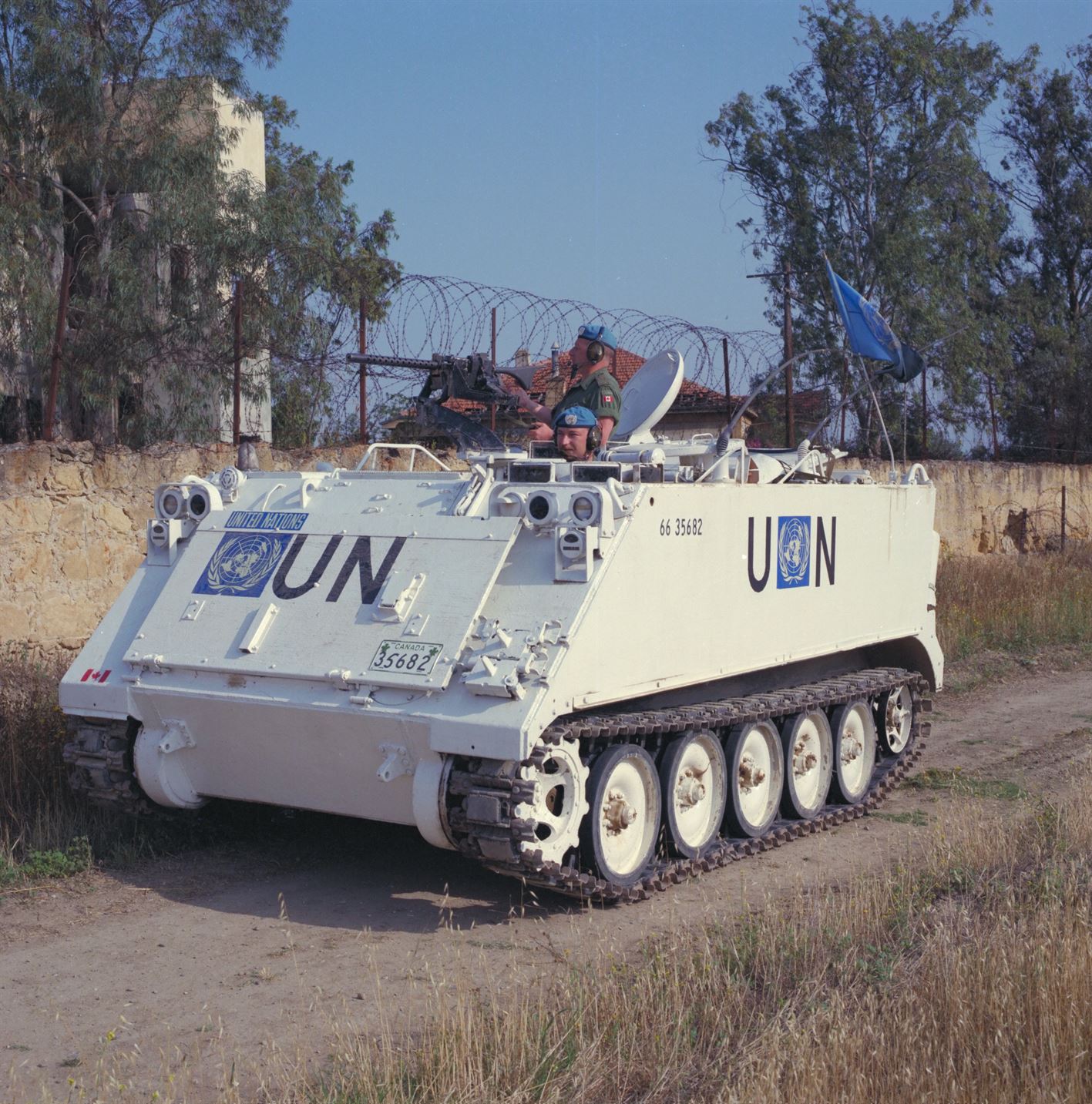
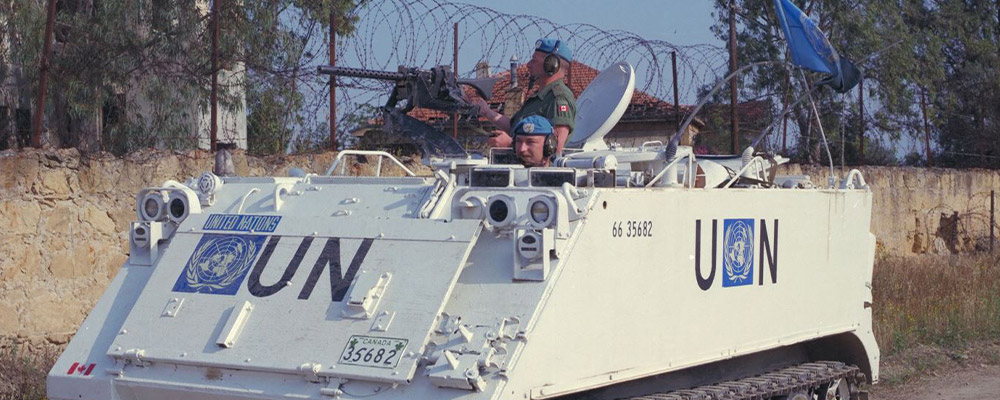
Canadian peacekeepers in armoured vehicle on patrol in Cyprus. (Photo: Department of National Defence)
A fragile peace
Over the next few years, United Nations officials tried to mediate the disagreements in Cyprus. Unfortunately, negotiations continued to fail and no solution was found. For ten years, while violence continued to sometimes flare up, the United Nations forces helped keep the fragile peace from shattering.
Coup d'état
The tense situation in Cyprus exploded in July 1974. Some Greek Cypriots carried out a coup d'état because they wanted to finally unite with Greece. The neighbouring country of Turkey did not want to see this happen and would soon respond with force.
Turkish invasion
On 20 July 1974, 40,000 Turkish soldiers began the invasion of Cyprus. Turkey claimed it was only trying to restore the situation there and protect the minority Turkish population. Canadian and other United Nations peacekeepers were suddenly caught in the middle of a war zone.
There were many dangerous situations. During fighting near the airport in Nicosia, the Canadians negotiated a local ceasefire. Greek and Turkish forces agreed to withdraw from the area. Our peacekeepers then occupied the airport, but the Turks still threatened to attack. The defending Canadians had only a few anti tank weapons and heavy machine guns. They cleverly moved around the airport, under cover of night, as if a larger force defended it. The strategy worked. Our peacekeepers held the crucial location.
Brave Canadian soldiers
Several weeks of active fighting raged on in Cyprus in the summer of 1974. Three Canadian peacekeepers died and 17 more became wounded during this time. Canadians would also show great bravery.
On 23 July 1974 some of our troops came under fire. Several soldiers were hit, including Captain Normand Blaquière. Private Michel Plouffe rushed to give the injured officer first aid but was wounded in the face. Despite being hit, he continued to tend to Blaquière amid the machine gun fire. Captain Alain Forand then arranged for covering fire and crawled forward over exposed ground to help the wounded men. He single-handedly dragged Blaquière to safety and then directed the rescue of Plouffe by Corporal Roland Whelan, Private Joseph Belley and Private Joseph Pelletier. Plouffe and Forand were awarded the Star of Courage for their remarkable actions. Belley, Pelletier and Whelan earned the Medal of Bravery.
Ceasefire
As the fighting in Cyprus continued, a diplomatic solution was being sought. A series of cease fires was negotiated and formal peace talks began. Finally, a plan to divide the island into two portions was put into action. A 180-kilometre long buffer zone running east to west across the island, passing through Nicosia, was created. This was referred to as the "Green Line," named after the colour of the marker that a general used to draw it on the map. It was a demilitarized zone with Turkish forces to the north and Greek forces to the south. It was not a perfect solution but it stopped the active fighting.
This approach did come at a cost for the people of the island. Many Greek and Turkish Cypriots became refugees in their own country as they were displaced by the partitioning.
Patrolling the Green Line
United Nations peacekeeping forces patrolled the Green Line over the many decades that followed. In some places, the Greek and Turkish zones are only separated by a few metres. It could be very tense and gunfire has regularly occurred there. Often it was not safe to move so much as a sandbag along the Green line because it might create an incident. Canadian peacekeepers had to live with the fact that they had to try to contain a volatile situation. Crowd control and dealing with upset mobs were ongoing challenges.
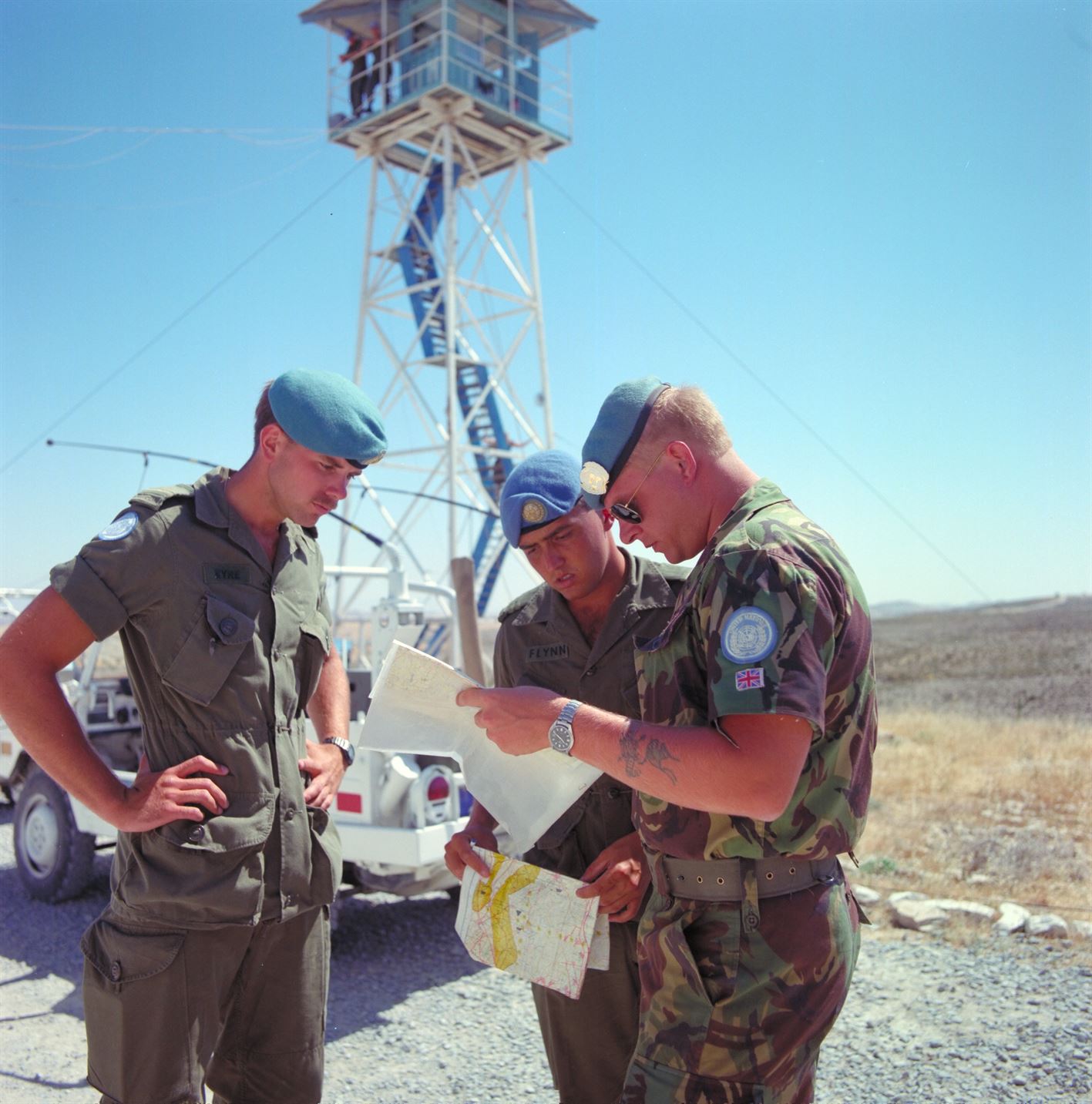
Peacekeepers meeting at United Nations observation point in Cyprus. (Photo: Department of National Defence)
Canada's participation evolves
A large Canadian contingent of between some 500 to 1,100 personnel served in Cyprus for almost 30 years. Most of our peacekeepers were pulled out in 1993. But a small Canadian military presence–codenamed Operation Snowgoose–remains there today. In total, more than 25,000 Canadians have served a six-month tour on the island over the years.
Sacrifice
Peacekeeping can be very dangerous duty. 28 Canadian peacekeepers died in Cyprus. They paid the ultimate price in our country's efforts to help the people of the island. The sacrifices of our peacekeepers can take other forms, as well. For some, their injuries and their experiences during these challenging international missions impact them and their families for the rest of their lives.