
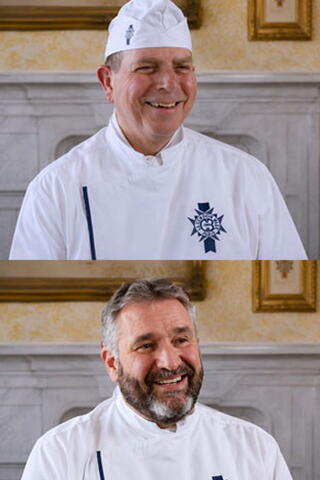

Carl Charbonneau
- Year joined: 1989, age 20
Paul Fuller
- 1983, reserve force; 1988, regular force
From the military to the kitchen
Le Cordon Bleu students Carl Charbonneau and Paul Fuller say their military experience prepared them for careers in fast-paced restaurant kitchens.
“Wearing a clean, pressed uniform, arriving on time, following structure—all of that is familiar,” says Charbonneau. “Leadership, teamwork, coordination, and multitasking are skills I developed in the military that transfer directly to the kitchen.”
Like Charbonneau, fellow Cordon Bleu student Paul Fuller sees many similarities between the military and the famous cooking school. “Discipline, hierarchy, structure, and uniforms—all very familiar. Kitchens operate much like the military, with defined roles and a clear chain of command.”
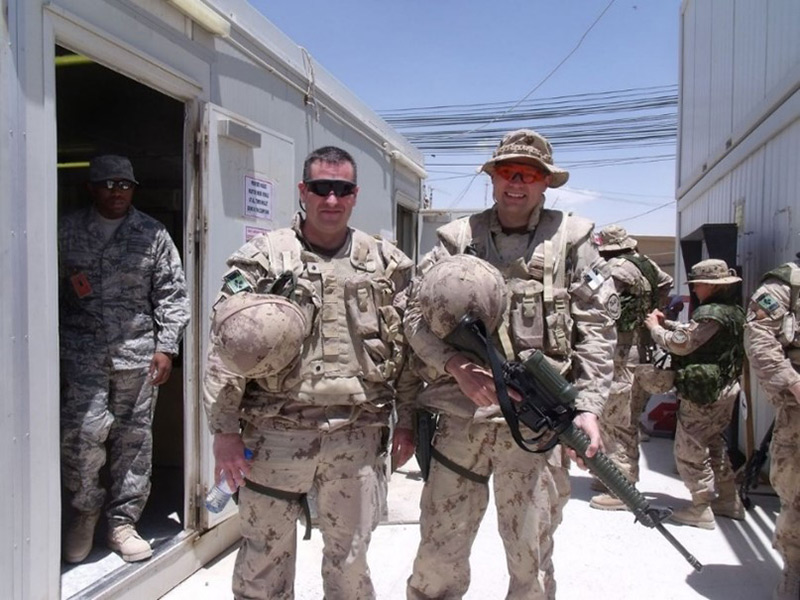
Carl Charbonneau, left, was deployed to Kandahar from May to October 2010, where he was a coordinator at the NATO Operations Centrefor close air support to troops in contact.
Professional soldiers and amateur chefs
Carl Charbonneau began his military career in the Royal Canadian Air Force, first working operationally in control towers and radar facilities. In his first 13 years, he moved up the ranks. He began leading teams and training others. Over his 27 years of service, he was posted to Goose Bay, Labrador, CFB Bagotville, Cold Lake, Alberta, Trenton, Ontario and Ottawa. He also took part in NATO training exercises in Norway and trained with the U.S. Air Force. In 2010, he was deployed to Afghanistan.
Charbonneau was released from the CAF at the rank of Major and settled down in Ottawa. He found the transition support from Veterans Affairs Canada very helpful as he adjusted to life after service.
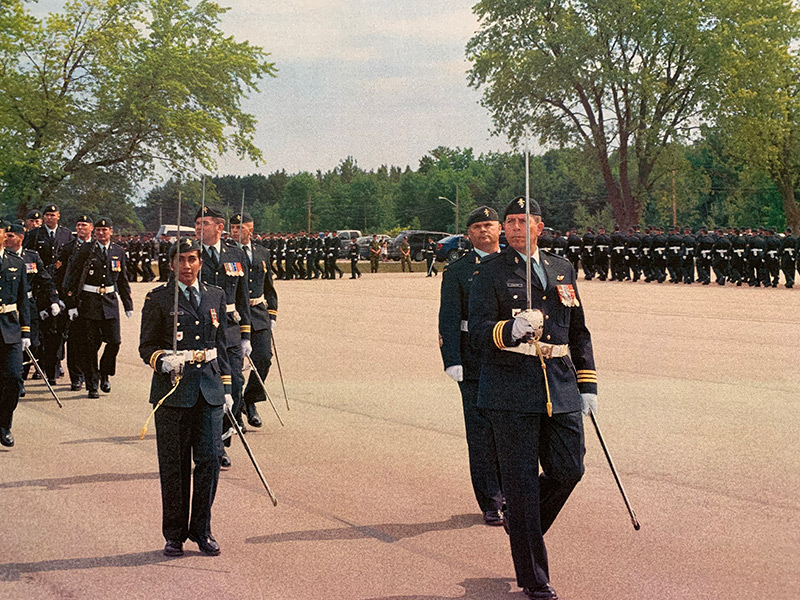
Colonel Paul Fuller (front, right) on parade with the Commandant Canadian Forces School Electrical and Mechanical Engineering.
Paul Fuller is a Franco-Ontarian. He served as a maintenance officer with the Royal Canadian Electrical and Mechanical Engineers (RCEME). “I oversaw the maintenance of land equipment, including vehicles, weapons systems, and electro-optical equipment.” He was deployed to Afghanistan in 2008, where he supported logistics operations.
After releasing at the rank of Colonel in 2019, he continued working with the Department of National Defence in a public service role. It was a familiar environment, working with some of the same colleagues from his time in uniform.
Then in 2024, he decided on a new path: professional food preparation.
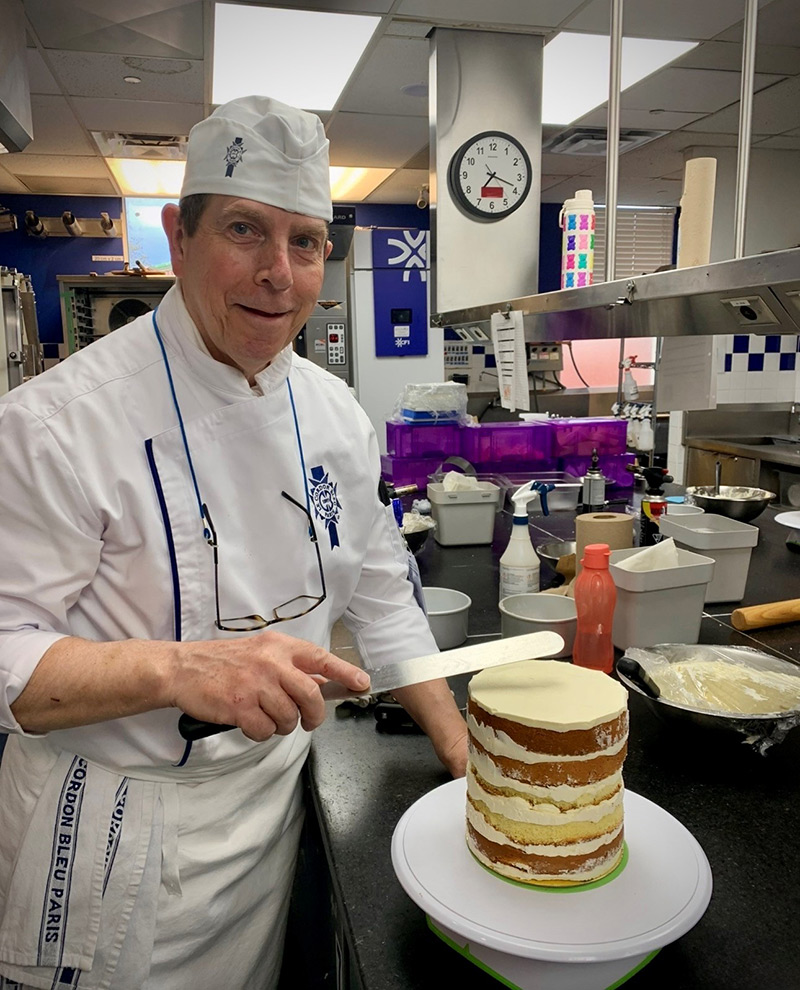
Fuller has always loved cooking for his family and now he’s making a new career of it. Here he is preparing a wedding cake.
“Cooking has always been a passion of mine. I’ve been cooking for my family for over 30 years.” To make it a new career, he enrolled at Le Cordon Bleu in Ottawa. “Thanks to the Veterans Affairs Canada Education and Training Benefit, I was able to return to school and formally develop that passion.”
Carl Charbonneau felt the same way. “Cooking has always been a passion of mine. I love traveling and experiencing new cuisines. When I explored culinary options in the region, Le Cordon Bleu stood out as an excellent choice.”
A world famous culinary establishment
Le Cordon Bleu Ottawa Culinary Arts Institute is the only Cordon Bleu campus in Canada. Similar to military training, its approach is highly structured. Classes are held three days a week. Each day starts with a two to three hour demonstration from a chef. After a short break, students start cooking by themselves. They present their dishes for evaluation and feedback on strengths and areas for improvement.
“The standard is very high,” Charbonneau says. “We’re taught by renowned chefs with extensive experience, and every dish we’ve prepared has been outstanding. Beef bourguignon, in particular, is a dish I grew up with and really enjoyed refining here.”
Lamb shank is Fuller’s favourite dish to prepare. “The cooking techniques and sauce work we’ve learned here made it far better than anything I’d done before,” he says. “Sauces are the key to great cooking.”
And at the end of the “school day,” the students do a thorough kitchen clean-up.
Another similarity to military life is the camaraderie among the students. “Our class included both younger students starting their careers and people like me pursuing a passion after another profession,” Charbonneau says. “We support each other and work well as a team.”
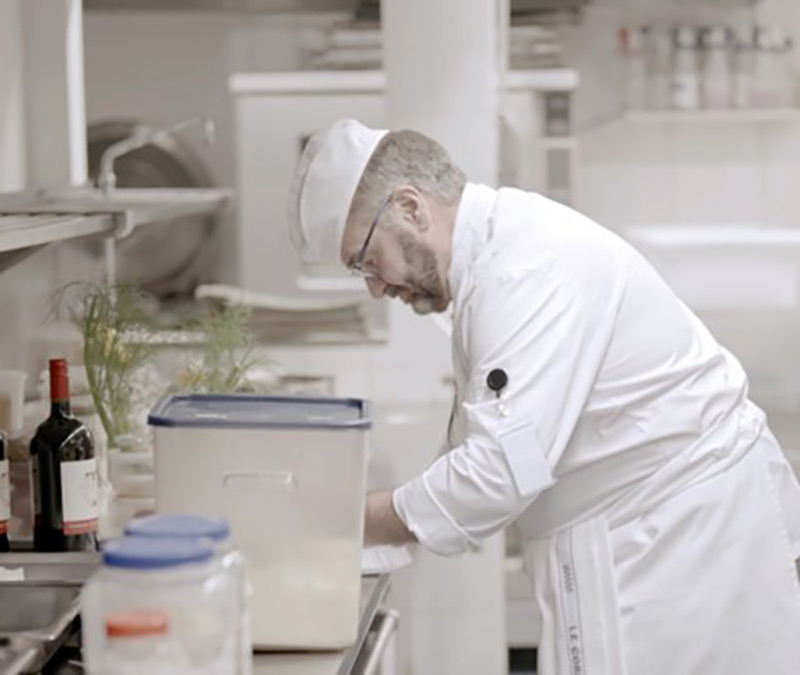
Carl Charbonneau sporting his uniform at Le Cordon Bleu Ottawa Culinary Arts Institute in Ottawa, working diligently at his station.
Turning passion into new careers
After graduating from Le Cordon Bleu, Cal Charbonneau plans to start his new career as a private chef, hosting events in private homes or rented venues.
Fuller, who completed the program at the end of last year, advises other Veterans considering culinary school to be passionate, but also realistic. “The hours and pay in the culinary world are very different from the military. For younger members, it can be an excellent second career. For others, it may be a meaningful way to stay active and engaged in retirement.”
“If culinary arts interest you, this program is an excellent way to pursue something entirely new,” Charbonneau agrees.
But Veterans need to consider the decision carefully. Le Cordon Bleu has high standards for acceptance of new students, along with a steep tuition price. Even applying costs $500.
As Veterans, Paul Fuller and Carl Charbonneau could turn to the Education and Training Benefit from Veterans Affairs Canada. “That financial support made this opportunity possible.” Charbonneau says.
“The application process was straightforward, and support was always available,” Fuller adds. “I encourage Veterans to call and explore their options—these benefits are there to help.”
He also advises Veterans and current Canadian Armed Forces members to make a transition plan. He says these plans should look at all of services and benefits Veterans Affairs Canada offers. “Programs like the VAC Education and Training Benefit recognize the sacrifices military families make and help Veterans transition into entirely new fields—not just cooking, but whatever passion they choose to pursue.”
New paths forward
Applying the discipline and teamwork developed in their long military careers to one of the world’s most prestigious learning institutions, they are turning a love of making good food into an art—and a career.
Video
With courage, integrity and loyalty, Paul Fuller and Carl Charbonneau are leaving their mark. They are Canadian Armed Forces Veterans. Discover more stories.
The well-being of Canadian Veterans is at the heart of everything we do at VAC. As part of this, we support and provide funding for education and training for Veterans after service. Learn more about the services and benefits that we offer.
If you are a Veteran, family member or caregiver, the support of a mental health professional is available anytime at no cost to you. Call 1-800-268-7708.