Heroes Remember interviews – Chinese-Canadian Veterans
Uncommon valour. Reluctant heroes. Unsung soldiers.
These are the phrases that describe the Chinese-Canadian men and women who took part in the Second World War. These are little known stories that also remind of us of a racist era the government simply didn't want Chinese-Canadians in the war effort.
Introduction
Most Canadians cannot even fathom there was a time in this country when Chinese-Canadians were denied the right to vote and banned from entering the professions. But this was the reality for the young men and women of Chinese-Canadian descent, the majority born on Canadian soil, at the outbreak of the Second World War. Why then, did they volunteer and risk their lives for a country that denied them the fundamental rights we now take for granted?
Listen as these Veterans speak candidly of their wartime efforts. Their recollections lay testimony to the Chinese-Canadians who knowingly or not, created fundamental political and social change in Canada.
Mary Ko Bong
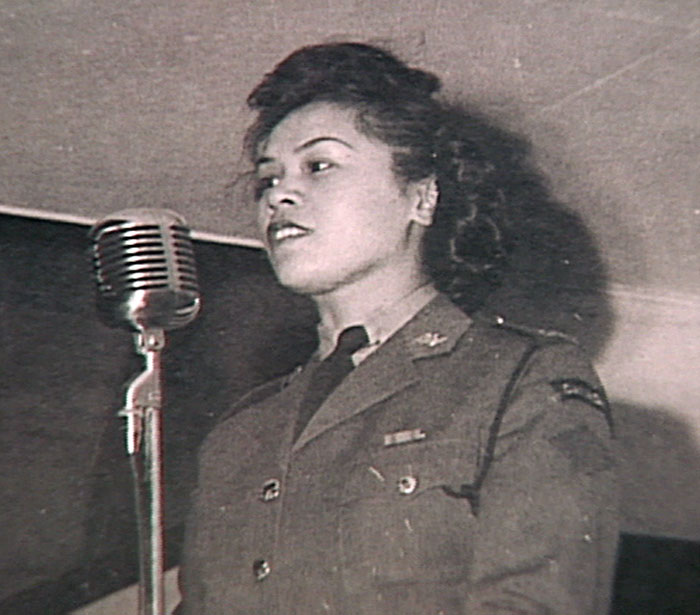
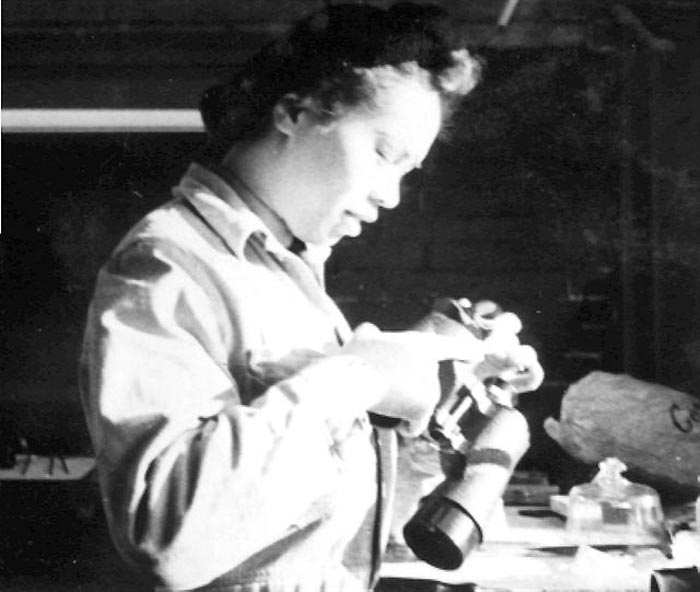
Mary’s family was one of the few where all of the siblings joined the army, but plucky Mary was first in line. Mary Ko Bong joined the Canadian Women's Army Corps and served as an instrument mechanic.
Interview
-
Mary Ko Bong interview - Transcript
Larry Wong (Interviewer)
Growing up in a devout Christian family in Victoria, Mary attended a segregated school for the Chinese. Her family was one of the few where all off the siblings joined the army, but plucky Mary was first in line. During the war, you had your brothers and you joining the army about the same time?Mary Ko Bong (Interviewee)
Yes, I... yes, yes. Actually I joined, I... I registered before John did.Larry
Oh you were the first then.Mary
(laughs) Yeah. I think I gave the sales office his vote. Yeah I was, somebody let the cat out of the bag. I wasn't telling them 'til I was... was going, you know.Larry
So you joined the army in Vancouver.Mary
No, in Victoria.Larry
Oh in Victoria.Mary
Yes.Larry
I see. Okay. Did they readily accept you because you were Chinese?Mary
Not until after the... what... don't know what they call it in those days, discrimination I guess. They... they weren't accepting any visible minorities up until '42 I guess... '43.Larry
Okay and what trade did you learn in the army?Mary
I learned to be a instrument mechanic.Larry
And what exactly was that?Mary
It dealt with optics and things like that so I was in the binoculars and compasses.Larry
But you were trained elsewhere for that weren't you?Mary
(We... we trained in Hamilton at Barrie Field. We learned it from scratch sort of. We had to learn how... how to run a machine.Larry
What kind of machines were they?.Mary
... And we had to learn how to run a lathe because we had to make, if there were screws and different parts missing that we were able to make that, we learned how to make them. Binoculars weren't so that difficult.Larry
So that was a very specialized field then?Mary
Yes.Larry
I see. Okay. Did they readily accept you because you were Chinese?Mary
It was quite, yes, quite a specialized field. In fact, there were just only two groups that took the course. It lasted for about six months, and they had representatives from every province, so there were about 30 girls each time; but out of 30 I think in each group, there were about only five that graduated.Larry
You mean there were only women in this particular field?Mary
Yes in this, yes. There were boys there but they put the girls in I guess in two groups. So it was very ... what... intense? And if you didn't know anything about mechanics or tools or things like that, it was quite some difficult thing to swallow. So they dropped off and the few that graduated, and of course there were there were also these specialized people that... In each group that was strange that each group that had two that were masters, had got their masters in ... mathematics. So in our group we had two, and the first group had two, and they worked on the range finders, and that was their secret instrument.Larry
So Mary, I understand you did entertainment in the Canadian army.Mary
I had studied singing and dancing, so I had classical training in both areas, and jazz.Larry
Did you have a large following of fans?Mary
(laughs)) No, no, no. That was a little bit out of you know, the usual. So... but probably most of the time I sort of surprised them.
Marshall Chow
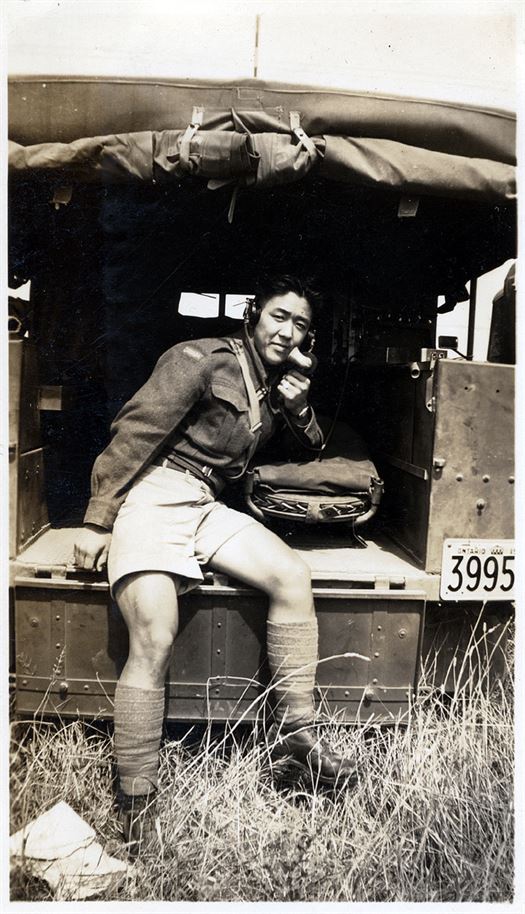
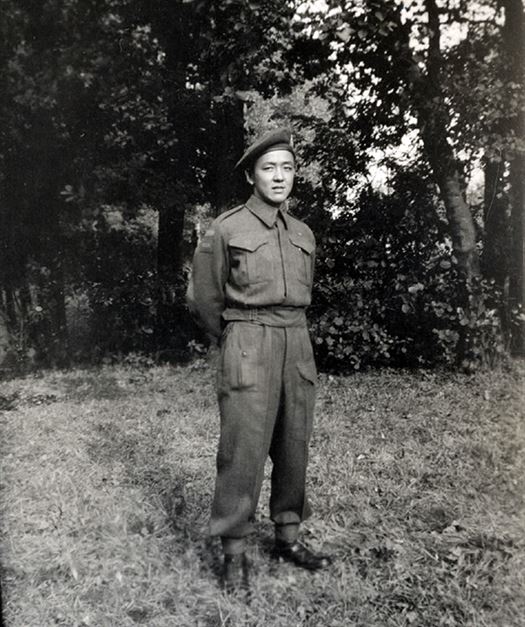
Unlike the experience of his fellow Chinese-Canadians on the west coast, the enlistment office in Alberta didn't bat an eye when Marshall signed up in 1941. Given a choice of duties, Marshall chose radio and wireless thinking that he would at least learn a trade while in service. Basic training began in Camrose, followed by stints in Edmonton, Calgary and Kingston. Before long, the prairie boy was crammed into the hold of the Louis Pasteur in Halifax bound for England.
Marshall spent the bulk of the war in Europe. Marshall remembers well, that whenever he was on leave, whether he donned his skates in Scotland or was just making friends with the locals, he did it all while proudly wearing his Canadian uniform.
Interview
-
Marshall Chow interview - Transcript
Ramona Mar (Interviewer)
The high school photo of teenager Marshall Chow of Elk Point, Alberta shows that he was the only Asian in his class of 13 students. Racial discrimination was, happily, not a part of Marshall's life. Like his fellow students, Marshall toyed with attending university until world events affected even the smallest towns on the prairies.Marshall Chow (Interviewee)
Well in in high school I was following the ah start of the war, Second World War, and I listened to all the losses we have at the ah Atlantic Ocean, our tonnage, all the shipping and it didn't look too good for us. I thought, well, they could go over and conquer England, then come over and conquer Canada and the States after. Well, the feeling I guess, everybody's joining up you know so it didn't feel very much different. I mean I guess we went we went to adventure and then of course, then we worried about the Germans could overrun us, you know, so and that way it's kind of patriotism, I guess, if you call it that your risk, willing to risk your life for that, for freedom and and justice.Ramona
Unlike the experience of his fellow Chinese-Canadians on the west coast, the enlistment office in Alberta didn't bat an eye when Marshall signed up in 1941. Given a choice of duties, Marshall chose radio and wireless thinking that he would at least learn a trade while in service. Basic training began in Camrose, followed by stints in Edmonton, Calgary and Kingston. Before long, the prairie boy was crammed into the hold of the Louis Pasteur in Halifax bound for England.Marshall
Well I got seasick (laughs). One day I got seasick and that. While we were eating, the dish was sliding from one end of the table to the other and then it comes back (laughs). Very very rough. Very rough ah sea, the Atlantic. Worse than the Pacific. We were crowded like rats in there. A ship will hold fifteen thousand troops and we were way down in the bottom and and I didn't like to sleep in the hammock which is curved. You sleep in that, you won't be able to walk straight next day so I slept under the table there, the dining dining table. It was straight, it's a little more comfortable.Ramona
Once in England, Marshall continued his wireless training with the Royal Canadian Corps of Signals. Communications he learned, was a key job but it put the operators at risk.Marshall
Then they could get us to send messages back to the infantry of whatever message they want to send, so communication is the most important, I think, because that's the nerve center of of the war. If you don't have communication, you can't fight a war. You don't know where you are or where your troops are, or where to attack and all that, so they try to um - not so much in England, but in the theatre of war, they try to bomb all the communications so they come to bomb us quite often sometimes.Ramona
Your job in communications was so vital during the war. Did you feel that, you know, you guys were more vulnerable for attack?Marshall
Oh yeah, oh yeah, we were bombed. The ah, I remember, in the in the Arne River, not far from Caen. Caen is only five miles from the beachhead and ah we were held up there for quite a while and the Germans used to come over with their planes, light up the whole sky, put down flares, you know, as bright as this, and we would of course have to, when they come to bomb, we have to dive for the slit trenches, dive in the slit trenches about three feet high. It accompanies about two or three people but I remember very well that time, well, when you look up in the sky, it's all lit up like this. You think, "well the pilot cannot see you." And you think,"neither can they drop the bomb in there," and I remember one occasion one of the guys behind me was, his knee, his leg was trembling like this, I could feel the vibration. We laughed aferwards.Ramona
Marshall spent the bulk of the war until VE day on the continent. Destined to be a life-long learner, Marshall remembers well, going on Leave. Whether he donned his skates in Scotland or made friends with the locals, he did it all proudly in his Canadian uniform.Marshall
Oh sure, I got pictures of all my girlfriends I don't want to show you (laughs). I can show it to you if you want to see it. (You have to have some fun) Oh yeah. Of course we have to have fun, make the best of it too, you know.Ramona
Thankful at war's end, Marshall was grateful to return to Alberta after his 4 years away.Marshall
Oh it was this beautiful feeling. When ah, when our train arrive in Edmonton four o'clock in the morning, four o'clock in the morning! I said, "Oh boy we're I'm going back to that old restaurant I used to on Jasper Avenue, have my bacon and eggs". That was a big treat. Oh yeah. Bacon and eggs.Ramona
Do you feel thanked enough? Do you think Canadians are are grateful for what you've done?Marshall
Oh yeah. Oh yeah. I think so yesterday I met a guy. He said, "Thank you for fighting for us". I get emotion.Ramona
Do you commemorate Remembrance day and participate? (um hum). How important is it for Canadians to tell you, "Thank you"?Marshall
Very important. We don't get that much appreciation. Only few recognize it, express it.Ramona
I thank you.
Daniel Lee
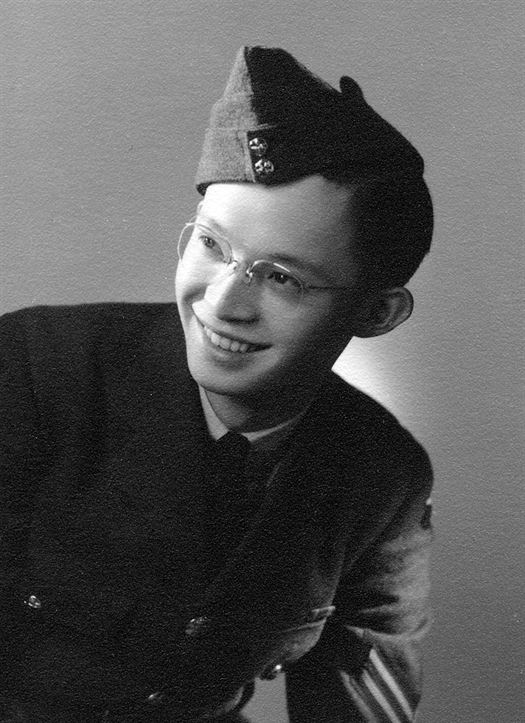
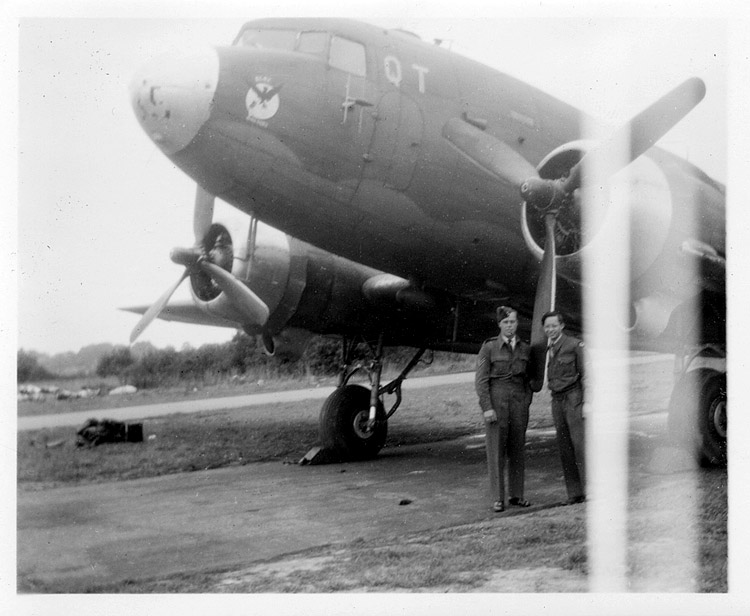
While his squadron would deliver precious mail to Canadian troops, Dan's job was to look after the engines of the 168-Heavy Transport Squadron. First, in Canada, and then from the base at Bigginhill, England from 1943 until the end of the war in Europe.
Interview
-
Daniel Lee interview - Transcript
Ramona Mar (Interviewer)
In many ways, Daniel Lee is the same energetic and determined 22- year-old who enlisted with the RCAF in 1942. Indeed, in his mid-eighties, Corporal Lee still fits into the uniform he was issued so many years ago. Being issued that uniform however, took plenty of drive on Dan's part. The son of a watchmaker and the 11th of 14 children, Dan was raised partly by his grandfather, the Reverend Chan Yu Tan, a pioneering Methodist missionary in British Columbia. Armed with a high school education and his grandfather's teachings, Dan tried to sign up for the air force in 1940, only to be turned down.Daniel Lee (Interviewee)
I didn't know at that time. the reason why was because it was under the King's rules and regulations it's. that is from Britain that no Orientals and can, or coloured, can join the navy or the air force, but you can, you are able to join the army because we were classified as aliens at that time because of the 1923, the Chinese Immigration Act.Ramona
Undeterred by a regulation he didn't know about, Dan took the train to Toronto to enroll in an aircraft mechanics course at Central Technical. When he graduated in 1942, he went back to the recruiting office. By then, the RCAF was ready to accept Chinese-Canadians and Dan was finally in.Daniel
They post me to... Rockcliffe when they. when they started the 168 Heavy Transport Squadron. That was in... 1943. At that time, the. the allies shipping suffered a lot of... losses (clears throat) due to the U-boats. They were sinking our shipping, and the morale was. was falling over in Europe because there was no mail from home. So our squadron was quickly formed to counteract that.Ramona
While his Squadron would deliver precious mail to Canadian troops, Dan's job was to look after the engines of the 168-Heavy Transport Squadron. He would do the same from Bigginhill, England from 1943 to the end of the war in Europe.Daniel
It's just, well, there was quite a lot of. a lot of work you have to do and. One thing we used to, when you get your hands so, so, so dirty when you're working, the only thing you can - clean the engines and everything. We have to use. gasoline. And lots of time, you know it's very hard on the hands because they don't give you any protective gear at all. And now when I'm older now I can find. I can, it come. the effects come after.Ramona
Back home in Canada, Dan joined everyone else in adjusting to a post-war world, but there were not enough jobs for air mechanics, and Dan turned to the family grocery business in Toronto, eventually marrying and raising a family. Since retiring to Vancouver, Dan has been a relentless community activist. As a member of Pacific Unit 280 of the Army Navy and Air Force, he represented his unit in Ottawa in 1994, when for the first time Chinese-Canadians were invited to participate in National Remembrance Day Services. He's also travelled to China and Holland, most recently attending the 60th Anniversary of the Liberation of Holland.Daniel
The people in Holland, is so grateful for what the Canadians did for them. So. and they treat the Canadians like they're one of their own. And in Holland you can see more Canadian flags shown than, than anywhere in Canada. And it gives you the some. in some way it hits your heart right away. There was a Canadian war cemetery. There was a young lady. She said, "Oh, I say, oh you people keep all those graves so nice." She said, "They teach us at school when I was," she said, "When I was five years old, and... what the Canadians did for them.Ramona
As part of his commitment to community, Dan annually organizes the poppy campaign in Vancouver. It's not surprising he's a top-seller. For his community efforts Dan has received many honours, but none higher than the Award of Merit from Dominion Command in 2004. It's a fitting tribute to the grandson who evidently learned his values and strong faith in community from his Methodist Church pioneer, Grandfather Chan.Daniel
To be a good citizen you got to start at home. Otherwise, a nation is just like a family. Everybody got to be happy at home otherwise the nation would be in trouble.
Peggy Lee
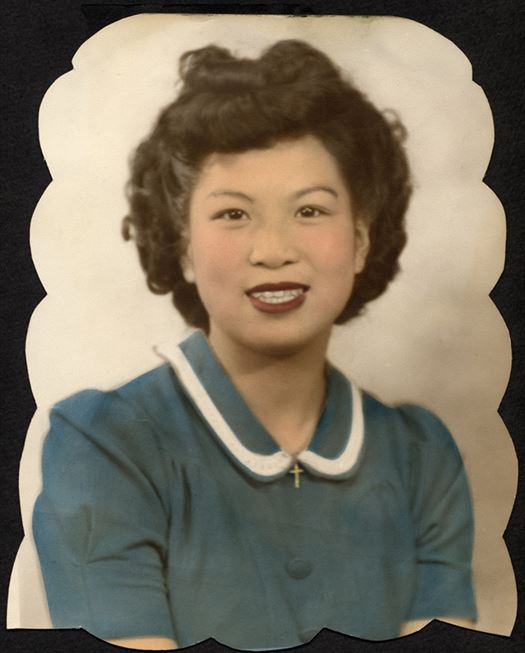
During the Second World War, Peggy was the youngest member serving with the Women's Ambulance Corps. After the war she would enjoy a very successful career as a businesswoman and activist for her community.
Interview
-
Peggy Lee interview - Transcript
Peggy Lee (Interviewee)
Well, my father came from Canton province, and he came over here and laid the railroad. I know. I think it was in the early 1900s or late 1800s; and the railroad ended in Prince Rupert. It never went any further. And because of that, he started a store and that's how we landed in Prince Rupert, and that's where we lived most of our life.Wesley Lowe (Interviewer)
You might think that Peggy Lee, growing up in the fishing village of Prince Rupert, would be safe from the concerns of war. However, even here, the tentacles of fear and suspicion reached far even to your neighbours.Peggy
I worked for a grocery store, you know, like the wholesaler, after work or before when I stopped school. We all went to the same school you know, Japanese all alike. I used to go to school with this Japanese girl named Emily and her brother... Tamanaka, I think. Yamanaka. They had a grocery store, and he use to come over and the only thing I ever felt was that he would be so. at that time, the Japanese was taking over China, remember? And he used to come and fight with my boss all the time. And he use to say to me, "Japan don't want to fight with China. We want to be their big brother." I said, "You're little land want to be big brother to China? You know?" Remember the ships they brought along the coast? The Japanese? They were here for war.
Why would they have those three ships come down there? They were charting our coastline in order to invade us. That's why they sent the Japanese into all the... out of the. the . B.C., remember? Or out of the coastline; and they had a reason for that.Wesley
What did you do during World War Two?Peggy
War started in Prince Rupert already. We entertained some of the soldiers. I couldn't, couldn't read a bit of Chinese, but I followed the song, you know? And I got all the little people and we. at the church and we use to entertain the soldiers.
. And in the end of 1939 or 40, I came to Vancouver. And then, then one day, Dr. Chu's sister, Peggy . "They're gonna [sic] form a St. John's Ambulance Corps, you know, for women? Would you like to come?" And I said, "Oh, yes. I like to do what I can, too." You know, at that that time, Dr. Gung, Dr. Chu and Dr. Yip, they were the only three physicians in Vancouver or B.C. at that time, practicing amongst the Chinese, you know; and they were all very good. They volunteered their work. We had quite a nice platoon. You know too at that time I was doing hair for all these war workers at North Vancouver. They used to come in late, and we're not allowed to open late, but they allowed me to... to do them. You know, Rosie the Riveter. that are all. that's. in a way, that's when women found their place at going out to work. But anyway, getting back to the St. John's Ambulance Corps, it was very, very. I was so glad to be in it. We learned how to march.
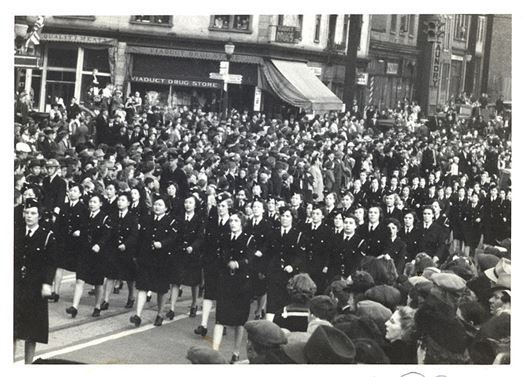
We took up... I took up S.O.S., never finished it, and I took up firefighting and sliding down (chuckles); it was... anyway, it was kinda [sic] enjoyable, too. Then I became . we took the course in St. John's Ambulance Corps and we took up home nursing. I got the certificate and then I was also a stretcher-bearer. The day that we sent the boys overseas. it was down on Hastings Street, and all those boys that you see in the Muse, I know them all. They were. you know, older than I was - one or two years, but not much. And then, I got involved in the canteen in Burrard Street. That's where I learned to wash dishes, make soda, dance with the. the... the soldiers; and I did all those things and it was a good experience for me because it made me part of something; and we marched in every parade you can think of. We can sunrise services, starting at five o'clock in the morning. We went to all of the. most of our drilling was down at the Seaforth Armoury. You know Seaforth Armoury?
We were going to do all the things, like if we had an air raid. We learned how to deliver a baby. We learned all the things to do incase we had a war, also marched in Chinatown for the blackout. You know, we had to check all the people to make sure everything was blacked out. We did all the things that we would do normally in a war so that we could ease the people to do the other part.Wesley
So you were being prepared just in case Canada was being invaded?Peggy
Yes, yes. They never said. Just in case. They never said anything about sending us overseas or anything, but we were the first Chinese platoon. That was remarkable.Wesley
The Women's Ambulance Corps was an all. all Oriental, all Chinese women.Peggy
That's why we were so unique - all Chinese women.Wesley
How did you find out the war ended? What was your reaction?Peggy
Oh, we were happy. We were all on the streets and everything.Wesley
How did you find out?Peggy
Well, it came over the news. I knew all the newspaper people, you know, and they all. you know... we were all just ecstatic. I remember all the ribbons, just like New York; all the ribbons coming down and we were all marching and I had this little friend from Prince Rupert down with me and we were marching up and down the street. We were just, just very, very happy. But mainly, it was so nice that the boys were coming back, you know? That was really good.Wesley
Do you consider yourself to be Canadian or Chinese-Canadian?Peggy
I'm proud to be a Canadian and the Chinese part come with my heritage. I am a Canadian first and proud to be part of Canada and I'll do anything for Canadian. You know that?
Gordon Quan
Gordon Quan, a member of a race that was initially refused entry into the armed forces, went on to a full military career in the Canadian Armed Forces.
Interview
-
Gordon Quan interview - Transcript
Wesley Lowe (Interviewer)
Unlike most soldiers, Gordy Quan felt a calling to serve his country in the military for all of his working life. One of very few Chinese to do so, Gordy now reflects on what that has meant to him and his community. What exactly did you do during the war?Gordon Quan (Interviewee)
When I join up we have to transfer from the Canadian Army to the British Forces, and I travel from here, from Canada to England, do all my documentation in London, England for a whole month. And then I (tape glitch) was qualified as a demolition expert. So from there, they shipped me over to India at Singha Hill. That what I call they call, the advanced training for three months of it (bird chirps in BG throughout). My. my job was to do demolition work, get behind line and... like blowing up a railway road and blow up... field depots; things like that, that you're attached to. My job was that ... demolition were because they like the way... not the same as the... like the American or the Canadian Forces. We are in a small group. There's only about 15 of us. And then my. the two of us that demolition, well. like my job was just to go in and we were, I would go into... Malaya there. There's a big, big petrol dump that we're gonna [sic] be. blow up... to able to blow it up... but it happened we were on the way but... the war end; we were lucky for the H-bomb. If it weren't for the H-bomb I don't think I'd be sitting here talking to you today.Wesley
After you came back from the war you worked for a while, but then you went back to the military. Why did you do that?Gordon
That's why I did that. When I come home, I have to settle down to find myself you know. some kind of either schooling or some kind of trade that I. you know could go on because on my education at the time was quite low right, so they offered me Veterans Affairs. Give us the opportunity to take some courses, so the only course I took was in the mechanical field, which adapted to me because I was always a good demolition expert with my hand and everything like that with the mechanical side of it so I took the mechanical trade.
There's a gentleman belonged to the militia in. in the Canadian Forces. So he. he asked me if I would come down and see him, have a chat with me at the. down the Armoury there if I were interested in it. So it happen at that time I say, well that's a good time for me to get in here to learn something and find out more about, you know, the life in the Armed Forces. That's how I joined, which gave me a lot opportunity. I got my education from it and got my trade and able to come out and work on the city streets. If I didn't have that trade with my Veteran's experience, would have never got into the city of Victoria.Wesley
You are one of the very few Chinese to do that.Gordon
I think I'm the only one. If I (laughs), if I look back at my background and my service, I was the first Chinese in the Public Work. work for the Public Work.Wesley
But you made it eventually.Gordon
Yes.Wesley
You made it.Gordon
And I have to work hard for it though (laughs).I hope they can have the militia for everybody in our country because that's where you separate the men and the boys. They make you to be a good citizen or you learn something from it. To me, I got my education from it. I come from the bottom to the top.
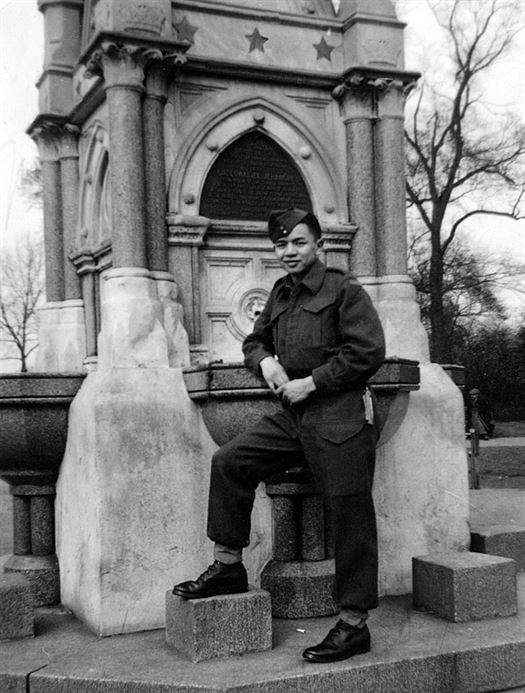
Andrew Wong
Andrew Wong was the only Chinese-Canadian to serve in the United States Merchant Marines during the Second World War.
"I was waiting for another ship in Vancouver when this American Liberty was in port and they needed one seaman, so they put me on it."
Interview
-
Andrew Wong interview - Transcript
Wesley Lowe (Interviewer)
Andy Wong was born in Victoria in 1925, the son of a railroad worker. His heart to serve was in the Air Force but when that didn't pan out, he looked for other options and wound up being one of very few Chinese in the United States Merchant Marines. How did you come to be part of the Merchant Marine?Andy Wong (Interviewee)
A couple of summers during the holidays I worked with the Canada CPR's steamships, and then in those days, if you were Oriental, you were automatically put in the galley. You were either cook, 'messman' or something. But all my life I loved the water so I wanted to go on deck, say I was a seaman, so that's where I went to... Vancouver. I went on the coastal freighters to get my experience on deck.Wesley
And then how did you wind up in the States?Andy
I was waiting for another ship in Vancouver when this American Liberty was in port and they needed one seaman, so they put me on it. So that was the agreement between the Allies during the war, is they will supply you with the personnel, you make the trip, and when you come back after the ship is paid off you go back to the port of signing up. So anyway, on that particular ship we went to France, and then we... we... we returned to the... the American side and we paid off in Mobile, Alabama.
It was real luck because it just so happened, the port representative in... in Mobile, Alabama, happened to be a former Torontonian. And... and he was the port representative which is similar to our harbour master here in Canada. So he said, "Oh you're Canadian." I said, "Yes I am." So he said, "How do you like American ships?" I said, "Oh they're luxurious." They were. They had lots of luxury a aboard. And then so... so... so he said, "Do you want to stay here?" And I... I told him "I can't. I have to go back to Vancouver where I signed on." So he said, "Give me a couple days. I'll see what I can arrange. " So two days later, he came back to the ship with a application and everything for the... to become an American Merchant Seaman. And I, I filled out all my application and then after they assigned me a Z number; that is the number that all the American Merchant Seamen had then. And so I became a merchant, so I stayed down there; then I did all my shipping out in the States.Wesley
What does it mean to be in the U.S. Merchant Marine? What, what did you do what, or what was your function in the war?Andy
Well without... without us we would have lost the war. We carry all the supplies, from bread to tanks; and an army cannot exist without the Merchant Marine or the Merchant Navy in, in the, in, in a Canadian sense. We carry everything everywhere, and I got in during the tail end of the war. And right after the war we had to carry ...... all the ...... relief supplies to all the ...... war-torn nations in Europe and around the world. Well I went to Finland, Denmark, Germany, France. England was our... usually was our destination, and I went to the South America. I went to the West Indies. I went to Korea. And for Liberty that was, we did pretty well because our top speed was around 10 knots. We weren't a fast. See the when they built the Liberties, they were meant to be disposable. In fact, when the war started as, if they made completed one trip they would've paid themselves off. And the Americans built 2,700 of them during the war; it was huge.Wesley
Would you be considered... like as part of the Merchant Marine, would... would you be considered a civilian, or you would be considered?Andy
No we were.Wesley
You were?Andy
That was just a wartime occupation. We were civilian.Wesley
You were civilians?Andy
And also called draft dodgers (laughs). We were.Wesley
Who called you draft dodgers?Andy
The armed forces; but they didn't know that they real... had to rely on us to get the supplies. They couldn't fight a war without us, and we were the target of the U-boats. That's why they wanna [sic] get rid of us; so that they can get the supplies.Wesley
The armed forces didn't give you the respect that you needed?Andy
We weren't recognized until 1990 (microphone noise).Wesley
Really? Oh, that's... that's quite something.Andy
That's right that, my discharge I showed you? That... that's a Armed Forces discharge.
Up until then, I just got the discharge from the Merchant Marine.Wesley
What would you like to say to the younger generation?Andy
Be part of the community. I guess you notice in the Chinese community they tend to stick together. I would say branch out, reach out. It's, it's a very... it's very rich out there. You learn a lot more; you... you gain more friends and, and you understand each other better.
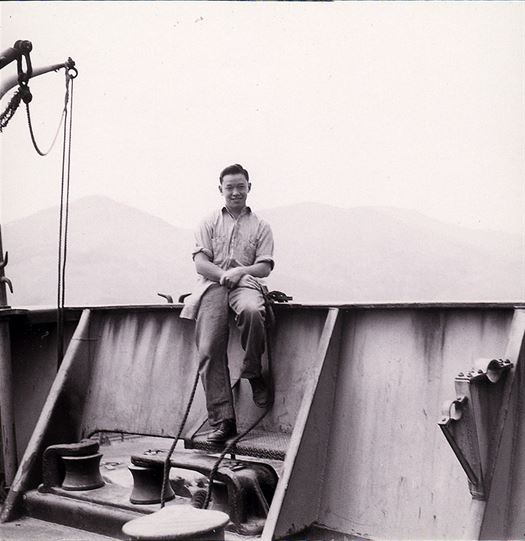
Frank Wong
Vancouver-born, Frank Wong was assigned to a mobile repair unit where his tour of duty took him from training camps in Britain, to Juno Beach, and triumphantly to Holland for the liberation.
By the end of the war, Frank was stationed in Holland where he witnessed the gratitude of the Dutch for their Canadian liberators. He's been back since, and been bestowed with medals and flowers all humbly received by a man who joined the army as a second class citizen and one who emerged as a full Canadian.
-
Frank Wong interview - Transcript
Ramona Mar (Interviewer)
Born in Vancouver in 1919, the second of seven children, Frank Wong's childhood, like so many of his contemporaries, was marked by poverty. The big city life in Vancouver translated into life in the ghetto, so his father moved the family to the small fishing village of Alert Bay, on Vancouver Island. The village was isolated, but not immune to the impact of war when Pearl Harbour was bombed.Frank Wong (Interviewee)
And I remember the Japanese fishing vessels were all rounded up and brought to Alert Bay and sent down to Vancouver. And then it was only then, that I said, "Oh God, maybe I should go down and join the army."
I felt it was my responsibility and I figured if I join the army there there's a possibility that I'm. after the war I may be able to get the franchise. And also, to prove to the government my loyalty to. to my country, and that well. that's probably the main reason I came down to join the army ...Yeah ...Ramona
After basic training in Vernon, British Columbia, Frank trained as a 'storeman' in Barrie Field and Ottawa, signing up for the overseas draft with the Royal Canadian Ordinance Corps. Within weeks, Frank boarded the troop ship, The Queen Elizabeth. The journey to Scotland took four days and Frank had no time for second thoughts.
Back on land, Frank was posted to Catherham on the Hill to join his unit, the First Canadian Army Troop Workshop.Frank
Our unit is the second echelon workshop. Our main function is repairing these um heavy artillery. There was at a 5.5 inch, 7.2 inch guns, and 155 millimetre guns and we also repair all their, their vehicles and instruments. And we have a blacksmith and. and everything. It's a second echelon. We have a staff of about 220 officers and. and men in. in our unit. And it's a strictly mobile unit; even the office is... is on wheel you know. And all the stores are all on trucks and, and repairs. Also, repairs like. rifles, machine guns, anti-tank guns and so on.
But our main. main function is to follow the... the... artillery. When the artillery goes into action, our job is to follow them - right beside them.Ramona
Over the next year and a half, Frank's unit would remain in England, continually training and waiting for orders to move to the continent.
A month after D-Day, Frank was huddled into the hold of a Liberty ship for the agonizing crossing to France. From there, Frank forced himself to jump into landing craft as he neared the congested Normandy coast.Frank
We landed on Juno Beach. And then the first thing I. they said to us was to keep on moving inland, don't linger on the beach, just move inland, because at that particular time there, the beach was still under enemy fire. They were still close enough for. and then if there's. for enemy to fire. So we just keep on, just move inland. So we moved inland, and then when we. inland to a field about a couple of. I think about two, three miles inland.
I remember when we went in there we had to dig a little slip trench, a fox hole, and I was an individual and every so often at night there, the first night there I remember looking up every every couple of hours to see if everybody is still around. It was kind of scary that day and then we could hear the German plane coming over at night. Thats the only time you see the German plane, at night time, they came over at night to try to bomb the beachhead. You know, so when you see the planes going over and the guns going off. That first night was a little bit, a little bit scary. I often wonder, you know, how I would react and things like this.
When they were shelling, I used to get under, go down to the basement or get into a foxhole. And then... I remember, it was kind of scary and I remember saying the Lords Prayer about a million times, (laughs) to keep my nerve up. And Id look up and I see some of my friends, they were mumbling too. I think they were doing the same thing too.
When you come under enemy fire and not be able to do anything, I mean you get kind of scared.Ramona
That first day after the landing was both frightening and exciting. It would be no match for what Frank would see days later in the city of Caen.Frank
I remember the... the city was completely destroying with all the artillery, and I remember there are so many people, dead people around, you know, not. not buried and everything. And I, I could still remember Caen because I got sick that day, because when we went in there, the smell was so bad that I, that I vomit. You know, and that's the, that's the only time I ever. I vomited. The smell was just out of this world, you know, there was so many people dead. It was in the summertime and they'd been fighting over that area for over a month there, a month and a half, and the smell was just out of this world. By that time the Germans theyre in full retreat. And I remember going through the country side. It was very exciting because every village we would go past the people would come out and with flowers in their hands and when we stopped they would bring wine and pastries and fruit for us to eat. We had to keep on moving. Every so often we would stop in one spot for a few days and then we had to move again.Ramona
By the end of the war, Frank was stationed in Holland where he witnessed the gratitude of the Dutch for their Canadian liberators. He's been back since, and been bestowed with medals and flowers all humbly received by a man who joined the army as a second class citizen and one who emerged as a full Canadian.
And there's one more footnote to Frank's story. One of his three daughters married a young man of German heritage, and Frank has discovered his son-in-law's father was in France at the same time as he was - both fighting on opposite sides. It would be hard to believe that years later, these soldiers would be united as fathers-in-law.
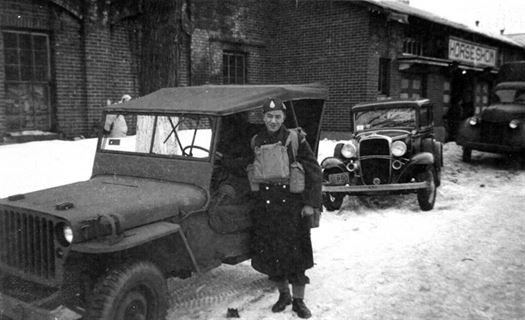
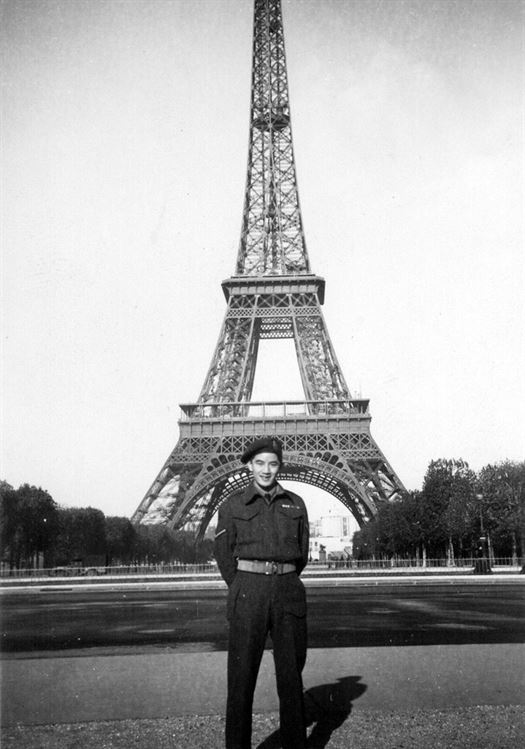
Larry Wong
Larry Wong was conscripted in 1944, and was the only Chinese-Canadian in his regiment. After basic training he was transferred to the Edmonton Fusiliers. The regiment was shipped to Newfoundland to replace the French regiment stationed there. They would stay in Newfoundland for about six months and then the war was over.
-
Larry Wong interview - Transcript
Larry (Interviewer)
Larry Wong was conscripted in 1944, and was the only Chinese in his regiment.Larry George Wong (Interviewee)
I was conscripted actually; I wasn't considered as a... a as general serviceman. I did join in a little later on to consider myself as a general service, and I thought maybe perhaps being ignored by the Canadian government for so long that maybe I had a little misforgiving [sic] about all of this but anyways, I got over that. And the... my... my sergeant that talked me into being a general serviceman, so that... that's what happened.Larry (Interviewer)
And where were you stationed with the army?Larry
After basic training in Halifax, I think it was three months basic training in Halifax in the winter. Oh, was it cold there. I'll have to tell you a funny story about that, about Halifax. I... I heard, we were issued four blankets and ... we had a pillow and ..., but even one blanket below and three blankets on top, I was still cold. Then I remembered ... hearing somebody saying that maybe you should put paper, newspaper in between the blankets and you'll stay a lot warmer. And that's what I did one night and then next day I was hearing some... some soldiers next to me saying that, "What was all that rustling last night? I couldn't sleep at all. " I was... I thought well maybe... maybe I better not put anymore newspaper into... in between the blankets (laughs).
After basic training I was... I was transferred to a regiment called the Edmonton Fusiliers, and they actually... we... they shipped us to Newfoundland and the regiment that the French regiment in Newfoundland, was shipped overseas. So we stayed in Newfoundland for roughly about... maybe about ... six... six months and then the war was over.
And we, I think we got shipped back to the... The regiment broke up in the meantime and I was shipped to Winnipeg, to a... a regiment, Princess Patricia's. And we spent the winter there and one thing I remembered in the... in Winnipeg was that one morning, standing at... at attention, I found out that that one of my ears were frozen. And the sergeant told me that... that my... my ears are frozen; I guess they'd turned white (laughs), and for 20 years after that, every spring my ears would itch.Larry (Interviewer)
Were there any other Chinese in the regiment?Larry
In the Edmonton, Edmonton Fusiliers I was the only Chinese I believe. I don't remember any other Chinese there. I was sent back to Vancouver and discharged there in 1948.