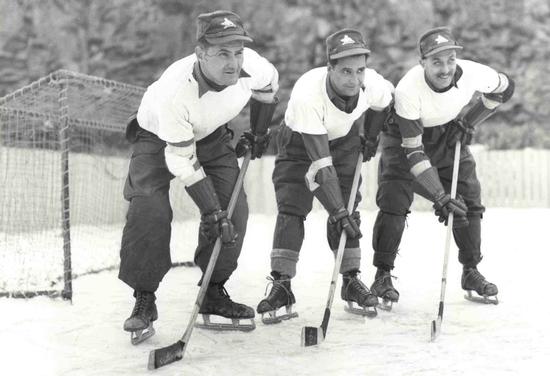
Many claim that Canada was the birthplace of hockey and few would dispute that it is Canada’s official winter game. The passion for this fast paced sport runs deep in every community. The relationship between hockey and our country’s military dates back more than a century. In fact it is believed that hockey actually had its origins in the military.
Countless hockey players of all skill levels have served in the military. From icy rinks in Europe and frozen rivers of Korea to dusty floors in Afghanistan, hockey has served to strengthen the troops as well as boost their morale. Numerous hockey trophies honour our service men and women.
First World War
Military hockey teams were created across Canada early on in the war. There were games between battalions, games between military members and civilians, and well-known matches in which the navy faced the army. Military hockey teams attracted lots of attention, such as the 228th Battalion (Northern Fusiliers) who even played in a professional league. As the war dragged on, more and more men were needed on the front lines. Hockey themes were even used in posters to encourage military service! Large number of young men ended up enlisting, creating a void in many arenas and women’s hockey suddenly became very popular.
There is no official count on the number of hockey players who served in the Great War, but more than 30 Canadians who perished in that war had significant ties to hockey. Memorial awards were created for many of these men, such as the Abbott Memorial Cup, to honour Edward Lyman Abbott, as well as the George Taylor Richardson Memorial Trophy. The tragic loss of prominent hockey players such as Allan “Scotty” Davidson and George Richardson inspired Captain James Sutherland and businessman Liam Carr to create a trophy to pay tribute to all Canadians who died at war.
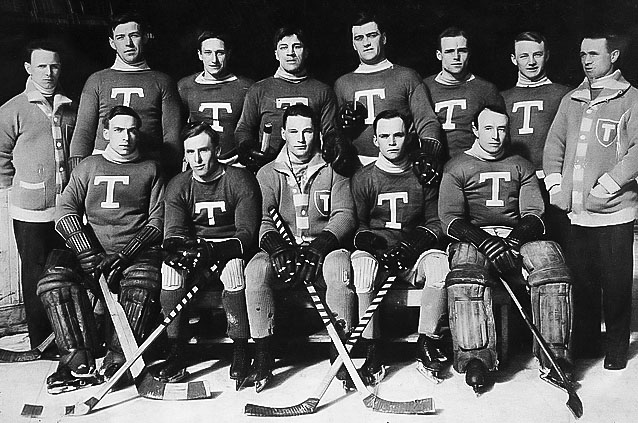
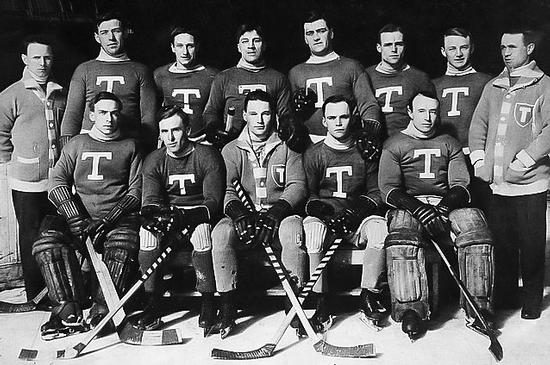
Allan McLean "Scotty" Davidson (seated in the middle) is seen here with the 1914 Toronto Blueshirts hockey team. He enlisted in September 1914 and was killed in action on June 16, 1915. Photo: Canadian Virtual War Memorial
The Memorial Cup was first awarded in 1919, one year after the end of the First World War. It is now awarded each year to the junior hockey champions of the Canadian Hockey League. The cup was donated in 1919 by the Ontario Hockey Association. Since then, the format of the tournament to decide the winner of the cup has been altered a few times, but a key element remains—it is always a powerful symbol of remembrance. At the 2010 Memorial Cup Tournament, held in Brandon, Manitoba, the championship trophy was rededicated to recognize Canada’s war dead from all conflicts. Veterans from the Second World War and the Korean War escorted the Memorial Cup in a touching ceremony that took place at CFB Shilo.
Few Canadian hockey teams have won gold at the Olympic Games. For the Winnipeg Falcons, this accomplishment was even more special due to the fact that seven of its players served during the First World War. Sadly, Frank Thorsteinson and George Cumbers lost their lives, and by coincidence, they both are buried in the Barlin War Cemetery in France. This tough blow did not prevent teammates Wally Byron, Frank Fredrickson, Konnie Johannesson as well as brothers Bobbie and Harvey Benson to don the skates during the war and play on their battalion’s team. After the war, the Winnipeg Falcons team was put back together and they went on to win the Allan Cup in 1919-1920, making them the national senior amateur men’s ice hockey champions of Canada. This title granted them the right to represent Canada at the 1920 Olympics games in Antwerp, Belgium. The first Winter Olympics (better suited for hockey!) would be held four years later. The victorious Falcons brought home Canada's first-ever Olympic gold medal in hockey.
Olympic Gold
Ice hockey was an Olympic sport for the first time in 1920. Canada was represented by the Winnipeg Falcons, who had won the Allan Cup that year as the country’s top senior men's amateur hockey team.
The Winnipeg Falcons had an interesting background. Founded in 1911, its roster was initially made up entirely of players of Icelandic descent. The coming of the First World War three years later had a great impact on the sports landscape in Canada as hundreds of thousands of young men would enlist in the military—including every member of the Falcons.
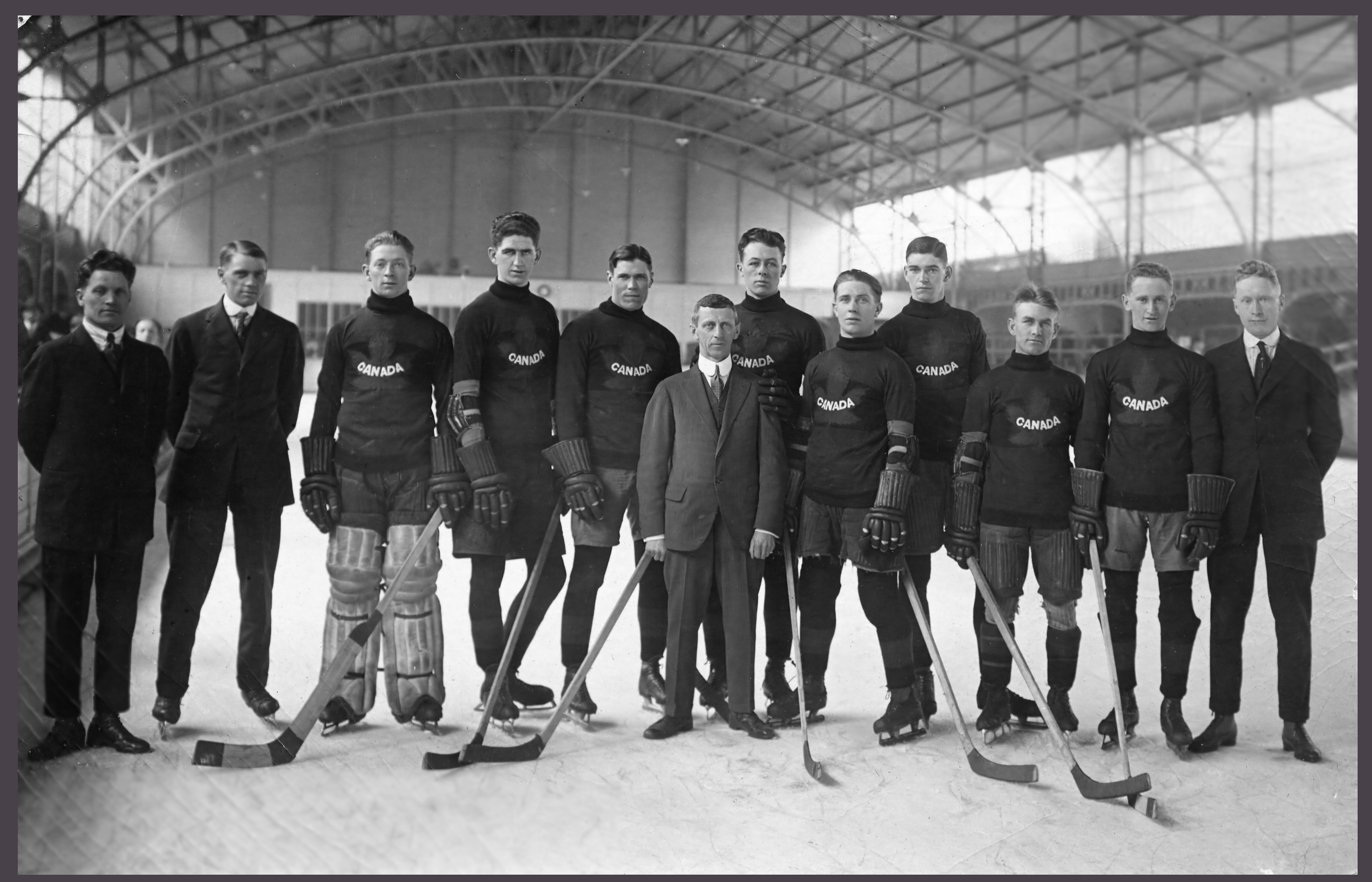
Members of the 1920 Canadian Olympic hockey team. Photo: Manitoba Sports Hall of Fame & Museum
The brave players served overseas during the war and two of them lost their lives. When the surviving members made it back home after the conflict, they laced up their skates again and their team would earn the right to represent Canada at the Olympics.
The 1920 Olympics Games were held in Antwerp, Belgium—a country that had suffered greatly during the recently-ended First World War. The Falcons would defeat their opponents handily (capped with a 12-1 victory over Sweden in the final) and won the very first gold medal in hockey. Before returning home to victory parades and accolades, the team toured the battlefields of nearby Flanders where several of them had served as soldiers not so long before.
Today, the Hockey Hall of Fame in Toronto and the Manitoba Hockey Hall of Fame both have permanent displays honouring the Falcons and their impressive Olympic victory.
A team of Icelandic-Canadians serve in the First World War before bringing home the very first gold medal in Olympic hockey.
Second World War
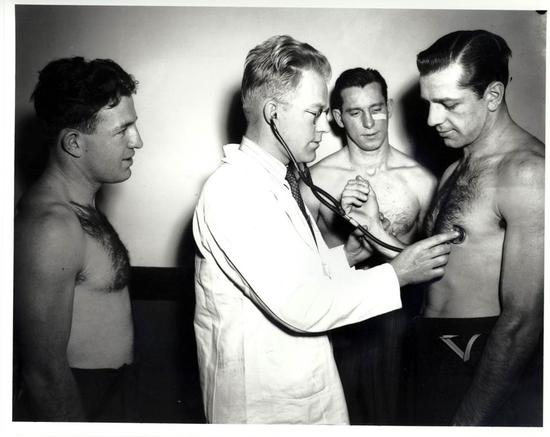
During the Second World War, many National Hockey League players put their careers on hold to serve in the military. Most players, though, did not enlist as dramatically as Milt Schmidt, Woody Dumart and Bobby Bauer. The three forwards for the Boston Bruins’ best line, ironically nicknamed the ”Kraut Line” because of their German ancestry, hung up their skates and enlisted together in the Royal Canadian Air Force on the same day in 1942. The fans went wild! All three saw action overseas as aircrew. Fortunately they survived the war and returned to the NHL, but not before they had given up three and a half years of their hockey careers to serve in the cause of peace and freedom. The teammates hadn’t lost their hockey flair and helped the Bruins reach the Stanley Cup finals in 1946.
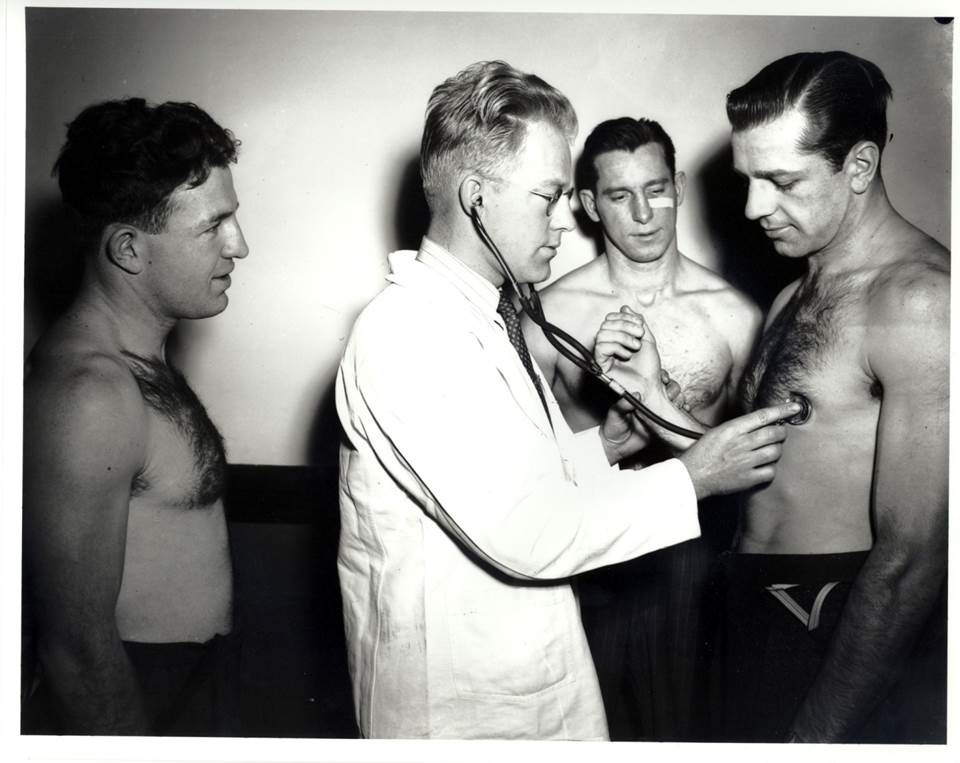
Boston Bruins Hockey Club front line Bobby Bauer, Porky Dumart and Milt Schmidt, who left hockey to become members of the RCAF, seen taking their medicals in 1942. Photo: Library and Archives Canada PA-108240
In Toronto, co-owner of the Maple Leafs, Conn Smythe (who had been decorated for bravery in the First World War) enlisted again at age 45. Leading by example, many Maple Leaf players also decided to join the war effort. Smythe was commanding an artillery battery in France when he was wounded in an enemy bombing attack. To this day, the National Hockey League trophy for the most valuable player in the playoffs is named in his honour. As Veteran Gordie Bannerman recalled in his memoirs, “Turk Broda of the Leafs and a few more NHL chaps were just overseas and had the help of Conn Smythe, Leafs owner, who commanded an artillery battery. Orme Payne, Sparky Ament, Darcy Spencer, Bob Bradley, and a couple more of our chaps, plus 5th LAA personnel were off to Amsterdam to play hockey. The fellows had a pretty good few weeks in the city of canals.”
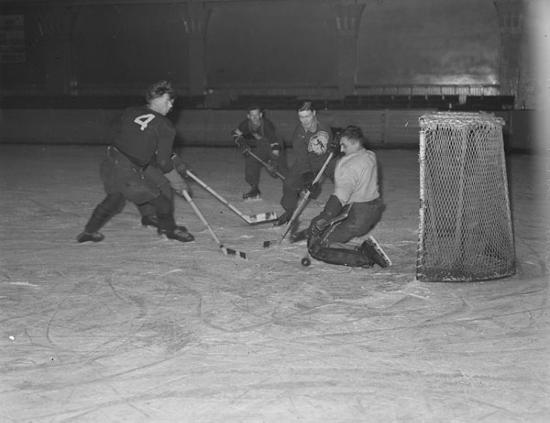
Some players, like Maurice “Rocket” Richard, could not enlist because of injuries they had received during their hockey careers. Other players enlisted but did not make it to the front lines. Having them play hockey either in Canada or in military camps overseas proved to be a pillar of strength for both civilians and the military. Highly competitive regimental hockey teams were formed, serving such purposes as keeping the men fit and entertaining the serving members on military bases.
The war also had a huge impact on the Canadian economy. Various peace-time factories were converted to supply much needed products for the war effort. For example, the Canadian Cycle and Motor Co. Ltd. of Weston, Ontario, which had made bicycles and hockey skates before the war, took over the manufacture of armaments including gun parts, tripods for Bren guns, and cradles and pivots for anti-tank guns.
While firm numbers are elusive, hundreds of Canadian hockey players from all leagues would end up serving during the Second World War and sadly, more than 50 would not survive.
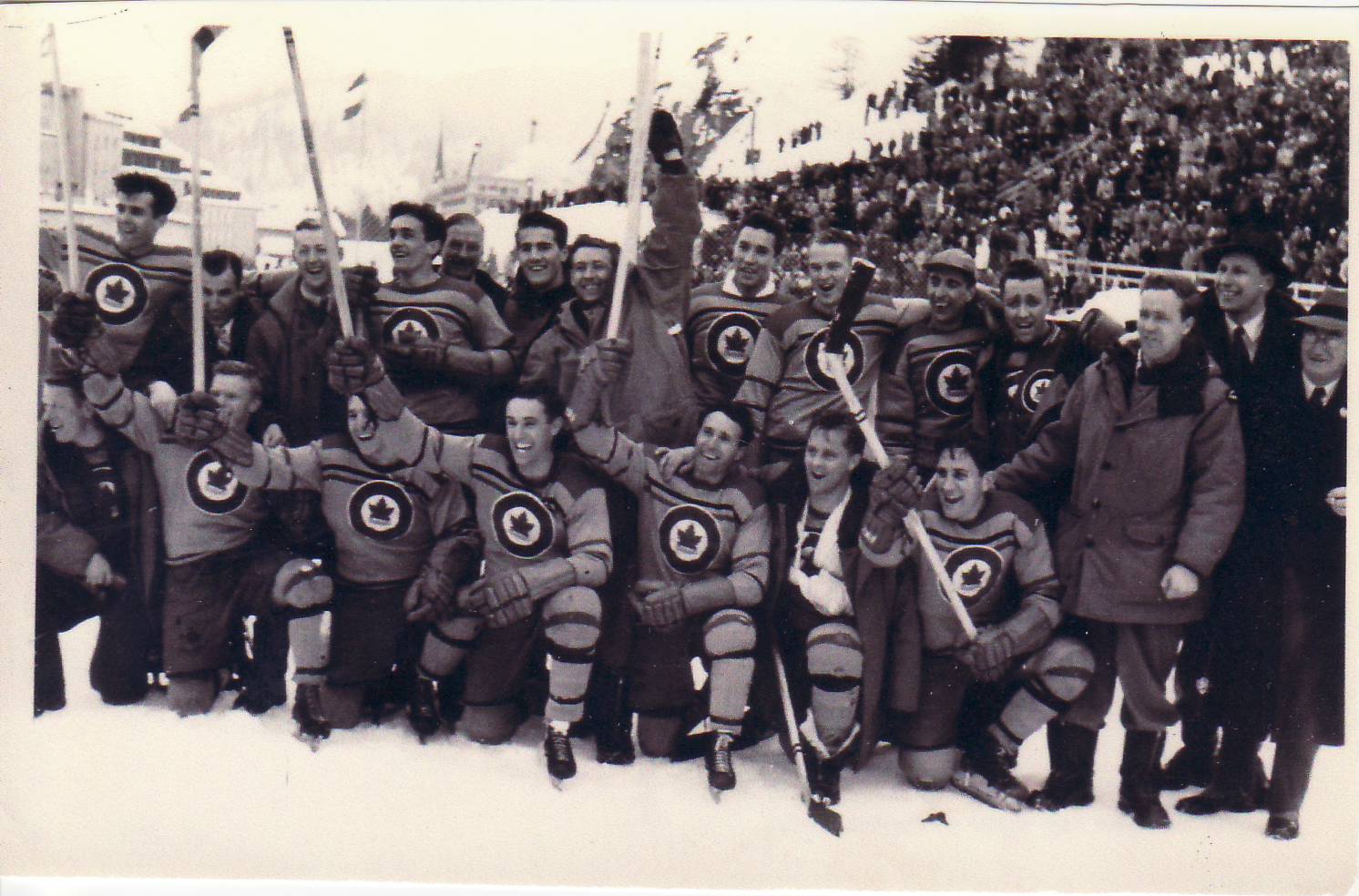
Following the Second World War, the 1948 Winter Olympic Games were held in St. Moritz, Switzerland. Many of the players on the Royal Canadian Air Force Flyers hockey team, representing Canada, were Veterans of the war. Despite a challenging tournament, the men finished in first place.
Olympic Gold… again!
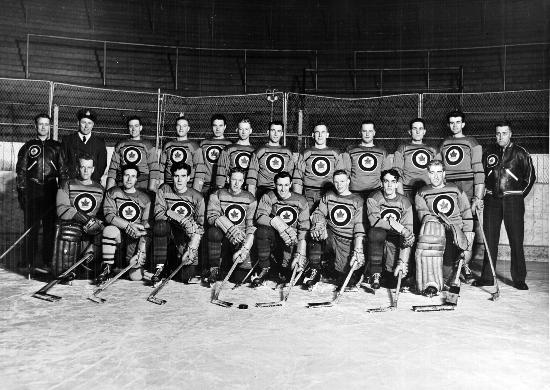
Less than three years after the end of the Second World War, the Winter Olympic Games were held in St. Moritz, Switzerland. Many of the players on the Royal Canadian Air Force (RCAF) Flyers hockey team that competed at the Games were Veterans of the war.
The team had a rocky beginning. It was formed at the last minute and lost several exhibition games, but Canada's underdogs came out on top. Even being pelted with snowballs by the hometown crowd during a game against the Swiss team on the outdoor rink could not stop them. The Flyers finished the round-robin tournament with seven wins and one tie for an overall record that deadlocked them with Czechoslovakia. Canada took home the gold medal based on their superior goals-for and goals-against averages.
In 2000, the RCAF Flyers’ gold medal win was selected as the ”greatest moment in Canadian Armed Forces sports history” and the team would be inducted into the Canadian Olympics Hall of Fame in 2008.
The RCAF Flyers celebrate their gold medal win over Switzerland. Back row, (L to R): André LaPièrre, Hubert Brooks, Andy Gilpin, Ted Hibberd, A. Sydney Dawes (head of the Canadian Olympics Association), Pete Leichnitz, Irving Taylor, Wally Halder, George Mara, Murray Dowey, George McFaul, Frank Boucher, Sandy Watson, and George Dudley (head of the Canadian Amateur Hockey Association). Front row (L to R): Roy Forbes, Orville Gravelle, Reg Schroeter, Ab Renaud, Patsy Guzzo, Louis Lecompte and Frank Dunster. Photo: Department of National Defence
Korean War
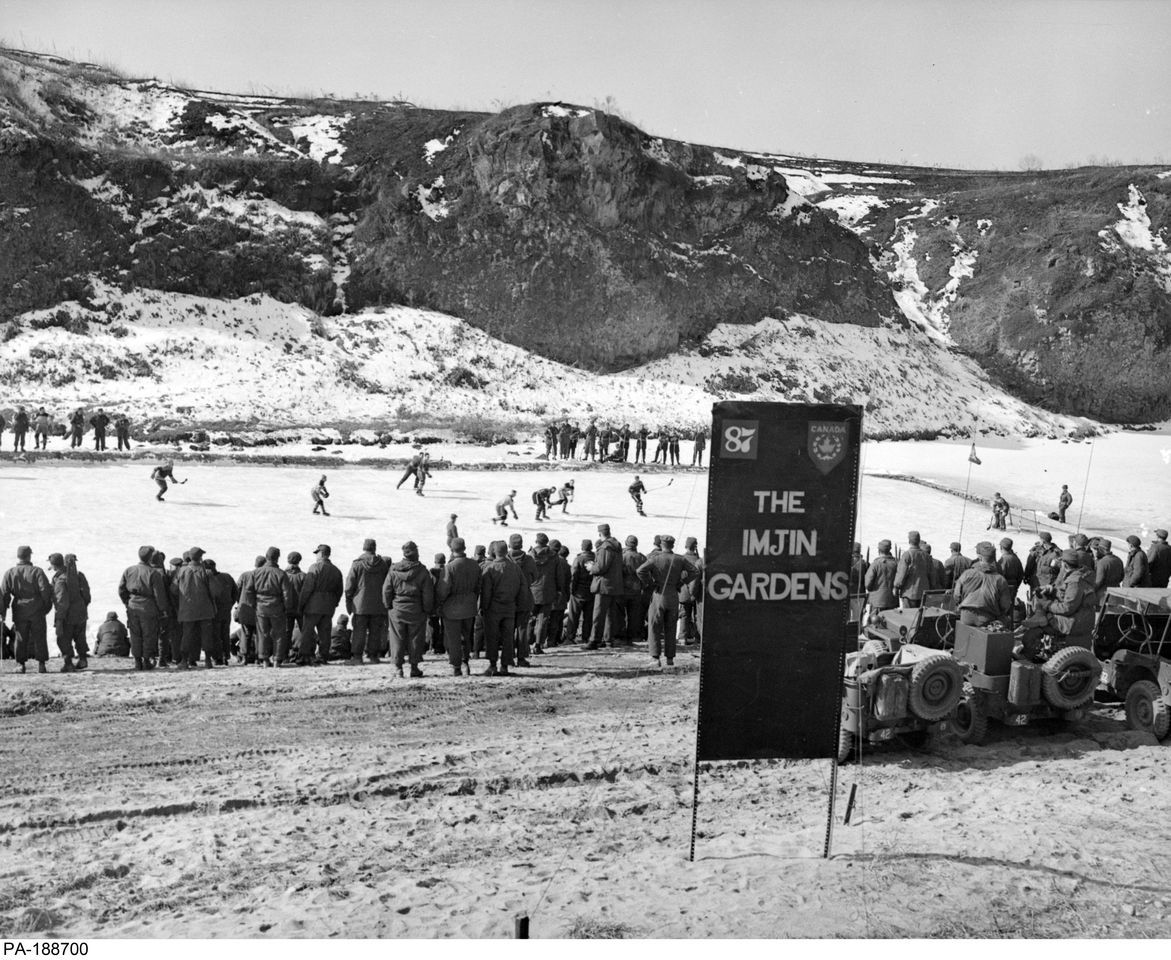
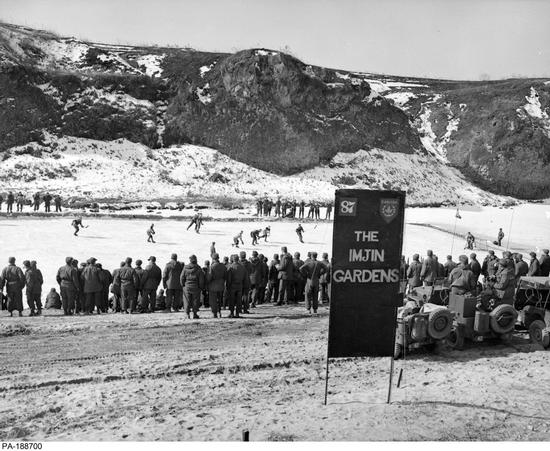
Imjin Gardens is the scene of a hockey game between teams of the Royal Canadian Horse Artillery officers and "Van Doos" officers in Korea in 1952. Photo: Library and Archives Canada PA-188700
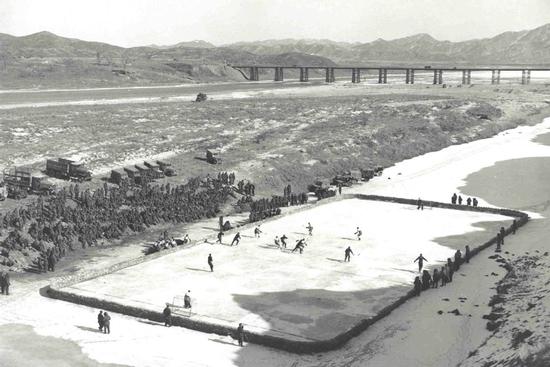
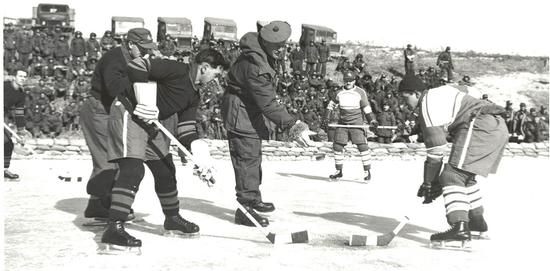
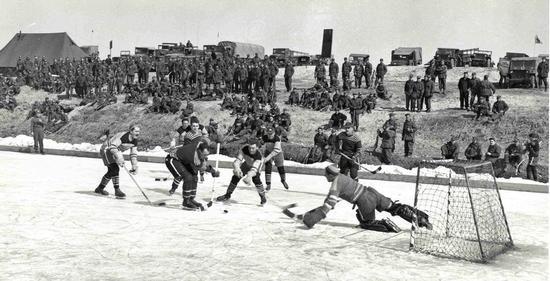
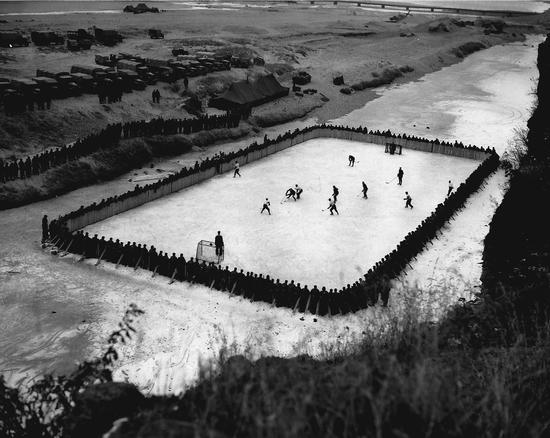
Our Canadian service members’ love of blending hockey with military service would continue in the Korean War. As the conflict progressed and the front lines became more stationary, our soldiers would find a way to play hockey in the Far East. During the colder months, they would clear the snow covering the ice on the Imjin River and play as the sound of artillery fire boomed in the distance.
The matches often saw different units square off, with pride and bragging rights on the line! On March 11, 1952, for example, players from the 1st Battalion of the Princess Patricia's Canadian Light Infantry and the 2nd Battalion of the Royal 22e Régiment played hockey on the frozen Imjin River in a well-remembered game. These kinds of sporting events helped bring a little normalcy to our troops serving so far from home in war-torn Korea.
Canadian Armed Forces
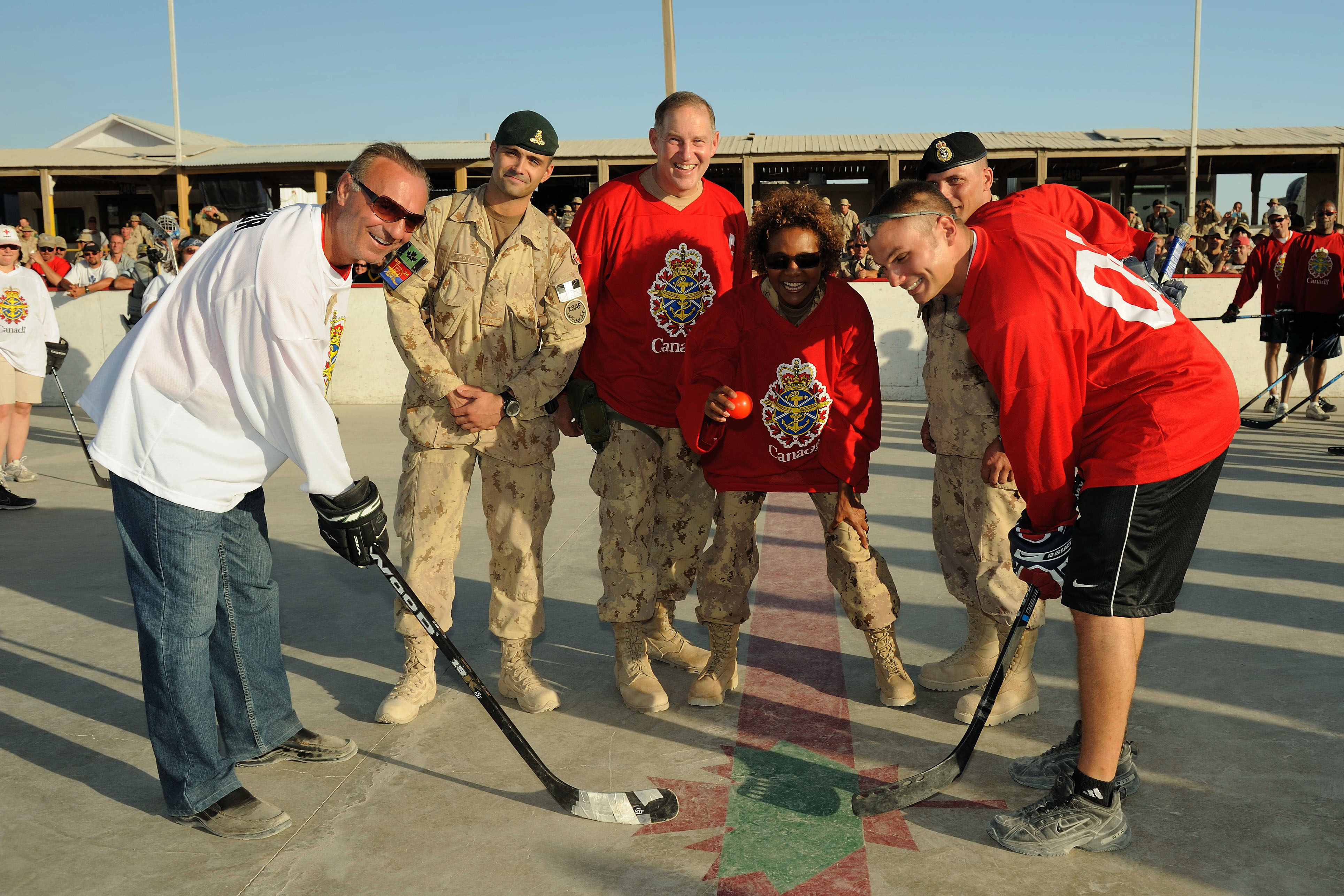
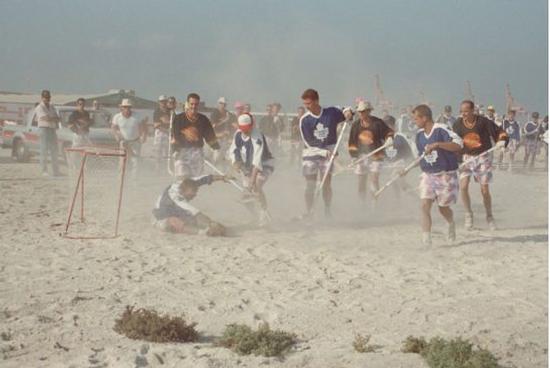
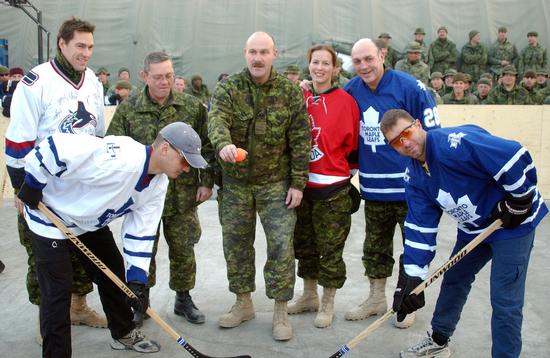
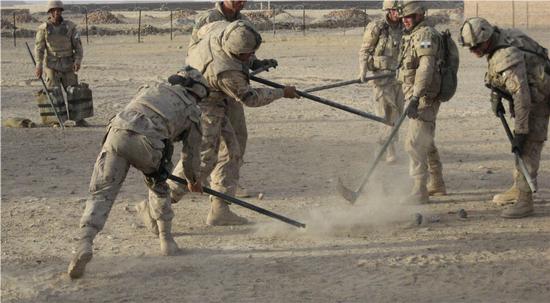
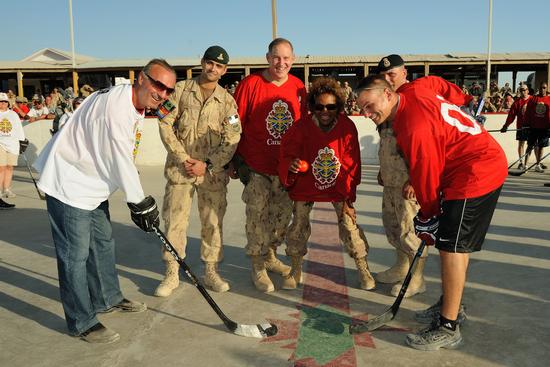
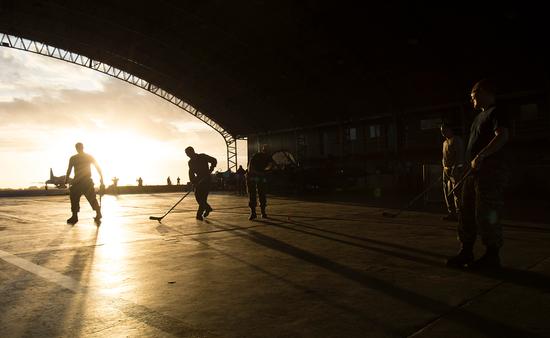
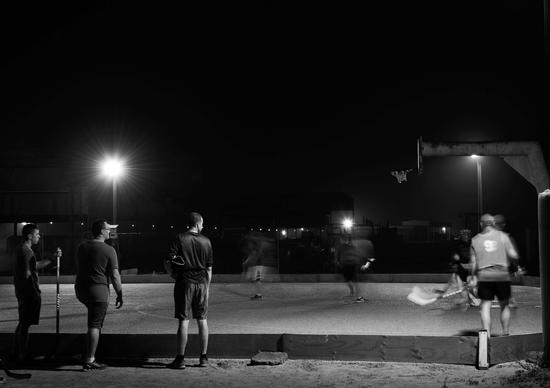
During the post-war years, many military bases across Canada built rinks to allow soldiers, sailors and airmen to play hockey for recreational and training purposes. Not surprisingly, the old military-hockey connection has continued in more recent times. Hockey sticks are sometimes packed when Canadian troops deploy in conflict zones. For example, in Kandahar, Afghanistan, where temperatures often reach 40°C, Canadian Armed Forces members built ball-hockey rinks. They played mostly at night, when the cooler temperature allowed for a faster-paced game. Former NHL players and celebrities like Guy Lafleur, Lanny MacDonald, Bob Probert and Don Cherry even went overseas to visit the troops, some of them playing exhibition games in mixed teams made up of hockey legends and serving members. But a hockey game wouldn’t be the same without referees, so former NHL officials were also on site to oversee the game!
The Right Honourable Michaëlle Jean, and General Natynczyk do the face-off of the Team Canada ball hockey game with Guy Lafleur and Corporal Grondin of 438 Tactical Helicopter Squadron in Afghanistan in 2008. Photo: Department of National Defence VL2009-0200-01
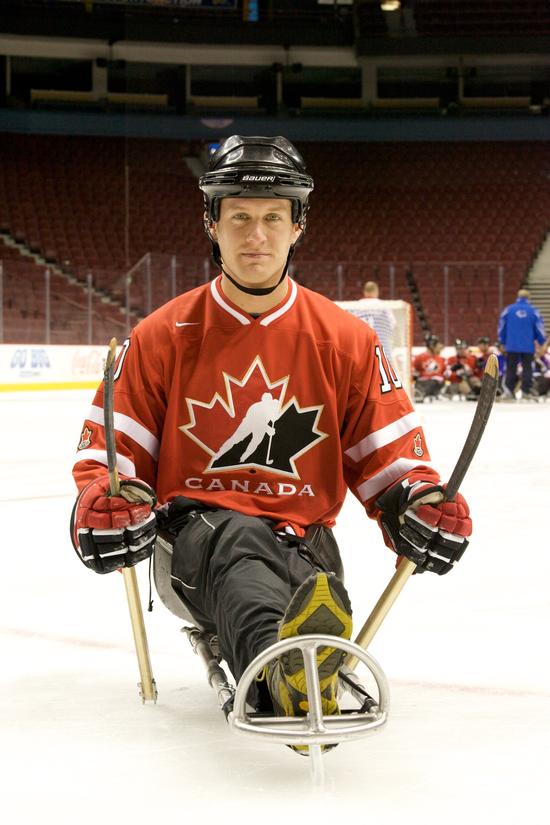
Hockey in the desert was helping boost the morale of our military but Afghanistan was a dangerous place to serve, and sadly some 158 CAF members lost their lives there during the course of our country’s 2001-2014 mission in the country. Many of our service members came back wounded, and stories of severely injured soldiers like Dominic Larocque demonstrate yet again the ties between hockey and the military. Losing a leg in Afghanistan, Larocque went through rehabilitation and was introduced to sledge hockey where he performed so well that he was selected to represent Canada in international competitions including the Paralympic Games. The team won a bronze medal in Sochi, Russia in 2014.
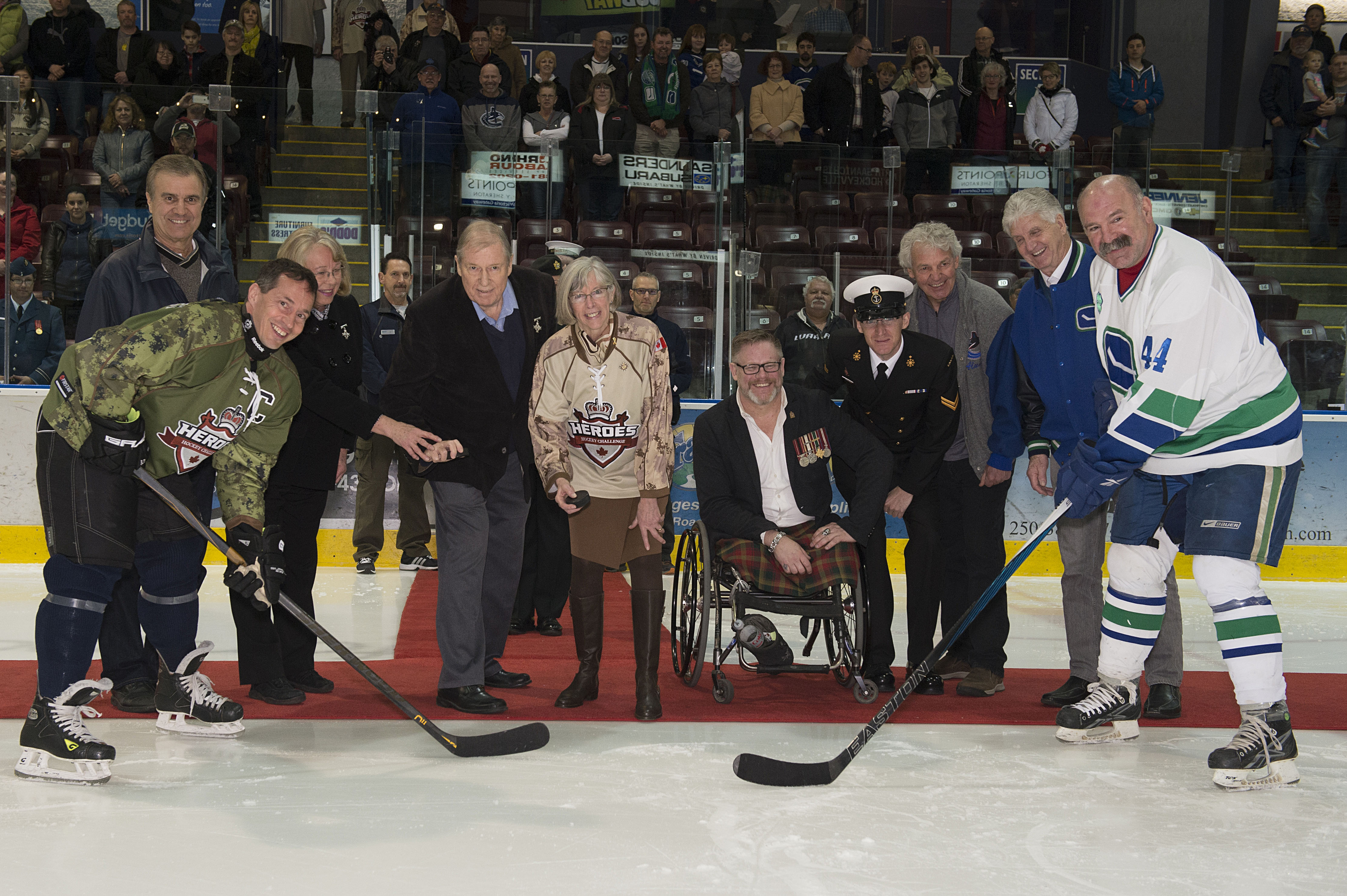
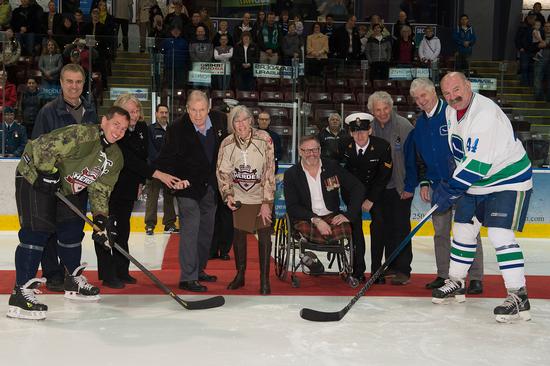
Today, many NHL teams have special games to honour the men and women in the Canadian Armed Forces. It is common to see professional athletes wear camouflage jerseys in warm-ups before those games and goaltenders sometimes play with specially-painted helmets that pay tribute to military members. Junior hockey teams design commemorative hockey jerseys, especially when playing in the Memorial Cup tournament. Ceremonial puck drops involving our men and women in uniform are held across Canada at all levels.
The Honourable Judith Guichon, Lieutenant Governor of British Columbia, prepares to drop the ceremonial puck at a game between the Vancouver Canucks Alumni and members of the Canadian Armed Forces in Colwood, British Columbia in 2016. Photo: Department of National Defence ET2016-0076-01
People and stories
Conn Smythe
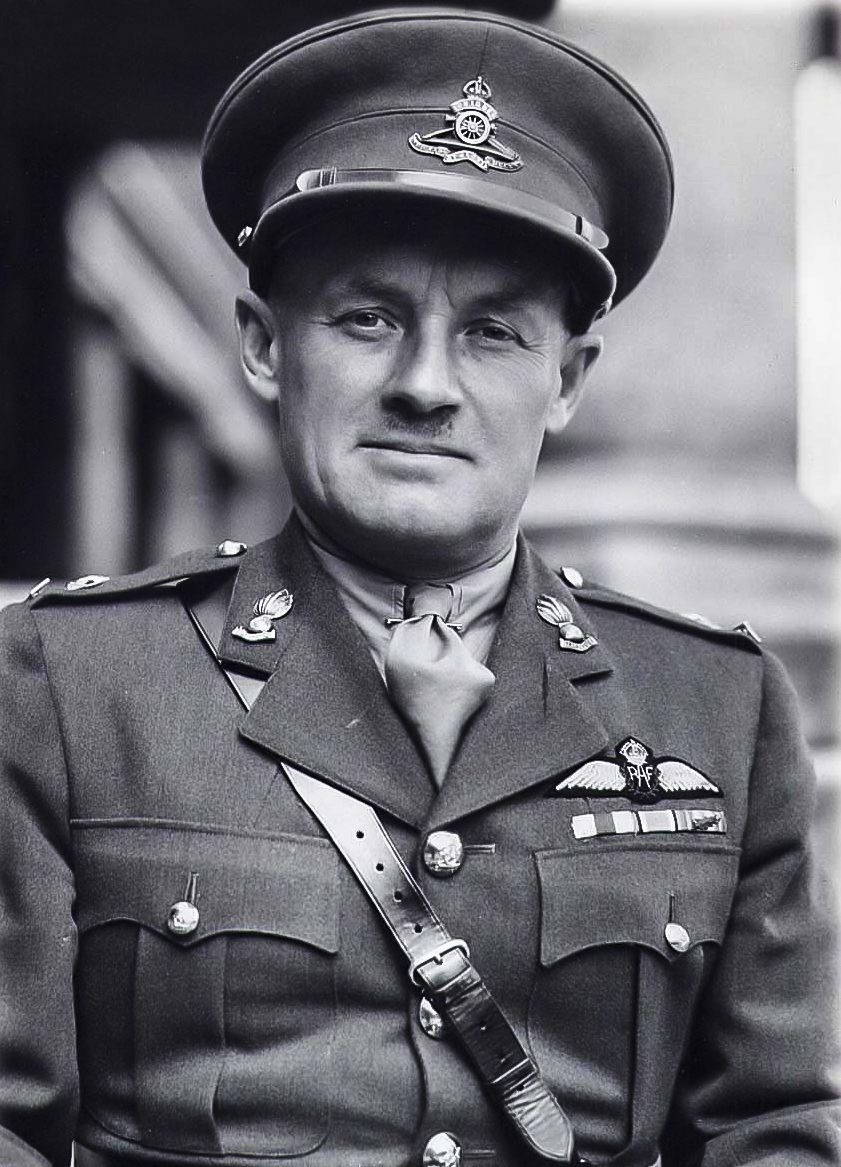
Conn Smythe in military uniform. Photo: MapleLeafs.com
Conn Smythe of Toronto played on the University of Toronto hockey team until the First World War interrupted his studies. A week after winning the Ontario Hockey Association championship in 1915, he and eight teammates enlisted. Smythe served in the Canadian Artillery where he earned the Military Cross. He transferred to the Royal Flying Corps in 1917 and was an airborne observer until being shot down and captured. Despite two escape attempts, he spent more than a year in a German prisoner of war camp.
Smythe returned to his hockey roots after the war and helped found the Toronto Maple Leafs. He also coached the Varsity Grads team that would go on to win at the 1928 Winter Olympic Games in St. Moritz, Switzerland. Smythe did not travel to Europe with his team in protest of a controversy over the eligibility of some of his players, but he still received a gold medal.
Remarkably, Smythe enlisted again at age 45 during the Second World War. He was commanding an artillery battery in France when he was wounded in an enemy bombing attack on an ammunition depot. Major Smythe survived, but suffered injuries that would affect him for the rest of his life. The National Hockey League trophy for the most valuable player in the playoffs is named in his honour.
Video stories
Watch and listen to personal recollections of Canadian Veterans with ties to hockey:
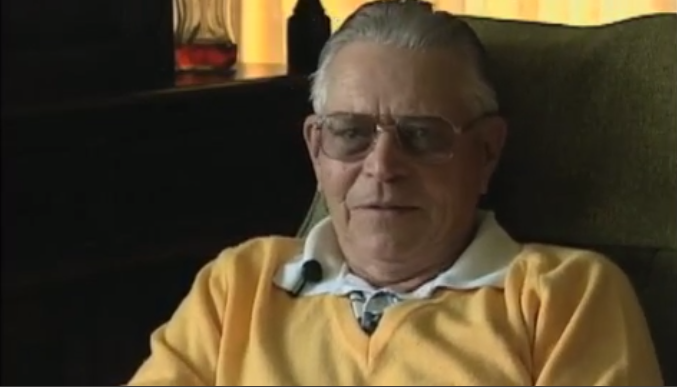
Mr. Stanway was born in Britain, and relocated to Montreal with his family at a young age and would develop into an elite junior hockey player. He joined the army 8 months after the Second World War began and would serve throughout the Italian campaign.
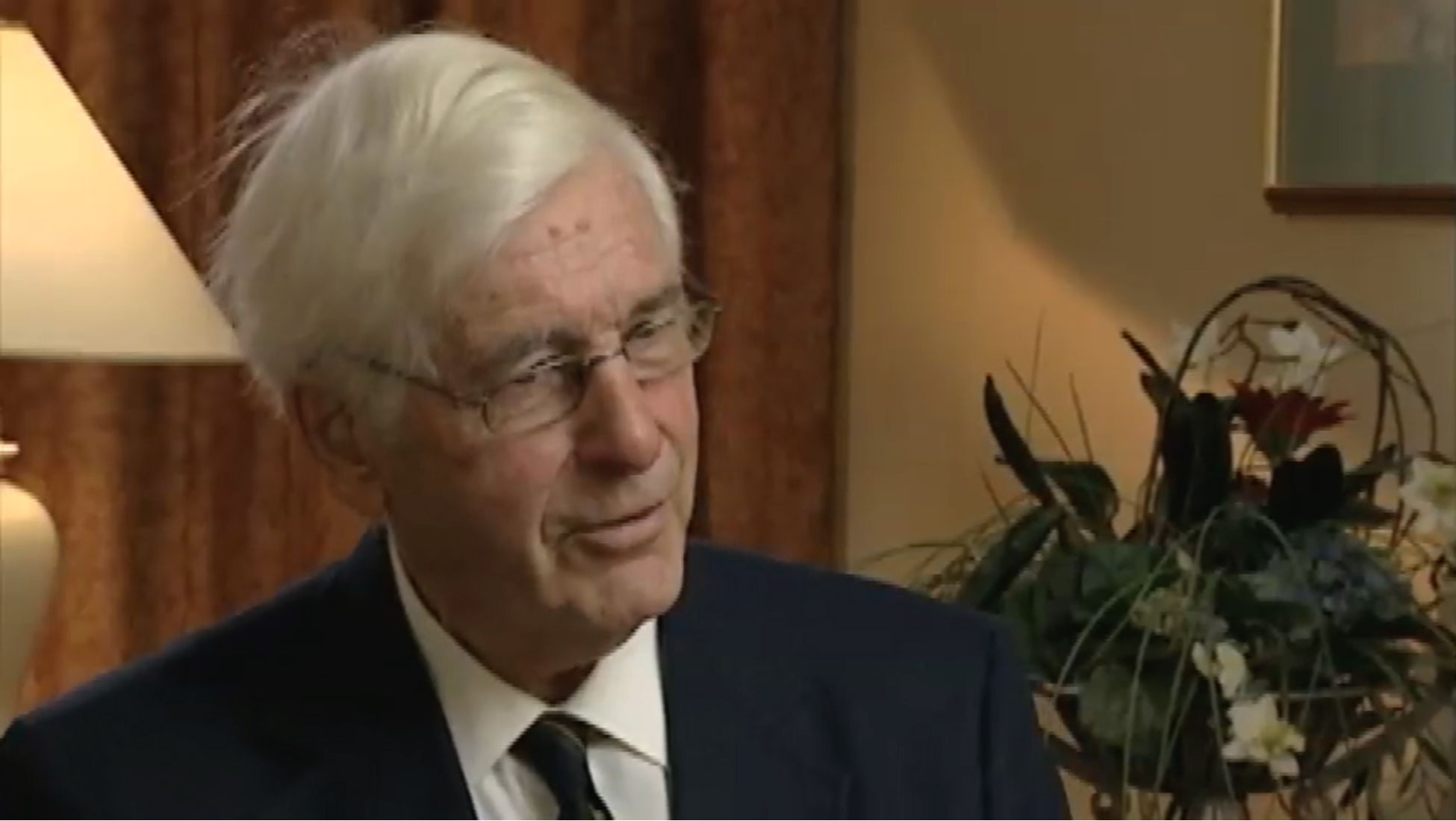
Mr. Edwards was born on a farm near Lockwood, Saskatchewan and had been good enough to try out for the Black Hawks hockey team before the war erupted. In June 1940, Mr. Edwards enlisted in the Air Force. By war’s end, he had served two tours of duty, flying over 360 missions. After the war was over he returned to Canada and continued service with the air force retiring as a wing commander.
Mr. McKiel was born in Lunenburg, Nova Scotia and joined 405 Squadron, Bomber Command in 1943; he was shot down and captured shortly thereafter. He would spend two years in prisoner of war camp, Stalag Luft 3, where he helped 76 officers escape, an event known as the “Great Escape.”
Mr. Williams describes the setup of camp within the soldiers compound and how they kept themselves entertained themselves while serving in Kosovo.
Honour Roll
Countless hockey players of all skill levels have served in the Canadian military over the years. Sadly, many of them gave their lives. View the list of Fallen Canadians with ties to hockey.
Photo Galleries
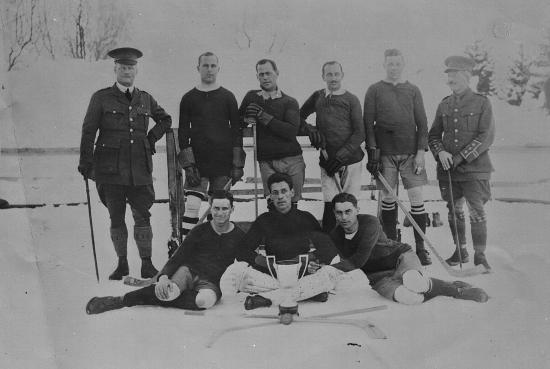
Hockey team during the First World War.
Photo: Library and Archives Canada 3386121
4 images
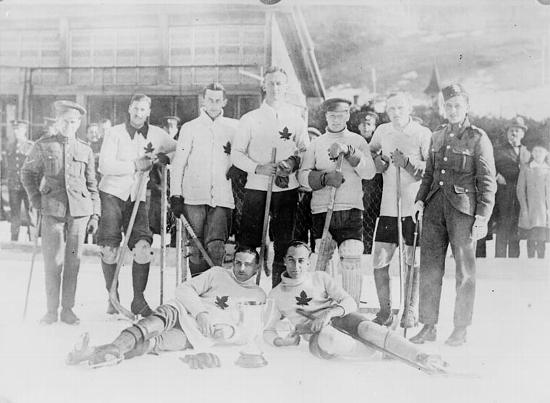
Champion hockey team among the Canadians interned in Switzerland in 1917.
Photo: Library and Archives Canada 3386118
4 images
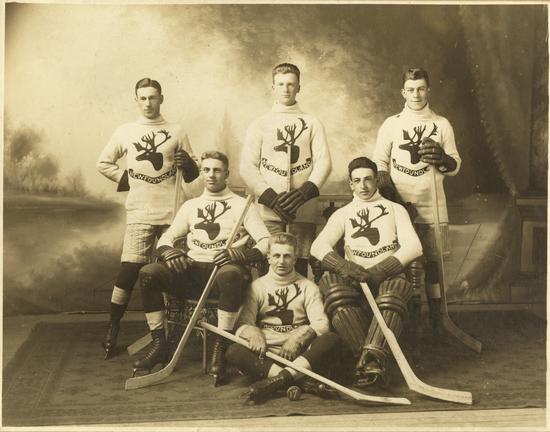
Royal Newfoundland Regiment hockey team in 1917.
Photo: The Rooms Provincial Archives Division, SANL 1.26.01.074
4 images
Five members of the 1914 Stanley Cup winners would one day be inducted in the Hockey Hall of Fame. Three of the future Hall of Fame players served in the Canadian Expeditionary Force during the First World War - Frank Foyston, George McNamara, and Allan McLean Davidson.
Photo: Canadian Virtual War Memorial
4 images
Photo gallery
First World War
Boston Bruins Hockey Club front line Bobby Bauer, Porky Dumart and Milt Schmidt, who left hockey to become members of the RCAF, seen taking their medicals in 1942.
Photo: Library and Archives Canada PA-108240
15 images
Winnipeg Rifles hockey team during the playoffs in 1942.
Photo: Library and Archives Canada 3607563
15 images
RCAF Flyers playing against the Quebec Aces in the Eastern Allan Cup Final in 1942.
Photo: Library and Archives Canada PA-108276
15 images
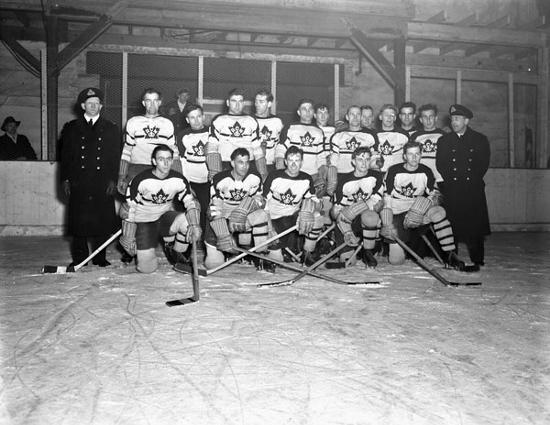
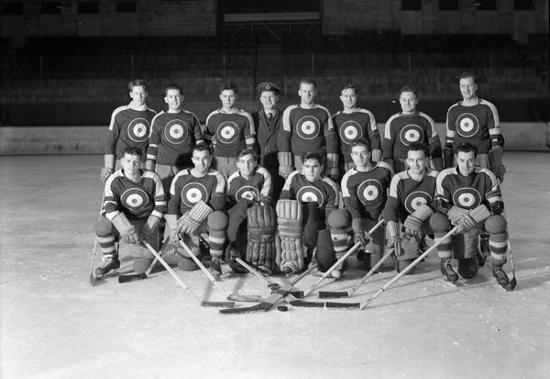
Royal Canadian Navy hockey team in Halifax, Nova Scotia in 1943.
Photo: Library and Archives Canada 3566772
15 images
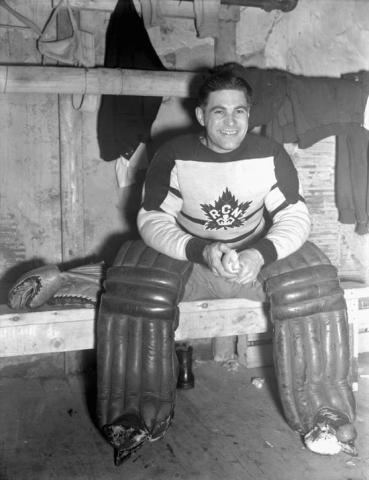
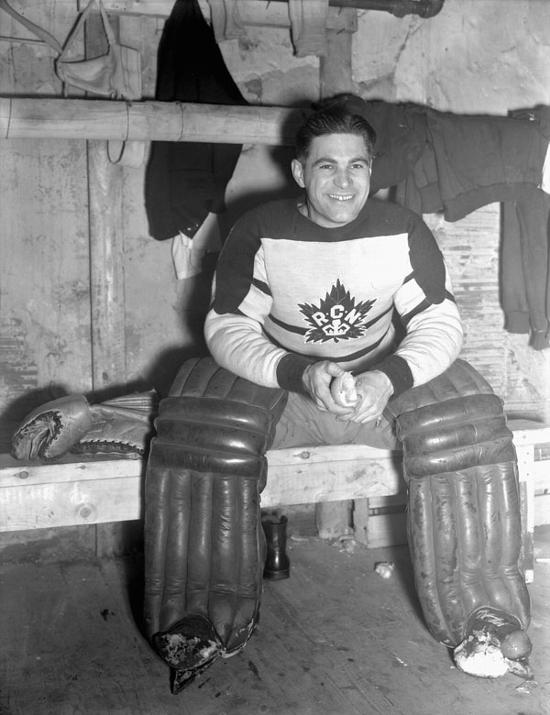
Hal Stade, goalie of the Royal Canadian Navy hockey team in 1943.
Photo: Library and Archives Canada 3566774
15 images
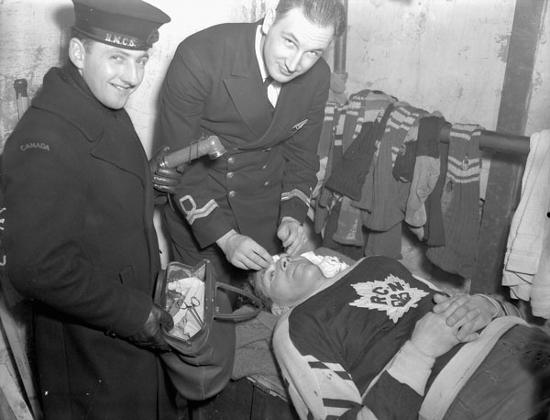
Sub-Lieutenant Fritz, of the Royal Canadian Navy hockey team, injured during a game in Halifax, Nova Scotia, in 1943.
Photo: Library and Archives Canada 3567107
15 images
RCAF No. 5 Operational Training Unit hockey team in British Columbia in 1943.
Photo: Library and Archives Canada 3199201
15 images
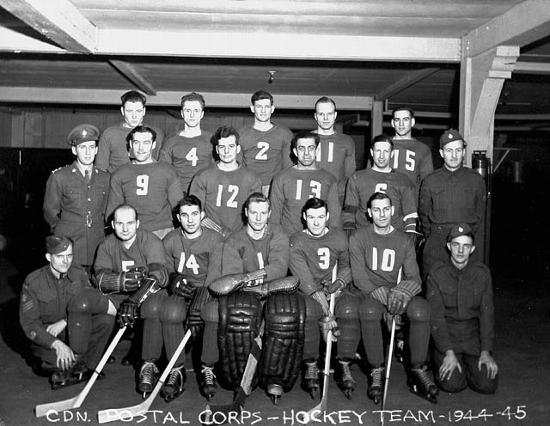
Canadian Postal Corps hockey team, 1944-1945.
Photo: Library and Archives Canada 2265922
15 images
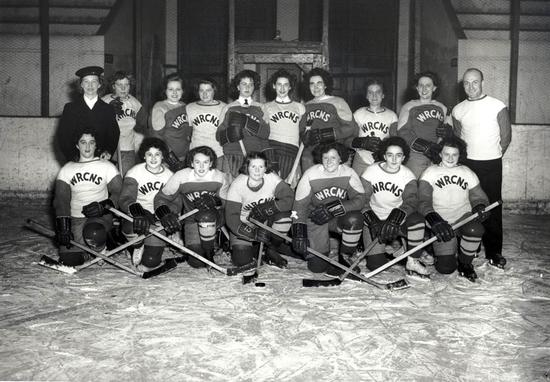
Women's Royal Canadian Naval Service hockey team in Halifax in 1944.
Photo: Library and Archives Canada PA-192638
15 images
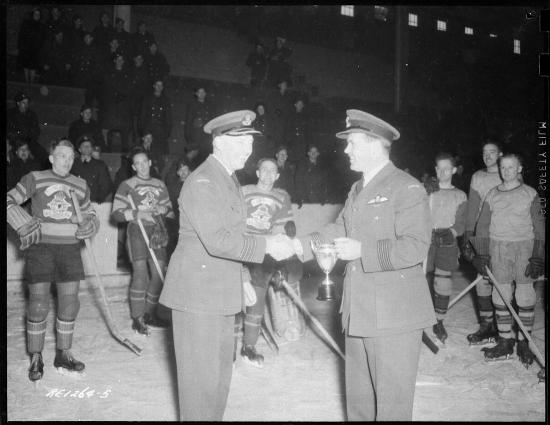
Aircraft Commanding Officer O'Brien at hockey game in 1944.
Photo: Library and Archives Canada 3583185
15 images
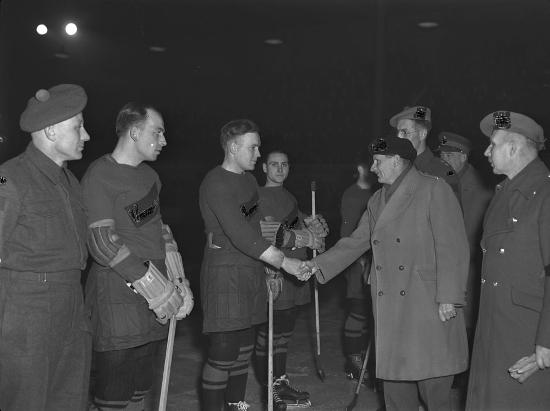
General Montgomery at Canadian Army hockey championship in 1944.
Photo: Library and Archives Canada 4542729
15 images
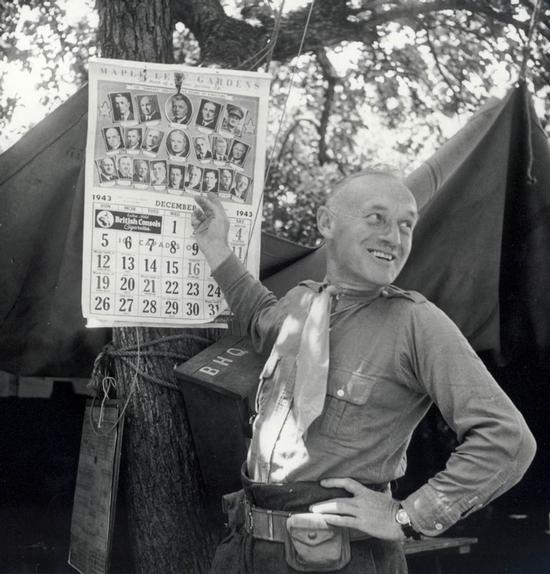
Major Conn Smythe, RCA, pointing out portraits of members of the Board of Directors of Maple Leaf Gardens on a Gardens calendar in France in 1944.
Photo: Library and Archives Canada PA-163191
15 images
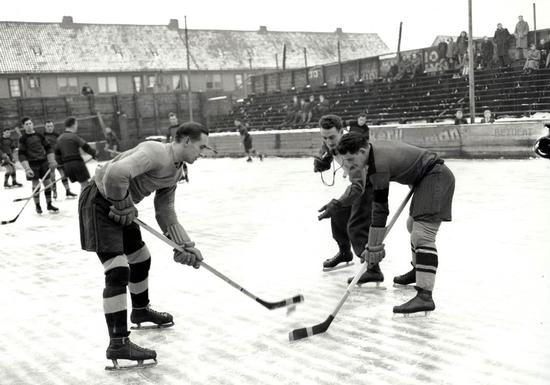
Corporal Vickeney drops the puck to start game in Tilburg, Netherlands, in 1945.
Photo: Library and Archives Canada PA-140902
15 images
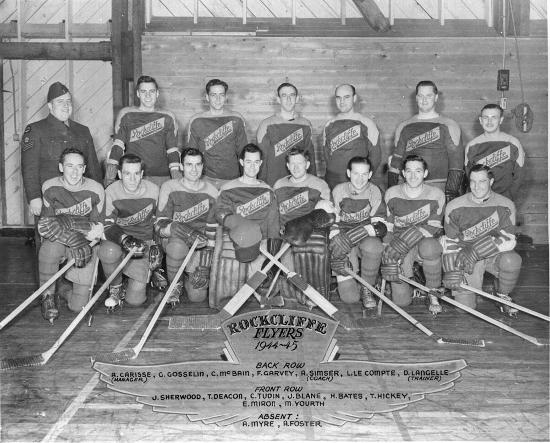
Rockcliffe Flyers hockey team in 1945.
Photo: Library and Archives Canada 3583744
15 images
RCAF Olympic hockey team in 1947.
Photo: Department of National Defense
15 images
Photo gallery
Second World War
Members of the 2nd Battalion Royal Canadian Regiment play hockey at Imjin Gardens in Korea in 1952.
Photo: Library and Archives Canada PA-188736
6 images
First official hockey game played by Royal Canadian Regiment in Korea in 1952.
Photo: Library and Archives Canada PA-184478
6 images
Imjin Gardens is the scene of a hockey game between teams of the Royal Canadian Horse Artillery officers and "Van Doos" officers in Korea in 1952.
Photo: Library and Archives Canada PA-188700
6 images
Hockey game between the Royal 22e Régiment and the Royal Canadian Horse Artillery in Korea in 1952.
Photo: Library and Archives Canada PA-184715
6 images
Some 400 spectators watch the 26 Canadian Infantry Brigade championship hockey game at Imjin Gardens in Korea in 1953.
Phoot: Library and Archives Canada PA-173471
6 images
Royal 22e Régiment hockey team members McCormick, Pelchat and Savard in Korea in 1953.
Photo: Library and Archives Canada PA-136787
6 images
Photo gallery
Korean War
Hockey game in the desert between sailors from HMCS Protecteur and HMCS Athabaskan in Bahrain, in 1990.
Photo: Department of National Defence
14 images
The first “Short/Beerenfenger Hockey Tournament”, at Camp Julien, in Afghanistan in 2003.
Photo: Department of National Defence KA2003-A446D
14 images
Hotel Company Combat Team, members of 2nd Battalion, Royal Canadian Regiment Battle Group, plays austere hockey at Patrol Base Wilson in 2007.
Photo: Department of National Defence ISX2007-0001
14 images
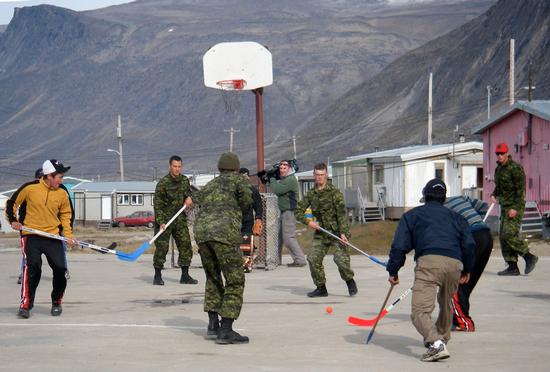
Soldiers from Eastern Ontario's 33 Canadian Brigade Group participate in a ball hockey game, with residents of Pangnirtung in Nunavut in 2008.
Photo: Department of National Defence ISX2008-0022
14 images
The Right Honourable Michaëlle Jean, and General Natynczyk do the face-off of the Team Canada ball hockey game with Guy Lafleur and Corporal Grondin of 438 Tactical Helicopter Squadron in Afghanistan in 2008.
Photo: Department of National Defence VL2009-0200-01
14 images
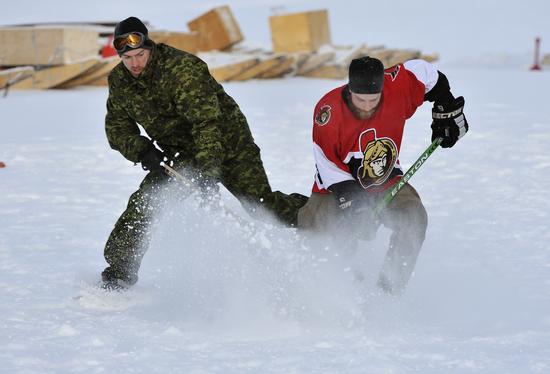
Leading Seamen Zurbriggen and Green fight for the hockey ball during Operation NUNALIVUT 10 Sports Day in CFS Alert in 2010.
Photo: Department of National Defence IS2010-3010-5
14 images
Members of the Royal Canadian Air Force play ball hockey with colleagues from other countries during a multinational exercise in Brazil in 2013.
Photo: Department of National Defence TN2013-0518-113
14 images
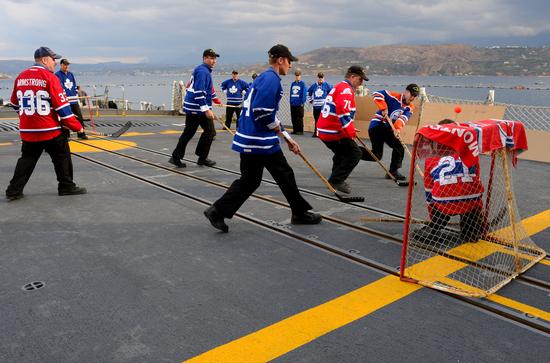
Ball hockey game on HMCS Toronto in the port of Chania, Greece during Operation REASSURANCE in 2014.
Photo: Department of National Defence IS2014-1054-06
14 images
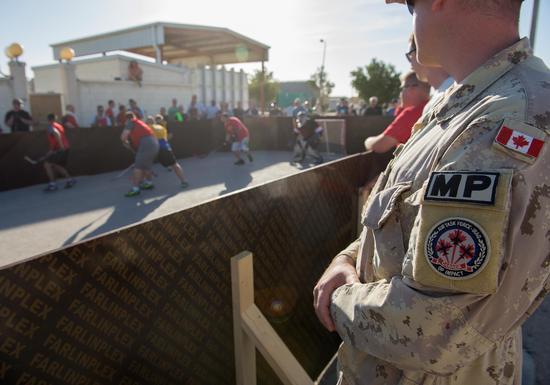
Members of Air Task Force - Iraq playing a game of ball hockey at Camp Patrice Vincent, in Kuwait, during Operation IMPACT in 2015.
Photo: Department of National Defence GD2015-0107-01
14 images
Members of Air Task Force - Iraq take part in a ball hockey game at Camp Patrice Vincent, in Kuwait during Operation IMPACT in 2015.
Photo: Department of National Defence GD2015-0110-33
14 images
Veteran Dominic Larocque played sledge hockey at the 2014 Paralympic Winter Games in Sochi, Russia.
Photo: Department of National Defence
14 images
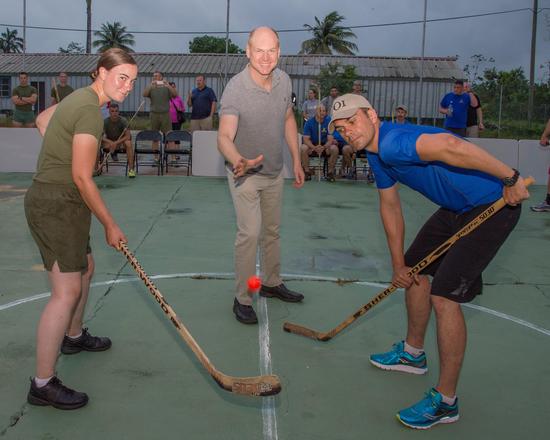
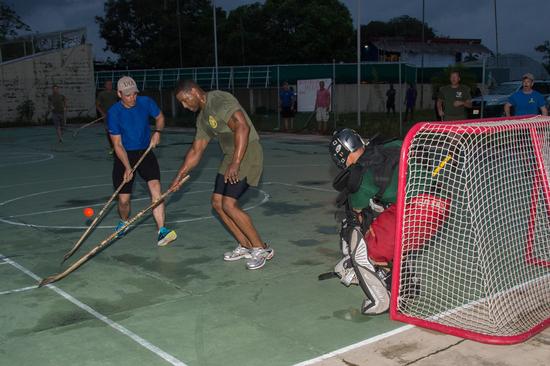
Ball hockey game between Canada and the United States during a friendly tournament in Belize in 2015.
Photo: Department of National Defence Sgt Yannick Bédard
14 images
Ball hockey game between Canada and the United States during a friendly tournament in Belize in 2015.
Photo: Department of National Defence
14 images
The Honourable Judith Guichon, Lieutenant Governor of British Columbia, prepares to drop the ceremonial puck at a game between the Vancouver Canucks Alumni and members of the Canadian Armed Forces in Colwood, British Columbia, in 2016.
Photo: Department of National Defence ET2016-0076-01
The Memorial Cup, one of the most prestigious and coveted trophies in North American sport, has a rich tradition that has shaped the way junior hockey is played in North America.
The Juno Beach Centre partnered with the Ontario Hockey League, in association with the Canadian Hockey League, to commemorate the 70th Anniversary of D-Day and the Normandy Landings.
Known as the Northern Fusiliers, the 228th mustered in North Bay, Ontario, under the command of Lt.-Col. Archie Earchman, and was successful in recruiting talented hockey players in the fall of 1916.