
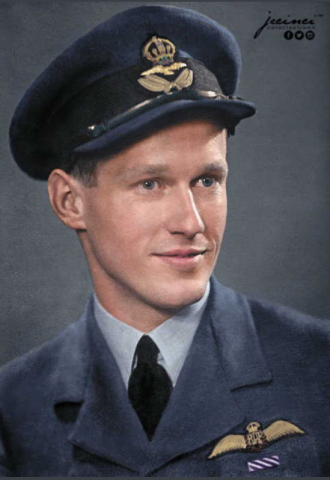
Ian Willoughby Bazalgette was born in Calgary on 19 October 1918. His family moved to Toronto in 1923 and then moved back to England in 1927.
In September 1940 he received a commission in the Royal Artillery and the following year he transferred to the Royal Air Force Volunteer Reserve. In the autumn of 1942 he was posted to No. 115 Squadron, R.A.F. for flying duties.
In September 1943 he went to an operational training unit as an instructor and in April 1944 he was posted to No. 635 (Pathfinder) Squadron as a flight commander with the rank of Squadron Leader. He earned a Distinguished Flying Cross in Italy on 9 July 1943.
The following particulars of his Victoria Cross are given in the London Gazette of 14 August 1945:
On 4 August 1944 Squadron Leader Bazalgette was "Master bomber" of a Pathfinder Squadron detailed to mark an important target at Trossy St-Maximin for the main bomber force.
When nearing the target his Lancaster came under heavy anti-aircraft fire. Both starboard engines were put out action and serious fire broke out in the fuselage and the starboard main-plane.
The bomb aimer was badly wounded. As the deputy "master bomber" had already been shot down, the success of the attack depended on Squadron Leader Bazalgette and this he knew. Despite appalling conditions in his burning aircraft, he pressed on gallantly, marking and bombing it accurately. That the attack was successful was due to his magnificent effort.
After the bombs had been dropped, the Lancaster dived, practically out of control. By expert airmanship and great exertion Squadron Bazalgette regained control. But the port inner engine then failed and the plane became a mass of flames. Squadron Leader Bazalgatte fought bravely to bring his aircraft and crew to safety.
The mid-upper gunner was overcome by fumes. Squadron-Leader Bazalgatte then ordered those of his crew who were able to leave by parachute to do so. He remain at the controls and attempted the almost hopeless task of landing the crippled and blazing aircraft in a last effort to save the wounded bomb aimer and helpless air gunner.
With superb skill and taking great care to avoid a French village, he brought the aircraft safely down. Unfortunately, it immediately exploded and this gallant officer and his two remaining crew members comrades – F/L Ivan Hibbert DFC and F/S Vernon Leeder – perished.
His remains were hidden by the local civilians until the arrival of the liberation forces. Then, on 8 October 1944, in a ceremony attended by his sister, Ethel, his body was laid to rest in Senantes Churchyard, Beauvais, France.
At the end of the war, the four survivors of the crew returned to England, and the full story of their last sortie was pieced together. Bazalgette was immediately recommended for the award of a posthumous Victoria Cross.
His heroic sacrifice marked the climax of a long career of operations against the enemy. He always chose the more dangerous and exacting roles. His courage and devotion to duty were beyond praise.
Recognition
His medal is on display at the Royal Air Force Museum (England).
In 1949, Mount Bazalgette in Jasper National Park was named after him.
In 1974, he was inducted as a Member of Canada's Aviation Hall of Fame.
In 1990 at the Nanton Lancaster Museum (Alberta) a plaque was unveiled by Ethel Broderick, Ian’s sister, and the markings of the Bazalgette aircraft (F2-T) were unveiled by Chuck Godfrey DFC, his wireless operator on the VC flight, and George Turner, his flight engineer.