
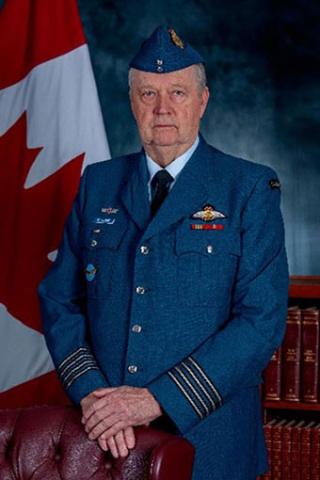

Joined
Regular Force 1979, Rejoin Reserve Force 1992

Postings
- CFB Chilliwack,
- CFB St-Hubert,
- CFB Portage la Prairie,
- CFB Winnipeg,
- NDHQ Ottawa,
Reserves postings at
- CFB Trenton,
- CFB Cold Lake,
- CFB Edmonton

Medals
- CD (second clasp July 2025)
- Sovereigns Medal for Volunteers
This content references suicide. If you’re thinking about suicide or worried about someone you know, call or text 9-8-8 any time for support. Whatever you’re going though, you are not alone.
If you are a Veteran, family member or caregiver in need of mental health support, the VAC Assistance Service is available to you 24/7, 365 days a year at no cost. Call 1-800-268-7708 to speak to a mental health professional right now.
A natural
Even before graduating high school, Steven Deschamps learned to fly.
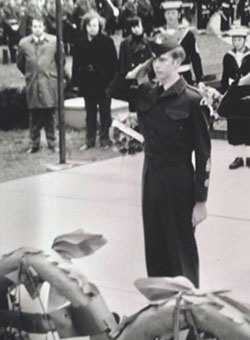
Young Air Cadet Steven salutes in front of a local cenotaph, ready to start his career in the Canadian Armed Forces.
Born into a military family in Cornwall, Ontario, Steven followed his older brothers and joined the Air Cadets. By the time he was finished with high school, he had qualified as a pilot.
“When you like something, you do well,” he says. “I became a pilot as a cadet and learned how to fly and started thinking, my career is going to be an Air Force officer.”
After graduation, Steven considered joining the Canadian Armed Forces (CAF) through the Officer Candidate Training program (ROTP), attending military college. But there was a complication.
“While I can't say that I knew that I was gay, there were overtones that suggested that it's not a good thing. If you were 18, 19 years old in 1979, it wasn't a safe place to be ‘out’.
“If it was known you were gay, you'd get discriminated in so many ways: ostracized by people around you, employers would not want you to be around. So you made sure you didn't show yourself to be gay.”
Being gay was also a reason to be dismissed from the Canadian military in 1979. “I reasoned, if I went to military college and then something went wrong, I’d owe the government a bunch of money for the college debt.”
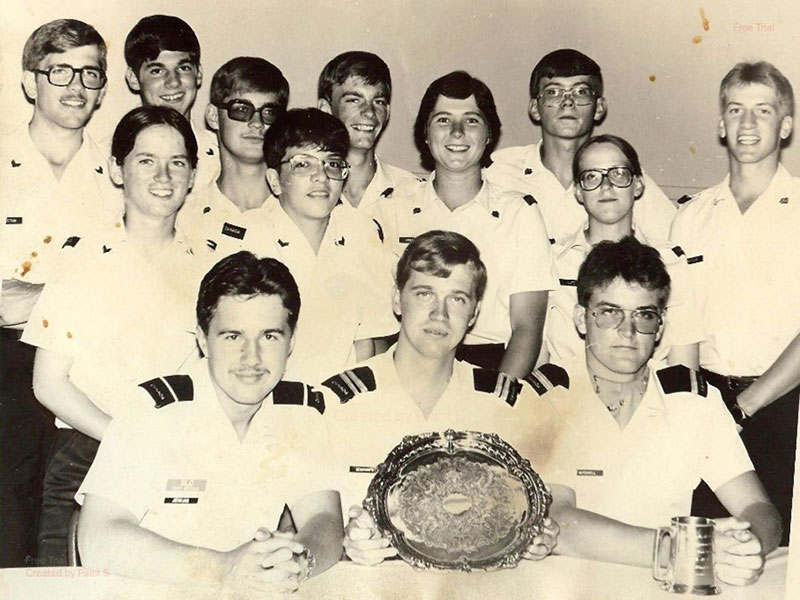
Steven Deschamps, middle front.
Instead, Steven joined the Direct Entry Officer (DEO) program after completing a three-year program at Saint Lawrence College in Cornwall.
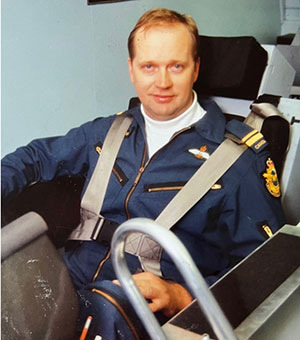
Steven Deschamps fulfilling his lifelong ambition to become a pilot.
“In 1979, I fulfilled my lifelong ambition. I had eight years in uniform at that point. I knew what the system was like and I loved it. I joined the armed forces as a regular force officer because I wanted to be a pilot.”
In 1980, Steven was posted to 10 Tactical Air Group at Canadian Forces Base (CFB) Saint-Hubert in Montreal for on-the-job training as a pilot while he waited for a posting to open at flying school. It was during this time that he met Denis. “I’m 22, 23 years old, now a Second Lieutenant, and I’m falling in love. And sure enough, the message comes: ‘You’re posted to Portage la Prairie, Manitoba, to learn how to fly.’”
The long-distance relationship became too much of a strain. Steven asked to be released from pilot training, and took a position as a public relations officer in Ottawa to be near Denis. There, he moved into an apartment with Denis. “My boyfriend and I could be roommates. That was the pseudo-relationship that we had to have to hide in.”
Caught in the LGBT Purge
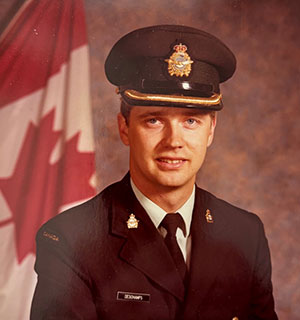
Steven Deschamps as a young Air Force Officer.
In April of 1982, he received a summons to attend a background check with the Special Investigations Unit at Royal Canadian Air Force (RCAF) Base Ottawa North, also called Rockcliffe. Two plain-clothes sergeants took him into a windowless room, where they showed him an anonymous letter that claimed he was gay.
“I think I stopped breathing at that point. For the next five hours or so, they interrogated me. Where did this letter come from? Which I had no idea—nor did they.”
The questioning became increasingly aggressive. “At one point, I just told them what they wanted to know and said, ‘I’m gay.’ Then they wanted to know more. ‘Who do you know? Where do you go to meet other gay people?’ And then very personal questions about your sex life.
“If I had been allowed to have a lawyer, none of this would have occurred. During the interrogations, we were deprived all legal rights and ordered not to tell anyone about the investigation, not even a priest.”
But this was 1982, and according to Canadian Forces Administrative Order (CAFO)19–20, homosexuality was grounds for release. The interrogators also threatened Deschamps with jail if he spoke about the event.
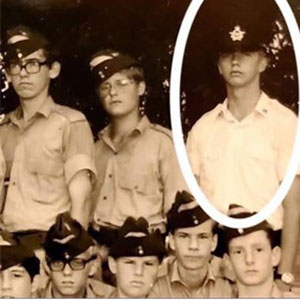
Deschamps’ dreams of becoming a pilot were quickly fading away as the LGBTQ Purge interrogations continued.
The Brigadier General of his division told him he was a disgrace to the armed forces and the people of Canada, and particularly to his unit. But that was not the only humiliation.
“I was paraded through National Defence headquarters for release. It's a really weird thing, because it's like being paraded through a prison. People are whispering, ‘gay’ or something like that. A military policeman took me to the front door of the NDHQ at 101 Colonel By Dive, took my pass away and then booted me out onto the street.
“I remember thinking there was the Laurier Bridge there, and thought if I jumped off, it could all end. But I reasoned the bridge wasn't high enough to kill me and no one would know why I would want to kill myself.”
The dismissal weighed heavily on Deschamps. “I was suffering from PTSD, but I didn't know it. I drank heavily at times.
“I thought I was the only one. That was very much the case for all of us. When I talked to other Purge survivors later, I found they went through the same thing. We all thought we were the only ones this ever happened to, we had no idea that this was a purge, a very large thing.”
But Deschamps proved far more resilient than the CAF gave him credit for in 1982. He quickly moved into another career, starting at Algonquin College in Ottawa, and then with IBM in Toronto. “I thrived,” he says. “IBM sent me to their own engineers school and I was trained in the latest computer technology.”
Many other LGBT Purge victims did not thrive. Many suffered shame, depression, even ostracization from their families and communities. Some died by suicide.
Deschamps points out an irony of his story: at the same time that he was being dismissed for being gay in 1982 in Ottawa, Queen Elizabeth II and Pierre Elliot Trudeau, Prime Minister of Canda, were signing the Canadian Constitution which included the Charter of Rights and Freedoms—legislation that forbids discrimination on the grounds of sexual orientation.
Ten years later, he decided to address “this ignominious release in the armed forces.” He applied to re-enter the CAF, reasoning that if rejected, he could claim discrimination under the Charter of Rights and Freedoms.
Meanwhile, another survivor, Michelle Douglas, had launched a Charter lawsuit over her dismissal as part of the purge. In October 1992, the federal courts approved a settlement in favour of Douglas, and the Chief of Defence Staff repealed CFAO 19–20 on 30 October. With that decision, Steven Deschamps was re-enrolled in the Reserves.
“The showdown that fall at the Vancouver Recruiting Centre was intensely stressful. My Commanding Officer had been instructed by Headquarters to coach me into denying that I was gay—to claim it had all been a mistake back in 1982. That way, they could quietly turn a blind eye. I remember telling my CO, I refused to lie in 1982 and they kicked me out. Now, HQ would have me lie so they could let me back in? I told them—'don’t ask the question!’”
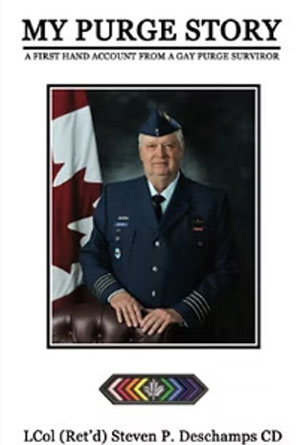
The book was a way for Deschamps to express how important it is for everyone to be accepting of each other.
Back in uniform, Deschamps rose to the rank of Lieutenant Colonel. Over the years, he says he saw a rapid evolution in the Canadian Armed Forces.
“Back in the late 2000s, young officers requested to serve with me because they knew that the CO was a gay man. It was a safe environment for them to serve.
"We must move beyond judging people through the distorted lens of what society has deemed 'normal.' These value judgments serve only to marginalize and divide. True inclusion begins when we look someone in the eye, see them for who they are—not how others define them—and ask, 'How can I be supportive?' That simple shift in perspective has the power to build a more just and compassionate society.” That conviction led Steven to publish “My Purge Story: A First Hand Account from a Gay Purge Survivor,”, all about his experiences being dismissed from the CAF, and then re-enlisting as a gay person.
The way forward
Steven Deschamps retired from the Reserves in 2013, but his service did not end there. In 2022, he was appointed Honourary Colonel of the 443 Maritime Helicopter Squadron in Victoria, BC.
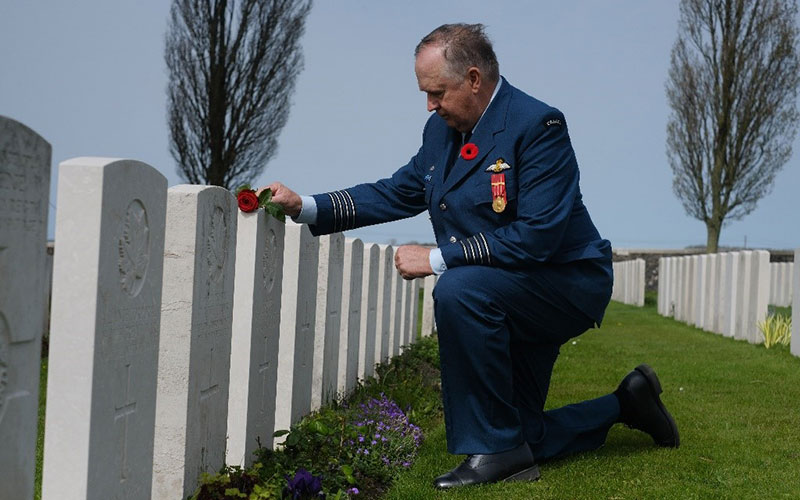
Deschamps wants to ensure that the stories of the LGBTQ Purge are heard to avoid history repeating itself.
His uniform proudly bears the Canada Pride Citation. He is one of only three CAF members wearing the citation today. In his pocket is the Rainbow Veterans of Canada crest. “I’m very proud of it. It’s the first in Canada to have King Charles III’s Royal Crown on it. It’s called the Canadian King’s Crown, and it was proclaimed on the first of May, 2024. It’s the first time King Charles III has lent credence to a gay military organization.”
“Artifacts like this show that people will take our story seriously and want to understand it better, so that we can never repeat it.”
With courage, integrity and loyalty, Steven Deschamps is leaving his mark. He is a Canadian Armed Forces Veteran. Discover more stories.
From now until early 2026, The Canadian Museum for Human Rights will have Love in a Dangerous Time: Canada’s LGBT Purge exhibit on display to bring light to more stories from survivors of the LGBT Purge. There is also a travelling pop-up exhibition.
The well-being of Canadian Veterans is at the heart of everything we do. As part of this, we recognize, honour and commemorate the service of all Canadian Veterans. Learn more about the services and benefits that we offer.
If you are a Veteran, family member or caregiver, the support of a mental health professional is available anytime at no cost to you. Call 1-800-268-7708.