British Columbia

Province Code
BC
City/Municipality
Vancouver
Memorial Number
59026-055
Type
Address
Burrard Street and W 15th Avenue
Location
Canadian Memorial United Church, Narthex
in Canada
Yes
GPS Coordinates
49.2580818, -123.1459623
Inscription

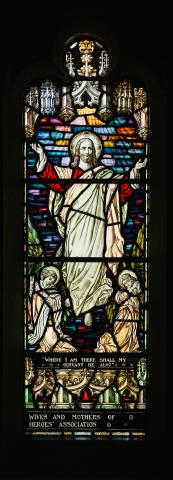
"WHERE I AM THERE SHALL MY
SERVANT BE ALSO."

WIVES AND MOTHERS OF
HEROES' ASSOCIATION.

Image
Photo Credit
Canadian Memorial United Church and Centre for Peace
Caption
The Transfigured Soldier stained glass window
War or Conflict Term
Province
!4v1622487793072!6m8!1m7!1sBhTo-GoGMRoV-vQ0me-CTw!2m2!1d49.25808175008721!2d-123.1459623271083!3f226.2479404422196!4f8.907012790348716!5f1.4499580245881227
Body Content

The Transfigured Soldier was erected in Canadian Memorial United Church by the widows, wives and mothers of Great Britain’s Heroes’ Association and was dedicated by Mrs. J.C. Kemp. It depicts a soldier dying on the battlefield with Jesus ministering to him. 

City
Vancouver
Country
Type Description
Stained glass window
Memorial CF Legacy ID
11115
City/Municipality
Vancouver
Memorial Number
59026-054
Type
Address
Burrard Street and W 15th Avenue
Location
Canadian Memorial United Church, Narthex
in Canada
Yes
GPS Coordinates
49.2580818, -123.1459623
Inscription

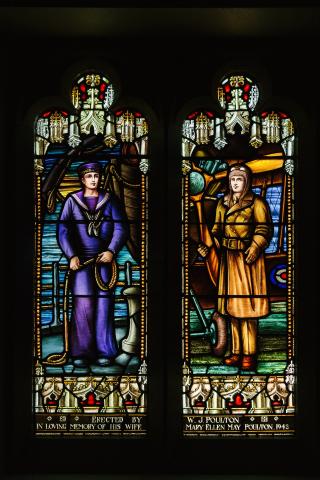
ERECTED BY W.J. POULTON
IN LOVING MEMORY OF HIS WIFE MARY ELLEN MAY POULTON, 1942

Image
Photo Credit
Canadian Memorial United Church and Centre for Peace
Caption
The Sailor and The Airman stained glass windows
1 of 3 images
Image
Photo Credit
Canadian Memorial United Church and Centre for Peace
Caption
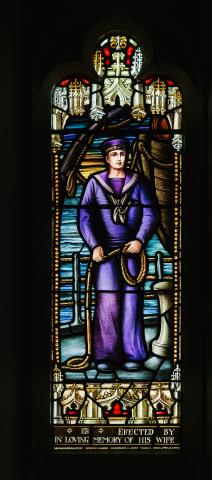
The Sailor
1 of 3 images
Image
Photo Credit
Canadian Memorial United Church and Centre for Peace
Caption
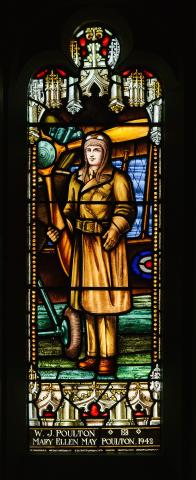
The Airman
1 of 3 images
Province
!4v1622487793072!6m8!1m7!1sBhTo-GoGMRoV-vQ0me-CTw!2m2!1d49.25808175008721!2d-123.1459623271083!3f226.2479404422196!4f8.907012790348716!5f1.4499580245881227
Body Content

The Sailor and The Airman were both erected in Canadian Memorial United Church by Mr. William Poulton and their inscriptions are to be read together. For many years, Mr. Poulton and his wife had taken a great interest in Canadian Memorial Chapel. 

A tribute to the many young Canadians who lost their lives on the high seas while serving in Canada’s navy, The Sailor depicts an ordinary seaman with sincerity, strength and courage standing out in his strong face.

The Airman honours the hundreds of young Canadians who gave their lives in flimsy aircraft with the Royal Flying Corps or Royal Naval Air Service  and, when the two joined, the Royal Air Force. It was reproduced from a painting by Sir William Orpen, R.A., and depicts the extreme youthfulness of those who served in the Royal Air Force in the First World War. It was unveiled by Mrs. N. B. Gale, sister of the late Mrs. Wm. Poulton and dedicated by Reverend Arthur Bischlager, Naval Chaplain, Esquimalt.

City
Vancouver
Country
Type Description
Stained glass windows
Memorial CF Legacy ID
11114
City/Municipality
Vancouver
Memorial Number
59026-053
Type
Address
Burrard Street and W 15th Avenue
Location
Canadian Memorial United Church, Narthex
in Canada
Yes
GPS Coordinates
49.2580818, -123.1459623
Inscription

ERECTED BY
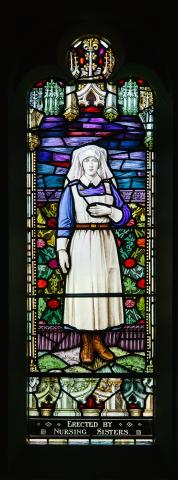
NURSING SISTERS

Image
Photo Credit
Canadian Memorial United Church and Centre for Peace
Caption
The Nurse stained glass window
War or Conflict Term
Province
!4v1622487793072!6m8!1m7!1sBhTo-GoGMRoV-vQ0me-CTw!2m2!1d49.25808175008721!2d-123.1459623271083!3f226.2479404422196!4f8.907012790348716!5f1.4499580245881227
Body Content

The Nurse was erected in Canadian Memorial United Church by Nursing Sisters of the First World War and dedicated by Captain the Reverend E.D. McLaren, MA, DD. The spiritual expression on the face of the nurse typifies sacrificial service. This window was held in special regard by the congregation because for years the surviving members of the Nursing Sisters attended their Remembrance Day service.

City
Vancouver
Country
Type Description
Stained glass window
Memorial CF Legacy ID
11113
City/Municipality
Surrey
Inscription

(Canada side)

BRETHREN DWELLING TOGETHER IN UNITY

(United States side)

CHILDREN OF A COMMON MOTHER

Province
!4v1660226287317!6m8!1m7!1sCAoSLEFGMVFpcE4xR0ltaWUySm1mdWx6UkNmZHN3R1I4MTJHMFVoblpJaHAyVjls!2m2!1d49.00226889799719!2d-122.7566207714994!3f267.5748302596101!4f19.713864423148095!5f0.7820865974627469
Body Content

Peace Arch Provincial Park is a 22-acre park commemorating the Treaty of Ghent from the War of 1812. A giant commemorative, concrete arch straddles the border of Canada and the United States. The 67-foot Peace Arch is jointly maintained by the two countries.

Sam Hill, a prominent American businessman, conceived the idea of the Arch to mark the War of 1812 treaty. Financed and built by Sam, the arch was initially known as Sam's Peace Arch. Designed by Augustus Warren Gould of Gould and Champney, construction began in 1920. The Peace Arch was fitted with two iron gates, left open to symbolize peace between the two great nations, and dedicated on 6 September 1921. Sam laid a hollow cornerstone within which he placed a hammered steel box made from a captured slave ship. Inside the box, he placed a piece of the Beaver and Mayflower. 

The Peace Arch was a vision Sam shared with his Canadian friend, former Mayor of Victoria British Columbia, Alfred Todd. Alfred recognized the ties between the United States and Canada were not just different, but exceptional. The two partnered for more than seven years to memorialize this harmony with an arch that would serve as a portal of peace between the two nations. 

The lands around the Arch were acquired through donations and fundraising efforts. Two decades later, on November 7, 1939, the Peace Arch and surrounding lands on the Canadian side were officially dedicated as Peace Arch Provincial Park. The flower garden in the parks is in the shape of the Canadian flag. 


City
Surrey
Country
City/Municipality
Vancouver
Memorial Number
59026-052
Type
Address
Burrard Street and W 15th Avenue
Location
Canadian Memorial United Church, Narthex
in Canada
Yes
GPS Coordinates
49.2580818, -123.1459623
Inscription

ERECTED BY THE
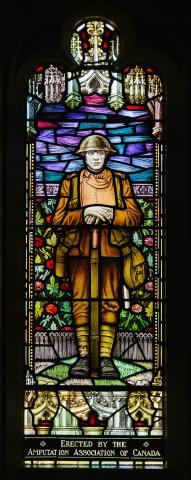
AMPUTATIONS ASSOCIATION OF CANADA

Image
Photo Credit
Canadian Memorial United Church and Centre for Peace
Caption
The Soldier stained glass window
War or Conflict Term
Province
!4v1622487793072!6m8!1m7!1sBhTo-GoGMRoV-vQ0me-CTw!2m2!1d49.25808175008721!2d-123.1459623271083!3f226.2479404422196!4f8.907012790348716!5f1.4499580245881227
Body Content

The Soldier was erected in Canadian Memorial United Church by the Amputation Association of Canada on behalf of their membership, who continue to be a living testament to the sacrifices that occur in war. It was dedicated by Brigadier-General Harold McDonald, CMG, DSO. 

City
Vancouver
Country
Type Description
Stained glass window
Memorial CF Legacy ID
11112
City/Municipality
Vancouver
Memorial Number
59026-051
Type
Address
Burrard Street and W 15th Avenue
Location
Canadian Memorial United Church
in Canada
Yes
GPS Coordinates
49.2580818, -123.1459623
Image
Photo Credit
Canadian Memorial United Church and Centre for Peace
Caption
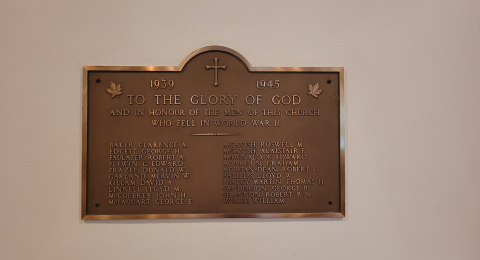
Canadian Memorial United Church Second World War Plaque
War or Conflict Term
Province
!4v1622487793072!6m8!1m7!1sBhTo-GoGMRoV-vQ0me-CTw!2m2!1d49.25808175008721!2d-123.1459623271083!3f226.2479404422196!4f8.907012790348716!5f1.4499580245881227
Body Content

In the west transept of Canadian Memorial United Church is a plaque honouring the men of this church who fell in the Second World War. It was donated, along with a picture of the grave of the Unknown Soldier, by Mrs. Louis Bennett.

City
Vancouver
Country
Type Description
Plaque
Memorial CF Legacy ID
11111
City/Municipality
Vancouver
Memorial Number
59026-050
Type
Address
Burrard Street and W 15th Avenue
Location
Canadian Memorial United Church
in Canada
Yes
GPS Coordinates
49.2580818, -123.1459623
Inscription

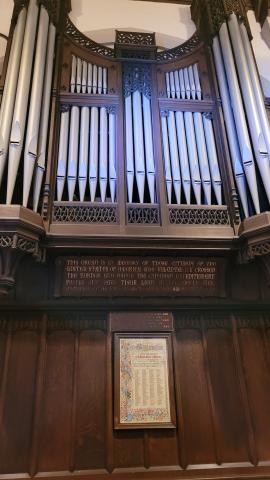
[Memorial Organ/Orgue du Souvenir]

THIS ORGAN WAS REBUILT AND REDEDICATED IN 1971 IN MEMORY OF MEMBERS OF THE ARMED FORCES WHO LOST THEIR LIVES IN THE SERVICE OF THEIR COUNTRY.

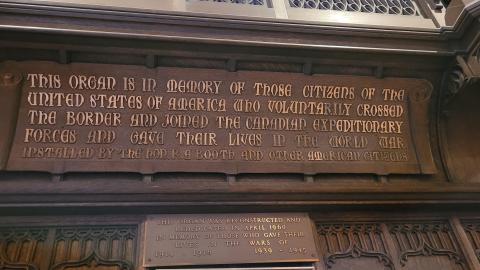
[Memorial Organ pipes right side/côté droit des tuyaux de l’orgue du Souvenir]

(plaque)
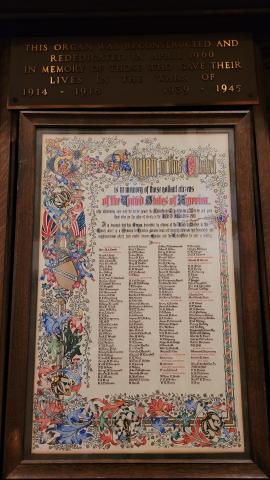
THIS ORGAN IS IN MEMORY OF THOSE CITIZENS OF THE
UNITED STATES OF AMERICA WHO VOLUNTARILY CROSSED
THE BORDER AND JOINED THE CANADIAN EXPEDITIONARY
FORCES AND GAVE THEIR LIVES IN THE WORLD WAR
INSTALLED BY THE HON. R.A. BOOTH AND OTHER AMERICAN CITIZENS

(plaque)
THIS ORGAN WAS RECONSTRUCTED AND
REDEDICATED IN APRIL 1960
IN MEMORY OF THOSE WHO GAVE THEIR
LIVES IN THE WARS OF
1914 - 1918      1939 - 1945

(framed print/reproduction encadrée) 
The Organ in this Church
is in memory of those gallant citizens
of the United States of America,
who voluntarily came over the border, joined the Canadian Expeditionary Forces, and gave
their lives on the altar of liberty in the World War, 1914-1918.

It is designed that this organ, presented by citizens of the United States to this
Church which is a Memorial to Canada's glorious dead, will tangibly illustrate that friendship and
neighbourliness which have existed between Canada and the United States for over a century.

Donors:

  • EUGENE: OREGON.
  • Hon. R.A. Booth.
  • PORTLAND: OREGON.
  • Frank C. Riggs.
  • William Whitfield.
  • Alex S. Pattullo.
  • Orin B. Coldwell.
  • Alex. C. Rae.
  • Dr. H.B. Hall.
  • Ben Selling.
  • E.H. Wyld.
  • Lawrence C. Dewlands.
  • Gwilym Jones.
  • P. Chappell Browne.
  • J.C. English.
  • Phil Grossmayer.
  • J.C. Hinsworth.
  • Nelson G. Pike.
  • E.P. Armstrong.
  • Thomas. J. Armstrong.
  • William Munsell.
  • Alex M. Clark.
  • John O.
  • Fred. J. Staver.
  • W.H. Rae.
  • W.H. Montgomery.
  • J.K. Gill.
  • Elliott R. Corbett.
  • T.D. Honeyman.
  • L.W. Cutler.
  • Ed. G. Titus.
  • Jack L. Wright.
  • C.H. Morden.
  • Phil Jackson.
  • S.J.H. French.
  • William Boyd.
  • Sidney C. Rasnnisseu.
  • E.S. Collins.
  • Frank H. Ransom.
  • George A. Braley.
  • Mrs. W. N. Youngson.
  • J.T. Wilson.
  • George M. Cormoall.
  • M. Smith.
  • R.U. Glisan.
  • R.J. Brix.
  • R.J. Paterson.
  • Robert A. Sprouse.
  • Eric V. Hansen.
  • Dr. J.H. Dickson.
  • Julius Meier.
  • James B. Kerr.
  • Amery Olmstead.
  • Guy W. Talbot.
  • Andrew R. Porier.
  • A.M. Wright.
  • S.P. Lockwood.
  • J.J. Ross.
  • SEATTLE: WASHINGTON.
  • A.S. Eldridge.
  • Mrs. A.A. Eldridge.
  • J.P. Douglas.
  • Horace C. Henry.
  • J.D. Lowman.
  • Hubbard F. Alexander.
  • A.B. Stewart.
  • B.A. Garber.
  • Thomas D. Stimson.
  • Mrs. Eupheunia R. Fisher.
  • Will P. Fisher.
  • O.D. Fisher.
  • Fred Everett.
  • Captain W.O. Mckay.
  • H.J. Jrrard.
  • L.G. Pattullo.
  • Otto R. Rabel.
  • John T. Lund.
  • Claude A. Eleilbrick.
  • John W. Eddy.
  • W.W. Moulton.
  • W. J. Norton.
  • Alexander Baillie.
  • R.D. Merrill.
  • Victor H. Effeuddahl.
  • Edward. W. Campbell.
  • W.W. Kent.
  • William L. Rhodes.
  • H. Manning.
  • J. Wilson.
  • John L. Heffernan.
  • James R. Stirrat.
  • A. McEwass.
  • Adolph H. Luiden.
  • R. Smith.
  • Gilbert M. Butterworth.
  • John C. Eden.
  • Harry G. Brace.
  • D.E. Skinner.
  • Worrall Wilson.
  • F.J. Martin.
  • Mrs H.S. Kerry.
  • Miss Glen Kerry.
  • Miss Olive Kerry.
  • James W. Spaugler.
  • Joshua Green.
  • P.W. Hull.
  • Mrs Montgomery Lynch.
  • Mrs. John McIver.
  • C.C. Carpenter.
  • W.T. Douglas.
  • C.A. Stewart.
  • A.S. Elford.
  • Mrs Maria T. Elford.
  • TACOMA: WASHINGTON.
  • Henry A. Rhodes.
  • Samuel Jackson.
  • Dr. E.A. Rich.
  • P.T. Beers.
  • Samuel Perkins.
  • A.P. Hickie,
  • James McCormack.
  • William B. Bust.
  • Art. Wiickens.
  • George Doug.
  • W.L. McCormack.
  • W.P. Hopping.
  • W.D. Hopping.
  • Major C.G. Griggs.
  • L. Howarth.
  • Will Killworth.
  • James A. Eves.
  • CENTRALIA: WASHINGTON.
  • Rocarians.
  • RAYMOND: WASHINGTON.
  • Rocarians.
  • HOQUIAM: WASHINGTON.
  • Frank Lamb.
  • EVERETT: WASHINGTON.
  • William C. Butler.
  • A.H.B. Jordan.
  • W.L. Winter.
  • W. Howorth.
  • Clayton Williams.
  • E.M. Metzger.
  • Dr. H.P. Howard.
  • MOUNT VERNON: WASHINGTON.
  • Charles E. Gackes.
  • BEELINGHAM: WASHINGTON.
  • R.A. Welsh.
  • E.W. Purdy.
  • E.B. Dewing.
  • A. Paige.
  • C. Morse.
  • J. Loggie.
  • Dan Campbell.
  • Mrs. C.X. Larrabee.
  • Norwal College.
  • PUYALLUP: WASHINGTON.
  • Charles Hood.
  • Mrs Charles Hood.
  • SOUTH ORANGE: NEW JERSEY.
  • G.W. Doane.
  • E.P. Balch.
  • A.G. Borden.
  • C.C. Baldwin.
  • Mrs. Herman Helms.
  • Mayor George Becker.
  • Fred Audrey.
  • Jroing Sickley.
  • O.D. Sickley.
  • Raymond Connolly.
  • Willard B. Halsey.
  • Charles R. Piper.
  • George Garrabant.
  • Robert Morrison.
  • G.D. Hofe.
  • NEWARK: NEW JERSEY.
  • Thomas E. Fitzsimmons.
  • MAPLEWOOD: NEW JERSEY.
  • Richard H. Davis.
  • NEW YORK.
  • John D. Rockefeller, Jr.
  • J. Elliott Hall.
  • D.W. Fraser.
  • K.K. McLaren.
  • W. Stephenson.
  • Mrs. W.W. Ferris.
  • R. Rae.

RIGHTEOUSNESS.
LIBERTY
PEACE.

Lord God of hosts be with us yet, lest we forget, - lest we forget!

J.WILLIAMS OGDEN

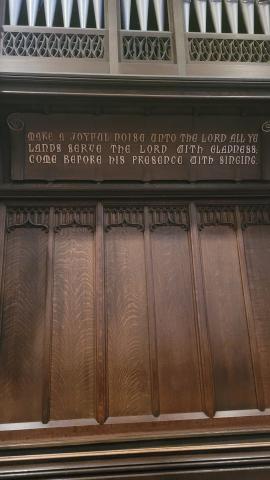
[Memorial Organ pipes left side/côté gauche des tuyaux de l’orgue du Souvenir]

Make a joyful noise onto the Lord all ye
Lands serve the Lord with gladness;
Come before his presence with singing.

Image
Photo Credit
Canadian Memorial United Church and Centre for Peace
Caption
Memorial Organ pipes right side inscription.
1 of 6 images
Image
Photo Credit
Canadian Memorial United Church and Centre for Peace
Caption
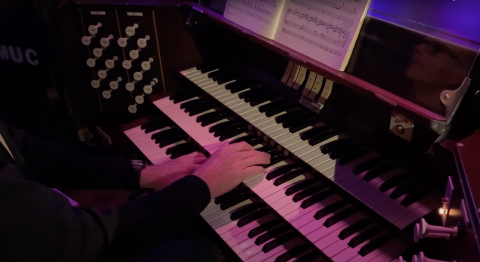
Memorial Organ
1 of 6 images
Image
Photo Credit
Canadian Memorial United Church and Centre for Peace
Caption
Memorial Organ pipes left side inscription.
1 of 6 images
Image
Photo Credit
Canadian Memorial United Church and Centre for Peace
Caption
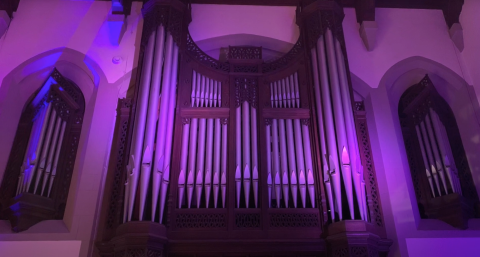
Memorial Organ pipes
1 of 6 images
Image
Photo Credit
Canadian Memorial United Church and Centre for Peace
Caption
Memorial Organ pipes right side inscription.
1 of 6 images
Image
Photo Credit
Canadian Memorial United Church and Centre for Peace
Caption
Memorial Organ pipes right side inscription.
1 of 6 images
Province
!4v1622487793072!6m8!1m7!1sBhTo-GoGMRoV-vQ0me-CTw!2m2!1d49.25808175008721!2d-123.1459623271083!3f226.2479404422196!4f8.907012790348716!5f1.4499580245881227
Body Content

Canadian Memorial Chapel was born in the hearts of private soldiers in the First World War who, guided by a sergeant, formed a working party to bury six of Canada's war dead. On a November night of 1915, in the Ypres Salient, France, one of the soldiers said to Reverend Lieutenant-Colonel (Lt.-Col.) George Fallis, CBEEDDD: "Padre, after the war is over some chaplain should build a memorial in Canada in memory of fellows like these who have given their all." From that moment on, he would never lay away their beloved dead without the idea of a memorial chapel in his mind.

The organ was being constructed by Casavant Freres of St. Hyacinthe, Quebec and was not intended to be a special memorial. Lt.-Col. Fallis was invited to address several Rotary Clubs in Oregon, where Senator R.A. Booth was district governor. At the senator’s home, Lt.-Col. Fallis told his family the story of Canadian Memorial Chapel, which was to be dedicated on Remembrance Day, 1928.

The next morning at breakfast, Senator Booth said that he and his wife were amazed to hear that some fifteen hundred Americans were killed while serving with the Canadian army. He suggested, in the interest of international good will, that he should start a movement to have the organ erected in memory of those citizens of the United States of America who had crossed the border, joined the Canadian Expeditionary Force and had given their lives. He went on to say that if this appealed to the Trustees of Canadian Memorial Chapel, he would start the fund by subscribing five thousand dollars. The organ was costing thirty thousand. Senator Booth worked faithfully towards funds for the organ, as did many of his friends in Portland, Seattle, Eugene, Tacoma, and other Pacific Coast cities.

The Reverend Captain R. J. Edmison of South Orange, New Jersey, gained loyal support from interested citizens of the United States on the Atlantic Coast. He had been a beloved Padre overseas and was minister of First Presbyterian Church.

Each Sunday morning a dear old member of Lt.-Col. Fallis’ church, Mrs. William Alcorn, would pause at the church door to say she was praying daily to God that he would be given the physical strength to carry on his heavy task. One Sunday she handed him a letter in which she wrote that while she was saying her daily prayer for him, God revealed to her that Lt.-Col. Fallis was to write John D. Rockefeller Jr. and ask him for a subscription toward the Memorial Organ. He accepted the letter as a notion of a very old lady. Sunday after Sunday, she would ask if he had written Mr. Rockefeller. One day she handed him a second letter and it was a rebuke at his lack of faith. She said every time she prayed for him, God would reveal to her that he should write. To please the dear lady, Lt.-Col. Fallis wrote, never dreaming that he would get a reply in which Mr. Rockefeller sent twenty-five hundred dollars.

The Memorial Organ was dedicated on November 18, 1928, by Senator Booth. It was followed by an organ recital by Mrs. Montgomery Lynch of the Music Faculty of the University of Washington in Seattle. Her program was from composers of nine nations, symbolizing the international character of this organ.

In April 1960, the organ was reconstructed and rededicated in memory of those who gave their lives in the First and Second World Wars. In 1971, it was rebuilt and rededicated in memory of all members of the Armed Forces who lost their lives in the service of their country.

City
Vancouver
Country
Type Description
Organ
Photo Credit
Canadian Memorial United Church and Centre for Peace
Memorial CF Legacy ID
11110
City/Municipality
Vancouver
Memorial Number
59026-049
Type
Address
Burrard Street and W 15th Avenue
Location
Canadian Memorial United Church
in Canada
Yes
GPS Coordinates
49.2580818, -123.1459623
Inscription

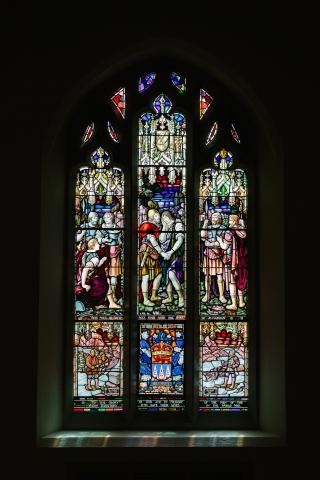
"COMRADESHIP."

"THE SOUL OF DAVID WAS KING WITH THE SOUL OF JONATHAN."

The Chilkoot
Pass-1898

The Royal
Mail

Yukon

TO THE GLORY OF GOD AND IN MEMORY OF THE MEN OF THE
YUKON TERRITORY WHO GAVE THEIR LIVES IN THE WORLD WAR.

Image
Photo Credit
Canadian Memorial United Church and Centre for Peace
Caption
Yukon Window
War or Conflict Term
Province
!4v1622487793072!6m8!1m7!1sBhTo-GoGMRoV-vQ0me-CTw!2m2!1d49.25808175008721!2d-123.1459623271083!3f226.2479404422196!4f8.907012790348716!5f1.4499580245881227
Body Content

Canadian Memorial Chapel was born in the hearts of private soldiers in the First World War who, guided by a sergeant, formed a working party to bury six of Canada's war dead. On a November night of 1915, in the Ypres Salient, France, one of the soldiers said to Reverend Lieutenant-Colonel (Lt.-Col.) George Fallis, CBEEDDD: "Padre, after the war is over some chaplain should build a memorial in Canada in memory of fellows like these who have given their all." From that moment on, he would never lay away their beloved dead without the idea of a memorial chapel in his mind.

On his return to Canada he was advised by Reverend S.D. Chown, DD, General Superintendent of the Methodist Church, to go to Vancouver and choose a site in Shaughnessy Heights facing the eternal hills to erect the chapel of his dreams. He arrived in Vancouver in May 1920, to a willing congregation and plans were quickly laid. 

Lt.-Col. Fallis' friend Chris Spencer, CBE, advised him that in order for there to be national significance to the chapel, he should go across Canada and interview lieutenant governors, premiers, statesmen and leaders of each province, asking them to underwrite the windows. Yukon Territory was last.

He did not travel to Yukon, but in January of 1929 wrote Major George Black, Member of Parliament, whose machine-gunners were a brave formation from the Sourdough country made famous by the Gold Rush and poems of Robert Service. During the First World War, Black recruited a regiment from the Yukon, became the company's captain ;and was wounded at the Battle of Amiens. A letter was sent to Major Black outlining the ideas to be incorporated in Canadian Memorial Chapel and asking for advice as to how to raise the money for the Yukon Window. Within forty-eight hours a telegram read, "Order the window. Yukoners will underwrite it."

The Imperial Order Daughters of the Empire in Yukon set itself the task of raising funds in the territory, while George Black contacted friends in various communities that he thought would commit themselves to collecting contributions.

The dedication of the window on 23 July 1929 was one of the most colourful as Sourdoughs came from San Francisco, Portland and Seattle to join with British Columbia's ex-Yukoners in seeing Sheriff Charles MacDonald, a typical son of the North, unveil the window and to hear the well-loved Reverend (Captain) George Pringle, BA, DD, of Yukon fame, give the dedication sermon. George had served Yukon parishioners for a decade and later served in the Canadian Expeditionary Force during the war. His son, George Pringle, Jr., was also a minister, but joined the Royal Canadian Air Force and was killed in action during the Second World War. George's nephew, John Percival Pringle, was killed in the First World War.

It was a reunion never to be forgotten, for Sourdoughs met that Sunday evening who had not been together since the stirring days of the gold rush. Mrs. George Smith (nee Beatrice Lome), the Klondike Nightingale, sang Knapp's "Open the Gates of the Temple."

Depicted in Yukon Window - “A Symbol of Comradeship.” The Biblical scene shows Jonathan and David making a covenant. David has just killed Goliath with a mere slingshot. Jonathan was so taken by David that we are told his soul was “knit” with David’s. He gives David all his weapons and armour, demonstrating his love. David and Saul, Jonathan’s father, have a falling out. Two years later Jonathan dies in battle. Both David and Saul come together in grief. The historic images depict the Chilkoot Pass of Gold Rush fame in 1898, and the Royal Mail-Dog Train and cariole.

City
Vancouver
Country
Type Description
Stained glass window
Photo Credit
Canadian Memorial United Church and Centre for Peace
Memorial CF Legacy ID
11104
City/Municipality
Vancouver
Memorial Number
59026-048
Type
Address
Burrard Street and W 15th Avenue
Location
Canadian Memorial United Church
in Canada
Yes
GPS Coordinates
49.2580818, -123.1459623
Inscription

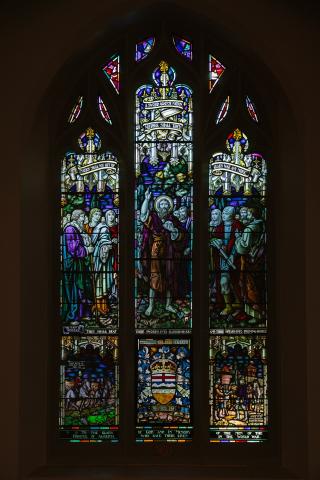
"NATION SHALL NOT LIFT UP A SWORD AGAINST NATION, NEITHER SHALL THEY LEARN WAR ANY MORE."

"THE VISION OF
DEMOCRACY."

"THEY SHALL BEAT THEIR SWORDS INTO PLOGHSHARES AND THEIR SPEARS INTO PRUNING-HOOKS."

Great March of
North West Mounted
Police 1874.

Arrival of Sir
George Simpson at a
Hudson Bay Fort 1835

Alberta

TO THE GLORY OF GOD AND IN MEMORY OF THE MEN OF THE
PROVINCE OF ALBERTA WHO GAVE THEIR LIVES IN THE WORLD WAR.

Image
Photo Credit
Canadian Memorial United Church and Centre for Peace
Caption
Alberta Window
War or Conflict Term
Province
!4v1622487793072!6m8!1m7!1sBhTo-GoGMRoV-vQ0me-CTw!2m2!1d49.25808175008721!2d-123.1459623271083!3f226.2479404422196!4f8.907012790348716!5f1.4499580245881227
Body Content

Canadian Memorial Chapel was born in the hearts of private soldiers in the First World War who, guided by a sergeant, formed a working party to bury six of Canada's war dead. On a November night of 1915, in the Ypres Salient, France, one of the soldiers said to Reverend Lieutenant-Colonel (Lt.-Col.) George Fallis, CBEED DD: "Padre, after the war is over some chaplain should build a memorial in Canada in memory of fellows like these who have given their all." From that moment on, he would never lay away their beloved dead without the idea of a memorial chapel in his mind.

On his return to Canada he was advised by Reverend S.D. Chown, DD, General Superintendent of the Methodist Church, to go to Vancouver and choose a site in Shaughnessy Heights facing the eternal hills to erect the chapel of his dreams. He arrived in Vancouver in May 1920, to a willing congregation and plans were quickly laid.

Lt.-Col. Fallis' friend Chris Spencer, CBE, advised him that in order for there to be national significance to the chapel, he should go across Canada and interview lieutenant governors, premiers, statesmen and leaders of each province, asking them to underwrite the windows. Alberta was the ninth province he visited.

In Edmonton, Lt.-Col. Fallis met with Judge William Legh Walsh whose son was a lieutenant in his old battalion of 1915. Judge Walsh sent Lt.-Col. Fallis to the Premier, Mr. Brownlee, with his blessing. When the Premier heard of the great success across Canada he smiled and said: "Well, it certainly is up to Alberta to do her part." He drew up a list of those that he thought should be interviewed, and commended Dr. Edgar Allin. He was the first subscriber to the Alberta window after the Premier. After being told one hundred dollars would be his share, he said, "Oh no, I should give at least two hundred."

Dr. Allin telephoned one of the leading merchants of Edmonton, W.T. Henry, and told him to meet with Lt.-Col. Fallis. Mr. Henry asked Lt.-Col. Fallis to be brief, but as the concept of Canadian Memorial Chapel unfolded, his interest grew, and Lt.-Col. Fallis asked him to subscribe at least one hundred dollars to the Alberta window. He opened his desk and wrote a cheque for two hundred. With a twinkle in his eye he said, "You're the only man who ever pried two hundred dollars out of me and made me feel actually good."

Mr. Brownlee advised that Patrick Burns, the elder business man of Alberta, would be a better choice to provide names to be interviewed in Calgary. Patrick was a devout Roman Catholic and had just recently been given an outstanding honour by the Pope. Lt.-Col. Fallis conferred with the Honourable R.B. Bennett who said that Patrick had long since outgrown parochial-mindedness and that he counted some of his greatest friends among Protestants. Patrick was impressed with the Canadian Memorial Chapel and said if Lt.-Col. Fallis would return the next day he would give him a list of those whom he thought should be asked to underwrite Calgary's share of the Alberta window. The following day Patrick said he had thought a great deal about the whole matter and felt that the names he should give would be those of men who had made the greatest contribution in the development of Calgary and Southern Alberta. "I have drawn up a list," he said with a quiet smile, "but alas they are all dead, so I have written a cheque for seven hundred dollars, which will be one hundred dollars for each of them."

Patrick was a broad-minded man for the list was headed by two Methodist ministers, the McDougalls, who had been pioneer missionaries. The third name was a Roman Catholic priest, Reverend Father Lacombe, after whom Lacombe, Alberta, was named. Another was Major-General P.B. Strange who was commander of the Northwest Mounted Police in Southern Alberta.

Lt.-Col. Fallis’ last visit was to Lethbridge where he was greeted by another friend of the war, Brigadier-General J.S. Stewart. He had made arrangements for Lt.-Col. Fallis to speak to the Canadian Club. Brigadier-General Stewart and Senator W.A. Buchanan quickly made sure that Lethbridge did their part.

Depicted in Alberta Window - “The Vision of Democracy” portrays the prophet Micah inspiring his followers to turn swords into ploughshares, designed to symbolize a warless world. This vision appealed to many Canadians after the death of nearly one in eight soldiers during WW I. The historical events depicted are the Great March of the Northwest Mounted Police in 1874 and the arrival of Sir George Simpson at a Hudson’s Bay fort. 

City
Vancouver
Country
Type Description
Stained glass window
Photo Credit
Canadian Memorial United Church and Centre for Peace
Memorial CF Legacy ID
11103
City/Municipality
Vancouver
Memorial Number
59026-047
Type
Address
Burrard Street and W 15th Avenue
Location
Canadian Memorial United Church
in Canada
Yes
GPS Coordinates
49.2580818, -123.1459623
Inscription

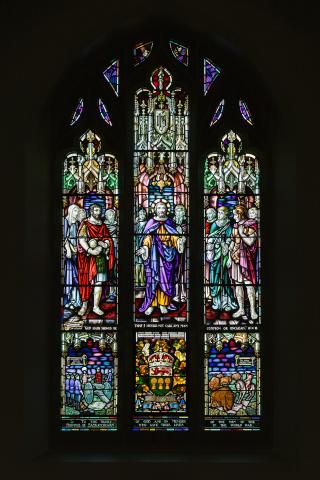
"BROTHERHOOD" "GOD HATH SHEWED ME THAT I SHOULD NOT CALL ANY MAN COMMON OR UNCLEAN."

Surrender of
Batoche
July 1885.

The Indian
Buffalo Hunt

Saskatchewan

TO THE GLORY OF GOD AND IN MEMORY OF THE MEN OF THE
PROVINCE OF SASKATCHEWAN WHO GAVE THEIR LIVES IN THE WORLD WAR.

Image
Photo Credit
Canadian Memorial United Church and Centre for Peace
Caption
Saskatchewan Window
War or Conflict Term
Province
!4v1622487793072!6m8!1m7!1sBhTo-GoGMRoV-vQ0me-CTw!2m2!1d49.25808175008721!2d-123.1459623271083!3f226.2479404422196!4f8.907012790348716!5f1.4499580245881227
Body Content

Canadian Memorial Chapel was born in the hearts of private soldiers in the First World War who, guided by a sergeant, formed a working party to bury six of Canada's war dead. On a November night of 1915, in the Ypres Salient, France, one of the soldiers said to Reverend Lieutenant-Colonel (Lt.-Col.) George Fallis, CBEEDDD: "Padre, after the war is over some chaplain should build a memorial in Canada in memory of fellows like these who have given their all." From that moment on, he would never lay away their beloved dead without the idea of a memorial chapel in his mind.

On his return to Canada he was advised by Reverend S.D. Chown, DD, General Superintendent of the Methodist Church, to go to Vancouver and choose a site in Shaughnessy Heights facing the eternal hills to erect the chapel of his dreams. He arrived in Vancouver in May 1920, to a willing congregation and plans were quickly laid. 

Lt.-Col. Fallis' friend Chris Spencer, CBE, advised him that in order for there to be national significance to the chapel, he should go across Canada and interview lieutenant governors, premiers, statesmen and leaders of each province, asking them to underwrite the windows. Saskatchewan was the eighth province he visited.

In Saskatchewan, Lt.-Col. Fallis went to Saskatoon first to interview His Honour the Lieutenant Governor, H.E. Munroe, who had been a Lieutenant-Colonel in the Canadian Army Medical Corps overseas, and an army friend. He was a great supporter of the soldiers being honoured in Canadian Memorial Chapel. He sent Lt.-Col. Fallis to interview President Murray of the University of Saskatchewan and no man could have been more deeply interested in the project. He felt that Scotland had produced more great men for its population than possibly any other part of the world because memorials all over the land told each rising Scottish generation of the greatness of their past. He subscribed to the Saskatchewan window not only in his own name, but in the name of his late great friend, Judge McLorg, who had done so much for northern Saskatchewan.

Colonel Robert Wallace Caswell, another good friend who had been in Lt.-Col. Fallis’ old battalion of 1915, made arrangements for Lt.-Col. Fallis to speak to the Canadian Club of which he was president. Friends in Regina were T.D. Brown, KC, Colonel J.A. Cross, DSO, and David Balfour, who were especially loyal in their help. In Moose Jaw, Lt.-Col. Fallis had the support of Reverend Captain Edward Church who had been a most successful chaplain in France. He took Lt.-Col. Fallis into his home and made appointments for him to meet a group of good citizens.

Depicted in Saskatchewan Window - “Peter’s Vision” symbolizes Universal Brotherhood. Peter dreams of all the things he fears about the Gentiles, yet God admonishes him saying, “How can anything I have made be profane?” Peter then sees God’s blessing fall upon the Gentiles and understands that the vision of God’s peace is meant for all. The historical events on this window portray the surrender at Batoche in 1885, and the Indian buffalo hunt. The end of WW I saw the formation of the League of Nations, an institution that also had as its goal a vision of peace for all. Its successor, the United Nations, continues to pursue that goal in a world that refuses to reject military might as its principal form of statesmanship.

City
Vancouver
Country
Type Description
Stained glass window
Photo Credit
Canadian Memorial United Church and Centre for Peace
Memorial CF Legacy ID
11102