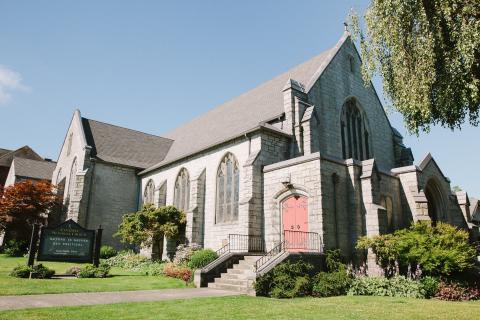
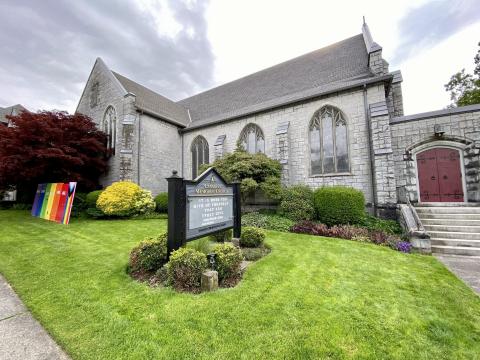
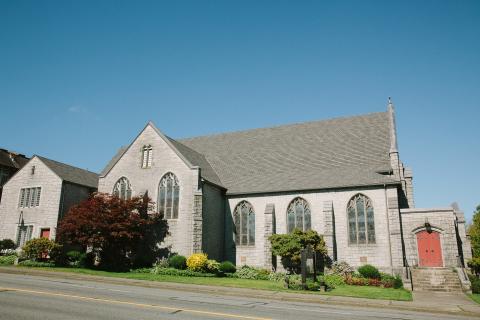
Canadian Memorial United Church is unique, not just for its pure Gothic style, or the extraordinary manner in which funds were raised throughout Canada for its construction, but also for its portrayal of Canadian unity and its Christian symbolism. This church in no way glorifies war, but is, above all, a peace memorial.
Canadian Memorial Chapel was born in the hearts of private soldiers in the First World War who, guided by a sergeant, formed a working party to bury six of Canada's war dead. On a November night of 1915, in the Ypres Salient, France, one of the soldiers said to Reverend Lieutenant-Colonel (Lt.-Col.) George Fallis, CBE ED, BD, DD: "Padre, after the war is over some chaplain should build a memorial in Canada in memory of fellows like these who have given their all." From that moment on, he would never lay away their beloved dead without the idea of a memorial chapel in his mind.
On his return to Canada he was advised by Reverend S.D. Chown, DD, General Superintendent of the Methodist Church to go to Vancouver, choose a site in Shaughnessy Heights facing the eternal hills and erect the chapel of his dreams. Chapels he visited in Italy, France, Belgium, England and Scotland, and chapels of the colleges of both Oxford and Cambridge were his inspiring guides. He arrived in Vancouver in May 1920, to a willing congregation and plans were quickly laid.
The first project was Memorial Hall and the second project was Memorial Chapel. All plans for the chapel were sent to Professor C.H.C. Wright, Head of the Department of Architecture in the University of Toronto, for judging. He awarded the project to Messrs. Twizell & Twizell. The plans had ten windows for the chapel, one for each Province and the Yukon Territory; also a Chancel Window symbolizing sacrifice; and an All Canada Window depicting the history and life of Canada.
Lt.-Col. Fallis was inspired by the chapels he visited during the First World War. He read the Bible day after day searching for stories to use as the religious motifs on the windows. When he found a story that emphasized world, brotherhood or soldier he made a note and ended up with 70 illustrations. He carefully eliminated one after another and when he was finished there were exactly ten. Studying them, he found there was a sequence to the stories:
Ontario: "The Nativity"—symbolizing, A Call to Peace.
Quebec: "The Call of the Disciples"—symbolizing, Enlistment.
Prince Edward Island: "David and his Valiant Soldiers"—symbolizing, The Sacrifices the Soldiers Made.
British Columbia: "The Story of the Centurion"—symbolizing, The Faith of the Soldier.
Yukon: "Jonathan and David"—symbolizing, The Love the Soldiers bore each other.
Manitoba: "Jacob Mourning for Joseph"—symbolizing, The Mourning of the Home Folk for Their Lost Loved Ones.
Saskatchewan: "Peter's Vision"—symbolizing, Universal Brotherhood.
Alberta: "The Vision of Democracy"—symbolizing, A Warless World.
New Brunswick: "The Sermon on the Mount"—symbolizing, Blessed are the Peacemakers.
Nova Scotia: "The Empty Tomb of the Risen Lord"—symbolizing, The Immortality of those who made the Supreme Sacrifice.
Lt.-Col. Fallis' friend Chris Spencer, CBE , advised him that in order for there to be national significance to the chapel, he should go across Canada and interview lieutenant governors, premiers, statesmen and leaders of each province, asking them to underwrite the windows. The goal was to involve Canadians from coast to coast with the idea of making this a truly national church. The first visit was to Victoria and after securing subscription for the British Columbia Window, Honourable Walter Nichol said: "Now that you have finished British Columbia, I should advise you to go to Prince Edward Island and if you get the support of the far West and the far East, I am sure the provinces in between will respond."
Each window portrays a biblical scene with the provincial coat-of-arms underneath, flanked on either side by historical scenes of the province it represents. A passage of scripture appropriate to the biblical theme is shown at the bottom and separate plates list the names of respective contributors. The windows were designed by Robert McCausland Company of Toronto and were dedicated at an evening service in December 1928. Provincial Windows were not without colonial, racial, gender and cultural assumptions of that time. In 2004, there was deconstruction on some of the values and ideas on these windows.
In the end, Lt.-Col. Fallis interviewed 161 leading men across Canada and practically every man thought of Canadian Memorial Chapel as a beautiful dream that should be made a reality.
Madame Ernestine Schumann-Heink was a Bohemian-born Austrian-American opera singer. During the First World War, she had a brother in command of an Austrian warship, her son August Heink in the German Navy, her stepson Walter Schumann and sons Henry Heink and George Washington Schumann all in the American Navy and her two sisters lived in Germany. She devoted herself to helping wounded soldiers, appearing before troops across the United States and raising funds for Red Cross, YMCA and Jewish War Relief. At sixty years of age she made her farewell tour, drawing sold out houses from New York to San Francisco. The Vancouver press printed the story of Madame Schumann-Heink's service to the United States and the success of her farewell tour, including the information that she was to sing in Seattle the following evening. It was eleven o'clock and the finance committee of Canadian Memorial Chapel had wrestled for hours trying to work out ways and means to raise more funds. Lt.-Col. Fallis told the story of Madame Schumann-Heink and her great interest in soldiers. Treasurer Norman Cull exclaimed, "You're going to Seattle on the midnight train to enlist her services in a great memorial concert here. I move we adjourn. Go and pack your bag." Within an hour he was on his way to Seattle.
Madame Schumann-Heink was at a hotel whose manager was a personal friend of Lt.-Col. Fallis and met him in the lobby. She had given instructions that she was to see no one until after the concert that night. The two men sat down and talked Madame Schumann-Heink for half an hour. Finally the manager said: "Just write her a short note. Tell her you are a padre who had four years overseas and that you would like to see her, and I think because you served with the soldiers she will give you a warm welcome."Lt.-Col. Fallis wrote the letter and placed it in her message box, sitting for hours waiting and watching. At five o'clock the letter was on its way to the great woman's suite. In less than half an hour a clerk handed him a letter from Madame Schumann-Heink herself. She wrote: "I love soldiers. Come and sit with me backstage during my concert tonight. I have a violin soloist assisting in the program and we can chat while he plays."
At 8:30 pm Lt.-Col. Fallis tapped on her door backstage. She said firmly, "Come in." She rose, held out her arms, gave a big hug and a kiss and exclaimed, "I love soldiers!" He told her the story of Canadian Memorial Chapel and asked her to come to Vancouver and give a concert in aid of the memorial fund. She rose, again embraced him and said, "I'll come as soon as I finish my tour, and you shan't pay a single penny."
The concert night was one never to be forgotten. Five thousand two hundred people crowded into Patrick Brothers' huge arena. All about the platform from which she sang were injured Veterans. Many were brought from the hospital in David Spencer's delivery wagons. Men who had not been out of Shaughnessy Military Hospital for years were carefully carried to the wagons that took the place of ambulances. Twenty-two stretcher cases lying on their backs, attended by nurses, looked up adoringly at her. Between renditions bouquets were presented and the great diva graciously accepted them, then moved quickly down the steps, literally tore them in parts and placed them at the feet of the Veterans on stretchers. When a blinded soldier presented her with roses from the Canadian Institute for the Blind, she bowed reverently for a pause so long that it brought an absolute hush over the vast audience. Then taking the sightless soldier by the arm she led him gently to his seat. As she came back to the dais there was scarcely a dry eye in the house. She was greeted with double and triple encores. When the concert ended, Madame Schumann-Heink held up her hand and a great silence fell over all. Then with a distinct German accent she said, "I thank you. This night is the crown of my life."
The first sod at Canadian Memorial Chapel was turned in July 1927 by Sir George Foster, KC, MG, President of the League of Nations Society of Canada. The Honourable Walter C. Nichol, Lieutenant Governor of British Columbia, laid the cornerstone on September 17, 1927, and the address was given by Major-General W.W. Foster, CM, DSO. Canadian Memorial Chapel was dedicated on November 9, 1928. The ceremony was conducted by Reverend (Major) Charles Williams, DD, assisted by Reverend F.E. Runnalls, BA, BD, Chairman and Secretary of Vancouver Presbytery. Regular services began on November 11, 1928, exactly ten years after the 1918 Armistice. As the first hymn was being sung the chief usher handed Lt.-Col. Fallis a cable. It was a message of congratulations from His Majesty King George V.
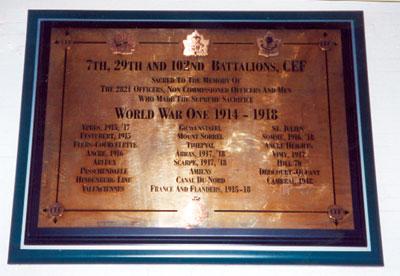
The memorial windows in the Narthex represent distinct branches of service in the war efforts during the First World War: The Soldier, The Sailor and The Airman, The Nurse, and The Transfigured Soldier. Over time they evolved as symbols acknowledging the sacrifice of those who served in the Second World War and the Korean War.
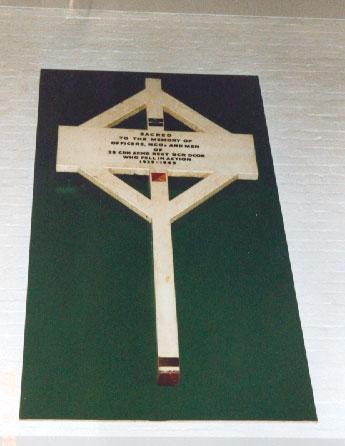
Other memorials in the church include: Books of Remembrance and Memorial Tablet, Memorial Organ, Second World War Plaque, and Founder's Portrait.