Needs further research
Minnedosa Cenotaph
(needs further research/recherche incomplète)
My VAC Account
My VAC Account(needs further research/recherche incomplète)
Needs further research
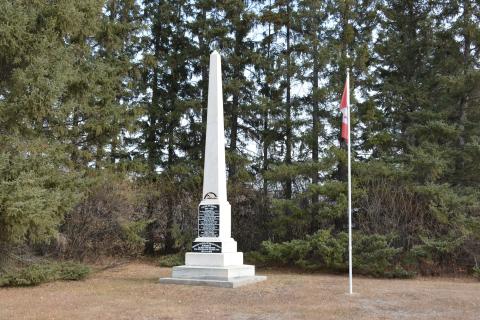
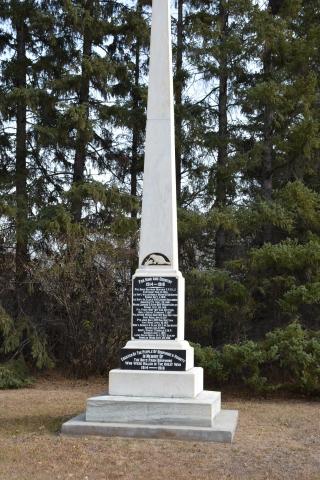
Erected by the Municipality of Miniota
In Grateful Remembrance of Those Who Fell in the Great Wars. Greater love hath no man than this: That a man lay down his life for his friends
The Miniota Cenotaph was erected in 1926, unveiled August 29, 1926 by the officer commanding military District #10, Major General H.D.B. Ketchen. This Cenotaph is quite beautiful, the front side (west) bearing the names of those who served in the First World War, the south side honours those who served in the Second World War, the east side bears the inscription "Erected by the Municipality of Miniota" and the north side bears the inscription "In Grateful Remembrance of Those Who Fell in the Great Wars. Greater love hath no man than this: That a man lay down his life for his friends". On each of the four corners of the base stands a small column, each bearing the names of two battle sites, Vimy, Ypres, Hill 60, St. Juliet, Mons, Somme, Arras, and Amiens.
TO THE MEMORY OF
OUR GALLAND SOLDIERS
WHO GAVE THEIR LIVES
FOR OUR COUNTRY
IN WORLD WAR
1939 - 1945
LOUIS CHARTRAND
LAWRENCE CHARTRAND
LAWRENCE GUIBOCHE
FREDERICK FLAMAND
ADELARD J. CHARTRAND
JOSEPH PORTER
ALBERT FAGNAN
WILLIAM PANGMAN
FRANCIS W. WELBURN
"GREATER LOVE THAN THIS NO MAN HATH.
THAT A MAN LAY DOWN HIS LIFE
FOR HIS FRIENDS."
ST. JOHN 15 13
The Camperville Second World War Memorial was erected in honour of those from the area that lost their lives during the Second World War. There is a second Camperville Second World War Memorial at this location.
Memorial Avenue was formally opened in 1927. The trees along the double boulevard were planted by Army and Navy Veterans. There were elm, ash and Chinese lilac—the last, the gift of Dr. Frank Skinner of the Dropmore Nurseries.
Along the boulevard is the Northwest Rebellion Monument, Russell Cenotaph and a gun emplacement from the First World War.
The Grandview Memorial Bell is set in a triangular shaped plot of land that was originally designated as Grandview Memorial Park. The land was donated by the Town of Grandview.
The Memorial Bell and First World War Tablet were established by the Girls Guild of Grandview to honour men from the Town and District who died in service during the First World War.
The Grandview Cenotaph is also located here.
(needs further research/recherche incomplète)
This statue, entitled "Behind Canadian Barbed Wire" was created by sculptor John Boxtel. The memorial is a reminder of Canada's First National Internment Operation, 1914 - 1920. The three figures portray the profound emotions that those caught up during this tragic episode in Canadian history experienced. While the central figure shows defiance, he is flanked by another man whose despair at the indignity of his needless confinement is portrayed by how he hides his face in shame. To his right stands an internee who, in contrast, has somehow endured the wartime hysteria and racism that precipitated the internment operations and now stands proudly confident of his future.
[front/devant]
ERECTED IN MEMORY
OF THE HEROES OF
FRANKLIN DISTRICT
WHO GAVE THEIR LIVES
IN THE GREAT WAR
1914 — 1918
PTE. OSCAR R.KERR
PTE. ERNEST ATTWOOD
PTE. WILLIAM MCMARTIN
PTE. RUSSELL ROBINSON
FLIGHT CADET W.FRANK BARKER
ERECTED
BY THE FRANKLIN
RED CROSS WORKERS
[right side/côté droit]
ALFRED ?
ROBERT ?
1939-1945
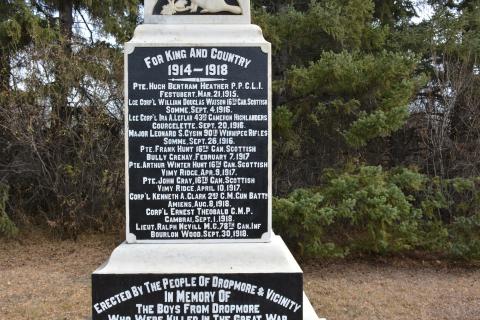
The Franklin Cenotaph was erected by the Franklin Red Cross Workers to commemorate five local men who died in the First World War. Later names were added to honour those who died in the Second World War.
(needs further research/recherche incomplète)
The Great War Memorial Committee was formed in 1920 for the purpose of erecting a memorial for the Veterans who lost their lives while serving in the Great War. In March 1921, a decision was made on the monument and an order was placed with Guinn & Simpson Company Limited of Portage La Prairie. Farmer’s volunteers to haul cement, gravel and stone free of cost to the committee.
The statue was made in Italy of Carrara marble and designed by Guinn & Simpson Company Ltd, Marble & Granite Dealers of Portage La Prairie, Manitoba. On 26 July 1921, they sent a letter to the committee that the statue of a solider had left Italy. The soldier is in webbing (personal load-carrying equipment) and wearing a helmet. He stands at attention with his left leg slightly advanced and a reversed rifle at his side. The origin of the statue in Italy explains why the uniform was not 100% accurately Canadian. The carvers were usually careful to put a maple leaf where Canadian uniforms had this symbol (on the cap and collar).
On 24 August Guinn & Simpson shipped part of the memorial consisting of the rough bases to Foxwarren. The statue arrived in Montreal in August and on 5 October the remaining parts of the memorial were shipped by train. The Foxwarren Cenotaph was unveiled on 11 November 1921.
(needs further research/recherche incomplète)
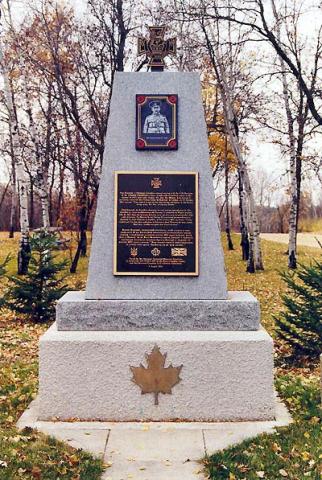
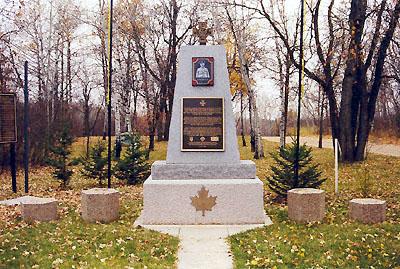
This street was named in honour of LCol William George Barker, VC.
ERECTED TO THE HEROES
OF THIS COMMUNITY
WHO SERVED IN
THE GREAT WAR
1914-1918
BY THE CRANDALL WOMENS
PATRIOTIC SOCIETY
The Crandall cenotaph was erected shortly after the end of the First World War by the Crandall Women's Patriotic Society. The exact date is unknown. For many years, Remembrance Day services were held at the Crandall Cenotaph. Now, however, as the numbers grow much smaller, Remembrance Day services are only held in Miniota. A small ceremony was held at the Crandall Cenotaph July 1, 2000 as a part of Crandall's 2000 Reunion. At that service a presentation was made to the community by Mr. Stuart Johnson who puts in many hours at the Brandon Airforce Museum in Brandon, Manitoba. This presentation consisted of a display board of pictures of local airmen lost during the war, along with a brief history of each, where they served and in what capacity, where they were killed and where they were buried.