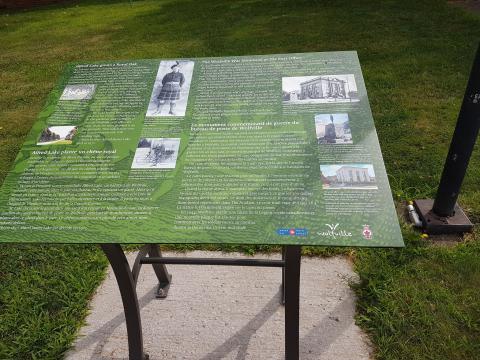
[interpretive panel/panneau d’interprétation]
Mona Parsons, Wolfville's unlikely war hero
Mona Louise Parsons, actor, nurse, resistance fighter (born Middleton, NS, 17 February 1901; died Wolfville, 28 November 1976). Mona Parsons was the only Canadian female civilian imprisoned by the Nazis in the Occupied Netherlands during World War II.
She was found guilty of treason for helping downed Allied airmen escape to England. Upon appeal her death sentence in March 1945, a chance encounter with the North Nova Scotia Highlanders three weeks later brought her to safety.
Work as a chorus girl in New York City's Ziegfeld Follies in 1929 did not satisfy the serious theatre career Mona Parsons envisioned. She returned to school, and became a nurse in 1935.
Parsons met and married Dutch millionaire businessman, Willem Leonhardt, in 1937. They lived a life of glamour and privilege in Laren, Holland until the Nazis invaded in 1940. For a year their work in a network rescuing Allied airmen went undetected. A Nazi informer's betrayal led to their arrests in 1941 - Mona in September and Willem in December.
A Nazi military tribunal condemned Parsons to death. Permitted to appeal, her sentence was commuted to life at hard labour. At Vechta prison, Parsons met Baroness Wendelien van Boetzelaer in January 1945, and escaped with her during an Allied bombing raid on March 25.
For three weeks, the two walked across Germany, posing as aunt and niece; Mona feigning mental impairment and a speech impediment to cover her accented German. The women became separated near the Dutch border. Parsons eventually encountered soldiers loading a truck. Her astonishment on learning they were members of the North Nova Scotia Highlanders equaled theirs upon learning the emaciated figure (5' 8", 87 lbs.) hailed from Nova Scotia.
Parons' wartime efforts garnered citations after the war from British Air Chief Marshall Lord Arthur Tedder, and from American General Dwight D. Eisenhower.
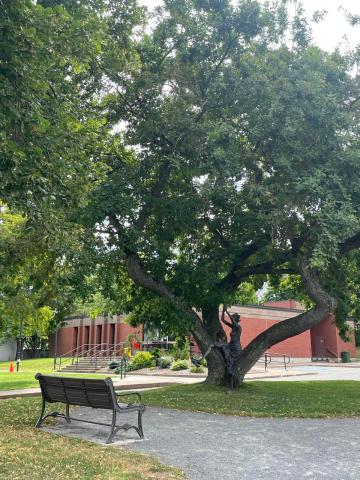
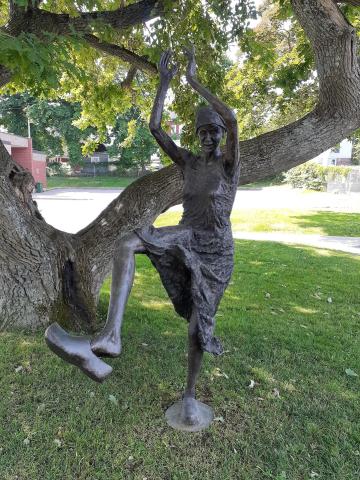
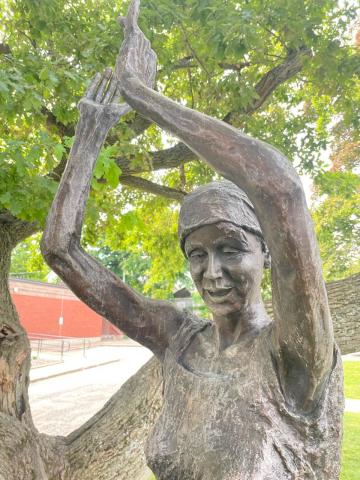
The sculpture of Mona Parsons — "The joy is almost too much to bear" showing her dancing on hearing of the liberation of Holland on May 5, 1945 — was created by Dutch-Canadian Nistal Prem de Boer, an artist living and working in the Annapolis Valley.
May 3, 1945
"Prison was a hard, nasty, cold, hungry and demoralizing life. We were always associated with criminals. That never should have been. Political prisoners should have been kept apart. The first year I was ill a lot, weighed only 94 pounds and was green - night sweats, coughing and diarrhea every day for 3 1/2 months and often vomiting. Tears have run down my cheeks for hunger... We slept four in a cell built for one. In all of the years of imprisonment I slept always on a straw sack on the floor... I was in solitary once for two weeks... Practically 4 years of isolation. During my first contact with people - after throwing off my half-witted act - I felt only half conscious of all that went about me. My body was shaky- my brain seemed quite numb - thoroughly incapable of absorbing what was said to me. My head spun. It just seemed too much all of a sudden..."
May 5, 1945
"Holland has capitulated - thrills and heartthrobs I can barely believe it!... How sweepingly and rapidly everything has gone this week. The joy is almost too much to bear!
So long, my dears
love Mona
Mona Parsons, l'improbable héroïne de guerre de Wolfville
Mona Louise Parsons, acrtice, infirmière, combattante de la résistance (née à Middleton, N.-É., 17 février 1901, décédé à Wolfville, le 28 novembre 1976). Mona Parsons fut la seule femme civile canadienne emprisonnée par les nazis dans les Pays-Bas occupés durant la Seconde Guerre mondiale.
Elle fut reconnue coupable de trahison pour avoir aidé des aviateurs alliés abattus à s'enfuir en Angleterre. En appel, sa piende de mort fut commuée en travaux forcés à perpétuité. Après une évasion hallucinate en mars 1945, une rencontre fortuite avec des soldats du régiment Highlanders du Nord de la Nouvelle-Écosse, trois semaines plus tard, la mit hors de danger.
Son travail comme danseuse de revue aux Ziegfeld Follies de New York City en 1929 ne répondait pas au désir de Mona Parsons de faire une sérieuse carrière théâtre. Elle reprit ses études et et devint infirmière en 1935.
Parsons rencontra et épousa Willem Leonhardt, homme d'affaires millionnaire néerlandais, en 1937. Ils vécurent une vie privilégiée et mondaine à Laren, en Hollande, jusqu'à l'invasion des nazis en 1940. Pendant un an, leur travail dans un réseau de secours aux aviateurs alliés ne fut pas détecté. La trahison d'un informateur nazi conduit à leur arrestation en 1941 - Mona en septembre et Willem en décembre.
Un tribunal militaire nazi a condamna Parsons à mort. Autorisée à faire appel, sa peine fut communée en travaux forcés à perpétuité. A la prison de Vechta, Parsons rencontra la baronne Wendelien van Boetzelaer en janvier 1945 et s'échappa avec elle durant un raid aérien allié le 25 mars.
Pendant trois semaines, les deux traversèrent à pied l'Allemagne, en se faisant passer pour une tante et sa nièce; Mona simulait une déficience mentale et un défaut d'élocution pour cacher son fort accent en allemand. Les femmes se trouvèrent séparées près de la frontière néerlandaise. Parsons rencontra finalement des soldats en train charger un camion. Son étonnement d'apprendre qu'ils étaient membres du régiment des Highlanders de la Nouvelle-Écosse du Nord n'eut d'égal que le leur lorsqu'ils apprirent que la femme émaciée (5 pi 8 po, 87 lb) était originaire de Nouvelle-Écosse.
Les efforts de Parsons en temps de guerre lui valurent des citations après la guerre du général de l'armée de l'air britannique, Lord Arthur Tedder, et du général américain Dwight D. Eisenhower.
La sculpture de Mona Parsons — « La joie est presque intolérable » la montre en train de danser à la nouvelle de la libération de la Hollande le 5 mai 1945 — a été crééd par le canadien-hollandaisNistal Prem de Boer, artiste vivant et travaillant dans la vallée d'Annapolis.
3 mai 1945
« La vie en prison était durre, cruelle, froide, affamée et démoralisante. Nous étions constamment associés avec des criminels. Cela n'aurait jamais dû l'être. Les prisonniers politiques auraient dû être guardés à part. La première année, j'ai beaucoup malade, je pesais seulement environ 94 lb et ma peau était verdâtre - avec des sueurs nocturnes, de la toux et de la diarrhée tous les jours pendant 3 mois et demi et souvent des vomissements. Des larmes coulaient sur mes joues à cause de la faim... Nous dormions à quatre dans une petite cellule construite prévue pour une personne. Pendant toutes les années d'emprisonnement, j'ai toujours dormi sur un sac de paille à même le sol... Une fois, j'ai été mise au cachot pendant deux semaines... Pratiquement 4 ans d'isolement. Lors de mon premier contact avec les gens - après avoir délaissé mon rôle de faible d'esprit - je ne me sentais à piene consciente de tout ce qui se passait autour de moi. Mon corps tremblait - mon cerveau semblait engourdi - totalement incapable d'absorber ce qu'on me disait. Ma tête tournait. C'en était trop, tout d'un coup... »
5 mai 1945
« La Hollande a capitulé - émotions et battements de cœur! Je peux à peine le croire!... Tout s'est passé si brusquement et si radicale et rapidement cette semaine. La joie est presque intolérable!
A bientôt, mes chéris
Je vous aime
Mona »
NOVA SCOTIA
Communities, Culture and Heritage
Wolfville
Canada
With the participation of the Government of Canada.
Avec la participation du gouvernement du Canada.
Allen Eaves and Elizabeth Browne