Saskatchewan

Province Code
SK
City/Municipality
Saskatoon
Memorial Number
47010-044
Type
Address
Rockingham Avenue and Ortona Street
Location
Montgomery Place
in Canada
Yes
GPS Coordinates
52.1110606, -106.7311032
Inscription

[park sign/signe du parc]

MONTGOMERY PARK

[plaque]

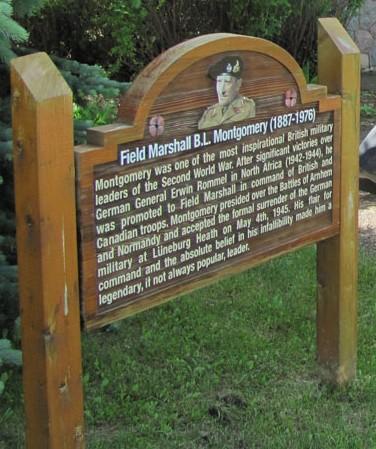
Field Marshall B.L. Montgomery (1887 – 1976)

Montgomery was one of the most inspirational British military
leaders of the Second World War. After significant victories over
German General Erwin Rommell in North Africa (1942 – 1944), he
was promoted to Field Marshall in command of British and
Canadian troops. Montgomery presided over the Battle of Arnhem
and Normandy and accepted the formal surrender of the German
military at Lüneberg Heath on May 4th, 1945. His flair for
command and the absolute belief in his infallibility made him a
legendary, if not always popular, leader.

Image
Photo Credit
Montgomery Place Community Association
Caption
Montgomery Park Plaque
Province
!4v1718369897170!6m8!1m7!1svc0HdLjxzpZWsCMn0akXiQ!2m2!1d52.11106063478562!2d-106.731103211282!3f58.25422038544875!4f-9.433823983359744!5f1.7815123749283663
Body Content

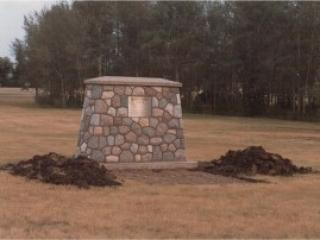
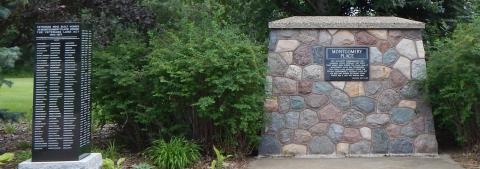
Montgomery Park is named in honour of Field Marshall Bernard Law Montgomery, 1st Viscount Montgomery of Alamein, KG, GCB, DSO, PC. It is located in Montgomery Place, an area developed in 1946 to house returning Second World War Veterans and their families. Most streets and parks in the area are named for prominent military members, famous battles, and military units. A duplicate of this plaque is located at the Montgomery Place Memorial.

In 2004, the Montgomery Place Community Association embarked on a project to explain the choice of names for Montgomery Place streets. The research and writing were undertaken by Kevin Gooding who was the Finance Director at the time, with help from President Jim Earle.

The signs were produced at Abe’s Sign Design Group of Saskatoon, with owner Gerry Tunicliffe giving the Association his whole-hearted support. Gerry even offered the Cassino Avenue sign free-of-charge, since his father had fought at the Battle of Monte Cassino. With interest and dedication, Gerry was also a great help to Kevin tracking down photos for the signs.

On September 22, 2007, Kevin, Jim and Vice-President Dave Price, along with Secretary Larry Rempel, Communications Director Gary Berg and resident Don Janzen, rented an auger and then dug, filled, tamped and installed the first 16 signs. Three more signs were installed later.


City
Saskatoon
Country
Type Description
Park
Memorial CF Legacy ID
9105
City/Municipality
Saskatoon
Memorial Number
47010-043
Type
Address
Merritt Street
Location
Montgomery Place
in Canada
Yes
GPS Coordinates
52.1118126, -106.731358
Inscription

[street sign/plaque de rue]

MERRITT ST

[plaque]

Lt. Colonel Cecil Merritt (1908 – 1991)

Lt. Col. Cecil Merritt won the first Victoria Cross given to a
Canadian in WWII for gallantry and inspired leadership during
the disastrous raid on Dieppe. He landed with the South
Saskatchewan Regiment at Pourville on August 19, 1942. To
capture important high ground to the east, they had to cross the
Scie by a bridge under heavy fire. Seeing the situation, Merritt
walked on to the bridge, waved his helmet to encourage his men
and shouted: “Come on over, there’s nothing to worry about
here”. After hours of heavy fighting, Merritt and his men were
taken captive. Merritt was commended for his leadership while
a prisoner.

Image
Photo Credit
Montgomery Place Community Association
Caption
Merritt Street Plaque
Province
!4v1621268312872!6m8!1m7!1sIc3JX5WDa3aF-ImYwebZEg!2m2!1d52.11181284239711!2d-106.7313585665641!3f345.9273751383577!4f-8.420916667583327!5f3.325193203789971
Body Content

Merritt Street is named in honour of Lieutenant-Colonel Cecil Merritt, VC. It is located in Montgomery Place, an area developed in 1946 to house returning Second World War Veterans and their families. Most streets and parks in the area are named for prominent military members, famous battles, and military units.

In 2004, the Montgomery Place Community Association embarked on a project to explain the choice of names for Montgomery Place streets. The research and writing were undertaken by Kevin Gooding who was the Finance Director at the time, with help from President Jim Earle.

The signs were produced at Abe’s Sign Design Group of Saskatoon, with owner Gerry Tunicliffe giving the Association his whole-hearted support. Gerry even offered the Cassino Avenue sign free-of-charge, since his father had fought at the Battle of Monte Cassino. With interest and dedication, Gerry was also a great help to Kevin tracking down photos for the signs.

On September 22, 2007, Kevin, Jim and Vice-President Dave Price, along with Secretary Larry Rempel, Communications Director Gary Berg and resident Don Janzen, rented an auger and then dug, filled, tamped and installed the first 16 signs. Three more signs were installed later.
Charles Cecil Ingersoll Merritt was born in Vancouver, British Columbia on 10 November 1908. In 1929 he graduated from the Royal Military College in Kingston, Ontario, and eventually enrolled in the Militia. When the Second World War began, Merritt was serving as an officer in The Seaforth Highlanders of Canada. In 1942 he became the commanding officer of The South Saskatchewan Regiment (SSR). On 19 August 1942, the SSR was one of the infantry battalions from the 2nd Canadian Infantry Division that participated in the raid on the French port of Dieppe. The battalion landed on Green Beach immediately in front of Pourville, a village just to the west of Dieppe. In order to reach its objectives east of the village, the Canadians were obliged to cross a bridge over the River Scie, which flowed through Pourville to the sea. The bridge and its approaches were swept by German artillery, machine gun and mortar fire coming from the heights dominating the eastern bank of the Scie, which brought the progress of the SSR to a halt. At this point, Lieutenant-Colonel Merritt came forward and took charge, walking calmly across the bridge at least four times under a storm of fire to conduct parties of his men to the eastern side. He then organized and led uphill assaults on several of the concrete “pillboxes” and other enemy positions that looked down on the bridge and the village, and succeeded in clearing them. Throughout the morning, Merritt energetically led his men, exposing himself recklessly to German fire. Although twice wounded, he organized the withdrawal of his battalion from the Pourville beaches, and mounted a rear guard that ensured that the greater part of the SSR and Queen’s Own The Cameron Highlanders of Canada were re-embarked for England. Merritt and the men of the rear guard could not be brought off, and were compelled to surrender.

For his exemplary leadership and valour, Lieutenant-Colonel Merritt was awarded the Victoria Cross. Merritt died in Vancouver, British Columbia on 12 July 2000.

City
Saskatoon
Country
Type Description
Street, plaque
Memorial CF Legacy ID
9104
City/Municipality
Saskatoon
Memorial Number
47010-042
Type
Address
McNaughton Avenue
Location
Montgomery Place
in Canada
Yes
GPS Coordinates
52.1146277, -106.7431376
Inscription

[street sign/plaque de rue]

McNAUGHTON AVE

[plaque]

General Andrew McNaughton (1877 – 1966)

General Andrew McNaughton first attained prominence in the
First World War as Brigadier General in command of the
Canadian Artillery at the age of 31. By the Second World War he
was head of the National Research Council, but returned to the
army as commander of the First Canadian Division. He was
instrumental in keeping Canadian troops together as one army,
rather than distributed amongst British units. He later served as
Minister of Defence and as a delegate to the United Nations.

Image
Photo Credit
Montgomery Place Community Association
Caption
McNaughton Avenue Plaque
War or Conflict Term
Province
!4v1621268207215!6m8!1m7!1sPY9sUZScXeunq758xbsVNw!2m2!1d52.11462711594952!2d-106.7431386780087!3f276.5329591555489!4f-9.354469826911483!5f3.325193203789971
Body Content

McNaughton Avenue is named in honour of General Andrew McNaughton, CH, CB, CMG, DSO, CD, PC, Commander of the 1st Canadian Infantry Division in 1939, Commander of the 1st Canadian Corps upon its formation in 1940 and subsequently Commander of the 1st Canadian Army when the latter was created in 1942. It is located in Montgomery Place, an area developed in 1946 to house returning Second World War Veterans and their families. Most streets and parks in the area are named for prominent military members, famous battles, and military units. McNaughton Avenue was named by the City of Saskatoon in the mid to late 1960s.

In 2004, the Montgomery Place Community Association embarked on a project to explain the choice of names for Montgomery Place streets. The research and writing were undertaken by Kevin Gooding who was the Finance Director at the time, with help from President Jim Earle.

The signs were produced at Abe’s Sign Design Group of Saskatoon, with owner Gerry Tunicliffe giving the Association his whole-hearted support. Gerry even offered the Cassino Avenue sign free-of-charge, since his father had fought at the Battle of Monte Cassino. With interest and dedication, Gerry was also a great help to Kevin tracking down photos for the signs.

On September 22, 2007, Kevin, Jim and Vice-President Dave Price, along with Secretary Larry Rempel, Communications Director Gary Berg and resident Don Janzen, rented an auger and then dug, filled, tamped and installed the first 16 signs. Three more signs were installed later.
City
Saskatoon
Country
Type Description
Street, plaque
Memorial CF Legacy ID
9103
City/Municipality
Saskatoon
Memorial Number
47010-041
Type
Address
Simonds Avenue
Location
Montgomery Place
in Canada
Yes
GPS Coordinates
52.1076401, -106.7393182
Inscription

[street sign/plaque de rue]

SIMONDS AVE

[plaque]

Lieutenant General Guy C. Simonds
1903 – 1974)

Lieutenant General Guy C. Simonds commanded the 1st Canadian
Infantry Division in the Sicilian and Italian campaigns. He then led
the Canadian Corps through the Normandy Invasion and the taking
of the Islands in the Scheldt Estuary, covering the approaches to
Antwerp, Belgium. Lieutenant General Simonds subsequently
became the Chief of the General Staff from 1951 – 1955.

(Note: the plaque indicates Lt. Gen. Simonds initials as Guy C., however his correct initials are G.G. – Guy Granville)/(Remarque : sur la plaque sont inscrites les initiales Guy C. pour le Lgén Simonds, mais ses initiales exactes sont G.G. – Guy Granville)

Image
Photo Credit
Montgomery Place Community Association
Caption
Simonds Avenue Plaque
Province
!4v1718302413698!6m8!1m7!1svN_v-gL2xlpIsWdZsKjW1Q!2m2!1d52.10764006133824!2d-106.7393181724713!3f90.69503116666854!4f-10.398501760843473!5f1.9350235771457491
Body Content

Simonds Avenue is named in honour of Lieutenant-General Guy Granville Simonds, CC, CB, CBE, DSO, CD, Commander II Canadian Corps and Acting Commander First Canadian Army during the Battle of the Scheldt in 1944 and Chief of the General Staff in 1951. It is located in Montgomery Place, an area developed in 1946 to house returning Second World War Veterans and their families. Most streets and parks in the area are named for prominent military members, famous battles, and military units. Simmonds Avenue was named by the City of Saskatoon in the mid to late 1960s.

In 2004, the Montgomery Place Community Association embarked on a project to explain the choice of names for Montgomery Place streets. The research and writing were undertaken by Kevin Gooding who was the Finance Director at the time, with help from President Jim Earle.

The signs were produced at Abe’s Sign Design Group of Saskatoon, with owner Gerry Tunicliffe giving the Association his whole-hearted support. Gerry even offered the Cassino Avenue sign free-of-charge, since his father had fought at the Battle of Monte Cassino. With interest and dedication, Gerry was also a great help to Kevin tracking down photos for the signs.

On September 22, 2007, Kevin, Jim and Vice-President Dave Price, along with Secretary Larry Rempel, Communications Director Gary Berg and resident Don Janzen, rented an auger and then dug, filled, tamped and installed the first 16 signs. Three more signs were installed later.
City
Saskatoon
Country
Type Description
Street, plaque
Memorial CF Legacy ID
9102
City/Municipality
Saskatoon
Memorial Number
47010-040
Type
Address
Cassino Avenue
Location
Montgomery Place
in Canada
Yes
GPS Coordinates
52.1068775, -106.728337
Inscription

[park sign/signe du parc]

LT. COL. D. WALKER PARK

[plaque]

Lt. Colonel Drayton E. Walker (1900 – 1975)

Born in Maple Creek Saskatchewan, Drayton Ernest Walker
achieved prominence as both a veteran and an educator. He left a
teaching career to serve with the Saskatoon Light Infantry in
1939, fighting in the invasion of Sicily. He became commanding
officer achieving the rank of Lieutenant Colonel. Injured in 1943,
he received the Distinguished Service Order. Walker returned to
Saskatoon where he became Principal of Bedford Road Collegiate
and later the first Principal of Mount Royal Collegiate. He retired in
1966 after a 3 year term as Principal of the Armed Services School
in Marville, France.

Image
Photo Credit
Saskatoon Star Phoenix
Caption
Lieutenant-Colonel Drayton Walker kissing his wife Margaret, October 3, 1945,
1 of 3 images
Image
Photo Credit
Montgomery Place Community Association
Caption
Lt. Col. D. Walker Park Plaque
1 of 3 images
Image
Photo Credit
Saskatoon Star Phoenix
Caption
Lieutenant-Colonel Drayton Walker leading the Saskatoon Light Infantry parading down 21st Street, October 3, 1945,
1 of 3 images
Province
!4v1718301610516!6m8!1m7!1sIiQyRE6V8h3_tyu0LAQ0KA!2m2!1d52.10687745021593!2d-106.7283370293848!3f354.03347311961164!4f-17.41687857621035!5f2.1636453454087854
Body Content

This park is named in honour of Lieutenant-Colonel Drayton Ernest Walker, DSO, Commanding Officer of the Saskatoon Light Infantry during the Second World War. It is located in Montgomery Place, an area developed in 1946 to house returning Second World War Veterans and their families. Most streets and parks in the area are named for prominent military members, famous battles, and military units. Lieutenant-Colonel D. Walker Park was named by the City of Saskatoon in the mid to late 1960s.

Drayton Walker and his wife Margaret had three sons — Peter, Phil and Teddy. The oldest was nine when their dad headed into the Second World War in 1939. He left behind a wide array of students, kids he educated and coached since taking his first teaching job in Prince Albert in 1922. He was teaching at City Park Collegiate when he left for the war.

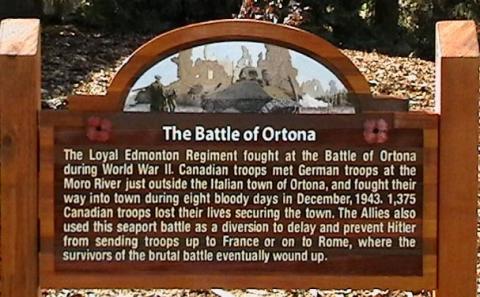
Drayton was a former University of Saskatchewan track star, which would prove beneficial overseas. Ten days before Christmas in 1943, a Quebec battalion was pinned down at the town of Casa Berardi, Italy. Drayton commanded a Saskatoon Light Infantry machine-gun support group that rolled in to help during the vicious, eight-day Battle of Ortona. He chose to personally co-ordinate the defensive tasks of his unit, occupied observation posts in the most forward infantry positions, and moved skillfully from post to post under heavy enemy fire. Under his direction, mortars and machine guns engaged the enemy with devastating results. Hit by shrapnel to the knee and hand, he continued to direct the fire of his weapons until the retention of the position was assured. Still on foot, he threaded his way back to brigade headquarters across ground swept by enemy fire and provided crucial information. His actions contributed greatly to the success not just of that operation, but of the ones that soon followed and he was awarded a Distinguished Service Order.

Shortly after Ortona, he was promoted to Lieutenant-Colonel and took over the battalion command in January 1945.  In October 1945, he returned home to his family and sealed it with a kiss to his wife, while their three sons stood in the background. His homecoming was photographed and ran on page 5 of the Saskatoon Star Phoenix. The boys hadn’t seen their father since he returned to Canada in 1942 for an instructional tour. After the kiss, soldiers paraded through Saskatoon’s downtown with Drayton at the front, leading his troops one last time.

Margaret experienced grievous loss during the war. She’d raised three boys, mostly on her own, in the six years since Drayton left to fight, and she’d also lost a brother. Her brother, William Campbell, was the commanding officer of HMCS Louisburg in 1943 when it was sunk by enemy dive bombers and torpedo planes in the Mediterranean. He received a posthumous citation for saving many lives, due to his prompt action. His bravery cost him his life.

Drayton was the principal at Bedford Road Collegiate starting in 1954, moving over from his job teaching history at Nutana Collegiate, before becoming Mount Royal Collegiate's first principal when it opened in 1960. The school’s motto, “Truth, Honour and Wisdom” was taken from Drayton’s wartime regiment. He later spent three years in France, serving as the principal of the Canadian Armed Services School. Drayton died on November 15, 1975, at the age of 75.

In 2004, the Montgomery Place Community Association embarked on a project to explain the choice of names for Montgomery Place streets. The research and writing were undertaken by Kevin Gooding who was the Finance Director at the time, with help from President Jim Earle.

The signs were produced at Abe’s Sign Design Group of Saskatoon, with owner Gerry Tunicliffe giving the Association his whole-hearted support. Gerry even offered the Cassino Avenue sign free-of-charge, since his father had fought at the Battle of Monte Cassino. With interest and dedication, Gerry was also a great help to Kevin tracking down photos for the signs.

On September 22, 2007, Kevin, Jim and Vice-President Dave Price, along with Secretary Larry Rempel, Communications Director Gary Berg and resident Don Janzen, rented an auger and then dug, filled, tamped and installed the first 16 signs. Three more signs were installed later.
City
Saskatoon
Country
Type Description
Park, plaque
Memorial CF Legacy ID
9101
City/Municipality
Saskatoon
Memorial Number
47010-039
Type
Address
Lancaster Boulevard and Lacaster Crescent
Location
Montgomery Place
in Canada
Yes
GPS Coordinates
52.1100807, -106.7246634
Inscription

[street sign/plaque de rue]

LANCASTER BLVD

[street sign/plaque de rue]

LANCASTER CR

[plaque]

Lancaster Bomber

The Lancaster Bomber was built by the A.V. Rose Company during
World War II. It was a favourite with bomber crews due to its
strong reliable performance and was said to be “a delight to fly”.
Along with the Halifax Bomber, it was the mainstay of the RCAF.
Some 7,378 planes were manufactured with 403 being built in
Canada. During the war it flew 156,023 sorties and dropped
608,612 UK tons of bombs, more than all the rest of the British
bombers combined. Its service life extended beyond World War
II, with many being converted for peace time use.

Image
Photo Credit
Montgomery Place Community Association
Caption
Lancaster Boulevard and Lancaster Crescent Plaque
Province
!4v1621267853593!6m8!1m7!1sIwVwOoPH4oVUOsvWoC76bA!2m2!1d52.11008298623591!2d-106.7246669685873!3f277.93251332078813!4f-13.471525557771272!5f3.325193203789971
Body Content

Lancaster Boulevard and Lancaster Crescent are named in honour of the Lancaster bomber and the air crews who flew this plane during the Second World War. It is located in Montgomery Place, an area developed in 1946 to house returning Second World War Veterans and their families. Most streets and parks in the area are named for prominent military members, famous battles, and military units.

In 2004, the Montgomery Place Community Association embarked on a project to explain the choice of names for Montgomery Place streets. The research and writing were undertaken by Kevin Gooding who was the Finance Director at the time, with help from President Jim Earle.

The signs were produced at Abe’s Sign Design Group of Saskatoon, with owner Gerry Tunicliffe giving the Association his whole-hearted support. Gerry even offered the Cassino Avenue sign free-of-charge, since his father had fought at the Battle of Monte Cassino. With interest and dedication, Gerry was also a great help to Kevin tracking down photos for the signs.

On September 22, 2007, Kevin, Jim and Vice-President Dave Price, along with Secretary Larry Rempel, Communications Director Gary Berg and resident Don Janzen, rented an auger and then dug, filled, tamped and installed the first 16 signs. Three more signs were installed later.
City
Saskatoon
Country
Type Description
Street, plaque
Memorial CF Legacy ID
9100
City/Municipality
Saskatoon
Memorial Number
47010-038
Type
Address
Haida Avenue
Location
Montgomery Place
in Canada
Yes
GPS Coordinates
52.1101205, -106.7360956
Inscription

[street sign/plaque de rue]

HAIDA AVE

[plaque]

HMCS Haida

The destroyer HMCS Haida served Canada during the Second
World War. Named after the native people of the Queen
Charlotte Islands in BC, she escorted merchant ships to Russia
on the Murmansk run and was on the scene when the
Scharnhorst was sunk. In a little more than four months in the
English Channel the convoy of ships she served in, sank or
helped destroy two large torpedo boats, two destroyers, a U-
boat, trawler, mine sweeper, cargo ship and patrol boat. HMCS
Haida is proudly displayed in Toronto.

Image
Photo Credit
Montgomery Place Community Association
Caption
Haida Avenue Plaque
Province
!4v1621267737552!6m8!1m7!1sg5zwjQyp7GRP9JNT14Lv9Q!2m2!1d52.11012205057339!2d-106.7360905079155!3f249.3803662937707!4f-7.792101095906133!5f3.325193203789971"
Body Content

Haida Avenue is named in honour of the HMCS Haida and her crews who served during the Second World War. It is located in Montgomery Place, an area developed in 1946 to house returning Second World War Veterans and their families. Most streets and parks in the area are named for prominent military members, famous battles, and military units.

In 2004, the Montgomery Place Community Association embarked on a project to explain the choice of names for Montgomery Place streets. The research and writing were undertaken by Kevin Gooding who was the Finance Director at the time, with help from President Jim Earle.

The signs were produced at Abe’s Sign Design Group of Saskatoon, with owner Gerry Tunicliffe giving the Association his whole-hearted support. Gerry even offered the Cassino Avenue sign free-of-charge, since his father had fought at the Battle of Monte Cassino. With interest and dedication, Gerry was also a great help to Kevin tracking down photos for the signs.

On September 22, 2007, Kevin, Jim and Vice-President Dave Price, along with Secretary Larry Rempel, Communications Director Gary Berg and resident Don Janzen, rented an auger and then dug, filled, tamped and installed the first 16 signs. Three more signs were installed later.
City
Saskatoon
Country
Type Description
Street, plaque
Memorial CF Legacy ID
9099
City/Municipality
Saskatoon
Memorial Number
47010-037
Type
Address
Dieppe Street
Location
Montgomery Place
in Canada
Yes
GPS Coordinates
52.1081946, -106.7414358
Inscription

[street sign/plaque de rue]

DIEPPE ST

[plaque]

Dieppe

A French resort town, Dieppe was the site of a Canadian-British
amphibious raid on August 19, 1942. The plan was to destroy
several German installations and leave immediately. The timing
depended strictly on sunrise with troops having to retreat
before high tide. It failed. Of 5,000 Canadian troops to land,
900 were killed and 1,300 taken prisoner. Many lessons were
learned from this ill-fated attack, including the importance of
prior air bombings and support of assault troops with artillery
fire. These valuable tactics were implemented in subsequent
raids, contributing to the success at Normandy two years later.

Image
Photo Credit
Montgomery Place Community Association
Caption
Dieppe Street Plaque
War or Conflict Term
Province
!4v1621267562244!6m8!1m7!1s5swlrw_gwUMFwJ2XIAlaKw!2m2!1d52.10818919970471!2d-106.7414578544324!3f27.369537077821306!4f-6.933994073279521!5f3.325193203789971"
Body Content

Dieppe Street is named in honour of the Canadians who fought in the Battle of Dieppe. It is located in Montgomery Place, an area developed in 1946 to house returning Second World War Veterans and their families. Most streets and parks in the area are named for prominent military members, famous battles, and military units.

In 2004, the Montgomery Place Community Association embarked on a project to explain the choice of names for Montgomery Place streets. The research and writing were undertaken by Kevin Gooding who was the Finance Director at the time, with help from President Jim Earle.

The signs were produced at Abe’s Sign Design Group of Saskatoon, with owner Gerry Tunicliffe giving the Association his whole-hearted support. Gerry even offered the Cassino Avenue sign free-of-charge, since his father had fought at the Battle of Monte Cassino. With interest and dedication, Gerry was also a great help to Kevin tracking down photos for the signs.

On September 22, 2007, Kevin, Jim and Vice-President Dave Price, along with Secretary Larry Rempel, Communications Director Gary Berg and resident Don Janzen, rented an auger and then dug, filled, tamped and installed the first 16 signs. Three more signs were installed later.
Although extremely valuable lessons were learned in the Raid on Dieppe, a steep price was paid. Of the 4,963 Canadians who embarked for the operation, only 2,210 returned to England, and many of these were wounded. There were 3,367 casualties, including 1,946 prisoners of war; 916 Canadians lost their lives. This street was named in their honour.

City
Saskatoon
Country
Type Description
Street, plaque
Memorial CF Legacy ID
9098
City/Municipality
Saskatoon
Memorial Number
47010-036
Type
Address
Currie Avenue
Location
Montgomery Place
in Canada
Yes
GPS Coordinates
52.1129412, -106.726876
Inscription

[street sign/plaque de rue]

CURRIE AVE

[plaque]

Lt. Col. David Vivian Currie (1913 – 1986)

Lt. Colonel David Currie is the only Saskatchewan born holder of
the Victoria Cross. Born in Sutherland and raised in Moose Jaw,
Currie joined the 29th Canadian Armoured Reconnaissance
Regiment in 1939. An “unflappable and, apparently unstoppable
individual” Currie and his troops defended St. Lambert in the battle
of Falaise Gap in August 1944. Down to 60 men and 12 tanks,
Major Currie held the town against repeated German counter-
attacks for 36 hours. In 1966 he became Sergeant at Arms of the
House of Commons.

Image
Photo Credit
Montgomery Place Community Association
Caption
Currie Avenue Plaque
Province
!4v1621267464848!6m8!1m7!1syztbjv2W4Ikp5QZwzds-qw!2m2!1d52.11294141169928!2d-106.7268751828632!3f273.08489475578324!4f-9.250482506211128!5f3.325193203789971"
Body Content

Currie Avenue is named in honour of Lieutenant-Colonel David Vivian Currie, VC. It is located in Montgomery Place, an area developed in 1946 to house returning Second World War Veterans and their families. Most streets and parks in the area are named for prominent military members, famous battles, and military units.

In 2004, the Montgomery Place Community Association embarked on a project to explain the choice of names for Montgomery Place streets. The research and writing were undertaken by Kevin Gooding who was the Finance Director at the time, with help from President Jim Earle.

The signs were produced at Abe’s Sign Design Group of Saskatoon, with owner Gerry Tunicliffe giving the Association his whole-hearted support. Gerry even offered the Cassino Avenue sign free-of-charge, since his father had fought at the Battle of Monte Cassino. With interest and dedication, Gerry was also a great help to Kevin tracking down photos for the signs.

On September 22, 2007, Kevin, Jim and Vice-President Dave Price, along with Secretary Larry Rempel, Communications Director Gary Berg and resident Don Janzen, rented an auger and then dug, filled, tamped and installed the first 16 signs. Three more signs were installed later.
David Vivian Currie was born in Sutherland, Saskatchewan on 8 July 1912. Before the Second World War, he was a member of a Militia unit based in Moose Jaw, Saskatchewan. During the campaign in France following the D-Day landings in Normandy on 6 June 1944, Currie was serving with the 29th Armoured Reconnaissance Regiment (The South Alberta Regiment).

Major Currie earned the Victoria Cross for his efforts on 18 August 1944 to capture and hold the village of St Lambert-sur-Dives during the fighting to block the escape route of large German forces cut off in the Falaise pocket. Leading a small force of tanks, infantry and anti-tank guns, but with no supporting field artillery fire, he organized an attack on the village and succeeded in seizing and consolidating a position half-way inside it. For 36 hours Currie’s force repeatedly thwarted attempts by German tanks and infantry to force a way through the village by counterattacking the Canadians. Finally, Major Currie and his men renewed their attack and drove the enemy out of St Lambert-sur-Dives, completing the capture of the village. His force had inflicted 800 casualties on the Germans and taken 2,100 prisoners.

Currie died in Ottawa, Ontario, on 24 June 1986. This street is named in his honour.

City
Saskatoon
Country
Type Description
Street, plaque
Memorial CF Legacy ID
9097
City/Municipality
Saskatoon
Memorial Number
47010-035
Type
Address
Crerar Drive
Location
Montgomery Place
in Canada
Yes
GPS Coordinates
52.10947, -106.72929
Inscription

[street sign/plaque de rue]

Crerar Dr.

[plaque/plaque]

Lt. General Harry D. Crerar (1888 – 1965). As the Canadian Chief of Staff, Crerar wanted a distinctly Canadian Corps, bringing together armoured and infantry divisions in a unified fighting force. In the past, Canadian regiments had been apportioned out to British armies, depending on the needs of the moment. Crerar created the First Canadian Corps. It consisted of the 1st Canadian Infantry Division, 5th Canadian Armoured Division, 1st Canadian Armoured Brigade and supporting units. After D-Day, Canadian troops led by Gen. Crerar distinguished themselves fighting against some of Hitler’s crack divisions.

Image
Photo Credit
Montgomery Place Community Association
Province
!4v1621267319889!6m8!1m7!1saEf7YcwLJZsiC7YRhI-gTA!2m2!1d52.10963584794305!2d-106.7293158969697!3f221.49191072834165!4f0.6216525273793252!5f3.325193203789971"
Body Content

Crerar Drive is named in honour of Lieutenant-General Henry Duncan Graham “Harry” Crerar CH, CB, DSO, KStJ, CD, PC. It is located in the Montgomery Place neighbourhood of Saskatoon, and area developed in 1946 to house returning Second World War veterans and their families. Most streets and parks in the area are named for prominent military members, famous battles, military units, and in one case, an aircraft.

City
Saskatoon
Country
Type Description
Street, plaque
Memorial CF Legacy ID
9096