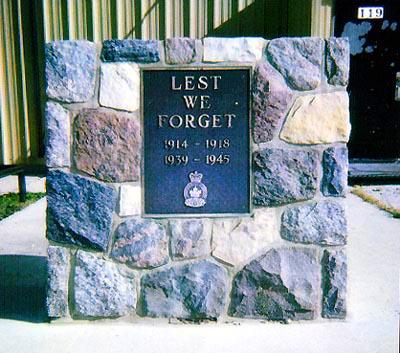
The Cairn was erected in 1980 in memory of the First and Second World War Veterans.
Spalding Memorial Cairn
LEST WE FORGET
1914-1918
1939-1945
Sign in to My VAC Account
Sign in to My VAC AccountLEST WE FORGET
1914-1918
1939-1945
The Cairn was erected in 1980 in memory of the First and Second World War Veterans.
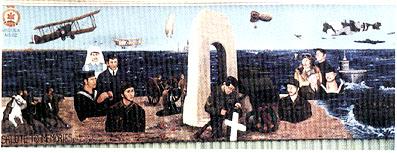
SALUTE TO MEMORIES
The Wadena, Saskatchewan Branch of the Royal Canadian Legion has dedicated an 8-by-24 foot mural named "Salute to Memories" on its wall facing Main Street. The two year volunteer project, dedicated to the men and women who fought to preserve Canada's freedom, is the work of Wadena Mural Images artists Rose Palechka, Lenora Hordos, Wendy Gauthier, and Betty MacPherson.
SOUTH SASKATCHEWAN
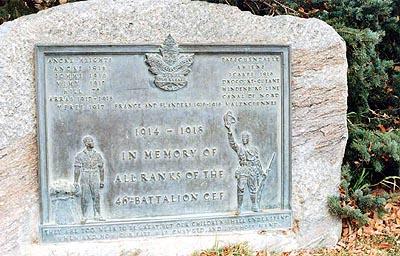
XLVI
OVERSEAS
CANADA
ANCRE HEIGHTS 1916
SOMME 1916
VIMY 1917
HILL 70
ARRAS 1917-1918
YPRES 1917
PASSCHENDAELE
AMIENS
SCARPE
DROCOURT-QUEANT
FRANCE AND FLANDERS 1916-1918
1914 — 1918
IN MEMORY OF
ALL RANKS OF THE
46TH BATTALION C.E.F.
THEY ARE TOO NEAR TO BE GREAT, BUT OUR CHILDREN SHALL UNDERSTAND
WHEN AND HOW OUR FATE WAS CHANGED AND BY WHOSE HAND.
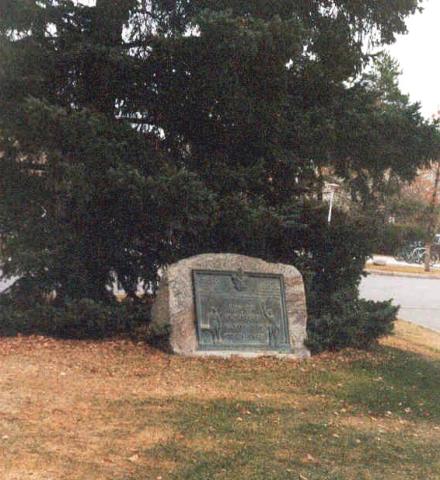
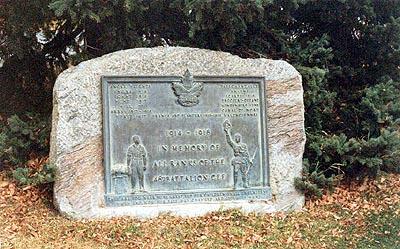
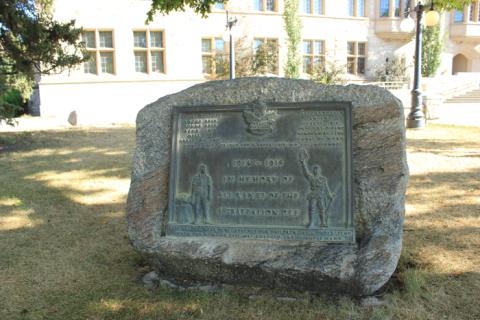
A memorial honouring the memory of those who served with the 46th Canadian Infantry Battalion (South Saskatchewan), Canadian Expeditionary Force in the First War, sits under a tree on the northeast corner of the Bowl. A plaque, designed by a woman sculptor in Winnipeg named M.J. Taylor, was presented to the University of Saskatchewan at a ceremony on November 11, 1933. Seventy members of the battalion were in attendance, alongside numerous others. After the ceremony the plaque was put away until a stone on which to mount it was found and then the stone and plaque were installed next to the physics building.
The image on the plaque depicts a farmer on the left with a bundle of hay, and on the right, a soldier raising his helmet to the heavens. In fighting at the battles named on this plaque, the farmer had effectively been transformed into a patriotic citizen-soldier.
Formed in February of 1915, the 46th battalion was filled primarily with Saskatchewan youths, many from the University of Saskatchewan. Also known as the "suicide battalion,” it fought in some of the bloodiest encounters of the war. Reinforcements were constantly needed as battle after battle decimated its ranks. Of the 5,374 men in the 46th battalion, 4,917 were either killed or wounded. A particularly costly battle was Passchendaele, where there were 403 casualties from the battalion's strength of 600 men.
With the end of the war came demobilization and the end of 46th battalion. The soldiers became Veterans and returned to civilian life. Many re-enrolled or entered the university for the first time. Of the 336 students, faculty and staff who enlisted, 67 "passed out of the sight of man by the path of duty and self-sacrifice". More than 100 were wounded and 33 were awarded medals of valour. The School of Engineering closed its doors for the 1916-1917 session when the faculty and students enlisted en masse.
Surviving members of the 46th believed it imperative that the memory of their brothers remain intact. Yet the decision to have it placed on campus reveals something even more significant. The battalion was born at Moose Jaw, but men of the 46th included Reginald Bateman, the university’s first Professor of English, and the battalion’s sole Victoria Cross recipient, Hugh Cairns. Among those honoured on the plaque are Harold Blair and Reginald Batemen, two members of faculty killed in France.

[front/devant]
(left side/côté gauche)
The University of
Saskatchewan
(right side/côté droit)
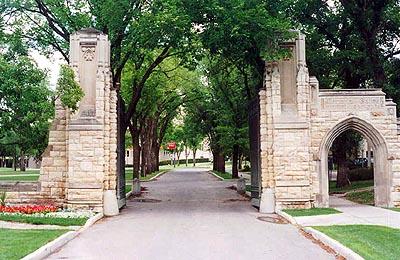
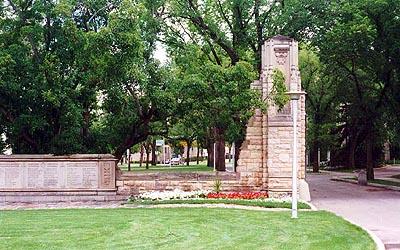
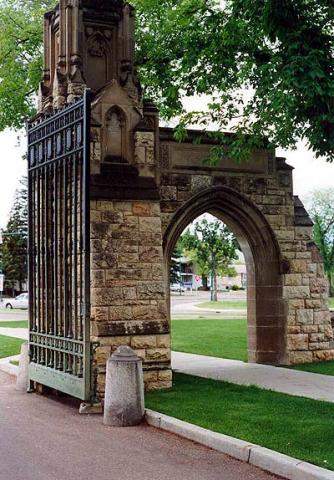
Memorial Gates
erected 1927 a.d.
[left pillar/colonne gauche]
BOGRLON
DURY
AMIENS
CDAMBRAI
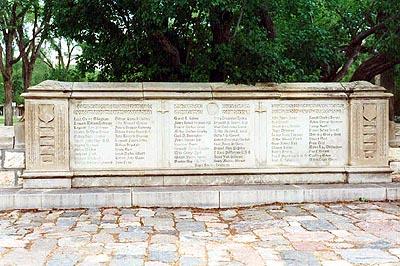
[wall/mur]
THESE ARE THEY WHO WENT
FORTH FROM THIS UNIVERSITY
[First Column/première colonne]
Hugh Carter Allingham
Renwick William Anderson
Reginald John Bateman
Charles Mr Vicar Bayne
William Dobie Braten
Harold John Blair MC
Charles Bremner
James Bryden
Frederick Burd
Thomas Caldwell
Gordon Mortimer Channell
[Second Column/deuxième colonne]
William Mansell Codling
John Stewart Cowan
James Douglas Cumming
William Henry Davis MC
John Kenneth Dawson
Reginald James Dillon
William Drysdale
Henry Egar
Lorne Burton Elliott
Wildred John Evans
John Fisher
[Second Section/deuxième section]
TO THE GREAT
WAR OF 1914 - 1918
[First Column/première colonne]
Ernest R. Gilmer
James Donald Grahamn MM
Robert Carlton Grant
Arthur Gordon Grurhy
Cyril N. Harrington
James Gordon Hill
Lawrence Homer
Grenville Carson Hopkins
Willis George Hunt
William Yeates Hunter
Franklin Magrr Keffer
[Second Column/deuxième colonne]
Perry Dennington Kisby
Reginald A. Lovers MM
Skuli Gudbrandur Lindal
Arthur Stephen K. Lloyd
Clifford McConnell
Robert Peuerol McCordick
Louis James McCuen
Michael Allan McMillan
J. Ross McPherson D.S.O.
Avard Yuill Mathews
Enoch Andrew Mitchell
[Centered/centrée]
James Shirley Heathcote
[Third Section/troisième section]
THEY GAVE THEIR LIVES THAT
WE MIGHT LIVE IN FREEDOM
[First Column/première colonne]
John James Moore
Fred Nesbitt
Josep Lees Nicholls
Angus Nicholson
George Irving Paterson
Arthur Edward Porlett
Elwyn Robert Reid
Thomas Ritchie
Robert Rousay
Roy E. Shuttleworth MM
Hugh A Silrox
[Second Column/deuxième colonne]
Ronald Charles Spence
Arthur George Storkings
George Swift
Robert Sifton Turriff
Wellesly Wesley-Irong
Edward West
Frank West
Wolfer Roy Whittingham
Paul P. Wiklund
Geoffrey Wilson
Wilfrid Grant Wilson
[right pillar/colonne droite]
YPRES
SOMME
VIMY
PASSCHEN
DALE
Sixty-seven University of Saskatchewan students and faculty lost their lives while on service during the First World War. The impact of the war on the University was immense: 330 students and faculty served during the War, a number equivalent to nearly all of the students who had registered the year prior to the beginning of the conflict.
The desire to honor the staff and students who had fallen during the Great War was strong within the University community. As early as August 1918, three months prior to the formal Armistice, University President Walter C. Murray began making enquiries into the cost of a suitable memorial. In 1926, a Memorial Committee was appointed and they decided upon gates made of solid bronze, imported from England; the remainder, made of local Greystone. Architect David R. Brown estimated the cost of what would come to be known as the Memorial Gates to be $30,000, with an additional $10,000 required for the memorial. A concerted fundraising effort among students and alumni helped cover the costs.
The Memorial Gates were unveiled by University President Walter C. Murray and dedicated by the Bishop George Exton Lloyd of Saskatchewan on 3 May 1928. Walter Murray also unveiled the tablet on which commemorates those who died in the First World War.
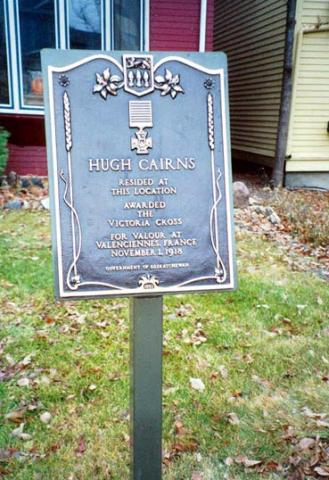
RESIDED AT
THIS LOCATION
AWARDED
THE
VICTORIA CROSS
FOR VALOUR AT
VALENCIENNES, FRANCE
NOVEMBER 1, 1918
GOVERNMENT OF SASKATCHEWAN
1995
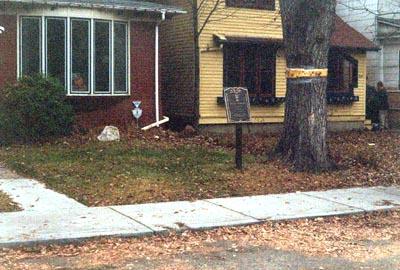
The Sergeant Hugh Cairns Plaque was erected by the Saskatchewan Heritage Foundation, Government of Saskatchewan in 1995. It was incorrectly installed at 418-10th Street E then moved to its current location.
Hugh Cairns was born in Ashington, England on 4 December 1896, and came with his family to Canada in May 1911. During the First World War, Cairns and his two brothers enlisted in the Canadian Expeditionary Force. For his actions in the attack by the Canadian Corps on Vimy Ridge in April 1917, Cairns received the Distinguished Conduct Medal.
On 1 November 1918, while Sergeant Cairns was serving with the 46th Infantry Battalion near Valenciennes in France, a German machine gun opened fire on his platoon as it advanced. Single-handed, he attacked the enemy position and captured the gun, using a Lewis light machine gun to kill the crew. Later, when progress was blocked again, he charged another group of German positions, killing 12 of the enemy and capturing 18 others along with two machine guns. When further resistance was encountered from enemy machine guns and artillery, Cairns, though wounded, led a successful effort to outflank and eliminate the defenders. Cairns’s small party inflicted many casualties and captured about fifty of the enemy and all of their guns. A subsequent patrol in which he participated forced 60 more enemy soldiers to surrender. It was while disarming this group of prisoners that Cairns was wounded again, this time severely. Although he still managed to open fire and kill many of his assailants, he was overwhelmed by about 20 of the other enemy prisoners and collapsed from weakness and the loss of blood. Cairns died the following day.
Sergeant Cairns received a posthumous Victoria Cross for his exemplary conduct in these actions.
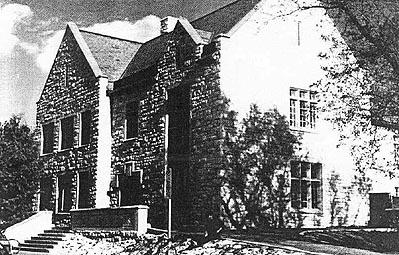
The Memorial Union Building was constructed 1953-1955 and was the last building in the centre of campus designed in the University's Collegiate Gothic Style and completely clad in greystone. It was constructed in remembrance of the war dead.
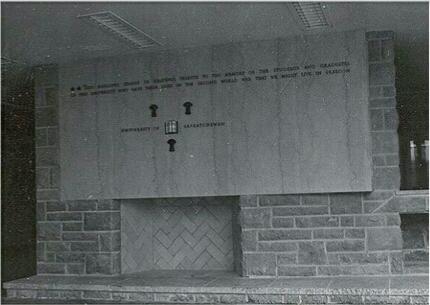
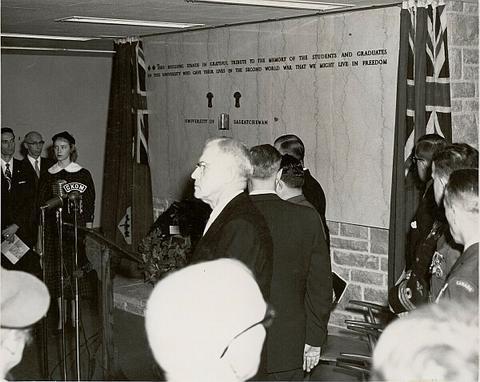
The memorial fireplace in the memorial union at University of Saskatchewan was unveiled on 11 November 1955 as a memorial to lost students and alumni of WWII.
The hallways of the Old Administrative Building (College Building) are decorated with scrolls that honour those members of the University of Saskatchewan who died or were wounded in the First World War.
IN LOVING MEMORY OF THOSE WHO SERVED
WE WILL REMEMBER THEM
Needs further research
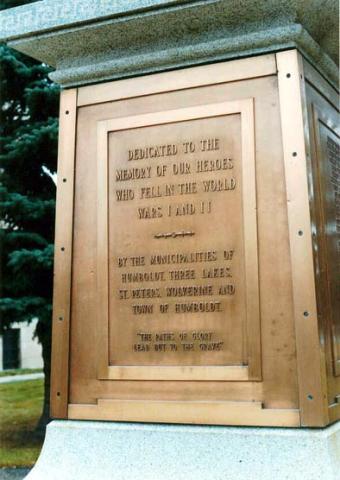
[Front/devant]
DEDICATED TO THE
MEMORY OF OUR HEROES
WHO FELL IN THE WORLD
WARS I AND II
BY THE MUNICIPALITIES OF
HUMBOLT, THREE LAKES,
ST. PETERS, WOLVERINE AND
TOWN OF HUMBOLT.
"THE PATHS OF GLORY
LEAD BUT TO THE GRAVE"
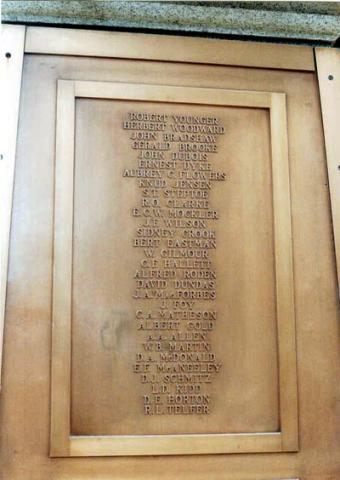
[First Side/premier côté]
ROBERT YOUNGER
HERBERT WOODARD
JOHN BRADSHAW
GERALD BROOKE
JOHN DUBOIS
ERNEST DYKE
AUBREY C. FLOWERS
KNUD JENSON
S.T. STEPTOE
R.O. CLARKE
E.C.W. MOCKLER
J.R. WILSON
SIDNEY CROOK
BERT EASTMAN
W. GILMOUR
C.F. HALLETT
ALFRED RODEN
DAVID DUNDAS
J.A. MACFORBES
J. FOY
C.A. MATHESON
ALBERT GOLD
A.A. ALLEN
W.B. MARTIN
D.A. MCDONALD
E.F. MCANELLEY
D.J. SCHMITZ
L.D. KIDD
D.E. HORTON
R.L. TELFER
[Second Side/deuxième côté]
V.F. MCHARG
I.G. GRICE
J. LENIUK
A.A. SHEPHARD
K.G. SMALLEY
G.C. PARKER
R.B. KOTCHORK
R.A. WIGNES
L.G. WADDELL
DUNCAN CAMERON
L.W. LENZ
J. MORPHY
W.C. GAY
L.C. KAWN
R.C. CONLEY
ALEX BAIN
W.J. PARENTEAU
J.A. WILLIAMS
M. TAGGETH
G. WIUM
M. WEBER
H. MURPHY
ERNEST ROPER
BERT ROPER
STEVE BERES
EDWIN WAGNER
J.P. KAVANAGH
J. REYNOLDS
A. BRITZ
B. FLACK
[Back/l’arrière]
ARTUHUR BOOKER
ROBERT CLARKE
G.S. MACDONALD
FRANK STOCKWELL
ERNEST WILSON
GARVIN WILSON
ARCHIE WILSON
EDWARD BOWES
SAMUEL CHURM
W.E. HEWITSON
TREAVOR JONES
REX KIRKWOOD
CYRUS SMYTHE
JOHN WIDDET
W.B. BRANDON
ALEXANDER BELLAMY
ALEXANDER DAVIES
ALEXANDER CAMERON
NELS CHRISTIANSEN
FREDERICK CLARKE
PERCY JOHNSTONE
MAURICE JORDAN
KENNETH MACINTOSH
CHARLES MACGINNIS
PETER MCCORKINDALE
GORDON STOCKALL
J.H. STRINGER
JAMES STEBBINGS
JOSEPH PINNETTE
WILLIAM TAYLOR
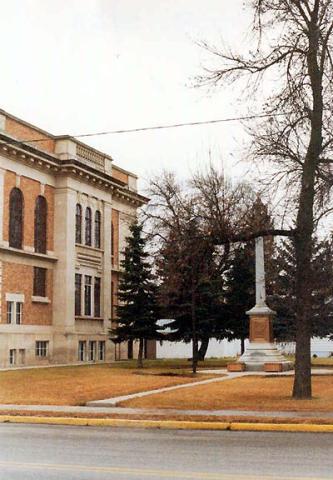
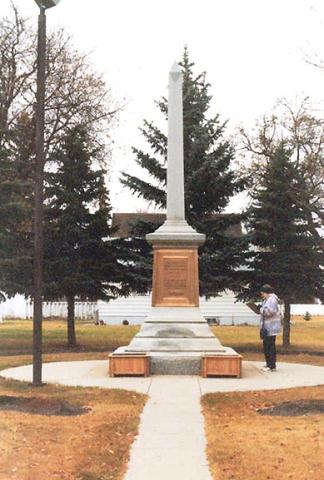
The monument was erected by the municipalities of Humboldt, Three Lakes, St. Peters, Wolverine, and the Town of Humbolt.
Samuel Hooper, an architect appointed Manitoba’s first Provincial Architect in 1904 and sculptor formed Hooper Marble and Granite Works to supply monuments. Despite Hooper’s death in 1911, the firm continued to operate; in the early 1920s, it was advertising regularly in the newspaper, with a factory in St. Boniface and a showroom at Portage and Spence, in Winnipeg. Hooper was contracted to put up a handsome obelisk in Humboldt, Saskatchewan in 1920.