Other

City/Municipality
Saskatoon
Memorial Number
47012-012
Type
Address
24th Street E and 5th Avenue N
Location
Star-Phoenix
in Canada
Yes
GPS Coordinates
52.1307792, -106.6573239
Inscription

1920
The Star-Phoenix 

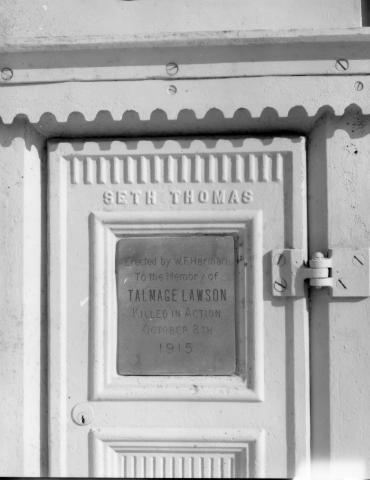
Erected by W.F. Herman
To the Memory of
TALMAGE LAWSON
KILLED IN ACTION
October 8th
1915

Image
Photo Credit
Keith Inches and Susan Harmer.
Caption
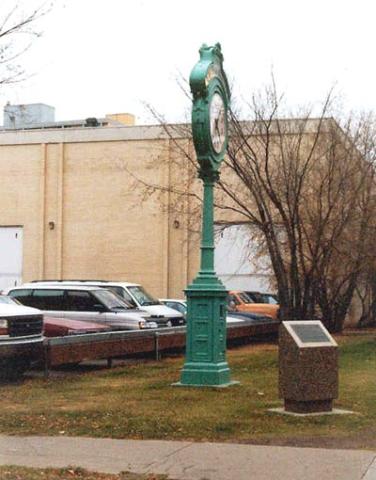
The Star-Phoenix Clock
1 of 5 images
Image
Caption
side view
1 of 5 images
Image
Caption
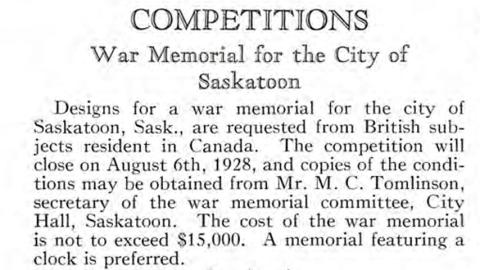
Newspaper article for memorial competition.
1 of 5 images
Image
Photo Credit
City of Saskatoon
Caption
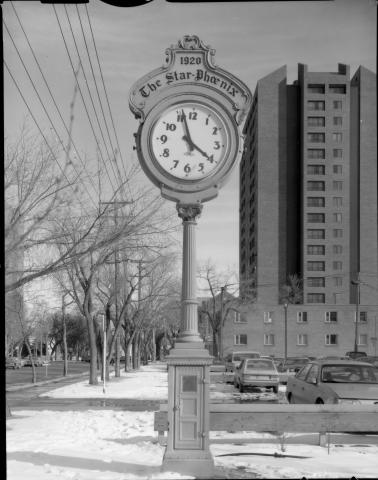
The Star-Phoenix Clock, 1988.
1 of 5 images
Image
Photo Credit
City of Saskatoon
Caption
plaque
1 of 5 images
War or Conflict Term
Province
!4v1621434163624!6m8!1m7!1sQ-hYFN7HlzkasTy3xojQGA!2m2!1d52.13077873034198!2d-106.6573249382979!3f80.56967412358213!4f3.459249156814124!5f3.0298445359500215
Body Content

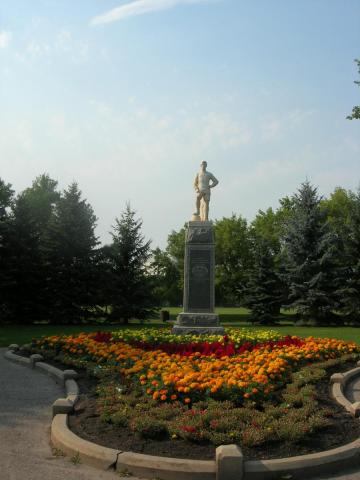
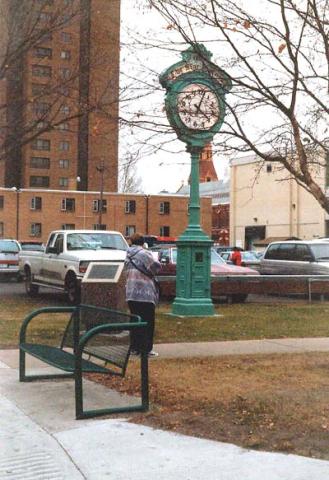
The Star-Phoenix Clock was erected on October 6, 1920, in memory of Talmage Lawson who perished in the First World War. In 1912, Talmage and his partner Bill Herman bought the Capital, one of Saskatoon's daily newspapers, and renamed it the Saskatoon Daily Star. In 1928, the Star amalgamated with the Phoenix and formed the Star-Phoenix which still serves the city today. The Star-Phoenix Clock is a protected heritage property established by Bill in memory of his partner. Bill hired the Seth Thomas Clock Company to create a timepiece and erected it outside the newspaper office at 20th Street East. Seth Thomas was the first to succeed in designing and making tower clocks in different countries.

The two-sided clock stands 15 feet high with a square pedestal and column of cast-iron. The clock was originally powered by a heavy counterweight and cranked every Monday morning. It now operates electrically via a cable running to the Star-Phoenix press room. Two heaters are turned on to keep it going in the winter. The clock had a large thermometer bolted onto it for the first several decades. There are two holes on the street-facing side where it was attached.

The old interior clockworks have been removed and new faces were put on in 1978. When the old clockworks and counterweights were removed, they were sent to Regina for scrap. Hugh McNaughton, a Star-Phoenix technician and Bert Buckle, a well-known local watch maker, went to Regina to retrieve them.

When the Star-Phoenix moved to 5th Avenue in 1967, the clock moved too. When it was moved the base was sandblasted to remove layers of paint. The original paint was black or brown. The clock was moved to its current location in 1979. 

Private Talmage Lawson was born in Prince Edward Island in 1879. Lawson spent his pre-war years trading and selling horses. Lawson’s mother, Alice, died unexpectedly in 1910 after a weeklong illness. He travelled the world extensively and when he got into Africa, took the railroad as far as it would go then journeyed deep into the continent on foot. After only a few days of hiking and sleeping on the ground, Lawson came down with a fever. He returned to the train, but his fever worsened. For nine days aboard the train, Lawson became delirious. He returned to Saskatoon and enlisted as a private in October of 1914. Private Thomas Lawson died at age 35 near the Belgian village of Kemmel.

City
Saskatoon
Country
Type Description
Clock tower, plaque
Memorial CF Legacy ID
3334
City/Municipality
Saskatoon
Memorial Number
47012-011
Type
Address
Corner of 25th and Spadina Streets
Location
945 Spadina Crescent E
in Canada
Yes
GPS Coordinates
52.1318897, -106.6516397
Inscription

[base]

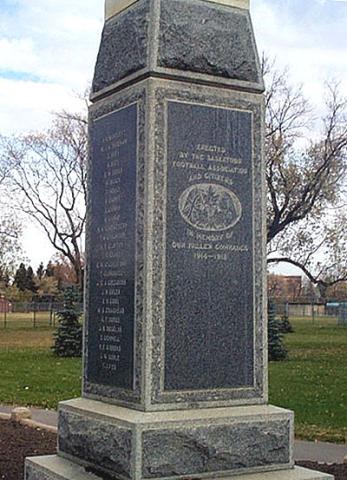
ERECTED BY THE SASKATOON FOOTBALL ASSOCIATION AND CITIZENS
IN MEMORY OF OUR FALLEN COMRADES
1914 - 1918

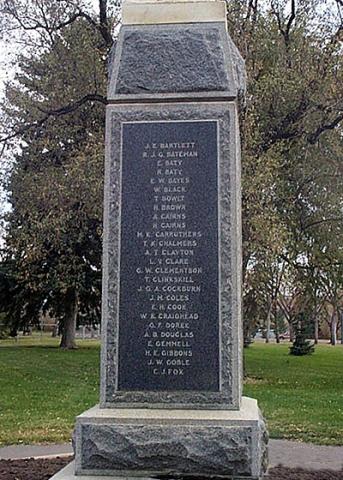
J.E. BARTLETT
R.J.G. BATEMAN
E. BATY
R. BATY
E.W. BAYES
W. BLACK
T. BOWLT
A. CAIRNS
H. CAIRNS
M.K. CARRUTHERS
T.K. CHALMERS
A.T. CLAYTON
L.N. CLARE
G.W. CLEMENTSON
T. CLINKSKILL
J.G.A. COCKBURN
J.M. COLES
E.H. COOK
W.K. CRAIGHEAD
G.F. DOREE
A.B. DOUGLAS
E. GEMMELL
H.E. GIBBONS
J.W. GOBLE
C.J. FOX
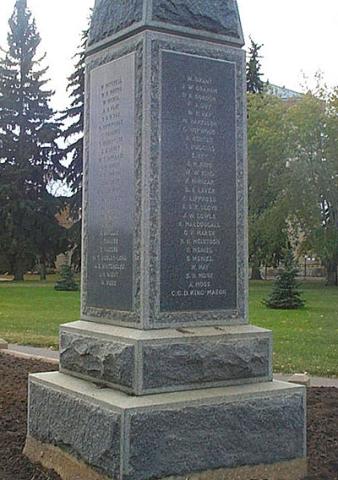
W. GRANT
J.W. GRAHAM
D.K. GORDON
F.J. GUY
W.P. HAY
W. HARRISON
G. HOPWOOD
A. HUNTER
T. HUGGINS
E. KEY
S.M. KING
P. KINNEAR
S.M. LAVER
F. LIPPROSS
A.S.K. LLOYD
J.W. LOWES
A. MACDOUGALL
G.H. MARSH
N.M. MCINTOSH
R. MCNEIL
S. MCNEIL
W. MAY
S.H. MONK
A. MOSS
C.G.D. KING-MASON
W. MITCHELL
W.K. MUNRO
W. NICHOL
A.H. PEAT
V.D.B. RAE
G. RIPPENGALE
C. ROBBINS
T. ROBERTSON
J.J. SCOTT
W.T. SINCLAIR
D.F. SMART
C.B. SMILLIE
T.H. SMITH
A.G. STARKINGS
C.A. STEBBING
A. STEELE
W. SPENCE
G. SWIFT
R. SMYLLIE
J. TINKESS
T. WATERS
W.T. WESLEY-LONG
A.E. WHITEHOUSE
J.H. WRIGHT
W. WOOD

Image
Photo Credit
City of Saskatoon/Ville de Saskatoon
Caption
front view
1 of 5 images
Image
Caption
front and left side details
1 of 5 images
Image
Caption
back details
1 of 5 images
Image
Caption
back details
1 of 5 images
Image
1 of 5 images
Province
!4v1621433667223!6m8!1m7!1s9jb1_OyzzfdGaJTlcfKsDw!2m2!1d52.13188971927509!2d-106.6516396566081!3f328.35015159298877!4f2.054887521889114!5f3.325193203789971"
Body Content

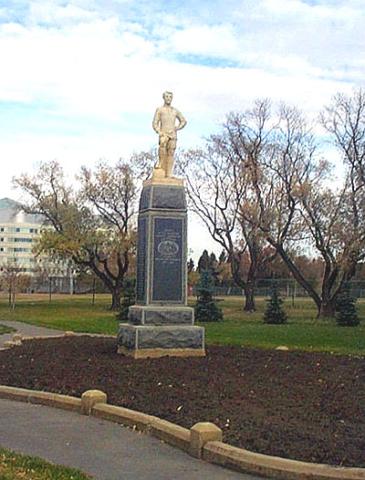
The Hugh Cairns Memorial, also known as the Footballer’s Memorial, features an 18 foot high marble statue of a footballer. Underneath the statue, Hugh Cairns' name is engraved, and on the statue’s base is the inscription of seventy-five Saskatoon football players’ names that lost their lives in World War I. The monument is located in Kinsmen Park near the South Saskatchewan River and the University Bridge.

The Hugh Cairns Memorial is a symbol of the lives that were lost during World War I, including that of Hugh Cairns who was born in 1896 in England but was raised in Saskatoon. Cairns was an apprentice plumber, and a member of the Christ Church football team and choir. He began his military service at the age of 19 in 1915 when he joined the 65th Battalion.  He later transferred to The 46th Battalion, Saskatchewan Regiment, where he attained the rank of sergeant.

In the summer of 1917, Cairns was awarded the Distinguished Conduct Medal for his bravery, during the Battle of Vimy Ridge.  He had led his machine gun crew against a German position, captured enemy gun emplacements and then stayed behind to cover the retreat of his men.  He incurred thirteen pieces of shrapnel in the encounter but recovered. Sergeant Hugh Cairns led three skirmishes during the advance at Valenciennes in Northern France; he was wounded on a fourth skirmish and died the next day, November 2, 1918. He was awarded the Victoria Cross posthumously in 1919 for his extraordinary efforts, an honour which has only been bestowed on six Saskatchewan Soldiers. The official statement which accompanied the award stated: "Throughout the operations he showed the highest degree of valour.  His leadership greatly contributed to the success of the attack."

To commemorate the sacrifice of Cairns and other fallen soldiers of World War I, the Hugh Cairns Memorial was unveiled on June 8, 1921. The monument has a polished granite base, and a marble statue resembling a footballer - Hugh Cairns. On the front of the granite base the following inscription is found "Erected by the Saskatoon Football Association and citizens In memory of Our Fallen Comrades 1914 – 1918." On the statue’s base is the inscription of seventy-five Saskatoon football players’ names that lost their lives in World War I (including the names of Hugh Cairns and his brother Albert).

Source: City of Saskatoon Built Heritage Database

City
Saskatoon
Country
Type Description
Granite statue and shaft
Memorial CF Legacy ID
3197
City/Municipality
Saskatoon
Memorial Number
47012-010
Type
Address
2108 Memorial Avenue
Location
Woodlawn Cemetery
in Canada
Yes
GPS Coordinates
52.1441713, -106.6582499
Inscription

[plaque on shaft/plaque sur socle]
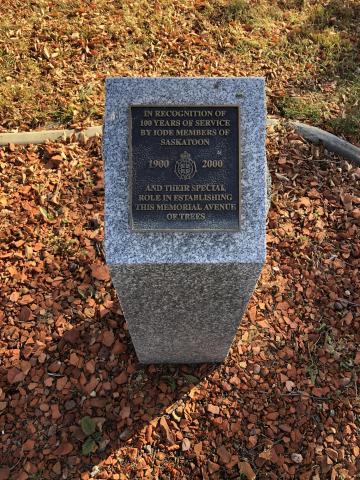
IN RECOGNITION OF
100 YEARS OF SERVICE
BY IODE MEMBERS OF
SASKATOON

1900 - 2000

AND THEIR SPECIAL
ROLE IN ESTABLISHING
THIS MEMORIAL AVENUE
OF TREES

[plaque on shaft/plaque sur socle]
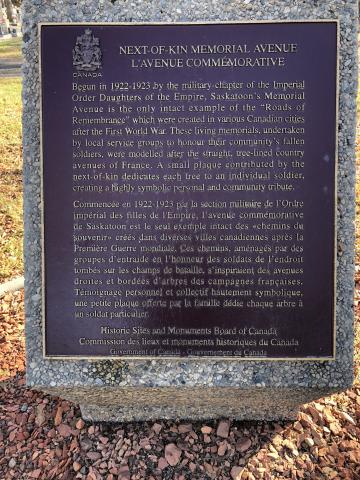
NEXT-OF-KIN MEMORIAL AVENUE
L'AVENUE COMMÉMORATIVE

Begun in 1922-1923 by the military chapter of the Imperial
Order Daughters of the Empire, Saskatoon's Memorial
Avenue is the only intact example of the "Roads of
Remembrance" which were created in various Canadian cities
after the First World War. These living memorials, undertaken
by local service groups to honour their community's fallen
soldiers, were modelled after the straight tree-lined country
avenues of France. A small plaque contributed by the
next-of-kin dedicates each tree to an individual soldier,
creating a highly symbolic personal and community tribute.

Commencée en 1922-1923 par la section militaire de l'Ordre
impérial des filles de l'Empire, l'avenue commémorative
de Saskatoon est le seul exemple intact des «chemins du
souvenir» créés dans diverses villes canadiennes après la
Première Guerre mondiale. Ces chemins, aménagés par des
groupes d'entraide en l'honneur des soldats de l'endroit
tombés sur les champs de bataille, s'inspiraient des avenues
droites et bordées d'arbres des campagnes françaises.
Témoignage personnel et collectif hautement symbolique,
une petite plaque offerte par la famille dédie chaque arbre à
un soldat particulier.


Historic Sites and Monuments Board of Canada
Commission des lieux et monuments historiques du Canada
Government of Canada - Gouvernement du Canada

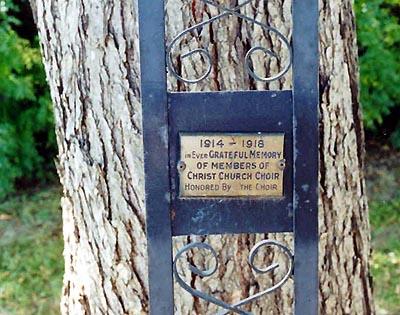
[tree plaque/plaque sur arbre]
1914 - 1918
IN EVER GRATEFUL MEMORY
OF MEMBERS OF
CHRIST CHURCH CHOIR
HONORED BY THE CHOIR

[plaque on tree/plaque sur arbre]
1914 - 1918
LIEUT. IVAN W. TINKESS
PTE. JAS. G. GALLAGHER
PTE. E.H. KING
HONORED BY NO. 777 R.B.P.

[gates at entrance near 33rd Street]

(left pillar plaque)

NEXT-OF-KIN
MEMORIAL
AVENUE

(right pillar plaque)

“TO THE
SACRED MEMORY OF
THOSE WHO SERVED
IN THE ARMED FORCES
AND
“REST FROM THEIR LABORS”
THIS NEXT-OF-KIN
MEMORIAL AVENUE IS
DEDICATED”.

Image
Photo Credit
City of Saskatoon
Caption
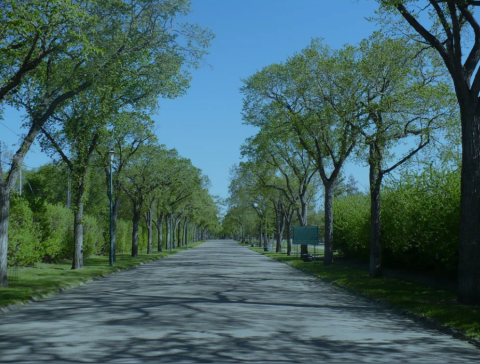
South Entrance looking north down Next-of-Kin Memorial Avenue, May 2008.
1 of 6 images
Image
Caption
plaques
1 of 6 images
Image
Caption
tree plaque
1 of 6 images
Image
Caption
tree plaque
1 of 6 images
Image
Photo Credit
City of Saskatoon
Caption
plaque on shaft
1 of 6 images
Image
Photo Credit
City of Saskatoon
Caption
plaque on shaft
1 of 6 images
Province
!4v1633457172794!6m8!1m7!1sW1hxz2hnc7ig9pglSDknHg!2m2!1d52.14417128499773!2d-106.6582498690229!3f354.7104960423604!4f8.999198092921375!5f0.7820865974627469
Body Content

The idea for a memorial avenue originated with the Education Committee of the local Military Chapter of the Imperial Order of the daughters of the Empire. Mrs. Jean Jarvis and Mrs. A. H. Hanson, key members of the committee, presented the concept to the City of Saskatoon in May 1922. The following month, the council endorsed a committee consisting of Parks Board staff and Imperial Order of the daughters of the Empire members. 

From the Saskatoon Imperial Order Daughters of the Empire branch: "A tree is a living memorial often more enduring than marble or bronze; a tree is a thing of beauty and of inspiration — a living token of the wonder and glory of nature — a symbol of service — for the life of a tree is a life of service, even the end of life is not the end of a tree's service; to the contrary, the end of a life opens new fields of service which add immeasurably to our civilization, our culture, and our happiness; therefore, is not a tree a fitting symbol for those valiant men who gave their lives for the service of their country and who died that humanity might continue to live in civilization, in culture, and in happiness?"

On June 17, 1923 the first trees were dedicated at a formal ceremony with Brigadier-General Alexander Ross, military units and representatives of every organization in Saskatoon in attendance. A crowd of 8,000 attended the event as 265 trees and plaques were dedicated. Each tree was purchased by the next-of-kin of a deceased soldier and dedicated to that specific individual with a brass plaque. For twenty years, Albert Meek skillfully engraved the plaques.

The 1923 ceremony was the first annual memorial service. Originally a private drive, Next-of-Kin Memorial Avenue was officially dedicated as a street on February 15, 1937. The yearly event and scope of the avenue has been expanded to memorialize those who died in both World Wars, the Korean War and all subsequent military engagements. Since that first dedication of 265 trees in 1923, more than 1,200 trees have been planted on various “branches” or avenues stemming from Next-of-Kin Memorial Avenue and running throughout the cemetery. The branches of the Avenue are names after distinguished soldiers, major battles, or ships.

The City of Saskatoon website maintains a listing of each memorial tree including the individual’s name, rank during service, place of death, age and the sponsor. The Imperial Order of the daughters of the Empire was responsible for the management of this program until February 10, 1986 when the City of Saskatoon assumed the administration of the program.

Two sets of gates are located within the initial Next-of-Kin Memorial Avenue. The first is the original entrance to Woodlawn Cemetery located on the north end of the Avenue. The original entrance is marked by two stone pillars and predates Next-of-Kin Memorial Avenue. The second gate is currently used as the entrance near 33rd Street. Two pillars of stone and brick were erected in the early 1950s. The Imperial Order of the daughters of the Empire contributed financially to the construction. A plaque is affixed to each pillar. 

In 1991 Jim Hall, an Executive Committee member of the Royal Canadian Legion, contacted the Historic Sites and Monuments Board of Canada with the proposal that Memorial Avenue be declared a National Historic Site. Gordon Fulton, along with Fern Graham, both of the Parks Service Architectural History Branch, had researched "Roads of Remembrance" in Canada and prepared a report.

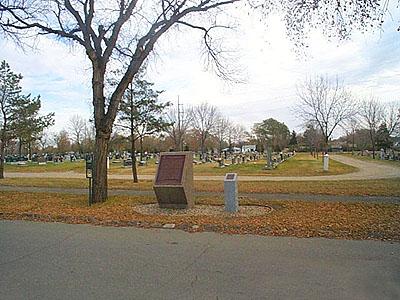
In 1992, the Next-of-Kin Memorial Avenue was designated a national historic site of Canada because: it is an excellent example of the “Roads of Remembrance” and it is the only such boulevard in Canada to have retained its integrity. Official recognition refers to the roadway known as Memorial Avenue, beginning at the north edge of Warman Road and ending at the stone cairn located between cemetery lots J and K and includes the road, the stone cairn and a measured boundary extending 14.2 meters from the center-point of Memorial Avenue. On August 28, 1994, a plaque was unveiled during the annual Decoration Day Memorial Service at the Soldiers' Cairn in Woodlawn Cemetery.

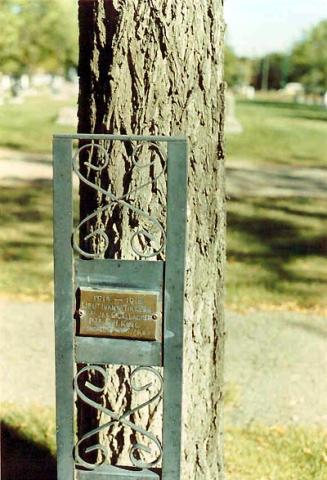
The Next-of-Kin Memorial Avenue National Historic Site of Canada is a picturesque 0.7 kilometer-long Road of Remembrance. The avenue begins at a pair of stone pedestals, flanked by a wrought-iron fence and runs northwards following the western boundary of the cemetery. It ends in a paved circle surrounding a stone memorial cairn. The asphalt-paved roadway is flanked on either side by a single row of 112 stately, mature elm trees, accompanied by bronze plaques on wrought-iron stands that dedicate each tree to a deceased soldier.

Each tree has a plaque and plaque stand associated with it. Each plaque, or brass plate, contains the individual’s name, rank and date of service. Initially serving as protection for the tree, the guards are now used solely as stands for the plaque. Some of the original guards have grown into some trees. In the past, plaques and stands have been replaced as required (due to damage). Three different styles of plaque stands have been used over the years and can be found on the avenue. The original style was replaced with a two-spiked plaque stand (date uncertain). In 1984, the Director of Woodlawn Cemetery chose a one-rod stand instead of two to facilitate lawn maintenance. Since 2002, replacement stands are replicas of the original style and are constructed of black wrought iron. They are distinguishable from the originals because they are slightly taller. Of the 1,360 memorial tree plaques, 99% are in honor of a Veteran.

In November 1918, Canadians turned to the duty of commemorating the dead. Some promoted practical memorials like Roads of Remembrance. These linear tree-lined avenues had trees that were typically a single species, regularly spaced along each side of the avenue that would grow tall and stately. American elms were chosen for many of these avenues. A small plaque was used to assign a particular tree to a specific fallen soldier. In some cases, the next-of-kin was involved in purchasing the tree and/or plaque for the deceased soldier.

Roads of Remembrance were based on two symbol-laden images. The first was France’s tree-lined country avenues: “long straight roads, with large elms on either side, beautiful and useful, and loved by the Canadians overseas.” The second symbol was a living memorial: trees represented the victory of life over death. Memorial trees became living symbols of the sacrifices made in France and Belgium.

City
Saskatoon
Country
Type Description
Street, trees and plaques
Memorial CF Legacy ID
6788
City/Municipality
Hepburn
Memorial Number
47012-009
Type
Address
3rd Ave S
Location
Hepburn M.B. Cemetery
in Canada
Yes
GPS Coordinates
52.5212, -106.73116
Inscription

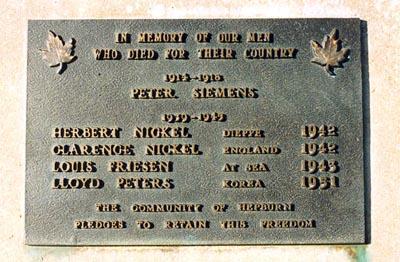
IN MEMORY OF OUR MEN
WHO DIED FOR THEIR COUNTRY
1914-1918
PETER SIEMENS
1939-1945
HERBERT NICKEL, DIEPPE, 1942
CLARENCE NICKEL, ENGLAND, 1942
LOUIS FRIESEN, AT SEA, 1943
LLOYD PETERS, KOREA, 1951
THE COMMUNITY OF HEPBURN
PLEDGES TO RETAIN THIS FREEDOM

Image
Photo Credit
Reuben Andres
Caption
detail of plaque
Province
!4v1621432660369!6m8!1m7!1se3Fsx0azZ7dNaDsvLQHbvQ!2m2!1d52.52063062799239!2d-106.7304228181074!3f336.0894569486431!4f2.955696171293397!5f0.7820865974627469"
Body Content

Needs further research

City
Hepburn
Country
Type Description
Bronze plaque
Memorial CF Legacy ID
3246
City/Municipality
Hafford
Memorial Number
47012-008
Type
Address
17 Main Street
Location
R M of Redberry
in Canada
Yes
GPS Coordinates
52.7275725, -107.3531703
Inscription

IN MEMORY OF
HAFFORD AND DISTRICT SERVICEMEN
WHO SACRIFICED THEIR LIVES
IN WORLD WARS I & II
1914-1918
CARTER, PTE. BERT
EMM, PTE. C.
GOLDIE, LT. A.L.
WILLIAMS, LT. C.

1939-1945
HERMAN, SGT. JOHN
KINDRACHUCK, RFMN. G.
KLAPOUSCHUK, PTE. M.
LEST WE FORGET
REMEMBRANCE COMMITTEE 1984.

Image
Photo Credit
Irene Attrux
Caption
front view
Province
!4v1621432373624!6m8!1m7!1sXY1sbLtQGqHb7dxu54kkvA!2m2!1d52.72757249515367!2d-107.3531703370325!3f69.57961047977338!4f-6.143287468352796!5f3.325193203789971"
Body Content

The cairn was erected by the Hafford Remembrance Day Committee.

City
Hafford
Country
Type Description
Cairn
Memorial CF Legacy ID
3245
City/Municipality
MacDowall
Memorial Number
47012-006
Type
Address
Sunset Street
Location
St. Stephen's Anglican Church
in Canada
Yes
GPS Coordinates
53.01614, -106.0149408
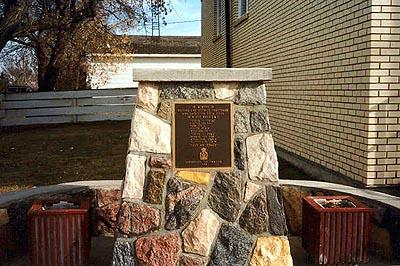
Inscription

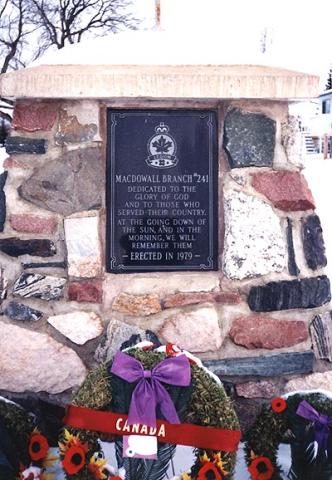
[plaque/plaque]

MACDOWALL BRANCH #241
DEDICATED TO THE GLORY OF GOD AND TO THOSE WHO SERVED THEIR COUNTRY.
AT THE GOING DOWN OF THE SUN, AND IN THE MORNING, WE WILL REMEMBER THEM

ERECTED IN 1979

Image
Photo Credit
Marie A. Best
Caption
cairn (front)
1 of 3 images
Image
Caption
cairn (front details)
1 of 3 images
Image
Caption
cairn (front)
1 of 3 images
Province
!4v1621431920969!6m8!1m7!1sjN7m03DhD7g0UbhHbAO47g!2m2!1d53.01614004403416!2d-106.0149407585434!3f3.524537944289875!4f-2.083877200419977!5f1.7086706115841004"
Body Content

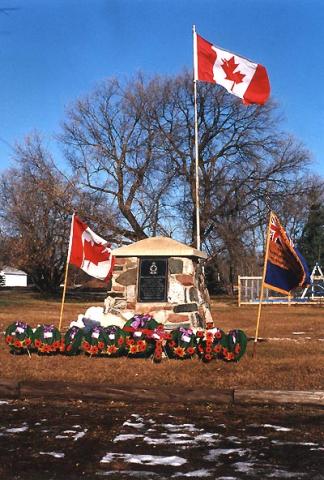
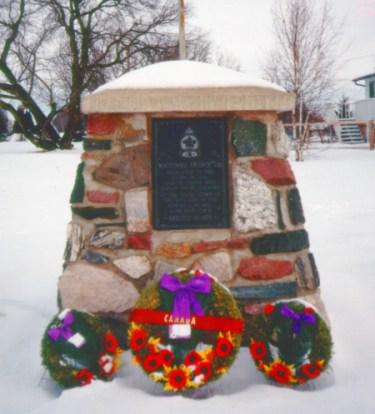
Constructed by stonemason Ernest W. Lapointe for Royal Canadian Legion Branch No. 241, this memorial to Canadian veterans was unveiled in 1979.

City
MacDowall
Country
Type Description
fieldstone cairn
Memorial CF Legacy ID
2383
City/Municipality
Duck Lake
Memorial Number
47012-003
Type
Address
Highway 212
Location
Battle of Duck Lake National Historic Site of Canada
in Canada
Yes
GPS Coordinates
52.8242359, -106.2742353
Inscription

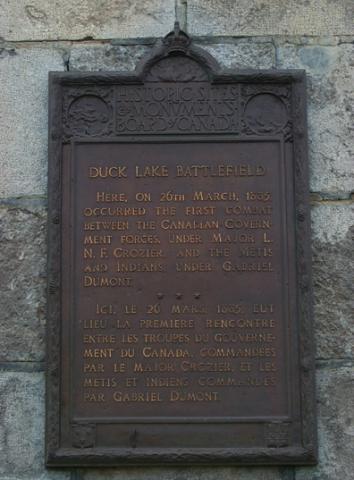
DUCK LAKE BATTLEFIELD

HERE, ON 26TH MARCH, 1885,
OCCURRED THE FIRST COMBAT
BETWEEN THE CANADIAN GOVERN-
MENT FORCES, UNDER MAJOR L.
N.F. CROZIER, AND THE MÉTIS
AND INDIANS, UNDER GABRIEL
DUMONT.

ICI, LE 26 MARS 1885, EUT
LIEU LE PREMIÉRE RECONTRE
ENTRE LES TROUPES DU GOUVERNE-
MENT DU CANADA. COMMANDÉES
PAR LE MAJOR CROZIER, ET LES
MÉTIS ET INDIENS COMMANDÉS
PAR GABRIEL DUMONT.


Image
Photo Credit
© Parks Canada
Caption
front inscription
1 of 4 images
Image
Caption
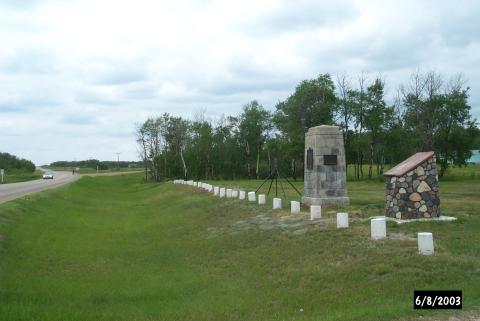
surroundings
1 of 4 images
Image
Caption
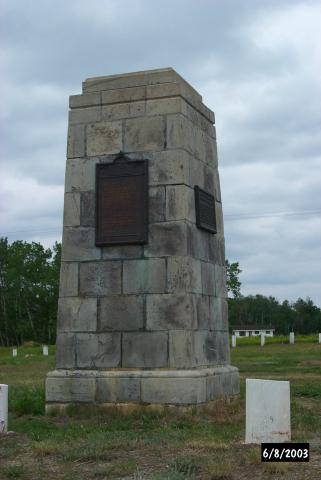
Duck Lake Battlefield Cairn
1 of 4 images
Image
Caption
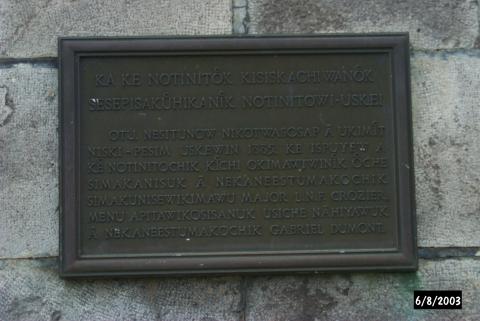
right side inscription (Cree language)
1 of 4 images
Province
!4v1679494226513!6m8!1m7!1sTDqVHHAOqHT75RIHp_ChMg!2m2!1d52.82423591902865!2d-106.2742352930586!3f19.437609863574053!4f-7.731318805256578!5f2.159765751074879
Body Content

This cairn was erected in 1950 and the Battle of Duck Lake was designated a national historic site by the federal government on the recommendation of the Historic Sites and Monuments Board of Canada. It is located on the site of the first battle of the Northwest Resistance of 1885, within Beardy's and Okemasis' Cree Nation.

At this place on 26 March 1885, the first in a series of battles took place and was considered an important victory for the Métis, who were grieved by uncertainty over land rights in the wake of Canadian expansion and encroaching settlement. While on the way to confiscate guns and ammunition from Hillyard Mitchell’s store near Duck Lake, a group of North West Mounted Police and civilians encountered a larger group of Métis, led by Gabriel Dumont. After a shot was fired, the North West Mounted Police and civilians retreated. As news of this encounter spread, Superintendent Leif N.F. Crozier gathered 52 North West Mounted Police, as well as 43 civilians, and they made their way along the Carlton Trail toward Duck Lake into Chief Beardy’s reserve. Chief Beardy made it clear that he wanted no part in the upcoming skirmish, and that he did not support Louis Riel. Meanwhile, the group of Métis had grown to include Isidore Dumont, Louis Riel, and Cree allies. The two groups eventually met, and the battle began when a North West Mounted Police interpreter, fearing an ambush, fired and killed Isidore Dumont. After 30 minutes of fighting with casualties suffered on both sides, Crozier ordered a retreat, and Riel ordered his followers not to shoot at them as they left.

City
Duck Lake
Country
Type Description
Cairn
Photo Credit
© Parks Canada
Memorial CF Legacy ID
11570
City/Municipality
Leask
Memorial Number
47012-001
Type
Address
231 1 Ave
Location
On the corner
in Canada
Yes
GPS Coordinates
53.0204778, -106.7430901
Inscription

[front/devant]

ERECTED TO]
THE MEMORY OF]
THOSE HEROES]
MEN OF THIS]
DISTRICT, WHO SO]
NOBLY SACRIFICED]
THEIR LIVES
IN DEFENCE OF
THEIR COUNTRY IN
THE GREAT WAR OF

1914-1918

we are the dead, short days ago
we lived, felt dawn, saw sunset glow
loved and were loved and now we lie
in flanders field

WORLD WAR II

1939-1945

PRIVATE H.L. DICUS
SAPPER L. SMITH
RIFLEMAN L. RENAUD
WARRANT OFFICER W.W. DUNCAN
SERGEANT H. DREAVER
SERGEANT L.E. LALONDE

[right side/côté droit]

LEADING SEAMAN

A. SMYTHE

PRIVATES

J. BOURASSA
W. BOURASSA
W. MORROW
W. NUTTER
H. STANNARD
A. CHAMBERS

Image
Caption
obelisk (front and right side)
1 of 3 images
Image
Caption
obelisk (front)
1 of 3 images
Image
1 of 3 images
Province
!4v1621431153964!6m8!1m7!1svV-XlWttd2TEIycDwW7Fig!2m2!1d53.02047775377532!2d-106.7430900996035!3f237.93525899724165!4f-4.497606461061892!5f2.790624002493023"
Body Content

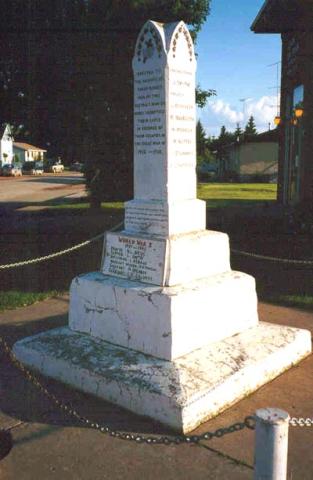
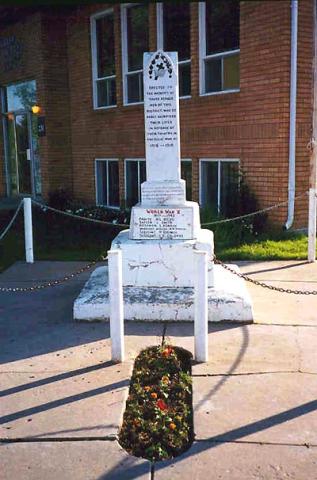
This memorial was erected in honour of the local war dead of the First World War. A wooden plaque and further inscriptions were added after the Second World War to record the local fallen of that conflict.

City
Leask
Country
Type Description
Concrete obelisk
Memorial CF Legacy ID
1978
City/Municipality
Moosomin
Memorial Number
47011-117
Type
Address
710 Main Street
Location
Royal Canadian Legion Branch 81
in Canada
Yes
GPS Coordinates
50.1437642, -101.6673153
Image
Caption
Guy Chestnut Plaque
1 of 3 images
Image
Caption
Metal art plaques.
1 of 3 images
Image
Caption
Walls of Remembrance
1 of 3 images
Province
!4v1621430854978!6m8!1m7!1spWhsQGyoc9A7PsXwMiw_3g!2m2!1d50.14376322486033!2d-101.6673137427376!3f307.35312932767994!4f6.61071561048216!5f0.7820865974627469
Body Content

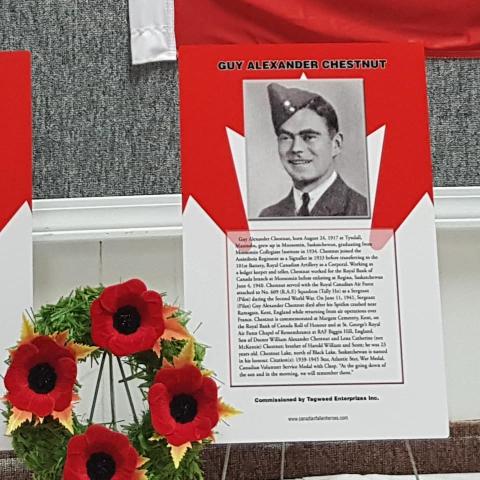
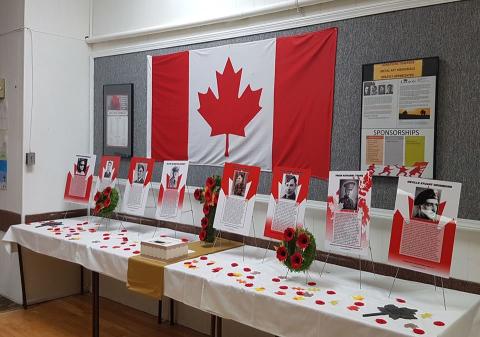
Moosomin Royal Canadian Legion Branch 81 memorialized all 85 of the soldiers listed on the Moosomin Cenotaph by commissioning metal art plaques. Each plaque hung in the legion includes a photo, or a copy of the attestation papers if a photo was not available, and biography of the soldier. There are 26 plaques with soldiers that had ties to the Moosomin area but are not listed on the cenotaph, for a total 111 plaques.

The Legion got started on this project after the Moosomin town council was contacted by Canadian Fallen Heroes, the organization that researches, writes biographies and locates photos of the fallen heroes. The Legion unveiled the first eight plaques on Remembrance Day 2018 and the final plaques were completed for Remembrance Day 2019.

This project would not have been possible to be complete in such a short time period without the support of the business in the town of Moosomin and district.

City
Moosomin
Country
Type Description
Display
Photo Credit
Royal Canadian Legion Branch 81
Memorial CF Legacy ID
10093
City/Municipality
Frobisher
Memorial Number
47011-116
Type
Address
Location
Frobisher Legion Hall
in Canada
Yes
GPS Coordinates
0, 0
Image
Photo Credit
Frobisher tourism
Caption
Frobisher sign
Province
Body Content

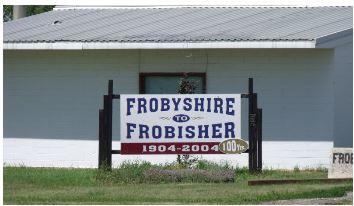
On December 3, 1947, the Frobisher Branch was formed. Some years later the BESL part of the title was dropped and it became The Royal Canadian Legion, Frobisher Branch 343. 

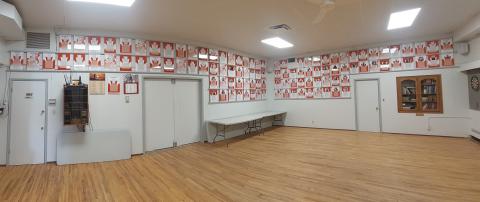
Over the years, there was always a November 11th service held, followed by a pot-luck meal and a time of singing and fellowship. This continued until 1997, when dwindling numbers in membership made it difficult to organize, so the Legion voted to attend and take part in the services at the school who very ably have been conducting a community service. In 1987, the Legion undertook a Remembrance project of putting up a photo gallery of all past Veterans and also made Honour Rolls to be placed in certain locations throughout the town. In 1990, a cenotaph was built in front of the Frobisher Legion hall to recognize the fallen soldiers of the great wars. In 1986, the Branch and Auxiliary held their 60th Anniversary celebration, which included a tulip planting campaign. After the Branch and Auxiliary closef in 2002, the property was turned over to the town and some of the members transferred to the Alameda Branch.


City
Frobisher
Country
Type Description
Cairn
Photo Credit
Victoria Edwards
Memorial CF Legacy ID
10087