Other

City/Municipality
Regina
Memorial Number
47005-113
Type
Address
Scarth Street and Victoria Avenue
Location
Victoria Park
in Canada
Yes
GPS Coordinates
50.4481599, -104.6120414
Inscription

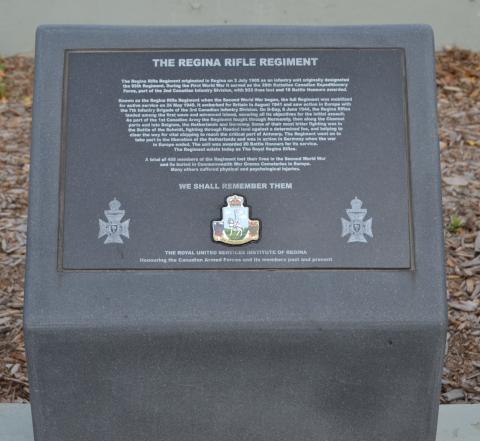
THE REGINA RIFLE REGIMENT

The Regina Rifle Regiment originated in Regina on 3 July 1905 as an infantry unit originally designated
the 95th Regiment. During the First World War it served as the 28th Battalion Canadian Expeditionary
Force, part of the 2nd Canadian Infantry Division, with 933 lives lost and 18 Battle Honours awarded.

Known as the Regina Rifles Regiment when the Second World War began, the full Regiment was mobilized
for active service on 24 May 1940. It embarked for Britain in August 1941 and saw action in Europe with
the 7th Infantry Brigade of the 3rd Canadian Infantry Division. On D-Day, 6 June 1944, the Regina Rifles
landed among the first wave and advanced inland, securing all its objectives for the initial assault.
As part of the 1st Canadian Army the Regiment fought through Normandy, then along the Channel
ports into Belgium, the Netherlands and Germany. Some of their most bitter fighting was in
the Battle of the Scheldt, fighting through flooded land against a determined foe, and helping to
take part in the liberation of the Netherlands and was in action in Germany when the war
in Europe ended. The unit was awarded 30 Battle Honours for its service.
The Regiment exists today as They Royal Regina Rifles.

A total of 453 members of the Regiment lost their lives in the Second World War
and lie buried in Commonwealth War Grave Cemeteries in Europe.
Many others suffered physical and psychological injuries.

WE SHALL REMEMBER THEM

THE ROYAL UNITED SERVICES INSTITUTE OF REGINA
Honouring the Canadian Armed Forces and its members past and present

Image
Caption
Regina Rifle Regiment Plaque
War or Conflict Term
Province
!4v1719332908773!6m8!1m7!1s3iyiwNW3kA8Ckhqz4tE5Iw!2m2!1d50.4481599238856!2d-104.6120413906108!3f233.44473263788103!4f-6.003722502635824!5f0.7820865974627469
Body Content

This plaque is part of a campaign started in 2020 by the Royal United Services Institute of Regina, a local organization of civilians and retired military personnel, to install a series of twelve commemorative plaques around the cenotaph. It was unveiled on 8 August 2022. The plaques explain Canada's wartime history.

The Regina Rifle Regiment originated in Regina on 3 July 1905 as an infantry unit originally designated the 95th Regiment. During the First World War it served as the 28th Battalion Canadian Expeditionary Force, part of the 2nd Canadian Infantry Division, with 933 lives lost and 18 Battle Honours awarded.

Known as the Regina Rifles Regiment when the Second World War began, the full Regiment was mobilized for active service on 24 May 1940. It embarked for Britain in August 1941 and saw action in Europe with the 7th Infantry Brigade of the 3rd Canadian Infantry Division. On D-Day, 6 June 1944, the Regina Rifles landed among the first wave and advanced inland, securing all its objectives for the initial assault. As part of the 1st Canadian Army the Regiment fought through Normandy, then along the Channel ports into Belgium, the Netherlands and Germany. Some of their most bitter fighting was in the Battle of the Scheldt, fighting through flooded land against a determined foe, and helping to take part in the liberation of the Netherlands and was in action in Germany when the war in Europe ended. The unit was awarded 30 Battle Honours for its service. The Regiment exists today as They Royal Regina Rifles.
City
Regina
Country
Type Description
Plaque
Photo Credit
Royal United Services Institute of Regina
Memorial CF Legacy ID
12759
City/Municipality
Regina
Memorial Number
47005-112
Type
Address
Scarth Street and Victoria Avenue
Location
Victoria Park
in Canada
Yes
GPS Coordinates
50.4481599, -104.6120414
Inscription

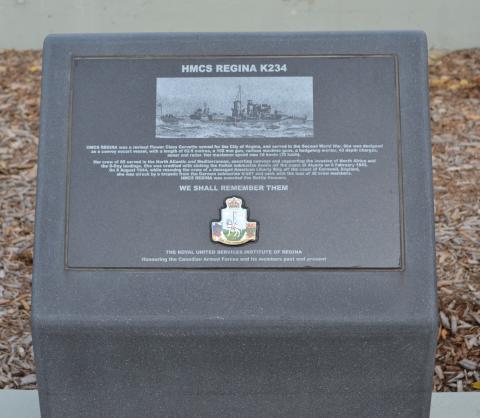
HMCS REGINA K234

HMCS REGINA was a revised Flower Class Corvette named for the city of Regina, and served in the Second World War. She was designed as a convoy escort vessel, with a length of 62.5 metres, a 102 mm gun, various machine guns, a hedgehog mortar, 40 depth charges, sonar and radar. Her maximum speed was 16 knots (30 km/h).

Her crew of 85 served in the North Atlantic and Mediterranean, escorting convoys and supporting the invasion of North Africa and
the D-Day landings. She was credited with sinking the Italian submarine Acorto off the coast of Algeria on 8 February 1943.
On 8 August 1944, while rescuing the crew of a damaged American Liberty Ship off the coast of Cornwall, England,
she was struck by a torpedo from the German submarine U-667 and sank with the loss of 30 crew members.
HMCS REGINA was awarded five Battle Honours.

WE SHALL REMEMBER THEM

THE ROYAL UNITED SERVICES INSTITUTE OF REGINA
Honouring the Canadian Armed Forces and its members past and present

Image
Caption
HMCS Regina K234 Plaque
Province
!4v1719332908773!6m8!1m7!1s3iyiwNW3kA8Ckhqz4tE5Iw!2m2!1d50.4481599238856!2d-104.6120413906108!3f233.44473263788103!4f-6.003722502635824!5f0.7820865974627469
Body Content

This plaque is part of a campaign started in 2020 by the Royal United Services Institute of Regina, a local organization of civilians and retired military personnel, to install a series of twelve commemorative plaques around the cenotaph. It was unveiled on 8 August 2022. The plaques explain Canada's wartime history.

HMCS Regina was a revised Flower Class Corvette named for the city of Regina, and served in the Second World War. She was designed as a convoy escort vessel, with a length of 62.5 metres, a 102 mm gun, various machine guns, a hedgehog mortar, 40 depth charges, sonar and radar. Her maximum speed was 16 knots (30 km/h).

Her crew of 85 served in the North Atlantic and Mediterranean, escorting convoys and supporting the invasion of North Africa and the D-Day landings. She was credited with sinking the Italian submarine Acorto off the coast of Algeria on 8 February 1943. On 8 August 1944, while rescuing the crew of a damaged American Liberty Ship off the coast of Cornwall, England, she was struck by a torpedo from the German submarine U-667 and sank with the loss of 30 crew members. HMCS Regina was awarded five Battle Honours.

City
Regina
Country
Type Description
Plaque
Photo Credit
Royal United Services Institute of Regina
Memorial CF Legacy ID
12758
City/Municipality
Regina
Memorial Number
47005-111
Type
Address
Scarth Street and Victoria Avenue
Location
Victoria Park
in Canada
Yes
GPS Coordinates
50.4481599, -104.6120414
Inscription

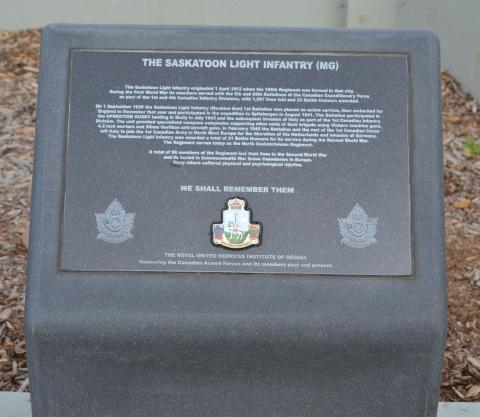
THE SASKATOON LIGHT INFANTRY (MG)

The Saskatoon Light Infantry originated 1 April 1912 when the 105th Regiment was formed in that city.
During the First World War its members served with the 5th and 65th Battalions of the Canadian Expeditionary Force
as part of the 1st and 4th Canadian Infantry Divisions, with 1,297 lives lost and 23 Battle Honours awarded.

On 1 September 1939 the Saskatoon Light Infantry (Machine Gun) 1st Battalion was placed on active service, then embarked for
England in December that year and participated in the expedition to Spitzbergen in August 1941. The Battalion participated in
the OPERATION HUSKY landing in Sicily in July 1943 and the subsequent invasion of Italy as part of the 1st Canadian Infantry
Division. The unit provided specialized weapon companies supporting other units of their brigade using Vickers machine guns,
4.2 Inch mortars and 20mm Oerlikon anti-aircraft guns. In February 1945 the Battalion and the rest of the 1st Canadian Corps
left Italy to join the 1st Canadian Army in North West Europe for the liberation of the Netherlands and invasion of Germany.
The Saskatoon Light Infantry was awarded a total of 21 Battle Honours for its service during the Second World War.
The Regiment serves today as the North Saskatchewan Regiment.

A total of 96 members of the Regiment lost their lives in the Second World War
and lie buried in Commonwealth War Grave Cemeteries in Europe.
Many others suffered physical and psychological injuries.

WE SHALL REMEMBER THEM

THE ROYAL UNITED SERVICES INSTITUTE OF REGINA
Honouring the Canadian Armed Forces and its members past and present

Image
Caption
Saskatoon Light Infantry (MG) Plaque
War or Conflict Term
Province
!4v1719332908773!6m8!1m7!1s3iyiwNW3kA8Ckhqz4tE5Iw!2m2!1d50.4481599238856!2d-104.6120413906108!3f233.44473263788103!4f-6.003722502635824!5f0.7820865974627469
Body Content

This plaque is part of a campaign started in 2020 by the Royal United Services Institute of Regina, a local organization of civilians and retired military personnel, to install a series of twelve commemorative plaques around the cenotaph. It was unveiled on 10 July 2022. The plaques explain Canada's wartime history.

The Saskatoon Light Infantry originated on 1 April 1912, when the 105th Regiment was formed in that city. During the First World War its members served with the 5th and 65th Battalions of the Canadian Expeditionary Force as part of the 1st and 4th Canadian Infantry Divisions, with 1,297 lives lost and 23 Battle Honours awarded.

On 1 September 1939, the Saskatoon Light Infantry (Machine Gun) 1st Battalion was placed on active service, then embarked for England in December that year and participated in the expedition to Spitzbergen in August 1941. The Battalion participated in Operation Husky landing in Sicily in July 1943 and the subsequent invasion of Italy as part of the 1st Canadian Infantry Division. The unit provided specialized weapon companies supporting other units of their brigade using Vickers machine guns, 4.2 Inch mortars and 20mm Oerlikon anti-aircraft guns. In February 1945 the Battalion and the rest of the 1st Canadian Corps left Italy to join the 1st Canadian Army in North West Europe for the liberation of the Netherlands and invasion of Germany. The Saskatoon Light Infantry was awarded a total of 21 Battle Honours for its service during the Second World War. The Regiment serves today as the North Saskatchewan Regiment.

City
Regina
Country
Type Description
Plaque
Photo Credit
Royal United Services Institute of Regina
Memorial CF Legacy ID
12757
City/Municipality
Regina
Memorial Number
47005-110
Type
Address
Scarth Street and Victoria Avenue
Location
Victoria Park
in Canada
Yes
GPS Coordinates
50.4481599, -104.6120414
Inscription

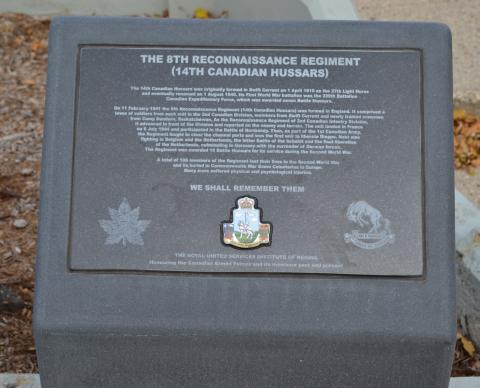
THE 8TH RECONNAISSANCE REGIMENT
(14TH CANADIAN HUSSARS)

The 14th Canadian Hussars was originally formed in Swift Current on 1 April 1910 as the 27th Light Horse
and eventually renamed on 1 August 1940. Its First World War battalion was the 209th Battalion
Canadian Expeditionary Force, which was awarded seven Battle Honours.

On 11 February 1941 the 8th Reconnaissance Regiment (14th Canadian Hussars) was formed in England. It comprised a
levee of soldiers from each unit in the 2nd Canadian Division, members from Swift Current and newly trained crewmen
from Camp Dundurn, Saskatchewan. As the Reconnaissance Regiment of 2nd Canadian Infantry Division,
it advanced in front of the Division and reported on the enemy and terrain. The unit landed in France
on 6 July 1944 and participated in the Battle of Normandy. Then, as part of the 1st Canadian Army,
the Regiment fought to clear the channel ports and was the first unit to liberate Dieppe. Next was
fighting in Belgium and the Netherlands, the bitter Battle of the Scheldt and the final liberation
of the Netherlands, culminating in Germany with the surrender of German forces.
The Regiment was awarded 15 Battle Honours for its service during the Second World War.

A total of 106 members of the Regiment lost their lives in the Second World War
and lie buried in Commonwealth War Graves Cemeteries in Europe.
Many more suffered physical and psychological injuries.

WE SHALL REMEMBER THEM

THE ROYAL UNITED SERVICES INSTITUTE OF REGINA
Honouring the Canadian Armed Forces and its members past and present

Image
Caption
8th Reconnaissance Regiment Plaque
Province
!4v1719332908773!6m8!1m7!1s3iyiwNW3kA8Ckhqz4tE5Iw!2m2!1d50.4481599238856!2d-104.6120413906108!3f233.44473263788103!4f-6.003722502635824!5f0.7820865974627469
Body Content

This plaque is part of a campaign started in 2020 by the Royal United Services Institute of Regina, a local organization of civilians and retired military personnel, to install a series of twelve commemorative plaques around the cenotaph. It was unveiled on July 10, 2022. The plaques explain Canada's wartime history.

The 14th Canadian Hussars was originally formed in Swift Current on 1 April 1910 as the 27th Light Horse and eventually renamed on 1 August 1940. Its First World War battalion was the 209th Battalion Canadian Expeditionary Force, which was awarded seven Battle Honours.

On 11 February 1941 the 8th Reconnaissance Regiment (14th Canadian Hussars) was formed in England. It comprised a levee of soldiers from each unit in the 2nd Canadian Division, members from Swift Current and newly trained crewmen from Camp Dundurn, Saskatchewan. As the Reconnaissance Regiment of 2nd Canadian Infantry Division, it advanced in front of the Division and reported on the enemy and terrain. The unit landed in France on 6 July 1944 and participated in the Battle of Normandy. Then, as part of the 1st Canadian Army, the Regiment fought to clear the channel ports and was the first unit to liberate Dieppe. Next was fighting in Belgium and the Netherlands, the Battle of the Scheldt and the final liberation of the Netherlands, culminating in Germany with the surrender of German forces. The Regiment was awarded 15 Battle Honours for its service during the Second World War. A total of 106 members of the Regiment lost their lives in the Second World War.

City
Regina
Country
Type Description
Plaque
Photo Credit
Royal United Services Institute of Regina
Memorial CF Legacy ID
12756
City/Municipality
Regina
Memorial Number
47005-109
Type
Address
Scarth Street and Victoria Avenue
Location
Victoria Park
in Canada
Yes
GPS Coordinates
50.4481599, -104.6120414
Inscription

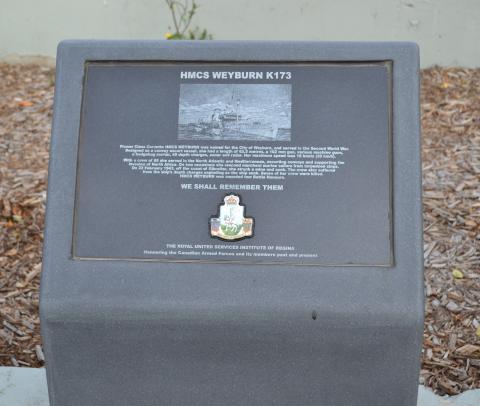
HMCS WEYBURN K173

Flower Class Corvette HMCS WEYBURN was named for the City of Weyburn, and served in the Second World War.
Designed as a convoy escort vessel, she had a length of 63.5 metres, a 102 mm gun, various machine guns,
a hedgehog mortar, 40 depth charges, sonar and radar. Her maximum speed was 16 knots (30km/h).

With a crew of 85 she served in the North Atlantic and Mediterranean, escorting convoys and supporting the
invasion of North Africa. On two occasions she rescued merchant marine sailors from torpedoed ships.
On 22 February 1943, off the coast of Gibraltar, she struck a mine and sank. The crew also suffered
from the ship's depth charges exploding as the ship sank. Seven of her crew were killed.
HMCS WEYBURN was awarded two Battle Honours.

WE SHALL REMEMBER THEM

THE ROYAL UNITED SERVICES INSTITUTE OF REGINA
Honouring the Canadian Armed Forces and its members past and present

Image
Caption
HMCS Weyburn Plaque
Province
!4v1719332908773!6m8!1m7!1s3iyiwNW3kA8Ckhqz4tE5Iw!2m2!1d50.4481599238856!2d-104.6120413906108!3f233.44473263788103!4f-6.003722502635824!5f0.7820865974627469
Body Content

This plaque is part of a campaign started in 2020 by the Royal United Services Institute of Regina, a local organization of civilians and retired military personnel, to install a series of twelve commemorative plaques around the cenotaph. It was unveiled on August 19, 2022. The plaques explain Canada's wartime history.

Flower Class Corvette HMCS Weyburn was named for the City of Weyburn, and served in the Second World War. Designed as a convoy escort vessel, she had a length of 63.5 metres, a 102 mm gun, various machine guns, a hedgehog mortar, 40 depth charges, sonar and radar. Her maximum speed was 16 knots (30km/h).

With a crew of 85 she served in the North Atlantic and Mediterranean, escorting convoys and supporting the invasion of North Africa. On two occasions she rescued merchant marine sailors from torpedoed ships. On 22 February 1943, off the coast of Gibraltar, she struck a mine and sank. The crew also suffered from the ship's depth charges exploding as the ship sank. Seven of her crew were killed. HMCS Weyburn was awarded two Battle Honours.

City
Regina
Country
Type Description
Plaque
Photo Credit
Royal United Services Institute of Regina
Memorial CF Legacy ID
12755
City/Municipality
Regina
Memorial Number
47005-108
Type
Address
Scarth Street and Victoria Avenue
Location
Victoria Park
in Canada
Yes
GPS Coordinates
50.4481599, -104.6120414
Inscription

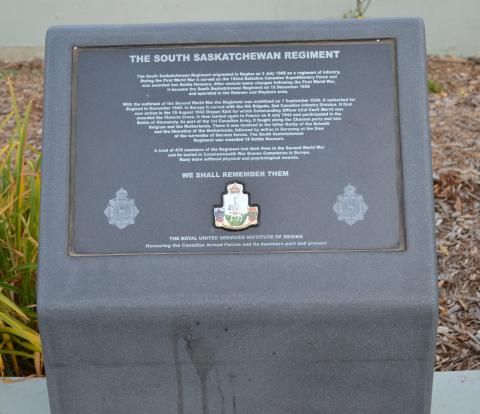
THE SOUTH SASKATCHEWAN REGIMENT

The South Saskatchewan Regiment originated in Regina on 3 July 1905 as a regiment of infantry.
During the First World War it served as the 152nd Battalion Canadian Expeditionary Force and
was awarded two Battle Honours. After several name changes following the First World War,
it became the South Saskatchewan Regiment on 15 December 1935
and operated in the Estevan and Weyburn area.

With the outbreak of the Second World War the Regiment was mobilized on 1 September 1939. It embarked for
England in December 1940. In Europe it served with the 6th Brigade, 2nd Canadian Infantry Division. It first
saw action in the 19 August 1942 Dieppe Raid for which Commanding Officer LCol Cecil Merrit was
awarded the Victoria Cross. It then landed again in France on 8 July 1944 and participated in the
Battle of Normandy. As part of the 1st Canadian Army, it fought along the Channel ports and into
Belgium and the Netherlands. There it was involved in the bitter Battle of the Scheldt
and the liberation of the Netherlands, followed by action in Germany at the time
of surrender of German forces. The South Saskatchewan
Regiment was awarded 18 Battle Honours.

A total of 475 members of the Regiment lost their lives in the Second World War
and lie buried in Commonwealth War Graves Cemeteries in Europe.
Many more suffered physical and psychological wounds.

WE SHALL REMEMBER THEM

THE ROYAL UNITED SERVICES INSTITUTE OF REGINA
Honouring the Canadian Armed Forces and its members past and present

Image
Caption
South Saskatchewan Regiment Plaque
War or Conflict Term
Province
!4v1719332908773!6m8!1m7!1s3iyiwNW3kA8Ckhqz4tE5Iw!2m2!1d50.4481599238856!2d-104.6120413906108!3f233.44473263788103!4f-6.003722502635824!5f0.7820865974627469
Body Content

This plaque is part of a campaign started in 2020 by the Royal United Services Institute of Regina, a local organization of civilians and retired military personnel, to install a series of twelve commemorative plaques around the cenotaph. It was unveiled on August 19, 2022. The plaques explain Canada's wartime history.

The South Saskatchewan Regiment originated in Regina on 3 July 1905 as a regiment of infantry. During the First World War it served as the 152nd  Battalion Canadian Expeditionary Force and was awarded two Battle Honours. After several name changes following the First World War, it became the South Saskatchewan Regiment on 15 December 1935 and operated in the Estevan and Weyburn area.

With the outbreak of the Second World War the Regiment was mobilized on 1 September 1939. It embarked for England in December 1940. In Europe it served with the 6th Brigade, 2nd Canadian Infantry Division. It first saw action in the 19 August 1942 Dieppe Raid for which Commanding Officer Lieutenant-Colonel Cecil Merrit was awarded the Victoria Cross. It then landed again in France on 8 July 1944 and participated in the Battle of Normandy. As part of the 1st Canadian Army, it fought along the Channel ports and into Belgium and the Netherlands where it was involved in the Battle of the Scheldt and the liberation of the Netherlands, followed by action in Germany at the time of surrender of German forces. The South Saskatchewan Regiment was awarded 18 Battle Honours. A total of 475 members of the Regiment lost their lives in the Second World War.

City
Regina
Country
Type Description
Plaque
Photo Credit
Royal United Services Institute of Regina
Memorial CF Legacy ID
12754
City/Municipality
Regina
Memorial Number
47005-107
Type
Address
Scarth Street and Victoria Avenue
Location
Victoria Park
in Canada
Yes
GPS Coordinates
50.4481599, -104.6120414
Inscription

needs further research/recherche incomplète

Image
Caption
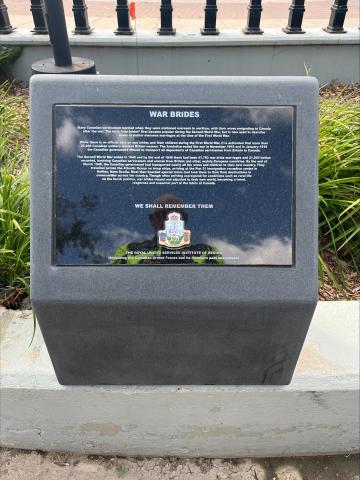
War Brides Plaque
War or Conflict Term
Province
!4v1719332908773!6m8!1m7!1s3iyiwNW3kA8Ckhqz4tE5Iw!2m2!1d50.4481599238856!2d-104.6120413906108!3f233.44473263788103!4f-6.003722502635824!5f0.7820865974627469
Body Content

This plaque is part of a campaign started in 2020 by the Royal United Services Institute of Regina, a local organization of civilians and retired military personnel, to install a series of twelve commemorative plaques around the cenotaph. It was unveiled on July 11, 2024. The plaques explain Canada's wartime history.

The War Brides Plaque commemorates the more than 25,000 British women that married British soldiers during the First World War and the 47,783 war bride marriages from the Second World War.

City
Regina
Country
Type Description
Plaque
Photo Credit
Royal United Services Institute of Regina
Memorial CF Legacy ID
12721
City/Municipality
Regina
Memorial Number
47005-106
Type
Address
2405 Legislative Drive
Location
Legislative Building
in Canada
Yes
GPS Coordinates
50.4330419, -104.6149188
Inscription

needs further research/recherche incomplète

Image
Caption
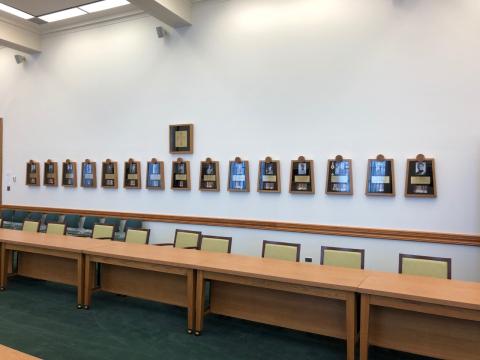
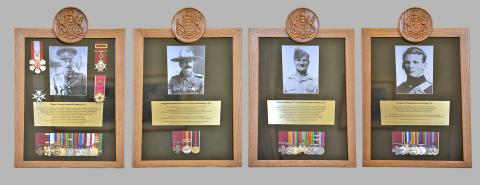
Victoria Cross Wall of Honour
1 of 5 images
Image
Caption
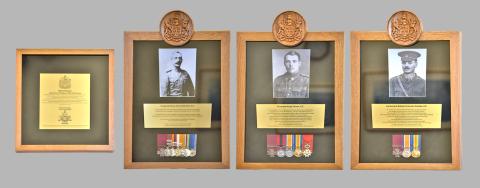
Wall of Honour; Corporal Beet, VC; Sergent Cairns ,VC and Lieutenant Combe, VC shadow boxes.
1 of 5 images
Image
Caption
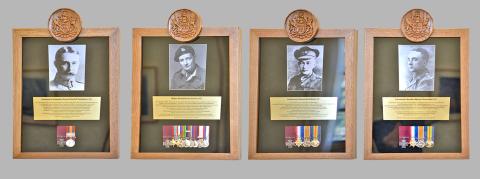
Lieutenant Cockburn, VC; Major Currie, VC; Lieutenant De Wind, VC and Lieutenant Flowerdew, VC shadow boxes.
1 of 5 images
Image
Caption
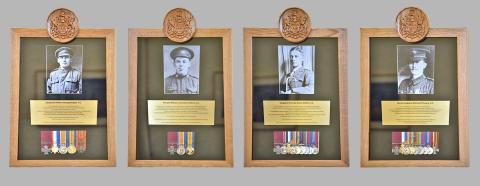
Sergeant Knight, VC; Private Milne, VC; Sergeant Mullin, VC;and Lance Coporal O'Leary, VC shadow boxes.
1 of 5 images
Image
Caption
Major Pearkes, VC; Sergeant Richardson, VC; Warrant Officer 2nd Class Osborn, VC and Sergeant Zengel, VC shadow boxes.
1 of 5 images
Province
!4v1725452805648!6m8!1m7!1sQ8tOPw10eybIPJMTP7TH9w!2m2!1d50.43304191839917!2d-104.6149188017387!3f177.53695732135049!4f8.216470720341164!5f0.7820865974627469
Body Content

All 15 Victoria Cross recipients on the Wall of Honour lived in Saskatchewan at one time. The shadow boxes were unveiled on a temporary mounting at a ceremony in the Legislative Building on 7 November 2018 and later moved to room 218.

In 1995, the Province placed a bronze plaque at each of their last residence.

City
Regina
Country
Type Description
Wall
Photo Credit
Royal United Services Institute of Regina
Memorial CF Legacy ID
12717
City/Municipality
Regina
Memorial Number
47005-105
Type
Address
Scarth Street and Victoria Avenue
Location
Victoria Park
in Canada
Yes
GPS Coordinates
50.4481599, -104.6120414
Inscription

needs further research/recherche incomplète

Image
Caption
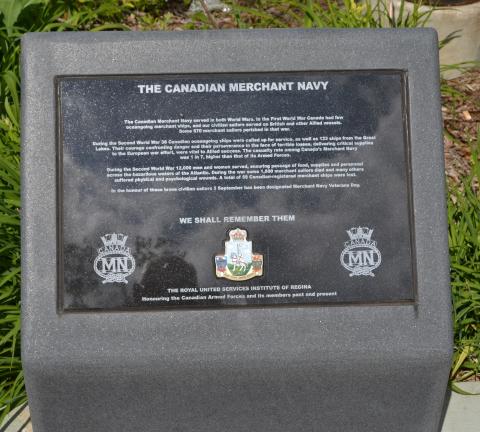
Canadian Merchant Navy Plaque
War or Conflict Term
Province
!4v1719332908773!6m8!1m7!1s3iyiwNW3kA8Ckhqz4tE5Iw!2m2!1d50.4481599238856!2d-104.6120413906108!3f233.44473263788103!4f-6.003722502635824!5f0.7820865974627469
Body Content

This plaque is part of a campaign started in 2020 by the Royal United Services Institute of Regina, a local organization of civilians and retired military personnel, to install a series of twelve commemorative plaques around the cenotaph. It was unveiled on August 31, 2023. The plaques explain Canada's wartime history.

The plaque commemorates those who served with the Merchant Navy in the World Wars.

City
Regina
Country
Type Description
Plaque
Photo Credit
Royal United Services Institute of Regina
Memorial CF Legacy ID
12634
City/Municipality
Regina
Memorial Number
47005-104
Type
Address
Scarth Street and Victoria Avenue
Location
Victoria Park
in Canada
Yes
GPS Coordinates
50.4481599, -104.6120414
Inscription

needs further research/recherche incomplète

Image
Caption
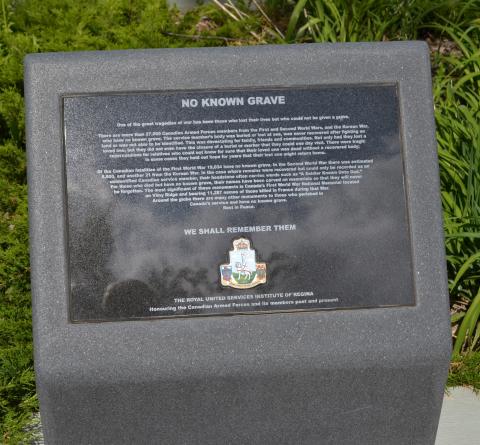
No Known Grave Plaque
Province
!4v1719332908773!6m8!1m7!1s3iyiwNW3kA8Ckhqz4tE5Iw!2m2!1d50.4481599238856!2d-104.6120413906108!3f233.44473263788103!4f-6.003722502635824!5f0.7820865974627469
Body Content

This plaque is part of a campaign started in 2020 by the Royal United Services Institute of Regina, a local organization of civilians and retired military personnel, to install a series of twelve commemorative plaques around the cenotaph. It was unveiled on August 1, 2023. The plaques explain Canada's wartime history.

This plaque commemorates those who served and have no known grave.

City
Regina
Country
Type Description
Plaque
Photo Credit
Royal United Services Institute of Regina
Memorial CF Legacy ID
12633