Other

City/Municipality
Sandspit
Memorial Number
59022-023
Type
Address
1 Airport Road
Location
Sandspit Airport
in Canada
Yes
GPS Coordinates
53.25066, -131.81387
Inscription

RCAF STATION SANDSPIT

FEBRUARY 1944 - AUGUST 1 1946

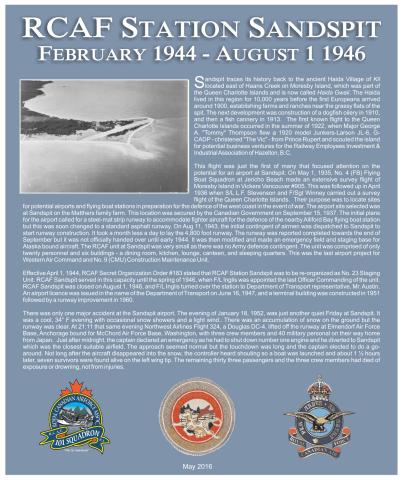
Sandspit traces its history back to the ancient Haida Village of KIL located east of Haans Creek on Moresby Island, which was part of the Queen Charlotte Islands and is now called Haida Gwaii. The Haida lived in this region for 10,000 years before the first Europeans arrived around 1900, establishing farms and ranches near the grassy flats of the spit. The next development was construction of a dogfish oilery in 1910, and then a fish cannery in 1913. The first known flight to the Queen Charlotte Islands occurred in the summer of 1922, when Major George A. “Tommy” Thompson flew a 1920 model Junkers-Larson JL-6, G-CADP-christened “The Vic”-from Prince Rupert and scouted the island for potential business ventures for the Railway Employees Investment & Industrial Association of Hazelton, BC.

The flight was just the first of many that focused attention on the potential for an airport at Sandspit. On May 1, 1935, No. 4 (FB) Flying Boat Squadron at Jericho Beach made an extensive survey flight of Moresby Island in Vickers Vancouver #905. This was followed up in April 1936 when S/L L.F. Stevenson and F/Sgt Winney carried out a survey flight of the Queen Charlotte Islands. Their purpose was to located sites for potential airports and flying boat stations in preparation for the defence of the west coast in the event of war. The airport site selected was at Sandspit on the Matthers family farm. This location was secured by the Canadian Government on September 15, 1937. The initial plans for the airport called for a steel-mat strip runway to accommodate fighter aircraft for the defence of the nearby Alliford Bay flying boat station but this was soon changed to a standard asphalt runway. On Aug 11, 1943, the initial contingent of airmen was dispatched to Sandspit to start runway construction. It took a month less a day to lay the 4,800 foot runway. The runway was reported completed towards the end of September but it was not officially handed over until early 1944. It was then modified and made an emergency field and staging base for Alaska bound aircraft. The RCAF unit at Sandspit was very small as there was no Army defence contingent. The unit was comprised of only twenty personnel and six buildings – a dining room, kitchen, lounge, canteen, and sleeping quarters. This was the last airport project for Western Air Command and No. 9 (CMU) Construction Maintenance Unit.

Effective April 1, 1944, RCAF Secret Organization Order #183 stated that RCAF Station Sandspit was to be re-organized as No. 23 Staging Unit. RCAF Sandspit served in this capacity until the spring of 1946, when F/L Inglis turned over the station to Department of Transport representative, Mr. Austin. An airport licence was issued in the name of the Department of Transport on June 16, 1947, and a terminal building was constructed in 1951 followed by a runway improvement in 1960.

There was only one major accident at the Sandspit airport. The evening of January 18, 1952, was just another quiet Friday at Sandspit. It was a cool 34° F evening with occasional snow showers and a light wind.. There was an accumulation of snow on the ground but the runway was clear. At 21:11 that same evening Northwest Airlines Flight 324, a Douglas DC-4, lifted off the runway at Elmendorf Air Force Base, Anchorage bound for McChord Air Force Base, Washington, with three crew members and 40 military personal on their way home from Japan. Just after midnight, the captain declared an emergency as he had to shut down number one engine and he diverted to Sandspit which was the closest suitable airfield. The approach seemed normal but the touchdown was long and the captain elected to do a go-around. Not long after the aircraft disappeared into the snow, the controller heard shouting so a boat was launched and about 1 ½ hours later, seven survivors were found alive on the left wing tip. The remaining thirty three passengers and the three crew members had died of exposure or drowning, not from injuries.

May 2016

Image
Caption
plaque
Province
Body Content

This plaque was dedicated on May 28, 2016, in memory of the Royal Canadian Air Force (RCAF) Station at Sandspit during the Second World War. It was erected as part of the Royal Canadian Airforce Association 101 Squadron's program of remembering RCAF Stations on North Island, Central Coast, and Haida Gwaii.

City
Sandspit
Country
Type Description
Plaque
Memorial CF Legacy ID
10512
City/Municipality
Sandspit
Memorial Number
59022-022
Type
Address
Kwuna Point Road
Location
Near Alliford Bay Waterdrome Dock
in Canada
Yes
GPS Coordinates
53.215235, -131.991338
Inscription

RCAF STATION ALLIFORD BAY

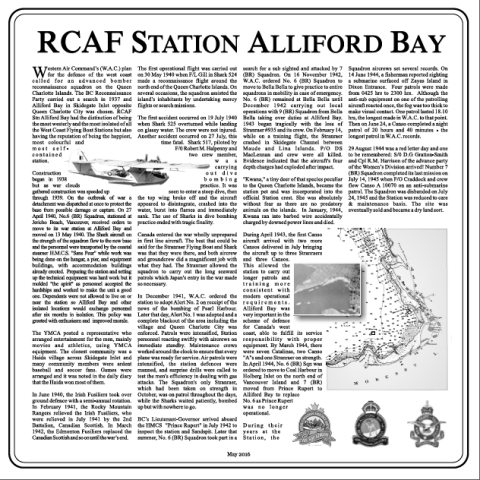
Western Air Command’s (W.A.C) plan for the defence of the west coast called for an advanced bomber reconnaissance squadron on the Queen Charlotte Islands. The BC Reconnaissance Party carried out a search in 1937 and Alliford Bay in Skidegate Inlet opposite Queen Charlotte City was chosen. RCAF Stn Alliford Bay had the distinction of being the most westerly and the most isolated of all the West Cost Flying Boat Stations but also having the reputation of being the happiest, most colourful and most self-contained station.

Construction began in 1938 but as war clouds gathered construction was speeded up through 1939. On the outbreak of war a detachment was dispatched at once to protect the base from possible damage or capture. On 27 April 1949, No. 6 (BR) Squadron, stationed at Jericho Beach, Vancouver, received orders to move to its war station at Alliford Bay and moved on 13 May 1940. The Shark aircraft on the strength of the squadron flew to the new base and the personnel were transported by the coastal steamer H.M.C.S. “Sans Peur” while work was being done on the hangar, a pier, and equipment buildings, with accommodation buildings already erected. Preparing the station and setting up the technical equipment was hard work but it molded “the spirit” as personnel accepted the hardships and worked to make the unit a good one. Dependents were not allowed to live on or near the station so Alliford Bay and other isolated locations would exchange personnel after six months in isolation. This policy was greeted with enthusiasm and improved morale.

The YMCA posted a representative who arrange entertainment for the men, mainly moved and athletics, using YMCA equipment. The closest community was a Haida village cross Skidegate Inlet and many community members were ardent baseball and soccer fans. Games were arranged and it was noted in the daily diary that the Haida won most of them.

In June 1940, the Irish Fusiliers took over ground defence with a semi-annual rotation. In February 1941, the Rocky Mountain Rangers relieved the Irish Fusiliers, who were relieved in July 1941 by the 2nd Battalion, Canadian Scottish. In March 1942, the Edmonton Fusiliers replaced the Canadian Scottish and so on until the war’s end.

The first operational flight was carried out on 30 May 1940 when F/L Gill in Shark 524 made a reconnaissance flight around the north end of the Queen Charlotte Islands. On several occasions, the squadron assisted the island’s inhabitants by undertaking mercy flights or search missions.

The first accident occurred on 19 July 1940 when Shark 525 overturned while landing on glassy water. The crew were not injured. Another accident occurred on 27 July, this time fatal. Shark 517, piloted by F/O Robert M. Halpenny and two crew member, was carrying out dive bombing practice. It was seen to enter a steep dive, then the top wing broke off and the aircraft appeared to disintegrate, crashed into the water, burst into flams and immediately sank. The use of Sharks in dive bombing practice ended with tragic finality.

Canada entered the war wholly unprepared in first line aircraft. The best that could be said for the Stranraer Flying Boat and Shark was that they were there, and both aircrew and groundcrew did a magnificent job with what they had. The Stranraer allowed the squadron to carry out the long seaward partrols which Japan’s entry in the war made so necessary.

In December 1941, W.A.C. ordered the station to adopt Alert No. 2 on receipt of the news of the bombing of Pearl Harbour. Later that day, Alert No. 1 was adopted and a complete blackout of the area including the village and Queen Charlotte City was enforced. Patrols were intensified, Station personnel reacting swiftly with aircrews on immediate standby. Maintenance crews worked around the clock to ensure that every plane was ready for service. Air patrols were intensified, the station defences were manned, and surprise drills were called to test the men’s efficiency in dealing with gas attacks. The Squadron’s only Stranraer, which had been taken on strength in October, was on patrol throughout the days, while the Sharks waited patiently, bombed up but with nowhere to go.

BC’s Lieutenant-Governor arrived aboard the HMCS “Prince Rupert” in July 1942 to inspect the station and Sandspit. Later that summer, No. 6 (BR) Squadron took part in a search for a sub sighted and attached by 7 (BR) Squadron. On 16 November 1942, the W.A.C. ordered No. 6 (BR) Squadron to move to Bella Bella to give practice to entire squadrons in mobility in case of emergency. No. 6 (BR) remained at Bella Bella until December 1942 carrying out local operations with 9 (BR) Squadron from Bella Bella taking over duties at Alliford Bay. 1943 began tragically with the loss of Stranraer #935 and its crew. On February 14, while on a training flight, the Stranraer crashed in Skidegate Channel between Maude and Lina Islands. P/O DS MacLennan and crew were all killed. Evidence indicated that the aircraft’s four depth charges had exploded after impact.

“Kwana,” a tiny deer of that species peculiar to the Queen Charlotte Islands, became the station pet and was incorporated into the official Station crest. She was absolutely without fear as there are no predatory animals on the islands. In January, 1944, Kwana ran into barbed wire accidentally charged by downed power lines and died.

During April 1943, the first Canso aircraft arrived with two more Cansos delivered in July bringing the aircraft up to three Stranraers and three Cansos. This allowed the station to carry out longer patrols and training more consistent with modern operational requirements. Alliford Bay was very important in the scheme of defence for Canada’s west coast, able to fulfill its service responsibility with proper equipment. By March 1944, there were seven Catalinas, two Canso “A”s and one Stranraer on strength. In April 1944, No. 6 (BR) Sqn was ordered to move to Coal Harbour in Holberg Inlet on the north end of Vancouver Island and 7 (BR) moved from Prince Rupert to Alliford Bay to replace No. 6 as Prince Rupert was no longer operational.

During their years at the Station, the Squadron aircrews set several records. On 14 June 1944, a fisherman reported sighting a submarine surfaced off Zayas Island in Dixon Entrance. Four patrols were made from 0425 hrs to 2300 hrs. Although the anti-sub equipment on one of the patrolling aircraft reacted once, the fog was too thick to make visual contact. One patrol lasted 18.10 hrs, the longest made in W.A.C. to that point. Then on June 24, a Canso completed a night patrol of 20 hours and 40 minutes – the longest patrol in W.A.C. records.

29 August 1944 was a red letter day and one to be remembered: S/O D.G. Gratton-Smith and Cpl R.M. Harrison of the advance party of the Women’s Division arrived! Number 7 (BR) Squadron completed its last mission on July 14, 1945 when F/O Craddock and crew flew Canso A 10070 on an anti-submarine patrol. The Squadron was disbanded on July 24, 1945 and the Station was reeducated to care & maintenance basis. The site was eventually sold and became a dry land sort.

May 2016

Image
Photo Credit
Bob Ells
War or Conflict Term
Province
Body Content

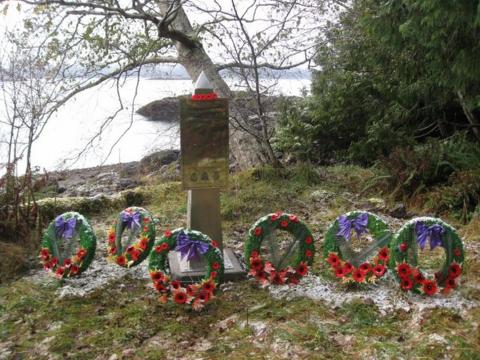
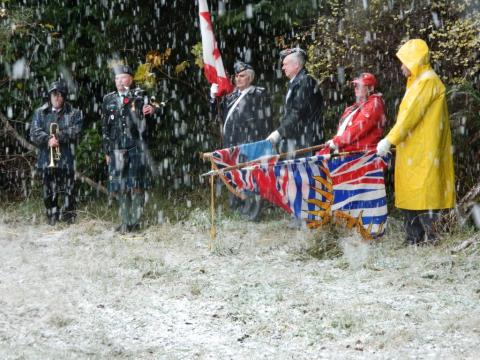
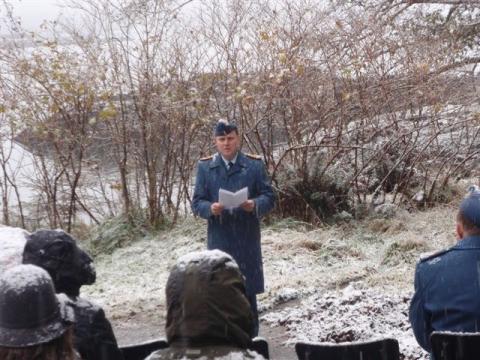
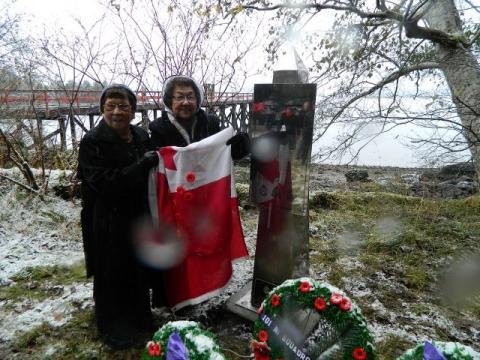
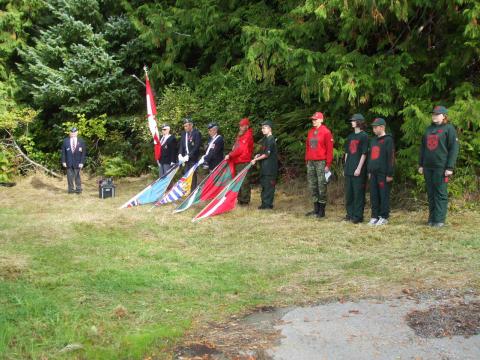
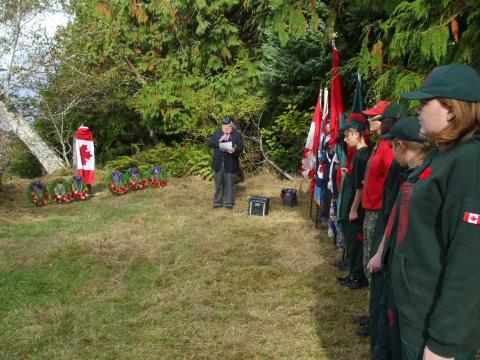
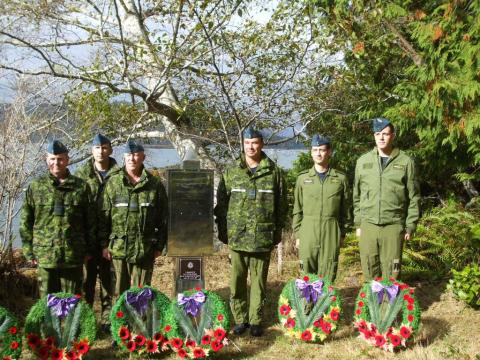
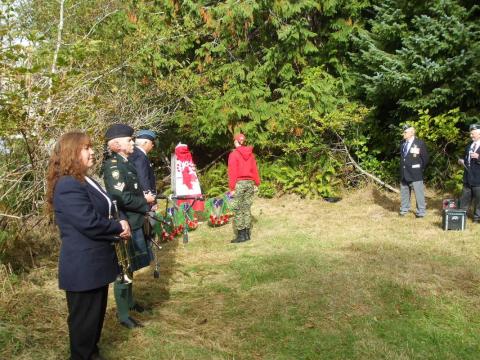
The RCAF Station Alliford Plaque, 30"x"30" stainless steel, was dedicated on May 28, 2016. The dedication included a colour party, bugler., piper, poppy ceremony and a laying of wreathes. It was erected as part of the Royal Canadian Air Force Association 101 Squadron's program of remembering Royal Canadian Air Force Stations on North Island, Central Coast and Haida Gwaii. It overlooks Alliford Bay and commemorates Western Air Command's most remote Second World War West Cost Flying Boat Station and the squadrons that served there.

The plaque is located near the RCAF Stranraer 935 Memorial and Shark 517 Memorial

City
Sandspit
Country
Type Description
Plaque - stainless steel
Memorial CF Legacy ID
10511
City/Municipality
Sandspit
Memorial Number
59022-020
Type
Address
Kwuna Point Road
Location
Near Alliford Bay Waterdrome dock
in Canada
Yes
GPS Coordinates
53.2151299, -131.992127
Inscription

RCAF Stranraer 935

Crashed Valentine’s Day (February 14) 1943

935 Crew List
P/O DS MacLennen (J13672) Pilot (Captain), Montreal, Que
P/O LG Thompson (J13697) Second Pilot, Chance Harbour, NB
P/O FW McConkey (J13153) WAG, Calgary, Alta
Sgt JO Gilmour (R50322) AFM Crewman, Vancouver, BC
Cpl JP Sperling (R64622) AEM Crewman, Chamberlain, Sask
F/L CWT Field (C3378) Passenger (Accounts Officer), Edmonton, Alta

P/Os MacLennan and Thompson were scheduled for a training flight to practice takeoffs and landings with a loaded and armed aircraft in the RCAF Alliford Bay landing area which is approximately 1 ½ miles to the west of this cairn. At 1553hrs 935 was given take-off clearance. The aircraft took off and at 1625hrs requested permission to land. Landing clearance was given and the aircraft made a normal landing. The aircraft took off and at approximately 1635hrs 935 again requested permission to land. Permission was granted and while attempting to land 935 made five bounces with the last bounce throwing the aircraft approximately 80 feet in the air. The aircraft then swerved sharply to port and dropped the port wing. After the aircraft hit the water it appeared that both the port upper and lower mainplanes broke off downwards from the wing roots. After the aircraft came to rest it started to sink immediately and within two minutes it was completely out of sight. Approximately two minutes after the aircraft sank a large volume of water rose to height of 8-10 feet. Almost immediately smoke and flame appeared on the surface of the water, the smoke rising nearly 1000 feet and the flames to a height of approximately twenty feet. The four 250 lb depth charges had detonated. Only the wing float was found and P/O McLennan’s body was eventually recovered.

Reqiescat en Pace Fratres

November 18, 2011

Image
Photo Credit
Russell Hellberg
Caption
Memorial overlooks the crash site of Stranraer
1 of 5 images
Image
Photo Credit
Russell Hellberg
Caption
Dedication ceremony.
1 of 5 images
Image
Photo Credit
Russell Hellberg
Caption
19 Wing Commander dedicates memorial.
1 of 5 images
Image
Photo Credit
Russell Hellberg
Caption
Ladies from Queen Charlotte City who used to visit the Station during the war.
1 of 5 images
Image
Photo Credit
Russell Hellberg
Caption
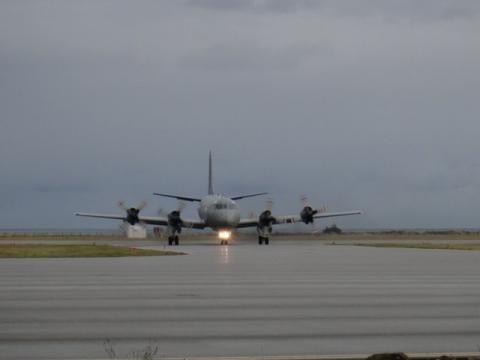
The 407 Aurora arrives in Sandspit with the dedication party.
1 of 5 images
Province
!4v1621604783376!6m8!1m7!1sCAoSLEFGMVFpcE5sZXU0OWFoVmlhbmJDbXAzZEpzaGpVOHZLSGh6SFBYM1ZnUnVE!2m2!1d53.21512990000001!2d-131.992127!3f93.56735257772176!4f4.1087624116254915!5f3.3215747596984486
Body Content

The RCAF Stranraer 935 Memorial, a 5 1/2' stainless steel obelisk mounted on a concrete slab, was erected on November 18, 2011. It honours the crew of Stranraer 935 and and is collocated with one for the Blackburn Shark 517. It overlooks the Royal Canadian Air Force Stranraer 935 crash site which is two kilometers away.

City
Sandspit
Country
Type Description
Obelisk, plaque - stainless steel
Memorial CF Legacy ID
9978
City/Municipality
Terrace
Memorial Number
59022-019
Type
Address
4702 Kerby Avenue
Location
Heritage Park Museum
in Canada
Yes
GPS Coordinates
54.533382, -128.5922067
Image
Photo Credit
Victoria Edwards
1 of 2 images
Image
1 of 2 images
War or Conflict Term
Province
!4v1621602635987!6m8!1m7!1sPbKALn2BTmxSq8_ll8GrYQ!2m2!1d54.53338199570867!2d-128.5922067374078!3f294.5375210719925!4f-2.9122230631156043!5f1.777120299690187
Body Content

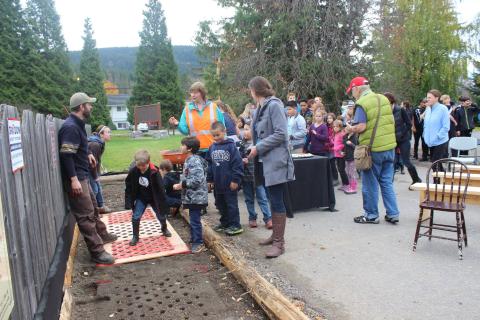
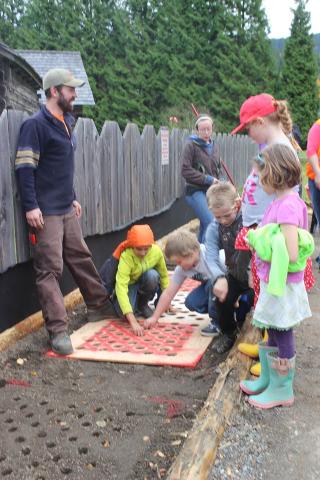
Terrace was one of the 140 communities selected from the more than 400 applications received by the Canadian Garden Council. Each of the 140 new 70th Anniversary Dutch-Canadian Friendship Tulip Gardens across the country will consist of 700 red and white tulip bulbs (350 of each colour) donated by Vesey’s Bulbs in Prince Edward Island.

The Garden was planted in fall 2015 by city gardener Eric Lennert. Tulip bulbs generally bloom between the end of April and the beginning of June depending on the type of tulip and where it’s planted.

The memorial is dedicated as a living monument in recognition of the 70th Anniversary of the original Dutch-Canadian Friendship Tulip Garden planted in Ottawa at the end of World War II in 1945. The memorial is in appreciation of the safe haven that members of Holland’s exiled royal family received during World War II, and in recognition of the role Canadian troops played in the liberation of the Netherlands.

City
Terrace
Country
Type Description
Garden
Memorial CF Legacy ID
8995
City/Municipality
Bella Coola
Memorial Number
59022-018
Type
Address
Location
Monarch Icefield
in Canada
Yes
GPS Coordinates
52.20389, -126.30659
Inscription

[cairn/tumulus]
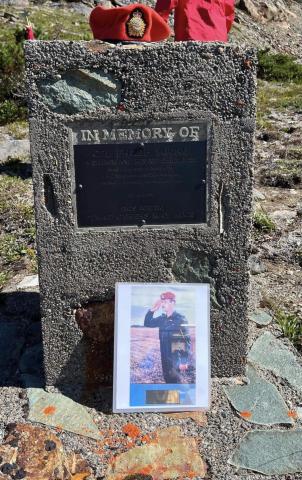
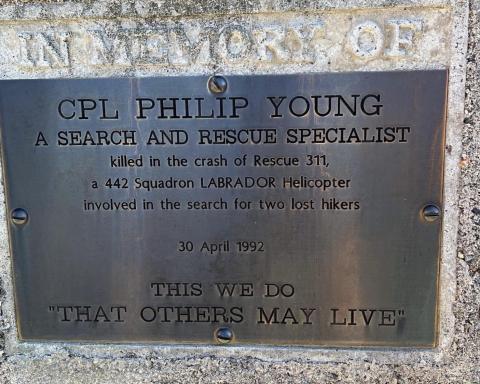
IN MEMORY OF
CPL PHILIP YOUNG
A SEARCH AND RESCUE SPECIALIST
killed in the crash of Rescue 311,
a 442 Squadron LABRADOR Helicopter
involved in the search for two lost hikers

30 April 1992

THIS WE DO
"THAT OTHERS MAY LIVE"

[cedar pole]
CPL PHILLIP YOUNG
442
SQUADRON

Image
Photo Credit
Ray Hawkes
Caption
Corporal Phillip Young Memorial
1 of 2 images
Image
Photo Credit
Ray Hawkes
Caption
inscription
1 of 2 images
Province
Body Content

On 30 April 1992 Boeing Vertol Helicopter Rescue 311 was searching for missing hikers near Bella Coola, British Columbia. During a hoisting sequence transferring personnel into the aircraft, the helicopter lost power and crashed. Corporal Phillip Young, a Royal Canadian Air Force Search and Rescue Technician was killed in the crash above Hammer Lakes close to the Monarch Icefield.

Three Bella Coola residents – Roger Harris, Douglas Baker and Andy Schmidt, all from the provincial emergency program, Corporal Young and Tony Isaacs, another Royal Canadian Air Force Search and Rescue Technician, were part of the search. The day before, tracks were found above Hammer Lakes on an air search and they planned to go back on skis. Roger drove the four of them up the Nusatsum Forest Service Road about 25 kilometers near the Odeguard Falls Trail. They walked to Hammer Lakes Trail, took a left then started skiing up toward the area where the tracks were spotted.

When they reached a particular knoll, the weather was deteriorating and Young and Isaacs called for the Labrador helicopter that was in the area searching to come and get them. There were no more signs to follow of where the hikers had headed. In the process of picking the crew up, the helicopter engine failed. Young was thrown out, Isaacs was still on the ground, Baker, Schmidt, and Harris were in the helicopter and crashed with it as it rolled about six times down the hill until it came to a rest upside down. The crew and searchers had various injuries, from cuts, burns and bruises to more serious non-life threatening injuries. A second Labrador helicopter was in the valley when the beacon went off indicating the first one had gone down and a crew headed out from the Bella Coola airport.

The lost hikers were found several months later on Mt. Dagon, 60 kilometers southeast of Bella Coola. A coroner’s report noted the hikers were caught in a snow avalanche as the cause of death.

A concrete cairn and a plaque were installed at the crash site on 7 July 1993, but Ray Hawkes felt that since then Young had been forgotten. In 2022, Hawkes planned a memorial ceremony with two segments. In the morning, he solo climbed in Young’s name up the northwest side of Mt. Saugstad and in the afternoon he organized a ceremony to install a commemorative post at 5,900 feet above the crash site. Hawke's eight-foot long piece of stained cedar with a flag and badges was raised next to the cairn. Corporal Philllip Young’s name and the Department of National Defence Search and Rescue technician motto “that others may live" are engraved on it.

City
Bella Coola
Country
Type Description
Cairn, pole
Photo Credit
Ray Hawkes
Memorial CF Legacy ID
11198
City/Municipality
Dease Lake
Memorial Number
59022-016
Type
Address
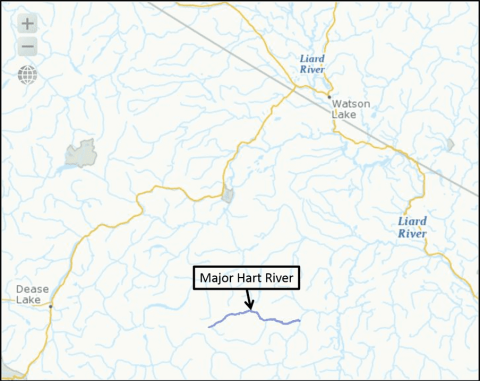
Major Hart River
Location
140 km east of Dease Lake
in Canada
Yes
GPS Coordinates
59.01417, -127.8575
Inscription

[on map/sur la carte]

Major Hart River

Image
Photo Credit
Map by Natural Resources Canada/ Government of Canada
War or Conflict Term
Province
Body Content

Major Hart River is named in honour of Major Edward Barton Hart. It was named by the Government of British Columbia on January 17, 1952.

Edward Barton Hart was born in Curragh, County Kildare, Ireland in December 1872. It is unclear as to when he immigrated to Canada but he did enlist in the 2nd Canadian Mounted Rifles and saw service in the Boer War with this regiment, attaining the rank of major by the end of the conflict. Returning to Canada at the end of June 1902 with the 2nd CMR, he joined the Royal North West Mounted Police and was notably involved with the RNWMP 1911 exploratory trip from Dease Lake to Fort Nelson, and up the Prophet River, in Northern British Columbia. By 1913 – 1914, Edward Barton Nelson was completing the first reconnaissance survey in the area of the Turnagain River and the river that would bear his name, in the Cassiar Land District. In January 1916, he once again answered the “call to arms” and enlisted in the 88th Battalion (Victoria Fusiliers), Canadian Expeditionary Forces, sailing for England in June 1916. He survived the battles of the First World War and returned to Canada, though little is known of him after his return.

City
Dease Lake
Country
Type Description
Geographical feature (River)
Memorial CF Legacy ID
9144
City/Municipality
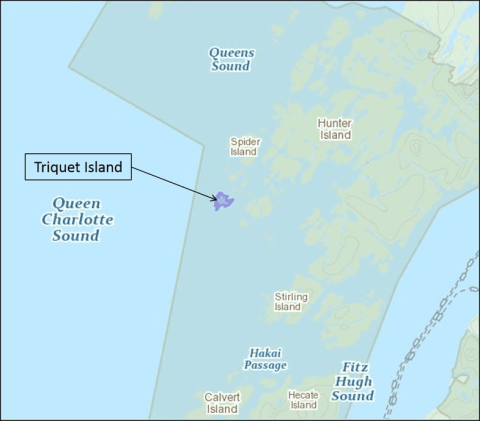
Triquet Island
Memorial Number
59022-015
Type
Location
About 130 km northwest of Port Hardy
in Canada
Yes
GPS Coordinates
51.8019274, -128.2484791
Inscription

[on map/sur la carte]

Triquet Island

Image
Photo Credit
Map by Natural Resources Canada/ Government of Canada
Province
Body Content

Triquet Island is named in honour of Brigadier Paul Triquet, VC. The island was named by the Government of British Columbia on May 11, 1944.

Paul Triquet was born in Cabano, Quebec on 2 April 1910. At the age of 17, he joined the Royal 22e Régiment. In December 1943, Captain Triquet was a company commander with the regiment’s battalion serving in Italy with the Canadian Army’s 1st Infantry Division.

On 13 December 1943, plans were made by the 1st Infantry Division to get around the western end of the German defences running inland from the Adriatic Sea just south of the small coastal city of Ortona. By “turning” the enemy line, the 1st Division hoped to open the way to Ortona, its objective, and to capture the city. The key to the success of the plan was an advance by the Royal 22e Régiment north-eastward along the road to Ortona to seize an important road junction.

At 10:30 on the morning of 14 December “C” and “D” Companies of the “Van Doos”, supported by tanks from “C” Squadron of The Ontario Regiment, began moving up both sides of the road. The force had already met and destroyed two German tanks. On the left, about half-way to the hamlet of Casa Berardi, Captain Triquet’s “C” Company began to encounter fierce resistance from enemy machine guns and infantry sheltered in wrecked buildings and in terrain favourable to the defenders, all backed up by tanks and self-propelled guns. On the right, “D” Company became lost and took no further part in the action that day. “C” Company and the Ontario tanks proceeded to fight their way through the opposition, knocking out three more tanks and eliminating the Germans’ defensive positions. At this stage, the company had been reduced to fifty men and one officer – Triquet. Although ammunition was running low, Triquet, his men and their supporting tanks persevered in the attack, capturing Casa Berardi late in the afternoon and driving on nearly to the crossroads. Here the survivors, now only fifteen strong with four tanks, were stopped by mortar fire, and retired to Casa Berardi to prepare for counterattacks. As darkness fell, “B” Company of the Royal 22e arrived to reinforce Triquet, and by the early hours of 15 December the battalion’s remaining two companies had reached Casa Berardi. The western flank of the German line had been turned. For his courageous and determined leadership resulting in the capture and retention of Casa Berardi, Captain Triquet received the Victoria Cross.

Triquet died in Quebec City, Quebec on 4 August 1980.

City
Triquet Island
Country
Type Description
Geographical feature
Memorial CF Legacy ID
9148
City/Municipality
Sandspit
Memorial Number
59022-014
Type
Address
Kwuna Point Road
Location
Near Alliford Bay Waterdrome dock
in Canada
Yes
GPS Coordinates
53.2151299, -131.992127
Inscription

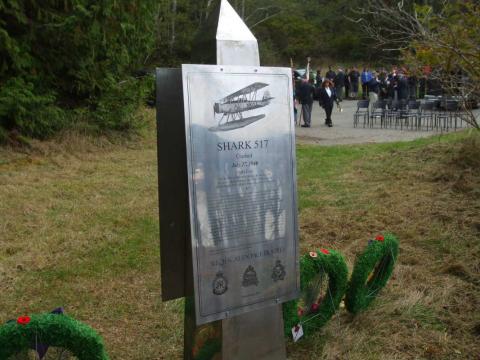
SHARK 517
Crashed
July 27, 1940

Flight Crew
F/O ROBERT M HALPENNY, Pilot C1296 Vancouver, BC
F/L ALLAN SIMPSON, Signals Officer, C1127, Vancouver, BC
LAC ROBERT L RICHARDSON, Wireless Tech, P4056 Vancouver

On 27 July 1940 F/L A. Simpson, the Signals Officer for #6 (B.R.) Squadron in Alliford Bay requested a flight test for a new wireless set and the modified crate (rack) for the shark. That afternoon after Shark 517 aircraft was modified F/O Halpenny requested that he be tasked to fly it. He was briefed to carry out diving tests and tight turns as the crate had to be tested under dive bombing conditions. He was instructed to get plenty of height and put some stress on the new gear. F/L Simpson the Signals Officer and LAC Richardson a wireless tech went with him to operate the equipment. The weather was clear with some scattered to broken cloud at 5,000’, winds were westerly at 10-12 mph.

The aircraft took off at 1555 and climbed to altitude over Skidigate and did one dive then climbed back up to 5,000’ and started another dive over Bush Island. This one was steeper than normal and the pitch increased to nearly vertical and the power was at max. When he tried to pull out at 1,000’ parts of the aircraft fell off and the aircraft plunged into the water and burst into flames. All occupants were killed instantly. Witnesses were unanimous in stating the dive was much steeper and the speed much higher than normal and the engine was at or near full power all the way down. The starboard aileron and elevator were found some distance from the crash and there was a tear on the left-wing fabric with indications that the left wing broke off before the crash. The stabilizer was set to full nose down, the throttle was wide open and the airspeed indicator had broken at 300 knots when the aircraft crashed at 1620. It had been airborne 25 minutes.

Following the accident dive bombing was no longer authorized, the maximum speed permitted for the Shark was restricted to 150 mph and the wings were strengthened.

REQIESCAT EN PACE FRATRES

CANADIAN RANGERS

AIR FORCE ASSOC. OF CANADA
R.C.A.F 101 SQUADRON N.I.
"On Se Souvien"

PER ARDVA RD ASTRA
ROYAL CANADIAN AIR FORCE

September 2013

Image
Caption
plaque
1 of 5 images
Image
Caption
Two minutes of silence for the crew of Shark 517.
1 of 5 images
Image
Caption
Dedication of the memorial by Bob Ells.
1 of 5 images
Image
Caption
Memorial party from 407 Squadron, 19 Wing.
1 of 5 images
Image
Caption
Sandspit Ranger Patrol member places poppy during the dedication ceremony.
1 of 5 images
Province
!4v1621604783376!6m8!1m7!1sCAoSLEFGMVFpcE5sZXU0OWFoVmlhbmJDbXAzZEpzaGpVOHZLSGh6SFBYM1ZnUnVE!2m2!1d53.21512990000001!2d-131.992127!3f93.56735257772176!4f4.1087624116254915!5f3.3215747596984486
Body Content

This memorial is a 5 1/2' stainless steel obelisk mounted on a concrete slab. It is dedicated to the crew of Shark 517 and is collocated with one for Stranraer 935. It was dedicated on September 21, 2013, by 101 Squadron and Haida Gwaii Flight members.

City
Sandspit
Country
Type Description
Obelisk - stainless steel, plaque
Photo Credit
Russ Hellberg
Memorial CF Legacy ID
9154
City/Municipality
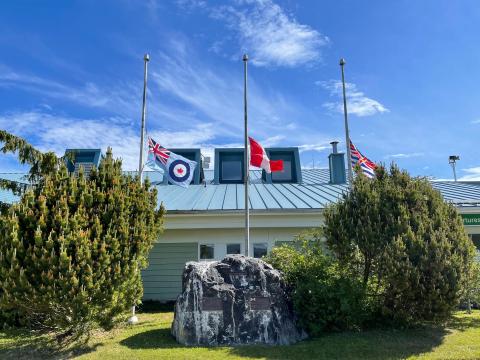
Sandspit
Memorial Number
59022-013
Type
Address
1 Airport Road
Location
Sandspit Airport
in Canada
Yes
GPS Coordinates
53.25066, -131.81387
Inscription

[top plaque/plaque supérieure]

FLIGHT 324 MEMORIAL

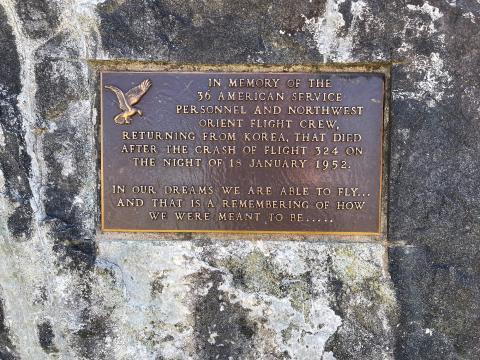
[left plaque/plaque gauche]

IN MEMORY OF THE
36 AMERICAN SERVICE
PERSONNEL AND NORTHWEST
ORIENT FLIGHT CREW,
RETURNING FROM KOREA, THAT DIED
AFTER THE CRASH OF FLIGHT 324 ON
THE NIGHT OF 18 JANUARY 1952.

IN OUR DREAMS WE ARE ABLE TO FLY...
AND THAT IS A REMEMBERING OF HOW
WE WERE MEANT TO BE.....

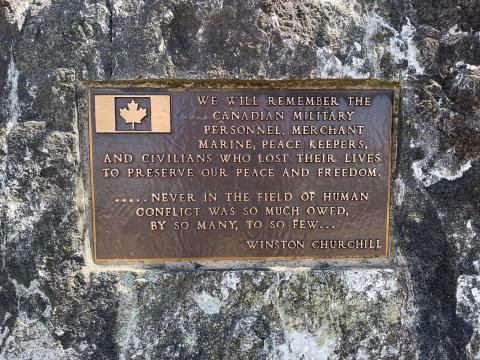
[right plaque/plaque droite]

WE WILL REMEMBER THE
CANADIAN MILITARY
PERSONNEL, MERCHANT
MARINE, PEACE KEEPERS,
AND CIVILIANS WHO LOST THEIR LIVES
TO PRESERVE OUR PEACE AND FREEDOM.

.....NEVER IN THE FIELD OF HUMAN
CONFLICT WAS SO MUCH OWED,
BY SO MANY, TO SO FEW...
WINSTON CHURCHILL

Image
Photo Credit
Robert Ells
Caption
surroundings
1 of 4 images
Image
Photo Credit
Robert Ells
Caption
front
1 of 4 images
Image
Photo Credit
Robert Ells
Caption
plaque
1 of 4 images
Image
Photo Credit
Robert Ells
Caption
plaque
1 of 4 images
War or Conflict Term
Province
Body Content

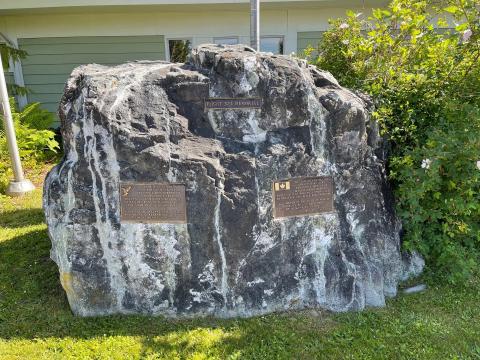
This memorial was erected to remember those who died in the crash of Flight 324 while returning from Korea on 18 January 1952. It also commemorates Canadian military, merchant marine, peacekeepers, and civilians who lost their lives for peace and freedom.

City
Sandspit
Country
Type Description
Slab
Memorial CF Legacy ID
9153
City/Municipality
Masset
Memorial Number
59022-012
Type
Address
1930 Dave Wanna Way
Location
Masset Municipal Airport
in Canada
Yes
GPS Coordinates
54.0220326, -132.1196441
Inscription

RCAF STATION MASSET

NOVEMBER 1943-OCTOBER 1945

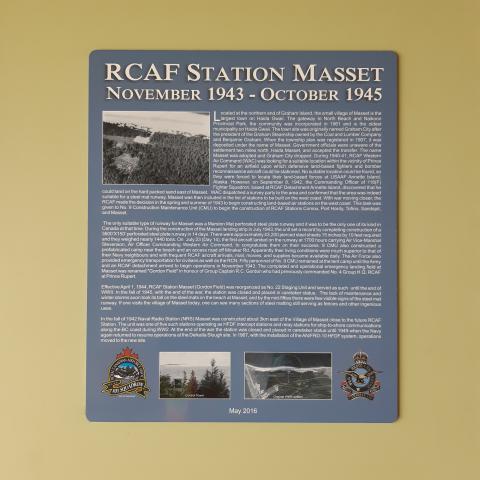
Located at the northern end of Graham Island, the small village of Masset is the largest town on Haida Gwaii. The gateway to North Beach and Naikoon Provincial Park, the community was incorporated in 1961 and is the oldest municipality on Haida Gwaii. The town site was originally named Graham City after the president of the Graham Steamship owned by the Coal and Lumber Company and Benjamin Graham. When the township plan was registered in 1907, it was deposited under the name of Masset. Government officials were unaware of the settlement two miles north, Haida Masset, and accepted the transfer. The name Masset was adopted and Graham City dropped. During 1940-41, RCAF Western Air Command (WAC) was looking for a suitable location within the vicinity of Prince Rupert for an airfield upon which defensive land-based fighters and bomber reconnaissance aircraft could be stationed. No suitable location could be found, so they were forced to locate their land-based forces at USAAF Annette Island, Alaska. However, on September 8, 1942, the Commanding Officer of 118(F) Fighter Squadron, based at RCAF Detachment Annette Island, discovered that he could land on the hard packed sand east of Masset. WAC dispatched a survey party to the area and confirmed that the area was indeed suitable for a steel mat runway. Masset was then included in the list of stations to be built on the west coast. With war moving closer, the RCAF made the decision in the spring and summer of 1943 to begin constructing land-based air stations on the west coast. This task was given to No. 9 Construction Maintenance Unit (CMU) to begin the construction of RCAF Stations Comox, Port Hardy, Tofino, Sandspit, and Masset.

The only suitable type of runway for Masset was a Marston Mat perforated steel plate runway and it was to the be the only one of its kind in Canada at the time. During the construction of the Masset landing strip in July 1943, the unit set a record by completing construction of a 3600’X15-‘ perforated steel plate runway in 14 days. There were approximately 43,200 pierced steel sheets 15 inches by 10 feet required and they weighed nearly 1140 tons. On July 23 (Day 14), the first aircraft landed on the runway at 1700 hours carrying Air Vice-Marshal Stevenson, Air Officer Commanding Western Air Command, to congratulate them on their success. 9 CMU also constructed a prefabricated camp near the beach and an access road of Minaker Rd. Apparently their living conditions were much superior to that of their Navy neighbours and with frequent RCAF aircraft arrivals, mail, movies, and supplies became available daily. The Air Force also provided emergency transportation for civilians as well as the RCN. Fifty personnel of No. 9 CMU remained at the tent camp until the Army and an RCAF detachment arrived to begin operations in November 1943. The completed and operational emergency landing field at Masset was renamed “Gordon Field” in honour of Group Captain R.C. Gordon who had previously commanded No. 4 Group H.W. RCAF at Prince Rupert.

Effective April 1, 1944, RCAF Station Masset (Gordon Field) was reorganized as No. 22 Staging Unit and served as such until the end of WWII. In the fall of 1945, with the end of the war, the station was closed and placed in caretaker status. The lack of maintenance and winter storms soon took its toll on the steel mats on the beach at Masset, and by the mid-fifties there were few visible signs of the steel mat runway. If one visits the village of Masset today, one can see many sections of steel matting still serving as fences and other ingenious uses.

In the fall of 1942 Naval Radio Station (NRS) Masset was constructed about 3km east of the Village of Masset close the future RCAF Station. The unit was one of five such stations operating as HFDF intercept stations and rely stations for ship-to-shore communications along the BC coast during WW2. At the end of the war the station was closed and placed in caretaker status until 1949 when the Navy again returned to resume operations at the Delkatla Slough site. In 1967, with the installation of the AN/FRD-10 HFDF system, operations moved to the new site.

May 2016

Image
Photo Credit
Ron Erlandson - Masset Municipal Airport
Caption
plaque
War or Conflict Term
Province
Body Content

The RCAF Station Masset Plaque was dedicated on May 28, 2016, in memory of the Royal Canadian Air Force Station at Masset during the Second World War. It was erected as part of the Royal Canadian Airforce Association 101 Squadron's program of remembering Royal Canadian Air Force  Stations on North Island, Central Coast, and Haida Gwaii.

City
Masset
Country
Type Description
Plaque
Memorial CF Legacy ID
10524