Other

City/Municipality
Keremeos
Memorial Number
59016-005
Type
Location
Memorial Park (located at the corner of 7th Avenue and 4th Street)
in Canada
Yes
GPS Coordinates
49.2051609, -119.8287959
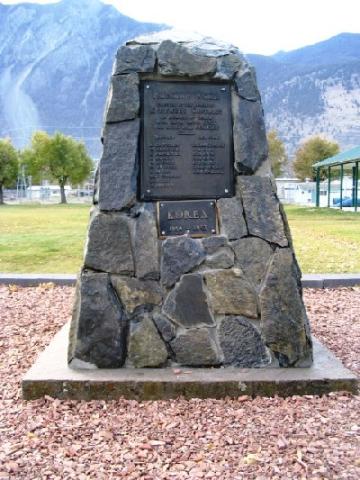
Inscription

[upper plaque/plaque du haut]

HONOUR ROLL
ERECTED BY THE PEOPLE OF
KEREMEOS DISTRICT
IN MEMORY OF THOSE WHO GAVE THEIR LIVES FOR KING AND COUNTRY

1914 - 1918

(needs further research/recherche incomplète)

1939 - 1945

(needs further research/recherche incomplète)

[lower plaque/plaque du bas]

KOREA
1950 - 1953

Image
Photo Credit
Julie Clements
Caption
cairn (front)
1 of 4 images
Image
Caption
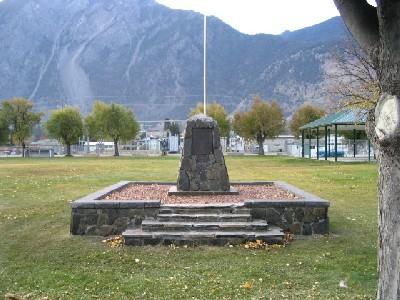
surroundings
1 of 4 images
Image
Caption
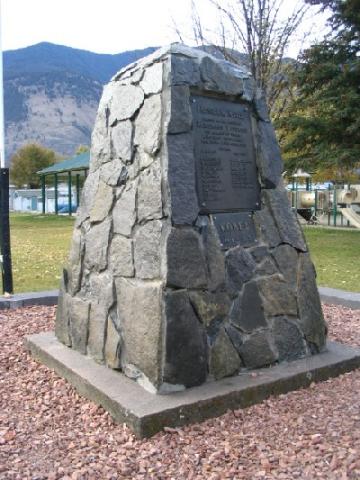
side
1 of 4 images
Image
Caption
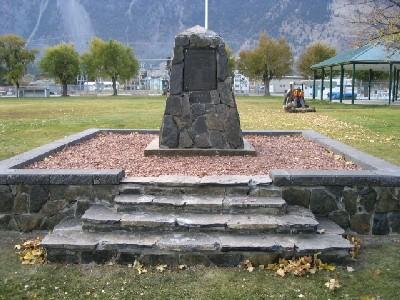
front
1 of 4 images
Province
!4v1620913145441!6m8!1m7!1sInDqhQ6o1RX8Kaeu-Wmj5g!2m2!1d49.20516093663318!2d-119.828795857447!3f139.3023727987392!4f-0.976032587089847!5f1.9016709310506714
Body Content

Erected by Royal Canadian Legion Branch No. 192, this memorial is dedicated to the local war dead of the First and Second World Wars and in memory of the Korean War. The Keremeos Cenotaph was constructed between the years of 1948 and 1953, in memory of those who served in the First World War, the Second World War, and the Korean War. In June 1967, the Cenotaph was moved to its present location. The Cenotaph was recently upgraded with funding support from the Royal Canadian Legion and the Village of Keremeos.

City
Keremeos
Country
Type Description
Stone cairn
Memorial CF Legacy ID
103
City/Municipality
Hope
Memorial Number
59016-004
Type
Address
Wallace Street
Location
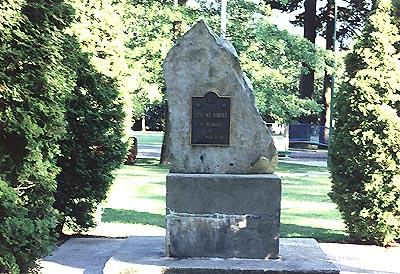
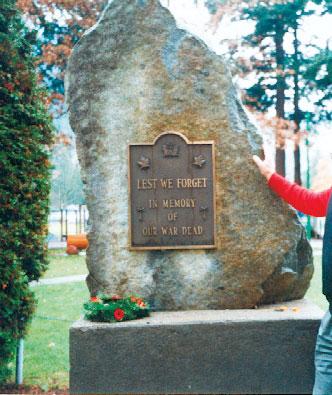
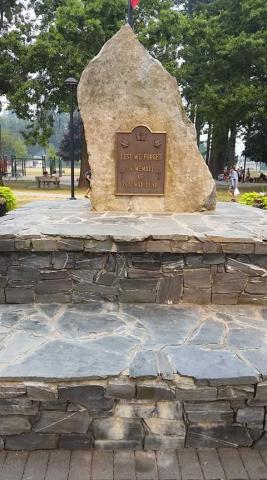
Memorial Park
in Canada
Yes
GPS Coordinates
49.379838, -121.4407725
Inscription

[plaque/plaque]

LEST WE FORGET

IN MEMORY OF OUR WAR DEAD

Image
Photo Credit
E.T. Barnes
Caption
slab (front)
1 of 3 images
Image
Caption
Facing West
1 of 3 images
Image
1 of 3 images
Province
!4v1620912694968!6m8!1m7!1s8OiPWDzAv_4YUzUCccP1Nw!2m2!1d49.37983798023978!2d-121.4407724699843!3f312.0735881808577!4f1.8088381869836922!5f1.1235245317707733
Body Content

This memorial is dedicated to the local war dead. The City of Hope erected the memorial. A bronze plaque is mounted on a section of natural rock from the area, sitting atop a concrete base. It is approximately nine feet tall. Hope is located about 150km east of Vancouver, is at 42m above sea level with a population of 7,000.

City
Hope
Country
Type Description
Granite slab
Memorial CF Legacy ID
97
City/Municipality
Hope
Memorial Number
59016-003
Type
Address
3 Avenue
Location
Memorial Park
in Canada
Yes
GPS Coordinates
49.3799591, -121.4418727
Inscription

[plaque/plaque]

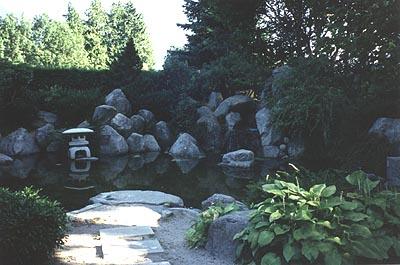
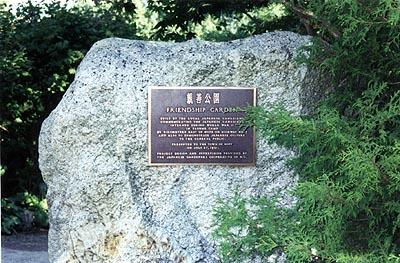
FRIENDSHIP GARDEN

BUILT BY THE LOCAL JAPANESE CANADIANS COMMEMORATING THE JAPANESE CANADIANS INTERNED DURING WORLD WAR II IN TASHME CAMP 20 KMS. EAST OF HOPE ON HWY. #3
AND ALSO TO DEMONSTRATE JAPANESE CULTURE TO THE GENERAL PUBLIC
PRESENTED TO THE TOWN OF HOPE ON JULY 27, 1991

PROJECT DESIGN AND SUPERVISION PROVIDED BY THE JAPANESE GARDENERS COOPERATIVE OF B.C.

Image
Caption
garden (full view)
1 of 2 images
Image
Caption
garden (plaque)
1 of 2 images
War or Conflict Term
Province
!4v1620912329012!6m8!1m7!1siJOc2p0SSDy-SYZyvXrG1A!2m2!1d49.37995914820517!2d-121.4418727199467!3f344.88843784302395!4f-1.8921490063405173!5f2.203098739175165
Body Content

Presented by local Japanese-Canadians to the town of Hope on 27 July 1991, this garden is dedicated to the memory of the Japanese-Canadians interned in the Tashme Camp, east of Hope, during the Second World War.

City
Hope
Country
Type Description
Garden
Memorial CF Legacy ID
2191
City/Municipality
Hope
Memorial Number
59016-002
Type
Address
344 Fort Street
Location
Royal Canadian Legion Branch No. 228
in Canada
Yes
GPS Coordinates
49.3792153, -121.4398169
Inscription

[front/devant]
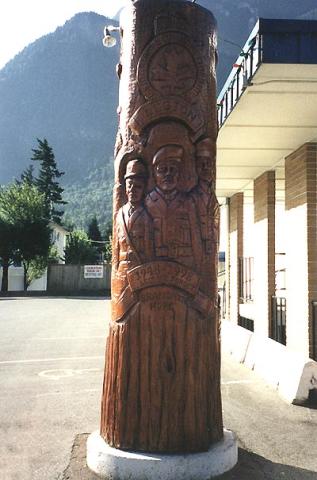
MEMORIAM - EORUMRETINEBIMUS
1948 - 1998
LEST WE FORGET

BRANCH 228
HOPE

Image
Caption
pillar (front)
Province
!4v1620911746182!6m8!1m7!1s_ng5ab0fqPFEYMIBKaiL7g!2m2!1d49.37921526972771!2d-121.4398168770276!3f127.25249420203764!4f-2.410558743505433!5f1.817010672221215
Body Content

Erected by Royal Canadian Legion Branch No. 228, this memorial is dedicated to Canadian veterans.

City
Hope
Country
Type Description
Sculpted wooden pillar
Memorial CF Legacy ID
2901
City/Municipality
Merritt
Memorial Number
59016-001
Type
Address
1950 Mamette Avenue
Location
Merritt Civic Center
in Canada
Yes
GPS Coordinates
50.1130454, -120.7891634
Inscription

[front/devant]
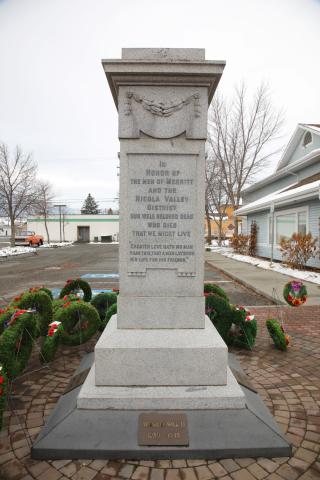
IN
HONOUR OF
THE MEN OF MERRITT
AND THE
NICOLA VALLEY
DISTRICT
OUR WELL BELOVED DEAD
WHO DIED
THAT WE MIGHT LIVE
"GREATER LOVE HATH NO MAN
THAN THIS, THAT A MAN LAY DOWN
HIS LIFE FOR HIS FRIENDS"


WORLD WAR II
1939 - 1945

[right side/côté droit]
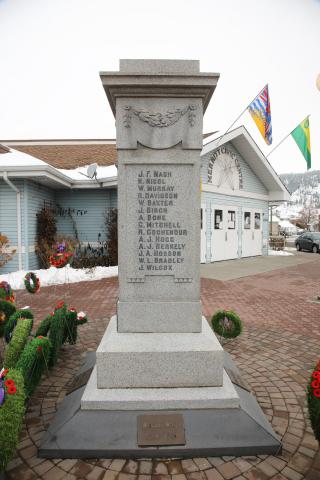
J. F. NASH
H. NICHOL
W. MURRAY
R. DAVIDSON
W. BAXTER
J. BIRCH
A. BONE
G. MITCHELL
R. GOCHENDUR
A. J. HOGG
A. J. BERKELY
J. A. HOBSON
W. L. BRADLEY
J. WILCOX


WORLD WAR I
1914 - 1918

[left side/côté gauche]
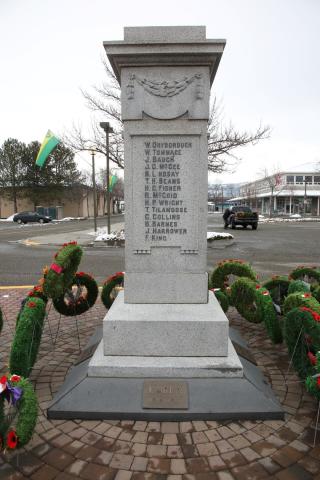
W. DRYBOROUGH
W. TOMMAGE
J. BAUCH
J. C. MCGEE
N. LINDSAY
T. H. BEANS
H. C. FISHER
R. MCCOID
H. P. WRIGHT
T. TILAMOOSE
G. COLLINS
B. BARNES
J. HARROWER
F. KING


KOREA
1950 - 1953

[back/arrière]
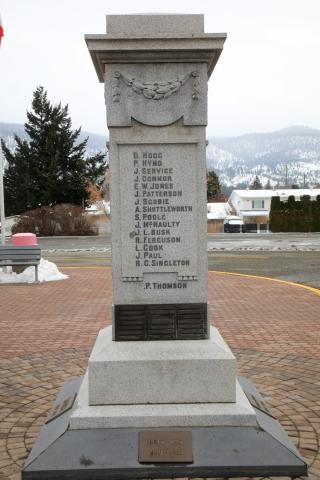
D. HOGG
P. HYND
J. SERVICE
J. CONNOR
E. W. JONES
J. SCOBIE
A. SHUTTLEWORTH
S. POOLE
J. MCNAULTY
J. L. BUSK
R. FERGUSON
L. COOK
J. PAUL
R. C. SINGLETON
P. THOMSON


  • B. H. BARBER
  • G. I. CHRISTIANSON
  • L. F. FAIRLEY
  • W. A. HOUSTON
  • W. A. MCIVOR
  • E. SOWERBY
  • E. L. BARRETT
  • J. A. DALTON
  • J. T. HARDY
  • A. F. MCDOUGAL
  • M. OVINGTON
  • L. F. BOULANGER
  • W. J. DUNNIGAN
  • W. J. KOLLER
  • A. HOGG
  • D. P. MCIVOR
  • H. PURVIS
  • E. WALKER

BOER WAR
1899 - 1902

Image
Caption
Merritt Cenotaph
1 of 4 images
Image
Caption
right side
1 of 4 images
Image
Caption
back
1 of 4 images
Image
Caption
left side
1 of 4 images
Province
!4v1620911581271!6m8!1m7!1sRbFdtTvhm41Q0J80cd7AJQ!2m2!1d50.1130327284141!2d-120.7891289476309!3f266.0122636722595!4f0.18438594336554104!5f1.7204377196369713
Body Content

The Merritt Cenotaph was largely the work of the local Ladies’ Auxiliary of the Great War Veterans’ Association. It was constructed by Patterson, Chandler, and Stephen Ltd. out of Vancouver and W.R. Chandler personally oversaw the placement of the monument. The cenotaph was unveiled on 6 November 1921, and dedicated to those who died in the First World War. Later, inscriptions were added for the South African War, Second World War and Korean War.

To recognize the 75th birthday of the City of Merritt, the Royal Canadian Legion Branch 96 restored the cenotaph on the courthouse lawn. Over $6,000.00 was raised for the project that included renewing the walkway, cleaning, replacing missing letters and placing black granite slates around the base. Unveiling and rededication took place following a parade on 23 July 1986.

On 5 November 2008, the cenotaph was moved to the Merritt Civic Centre.

City
Merritt
Country
Type Description
Stele - concrete
Photo Credit
Murphy Shewchuk
Memorial CF Legacy ID
109
City/Municipality
North Vancouver
Memorial Number
59015-034
Type
Address
Mount Seymour Road
Location
Mount Seymour Provincial Park
in Canada
Yes
GPS Coordinates
49.38045, -122.92087
Inscription

[plaque]
CANADIAN
ARMY

Hastings Lake
Cpl. Donald Perkins Hastings
Princess Patricia's Canadian Light Infantry
Dedication Ceremony 2013
North Vancouver's Korean War Hero

War or Conflict Term
Province
Body Content

Corporal Donald Hastings served with the Canadian Army in Korea. He is the only soldier from North Vancouver killed in the Korean War and the only soldier from British Columbia whose body was never recovered.

Corporal Hastings was born in North Battleford, Saskatchewan on 20 March 1929. He moved to British Columbia and completed grade 10 at North Vancouver High. During his school days he participated in Cadets. He enlisted in the Canadian Army on 26 July 1945 and served in the Merchant Navy, Canadian Army Pacific Force from 25 July 1945 to 14 June 1946. He was honorably discharged and earned the Canadian Volunteer Service Medal.

He re-enlisted on 17 January 1949 and was posted to the Princess Patricia’s Canadian Light Infantry in Calgary, Alberta. Corporal Hastings was sent to Korea, arriving on 30 January 1952. He was part of the Sniper Section and was killed in action during the Richardson Patrol on 15 October 1952. The area was overran by the enemy and heavily shelled by Canadian Gunners. No trace of Corporal Hastings was found.

Hastings Lake was named as part of the Remembrance Day ceremonies on 11 November 2005. Guy F. Black researched and submitted the name proposal to Government if British Columbia. His only connection was being a next door neighbour and friend to Corporal Hastings' sister-in-law Phyllis Hastings. Guy Black served in the Engineer Corps, Cadets and Reserves.

A ceremony was held on 15 September 2013 at Hastings Lake. It is located is deep in the backcountry and requires a long hard hike or a helicopter ride to reach. The lake was chosen with the help of North Shore Rescue. A commemorative plaque was installed by the team in advance and the ceremony was arranged around their training schedule. They helped Guy Black with the eight-year journey to honour a man so few know anything about.

City
North Vancouver
Country
Type Description
Lake
Memorial CF Legacy ID
10975
City/Municipality
North Vancouver
Memorial Number
59015-033
Type
Address
Lynn Valley
Location
About 3 km east of central North Vancouver
in Canada
Yes
GPS Coordinates
49.3369931, -123.0382508
Inscription

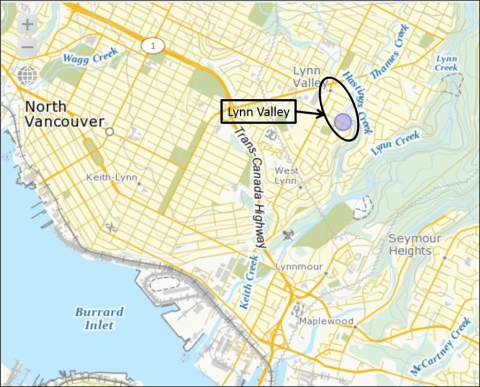
[on map/sur la carte]

Lynn Valley

Image
Photo Credit
Map by Natural Resources Canada/ Government of Canada
Province
!4v1620911240222!6m8!1m7!1sq7iSF8BrG2GZ3jdhmjAIGg!2m2!1d49.33699308327036!2d-123.0382508284587!3f34.45932903340157!4f5.725237963540593!5f1.078864796195357
Body Content

Lynn Valley is named in honour of Sapper John Linn, Royal Engineers, a member of the Columbia Detachment, a military unit that served in the lower mainland of BC from 1859 to 1863. The Linn family name was frequently misspelled “Lynn”, and that spelling of the neighbourhood name came into use at an early date. The name was used early to identify this area, but registered for use with the Government of Canada on July 19, 1979.

John Linn was born at Corstorphine, Edinburgh in July 1821, and joined the Army in 1846. He served in Halifax, Nova Scotia from 1848 to 1857, marrying Mary Robertson just before returning to England. In 1859, he sailed for British Columbia with his family, as a member of the Columbia Detachment of the Royal Engineers. A mason by trade, Linn had his part in the construction of roads and buildings and other projects in the newly established colony. When the Detachment was disbanded in October 1863, he chose to remain in the colony rather than return to England. In 1869 he moved his family from New Westminster to a house he built on the north shore of Burrard Inlet just east of what is now Lynn Creek. He worked as a mason and also logged, providing lumber for wharf construction in the area. Unfortunately, his new life in British Columbia was short lived as he fell seriously ill in 1875. He later died of a stroke in April 1876.

City
North Vancouver
Country
Type Description
Neighbourhood
Memorial CF Legacy ID
9143
City/Municipality
North Vancouver
Memorial Number
59015-032
Type
Address
Lynn Peaks
Location
About 13 km northeast of central North Vancouver
in Canada
Yes
GPS Coordinates
49.3946156, -123.0179476
Inscription

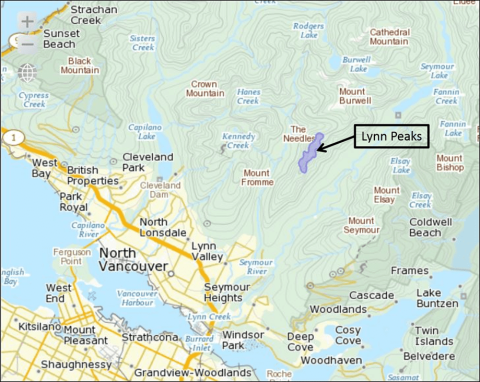
[on map/sur la carte]

Lynn Peaks

Image
Photo Credit
Map by Natural Resources Canada/ Government of Canada
Province
Body Content

Lynn Peaks is named in honour of Sapper John Linn, Royal Engineers, a member of the Columbia Detachment, a military unit that served in the lower mainland of BC from 1859 to 1863. The Linn family name was frequently misspelled “Lynn”, and that spelling of the mountain name came into use at an early date. The name was used as early as 1878 to identify this area, but registered for use with the Government of Canada on December 7, 1937.

John Linn was born at Corstorphine, Edinburgh in July 1821, and joined the Army in 1846. He served in Halifax, Nova Scotia from 1848 to 1857, marrying Mary Robertson just before returning to England. In 1859, he sailed for British Columbia with his family, as a member of the Columbia Detachment of the Royal Engineers. A mason by trade, Linn had his part in the construction of roads and buildings and other projects in the newly established colony. When the Detachment was disbanded in October 1863, he chose to remain in the colony rather than return to England. In 1869 he moved his family from New Westminster to a house he built on the north shore of Burrard Inlet just east of what is now Lynn Creek. He worked as a mason and also logged, providing lumber for wharf construction in the area. Unfortunately, his new life in British Columbia was short lived as he fell seriously ill in 1875. He later died of a stroke in April 1876.

City
North Vancouver
Country
Type Description
Geographical feature (peaks)
Memorial CF Legacy ID
9142
City/Municipality
North Vancouver
Memorial Number
59015-031
Type
Address
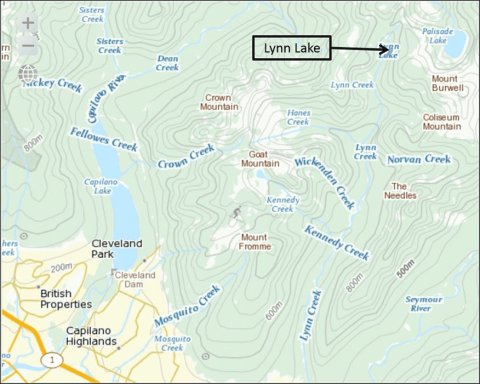
Lynn Lake
Location
About 14 km northeast of central North Vancouver
in Canada
Yes
GPS Coordinates
49.4416406, -123.0503814
Inscription

[on map/sur la carte]

Lynn Lake

Image
Photo Credit
Map by Natural Resources Canada/ Government of Canada
Province
Body Content

Lynn Lake is named in honour of Sapper John Linn, Royal Engineers, a member of the Columbia Detachment, a military unit that served in the lower mainland of BC from 1859 to 1863. The Linn family name was frequently misspelled “Lynn”, and that spelling of the lake name came into use at an early date. The name was used as early as 1878 to identify this area, but registered for use with the Government of Canada on December 7, 1937.

John Linn was born at Corstorphine, Edinburgh in July 1821, and joined the Army in 1846. He served in Halifax, Nova Scotia from 1848 to 1857, marrying Mary Robertson just before returning to England. In 1859, he sailed for British Columbia with his family, as a member of the Columbia Detachment of the Royal Engineers. A mason by trade, Linn had his part in the construction of roads and buildings and other projects in the newly established colony. When the Detachment was disbanded in October 1863, he chose to remain in the colony rather than return to England. In 1869 he moved his family from New Westminster to a house he built on the north shore of Burrard Inlet just east of what is now Lynn Creek. He worked as a mason and also logged, providing lumber for wharf construction in the area. Unfortunately, his new life in British Columbia was short lived as he fell seriously ill in 1875. He later died of a stroke in April 1876.

City
North Vancouver
Country
Type Description
Geographical feature (lake)
Memorial CF Legacy ID
9141
City/Municipality
North Vancouver
Memorial Number
59015-030
Type
Address
Lynn Creek
in Canada
Yes
GPS Coordinates
49.3141283, -123.033257
Inscription

[on map/sur la carte]

Lynn Creek

Image
Photo Credit
Map by Natural Resources Canada/ Government of Canada
Province
!4v1620909796469!6m8!1m7!1sWuRbSb31Z8-U60EYgch9sg!2m2!1d49.31412831044275!2d-123.0332570052086!3f9.290517709225618!4f5.692077455915054!5f0.7820865974627469
Body Content

Lynn Creek is named in honour of Sapper John Linn, Royal Engineers, a member of the Columbia Detachment, a military unit that served in the lower mainland of BC from 1859 to 1863. The Linn family name was frequently misspelled “Lynn”, and that spelling of the creek name came into use at an early date. The name was used as early as 1878 to identify this area, but registered for use with the Government of Canada on December 7, 1937.

John Linn was born at Corstorphine, Edinburgh in July 1821, and joined the Army in 1846. He served in Halifax, Nova Scotia from 1848 to 1857, marrying Mary Robertson just before returning to England. In 1859, he sailed for British Columbia with his family, as a member of the Columbia Detachment of the Royal Engineers. A mason by trade, Linn had his part in the construction of roads and buildings and other projects in the newly established colony. When the Detachment was disbanded in October 1863, he chose to remain in the colony rather than return to England. In 1869 he moved his family from New Westminster to a house he built on the north shore of Burrard Inlet just east of what is now Lynn Creek. He worked as a mason and also logged, providing lumber for wharf construction in the area. Unfortunately, his new life in British Columbia was short lived as he fell seriously ill in 1875. He later died of a stroke in April 1876.

City
North Vancouver
Country
Type Description
Geographical feature (creek)
Memorial CF Legacy ID
9140