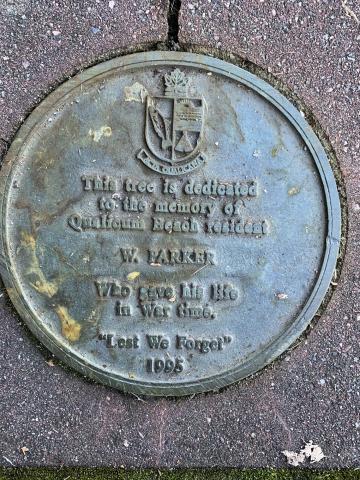
The W. Parker Tree and Plaque were erected along Memorial Avenue in 1995.
W. Parker Tree and Plaque
ACTA QUALICANA
This tree is dedicated
to the memory of
Qualicum Beach resident
W. PARKER
Who gave his life
in War time.
"Lest We Forget"
1995
My VAC Account
My VAC AccountACTA QUALICANA
This tree is dedicated
to the memory of
Qualicum Beach resident
W. PARKER
Who gave his life
in War time.
"Lest We Forget"
1995
The W. Parker Tree and Plaque were erected along Memorial Avenue in 1995.
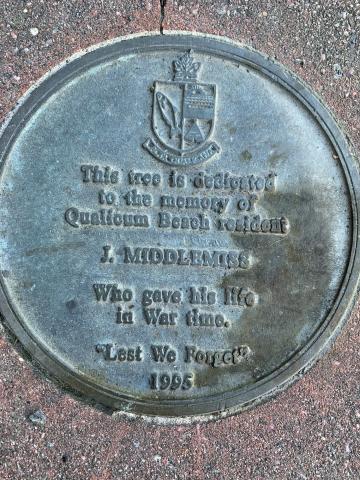
ACTA QUALICANA
This tree is dedicated
to the memory of
Qualicum Beach resident
J. MIDDLEMISS
Who gave his life
in War time.
"Lest We Forget"
1995
The J. Middlemiss Tree and Plaque were erected along Memorial Avenue in 1995.
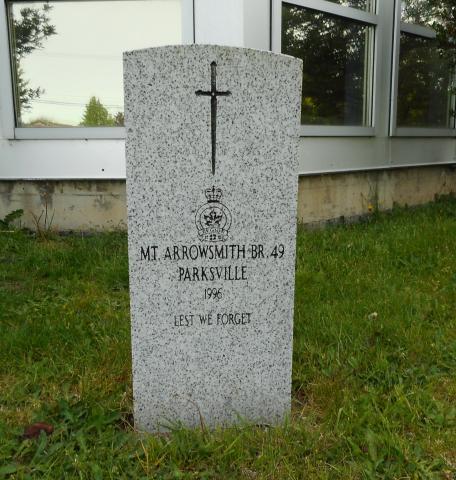
MT. ARROWSMITH BR. 49
PARKSVILLE
1996
LEST WE FORGET
In November of 1995 plans made by Georgia Keddy to purchase three Veterans memorials were approved. This was the first time in the North Central Vancouver Island Zone, which contains 10 Royal Canadian Legion branches, that such a venture had been attempted.
The memorials are located in Parksville at St. Anne's Church, Knox United Church and Yates Memorial. The memorials were constructed in June of 1996 in memory of the Parksville and area Veterans who survived the wars and died in later years. The dedication ceremony took place on October 27 1996. There was a colour guard, laying of wreaths, unveiling, and a light lunch served by the Ladies Auxiliary to Branch 49.
In Clayoquot BC, a community hall was chosen to be a fitting war memorial. The Hall was known as the Clayoquot Sound Soldiers Memorial Hall and dedicated to those from the district who gave their lives in the Great War. Armistice Day services were held in the Hall.
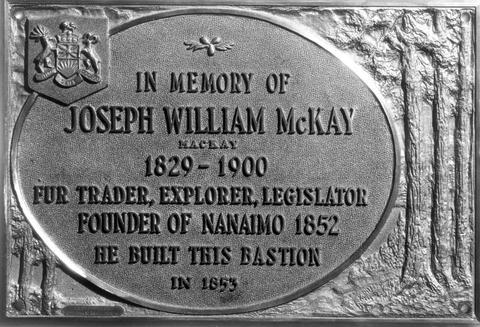
In Memory of Joseph William McKay 1829-1900 fur trader, explorer, legislator founder of Nanaimo 1852
He built this bastion in 1853
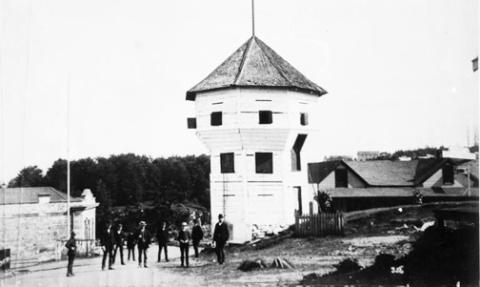
On September 16, 1945 a crowd gathered at the historic Bastion in Nanaimo to honor Joseph William McKay, a British Columbian Métis. The occasion was the unveiling of the following bronze plaque commemorating Joseph William McKay as the Founder of Nanaimo. This plaque is firmly affixed to the outside wall of the Bastion in a prominent position.
Fort Nanaimo was built under the direction of the Joseph William McKay of the Hudson’s Bay Company (HBC) in 1852 pursuant to the instructions of Governor James Douglas. The prior year McKay had learned from Chief "Coal Tyee" of the existence of coal at this site. The Fort was located on Nanaimo Harbour on the eastern coast of Vancouver Island. The settlement that grew up around this mining post has developed into the City of Nanaimo.
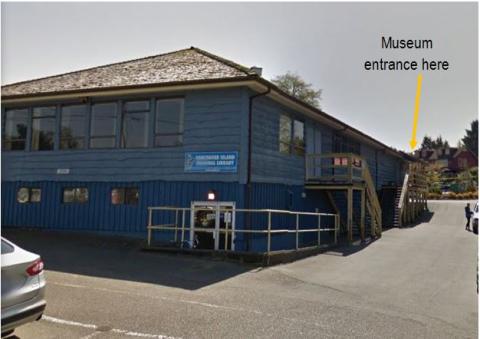
Today, the bastion is a museum. The second floor contains examples of the Bastion’s armament. As a defensive structure, the Bastion had two six-pount carronades for short range defense and may well have stored other firearms and gunpowder reserves. Along with the heavier cannons outside, their purpose was more ceremonial than defensive. The bell above the door on the outside of the second floor was originally mounted nearby on a nine metre pole, and was used as a signaling device, principally to announce the time, as watches and clocks were uncommon.
[inscription/inscription]
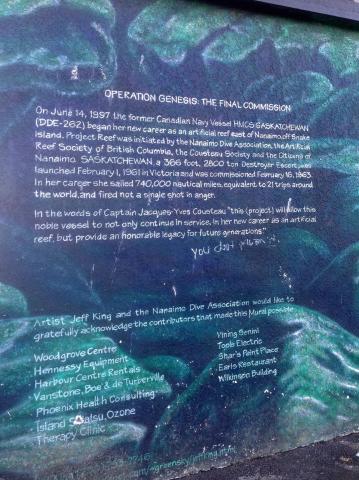
OPERATION GENESIS: THE FINAL COMMISSION
On June 14, 1997, the former Canadian Navy Vessel HMCS SASKATCHEWAN (DDE-262) began her new career as an artificial reef east of Nanaimo, off Snake Island. Project Reef was initiated by the Nanaimo Dive Association, the Artificial Reef Society of British Columbia, the Cousteau Society and the Citizens of Nanaimo. SASKATCHEWAN, a 366 foot, 2800 ton Destroyer Escort was launched February1, 1961 in Victoria and was commissioned February 16, 1963. In her career she sailed 740,000 nautical miles, equivalent to 21 trips around the world, and fired not a single shot in anger.
In the words of Captain Jacques-Yves Cousteau “this (project) will allow this noble vessel to not only continue in service in her new career as an artificial reef, but proved an honourable legacy for future generations.”
Artist Jeff Kin and the Nanaimo Dive Association would like to gratefully acknowledge the contributors that made this mural possible:
|
Woodgrove Centre |
*unreadable* |
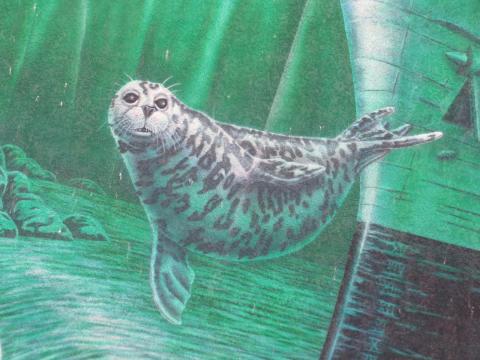
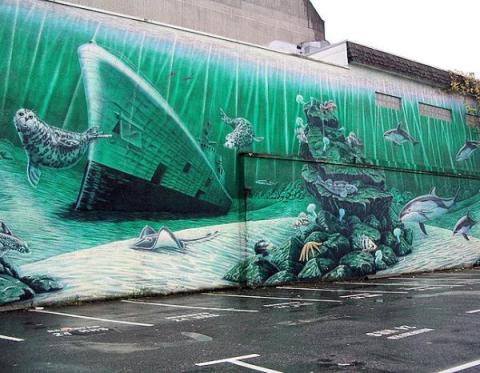
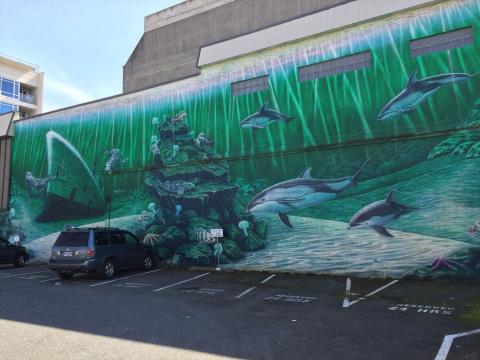
On June 14th, 1997 the HMCS Saskatchewan was sunk near Snake Island, just off Departure Bay, to start her new career as an artificial reef and dive spot. This mural, painted by Jeff King, is a tribute to the ship and the hard work put into the project by the Artificial Reef Society of BC.
The HMCS Saskatchewan was a Mackenzie-class Destroyer Escort, 366-feet long and 2900 tons. The ship/reef is located at 49° 12.96' N, 123° 53.070' W.
[road sign/panneau routier]
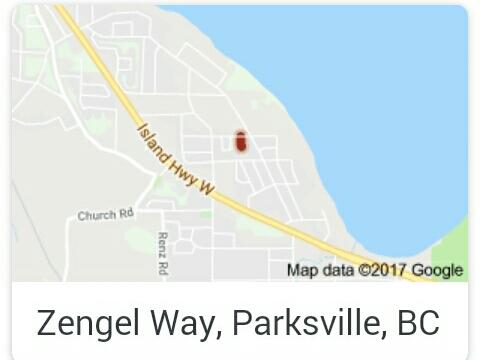
Zengel Way
Zengel Way, a beautiful cul-de-sac of Parkside Place dedicated in honor of Ray Zengel who fought in the Great War. Born as Raphael Louis Zengel - (1894 - 1977), he enlisted in the 45th Battalion. Upon arriving in France he was drafted to the 5th Canadian Infantry Battalion. Zengel was awarded many medals for his commitment to bravery and his unselfish acts, and his most recognized feat earned him the coveted Victoria Cross when during the Amiens fighting east of Warvillers he sacrificed his own safety.
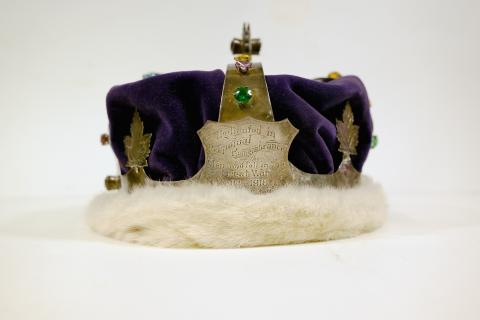
Dedicated in
Perpetual
Remembrance
of the
Men who fell in the
Great War
1914 — 1918
Nanaimo District
One of the most unique war memorials is the Nanaimo Empire Days Celebration Society's May Queen Crown. In 1918, the local May Queen winner dedicated her speech to the “men serving overseas in the First World War”. Then in 1925, Veterans of the Great War donated a sterling silver crown to the Empire Days society to be used for the May Queen coronation. It was designed and created by Nanaimo jeweler J. Thorneycroft. The original inscription on the crown read: “Dedicated in Perpetual Remembrance of the men who fell in the Great War, 1914-1918. Nanaimo District.”
By 1992 the crown was getting fragile so Branch 10, Royal Canadian Legion retired it and donated a new one. It was crafted by Branch 10 Comrade and jeweler William Proctor. For many years the Empire Days festival incorporated the Navy in the ceremonies to remember the sacrifices made. In 1995, Captain Jack Patten, Aide de Camp and a party of Canadian Scottish Regiment Veterans, took May Queen Alison Kenward and the new crown on a pilgrimage to the battlefields of the First World War. The battlefields of Ypres, Passchendaele, Menin Gate and other historic sites were visited. A solemn ceremony, with piper, cadets and Veterans ensured that the current generation remembered the sacrifices of the previous ones.
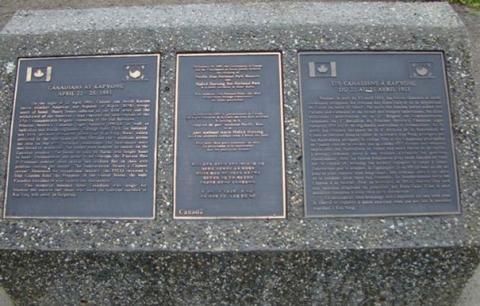
[left plaque/plaque gauche]
CANADIANS AT KAP'YONG
APRIL 22 - 25, 1951
On the night of 22 April 1951, Chinese and North Korean
forces attacked American and Republic of Korea (ROK) troops
north of Seoul. Heavy losses inflicted on the ROK Army and the
withdrawal of the American Corps required the intervention of the
27th Commonwealth Brigade, consisting of the 2nd Battalion.
Princess Patricia's Canadian Light Infantry (PPCLI) as well as
Austalian and British regiments. Through April 23rd, the battered
6th ROK division withdrew down Kap'Yong River valley,
protected by the Australians on Hill 504 and the Canadians across
the River on Hill 677. Attacked relentlessly, the Australians were
also forced to withdraw. The enemy then ordered an assault on the
Canadian position. The battle, lit only by flares, was fought hand
to hand. Outnumbered and about to be overrun, the Princess Pats
D Company ordered allied mortar and artillery fire on their own
position, routing the enemy. The bombardment forced a Chinese
retreat. Honoured for exceptional bravery, the PPCLI received a
Unit Citation from the President of the United States, the only
Canadian battalion to ever receive this distinction.
This memorial honours those Canadians who fought for
freedom and ensured that those who made the supreme sacrifice at
Kap'Yong will never be forgotten.
[centre plaque/plaque du centre][The balance of the wording is not clear in the photo./Le reste du texte n’est pas clair sur la photo.]them.
[The balance of the wording is not clear in the photo./Le reste du texte n’est pas clair sur la photo.]
[right plaque/plaque de droite][Translation of the plaque on the left (text not clear in photo)./Traduction de la plaque à gauche (le texte n'est pas visible dans la photo).]
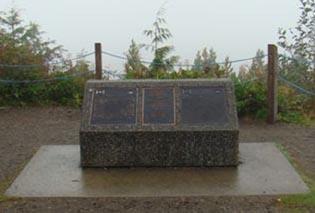
This memorial, placed in 1998 on the site of a radar station used during World War II, honours those who served during the Korean War as part of the 2nd Battalion Princess Patricia's Canadian Light Infantry. Members of this group were the first Canadian soldiers to set sail across the Pacific to serve in the Korean War in November of 1950, and helped in the Battle of Kap'Yong in April 1951, which was a turning point in the war.
(needs further research/recherche incomplète)
The General George R. Pearkes Senior Citizens Housing Society was created in 1969 in honour of George R. Pearkes, VC. It is a 42 unit, non-profit housing complex for seniors.