

Military service
Burial/memorial information
Flying Officer Doherty alerted Flying Officer Rowan T. Hutchinson, both whom were assigned to escort a naval vessel on a secret mission in the English Channel on 6 June 1943, when he spotted a trio of Folke-Wulf 1900's just as they launched surprise attack. His brief radio warning alerted Flying Officer Hutchinson to the danger, although Flying Officer Doherty's Mustang was immediately shot down.
Digital gallery of Flying Officer Lawrence Aloysius Doherty
-
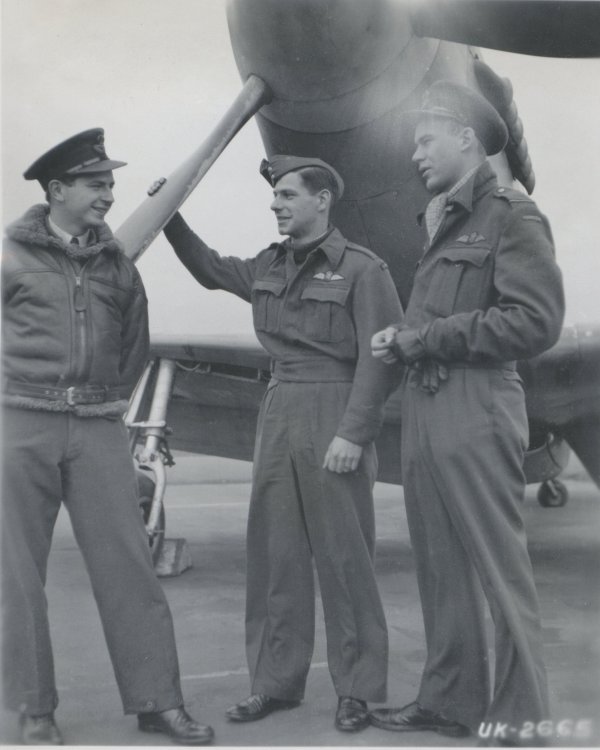
Group Photo
F/O Larry Doherty with F/O Bill Blakeny and F/O Rowan Hutchinson -
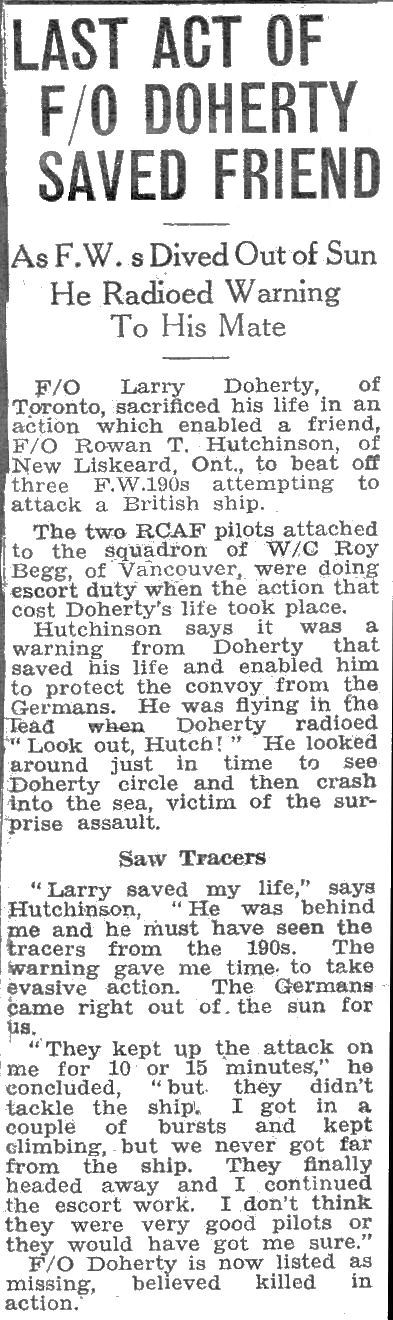
Newspaper Clipping
-
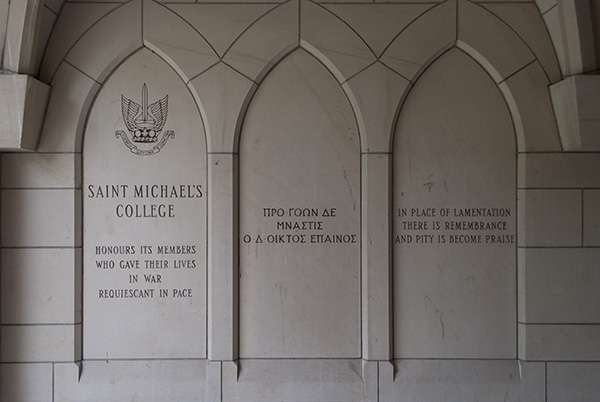
St. Michael’s College Memorial Intro
Inscriptions in the stone walls of the slype between More and Fisher Houses on the University of Toronto campus commemorate the men of St. Michael’s College (University of Toronto) and St. Michael’s College School (a private Catholic high school) who died in the First and Second World Wars and the Korean conflict. -

Detail of St. Michael’s College Memorial
Showing some of the Second World War names including that of Lawrence A. Doherty. -

St. Michael’s College Memorial
The memorial slype between More and Fisher Houses on the University of Toronto campus commemorates the men of St. Michael’s College (University of Toronto) and St. Michael’s College School (a private Catholic high school) who died in the First and Second World Wars and the Korean conflict. -

Memorial Arch
The names of those who died in the Second World War were added to the archway beneath the Soldiers’ Tower in 1949. The name of "F/O L.A. Doherty R.C.A.F.” is among the names inscribed. Photo: Cody Gagnon, courtesy of Alumni Relations. -
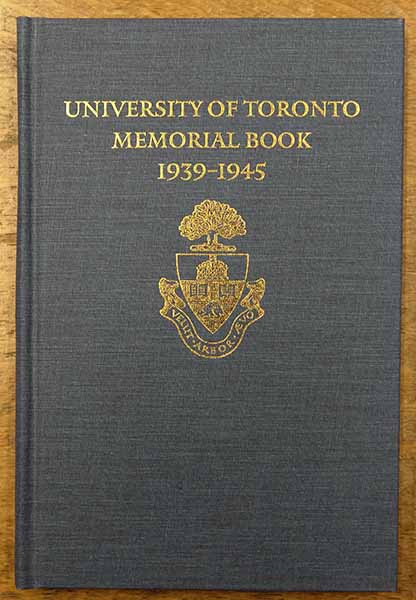
Memorial Book
University of Toronto Memorial Book, Second World War 1939-1945. Published by the Soldiers’ Tower Committee, 1993. Entry on page 18 reads: F/O Lawrence A. DOHERTY, 411 Sqn RCAF. Former student in St. Michael’s College, 1936. Killed in an air operation over the Bay of Biscay, 6 May 1943. Name inscribed on the Runnymede Memorial, Cooper’s Hill, Egham, Woking, Surrey, England. -
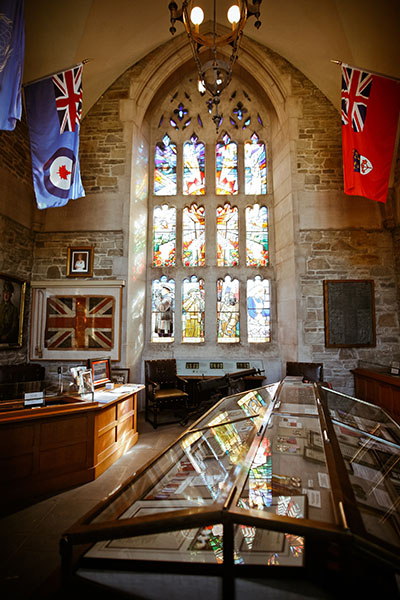
Memorial Room
Soldiers’ Tower, University of Toronto. Photo: David Pike, courtesy of Alumni Relations. -
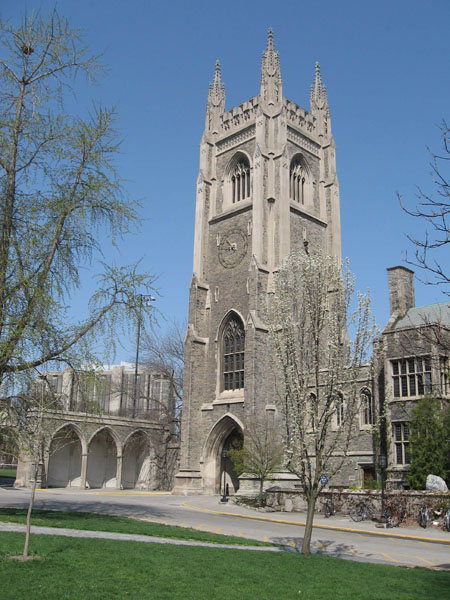
Soldiers' Tower
The Soldiers’ Tower was built by the University of Toronto Alumni Association in 1924 as a memorial to the Great War of 1914-1918. The names of those who died in that conflict are carved on the Memorial Screen at photo left. After the Second World War, more names were carved in the Memorial Arch at the Tower’s base. In total, almost 1200 names are inscribed. A Memorial Room inside the Tower contains mementoes and artifacts, and a 51-bell carillon serves as the audio element of the living memorial to the alumni, students, faculty and staff who died in the World Wars. The Soldiers’ Tower is the site of an annual Service of Remembrance. Photo: Kathy Parks, Alumni Relations. -
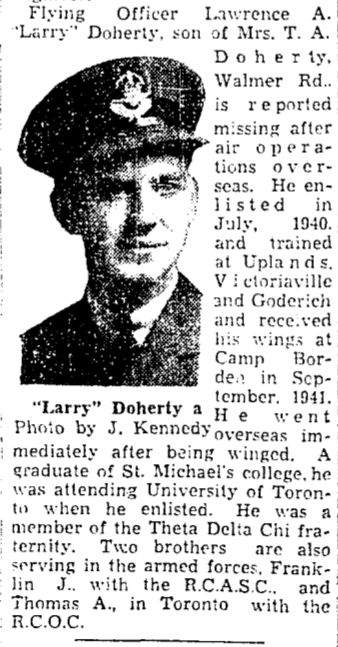
Newspaper clipping
From the Toronto Star June 1943. Submitted for the project Operation Picture Me -
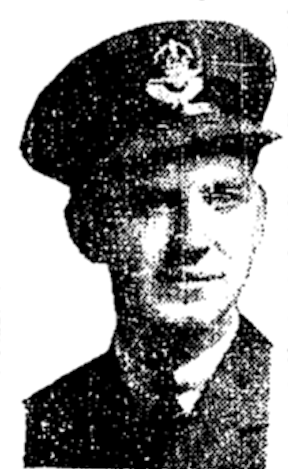
Newspaper clipping
From the Toronto Star June 1943. Submitted for the project Operation Picture Me -

Newspaper clipping
From the Toronto Star March 1944. Submitted for the project Operation Picture Me
Digital gallery of
Flying Officer Lawrence Aloysius Doherty
Digital gallery of
Flying Officer Lawrence Aloysius Doherty
Digital gallery of
Flying Officer Lawrence Aloysius Doherty
Digital gallery of
Flying Officer Lawrence Aloysius Doherty
Digital gallery of
Flying Officer Lawrence Aloysius Doherty
Digital gallery of
Flying Officer Lawrence Aloysius Doherty
Digital gallery of
Flying Officer Lawrence Aloysius Doherty
Digital gallery of
Flying Officer Lawrence Aloysius Doherty
Digital gallery of
Flying Officer Lawrence Aloysius Doherty
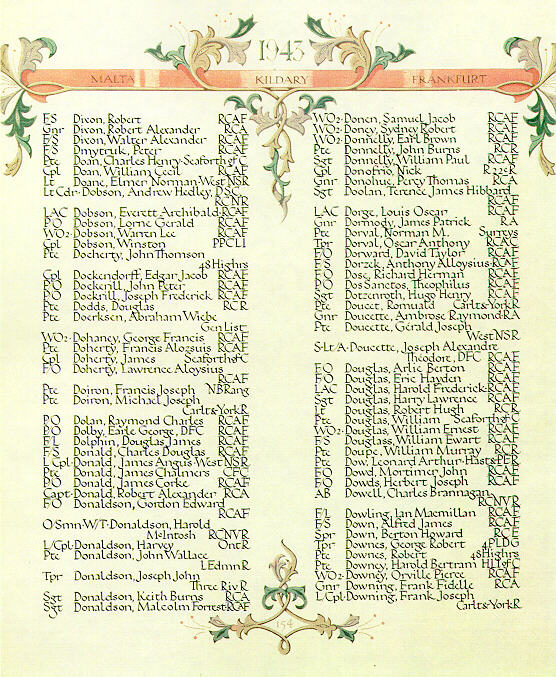
In the Books of Remembrance
Commemorated on:
Page 154 of the Second World War Book of Remembrance.
Request this page
Download this page
RUNNYMEDE MEMORIAL Surrey, United Kingdom
The design of the Runnymede Memorial is original and striking. On the crest of Cooper's Hill, overlooking the Thames, a square tower dominates a cloister, in the centre of which rests the Stone of Remembrance. The cloistered walks terminate in two lookouts, one facing towards Windsor, and the other towards London Airport at Heathrow. The names of the dead are inscribed on the stone reveals of the narrow windows in the cloisters and the lookouts. They include those of 3,050 Canadian airmen. Above the three-arched entrance to the cloister is a great stone eagle with the Royal Air Force motto, Per Ardua ad Astra". On each side is the inscription:
IN THIS CLOISTER ARE RECORDED THE NAMES OF TWENTY THOUSAND AIRMEN WHO HAVE NO KNOWN GRAVE. THEY DIED FOR FREEDOM IN RAID AND SORTIE OVER THE BRITISH ISLES AND THE LANDS AND SEAS OF NORTHERN AND WESTERN EUROPE
In the tower a vaulted shrine, which provides a quiet place for contemplation, contains illuminated verses by Paul H. Scott."
For more information, visit Commonwealth War Graves Commission.
The Poppy Design is a trademark of The Royal Canadian Legion (Dominion Command) and is used with permission. Click here to learn more about the poppy.
Did we miss something?
Contribute information to this commemorative page
Do you have photographs, information or a correction relating to this individual’s virtual memorial? Learn more about the CVWM and the information we collect.