
À propos de ce mémorial
This memorial is one of the six battle sites to commemorate Newfoundland’s accomplishments, contributions and sacrifices during the First World War.
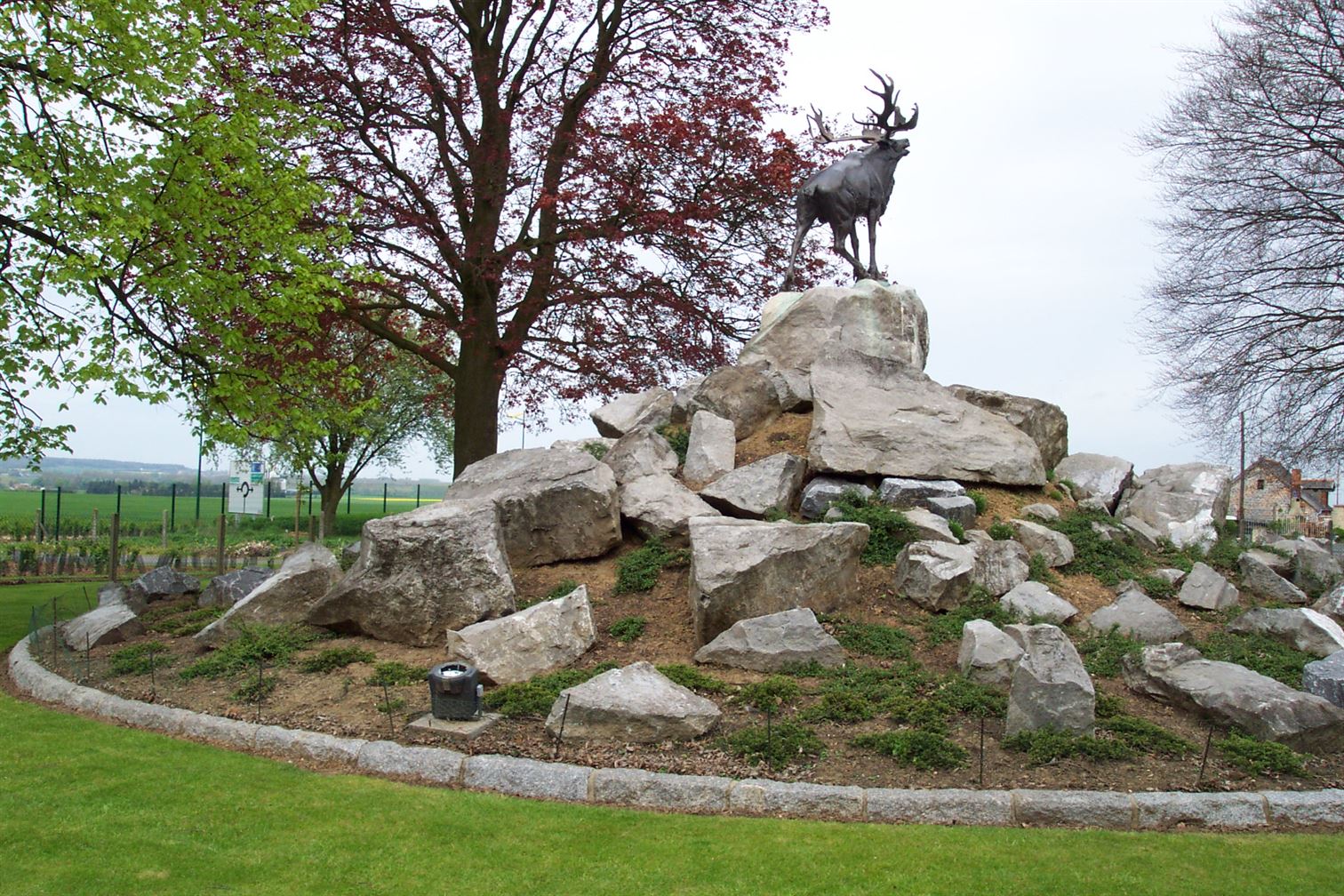
With these words, Field Marshal Sir Douglas Haig paid tribute to the "high courage and unfailing resolution" of all ranks of the Newfoundland Regiment who had fought under his command at the Battle of Cambrai, 1917. This was the achievement commemorated by the great bronze caribou, which stands on a rocky base just outside the village of Masnières, over half a kilometre north of the St. Quentin canal.
Did you know?
Newfoundland joined Canada in 1949. The province was officially renamed Newfoundland and Labrador in 2001. During the First World War, the entire area was a separate British dominion called Newfoundland. Soldiers from both the island of Newfoundland and mainland Labrador served in the Royal Newfoundland Regiment during the conflict.
Newfoundlanders in the Battle of Cambrai, 1917
In mid-November 1917, the Newfoundland Regiment, with General Byng's Third Army, was preparing to attack the Hindenburg Line in front of Cambrai. Haig's "great experiment" was to use massed armour for the first time in the war in order to open a breach in the enemy's defences through which infantry and cavalry would advance to capture Cambrai.
The assault, which went in at daybreak on November 20 without the customary preliminary artillery bombardment, took the Germans completely by surprise. With the tanks leading the way and opening wide gaps in the enemy wire, the Third Army broke through both Hindenburg systems, advancing from five to seven kilometres on a ten-kilometre front.
During the morning the 29th Division, in which the Newfoundland Regiment formed part of the 88th Brigade, came forward from reserve to complete clearing out pockets of enemy from the Hindenburg Support Line. Next, it was the Division's task to seize the bridgeheads over the St. Quentin Canal - the 88th Brigade on the right being charged with the capture of Masnières. In hard fighting the Newfoundlanders gained the outskirts of Masnières by nightfall on the 20th and next day completed clearing the town.
The Third Army's advance had created a salient some 15 kilometres wide and about six and one-half kilometres in depth. On November 30, the German Second Army launched a powerful counterattack against General Byng's exposed right flank. The full force of the blow from the German right wing fell on the Newfoundland Regiment and the other battalions of the 29th Division that were holding the bridgehead. When a German penetration south of Masnières threatened to encircle the slender holding, a spirited counterattack by all four battalions of the 88th Brigade forced the enemy back almost a kilometre and a half. That night the Newfoundland Commanding Officer wrote in his diary: "Our strength in the morning, 9 officers, 360 other ranks; at night, 8 officers, 230 other ranks." After clinging to their tenuous position astride the Canal for another 24 hours, the defending battalions were ordered to evacuate Masnières. The battle continued until December 4, when Byng ordered a withdrawal of the Third Army to a line that closely followed the old Hindenburg Support System.
In its struggle to seize and hold the bridgehead at Masnières, coupled with earlier fighting at the Third Battle of Ypres, the Newfoundland Regiment had earned unique recognition. It was granted the title "Royal" by His Majesty King George V. The distinction was one that no other regiment of the British Army was to have conferred on it during the First World War while fighting was still in progress.
Visit Canadian memorials in Europe
A profound experience awaits those who visit the monuments and cemeteries in Europe that honour Canada's contributions to defending peace and freedom.
Directions
The Masnières Newfoundland Memorial is about 10 kms south of Cambrai, 35 kms east of Arras, 45 kms south of Lille and 155 kms north of Paris. You can reach Cambrai by train or by bus and from there take a taxi to the Memorial.