
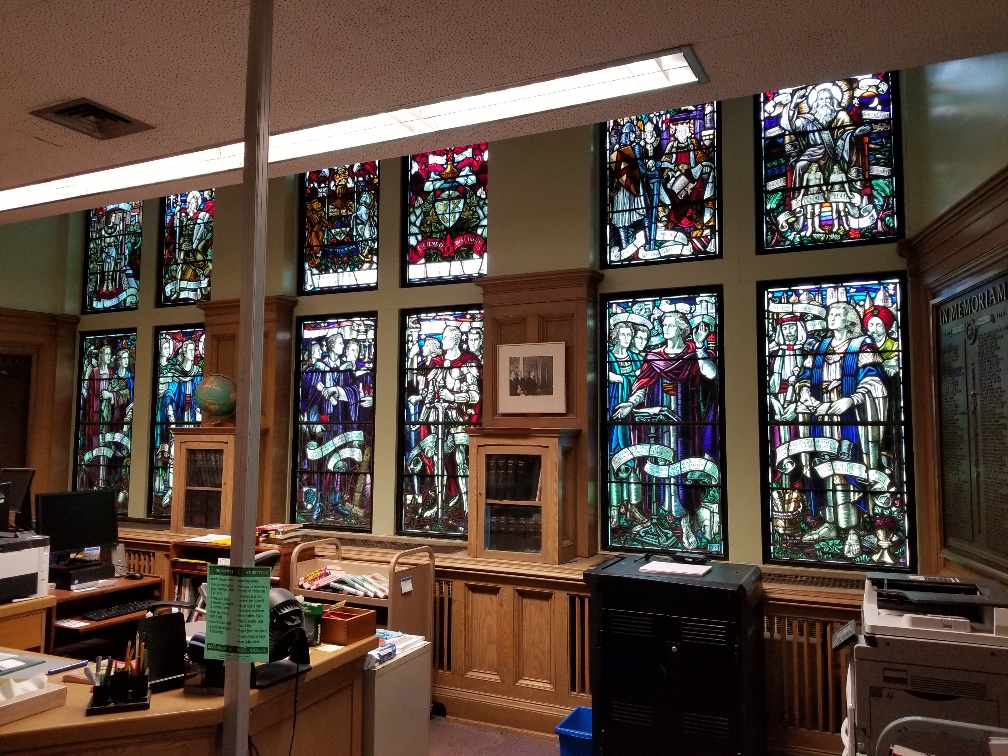
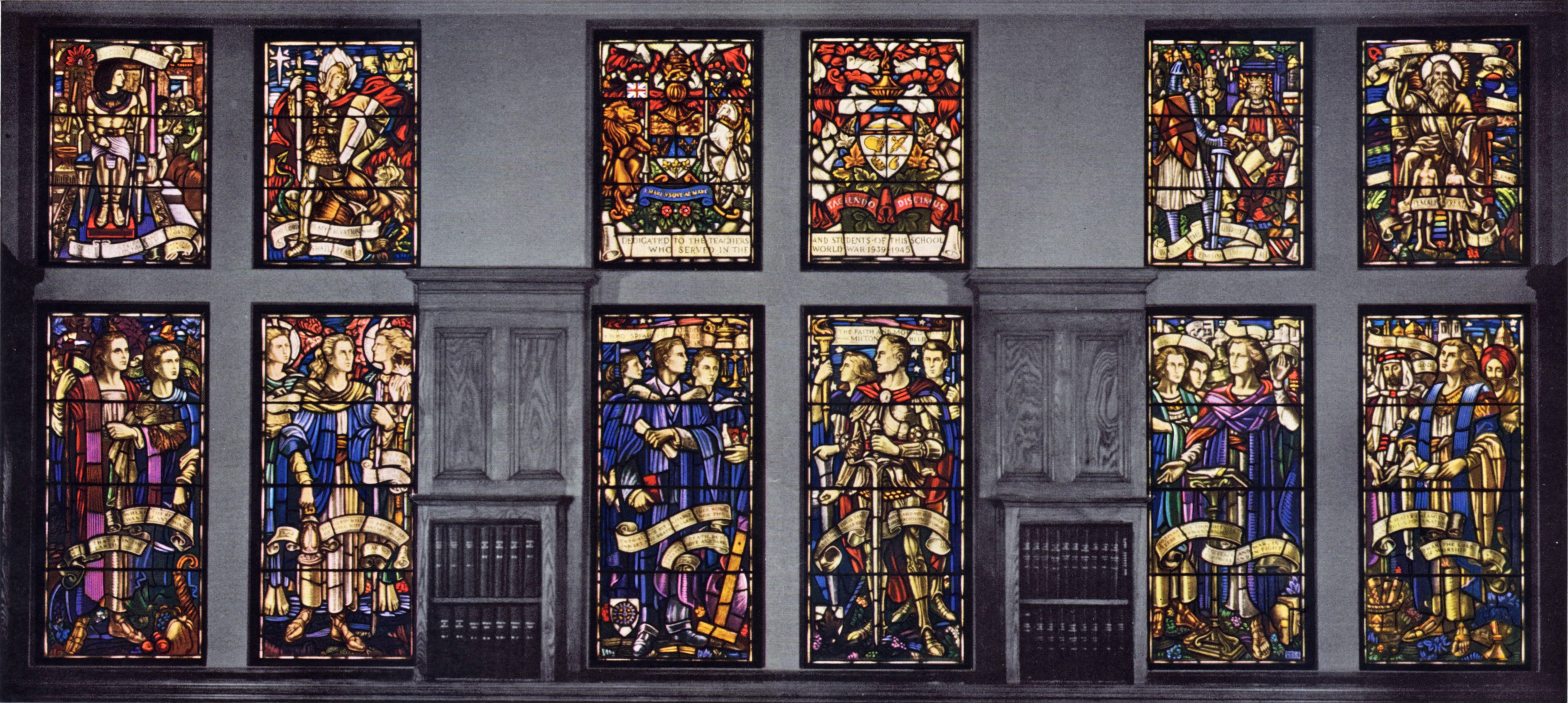
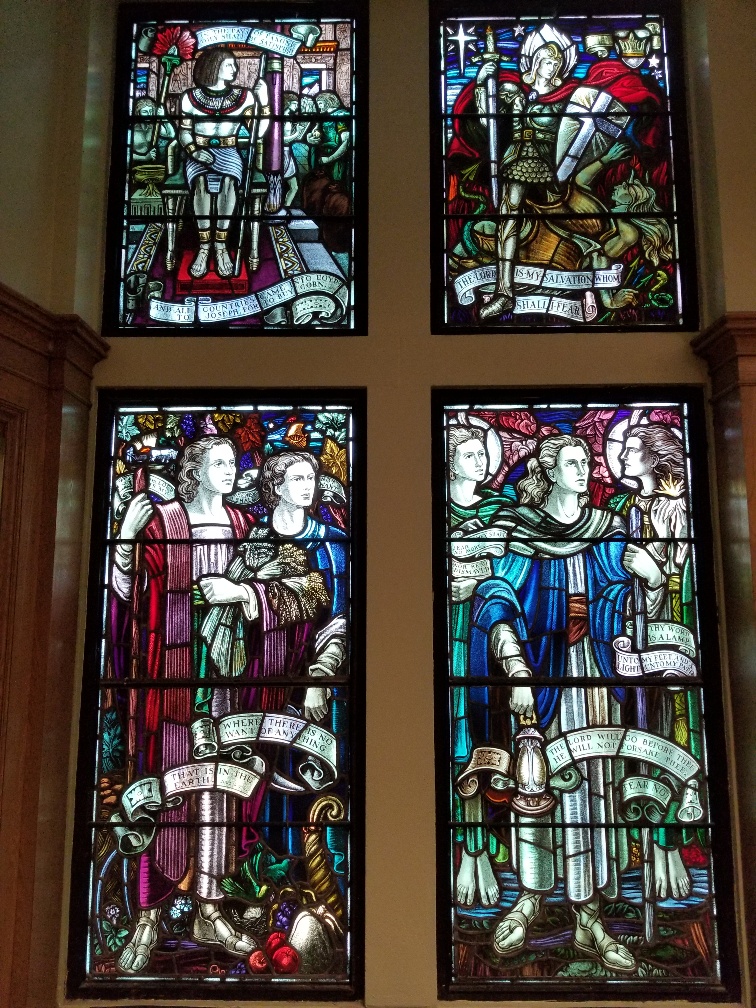
The Danforth Collegiate and Technical Institute War Memorial Windows consists of six stained glass windows that pay tribute to the teachers, students and ex-students who served in the Second World War. It was unveiled and dedicated on May 30, 1948, by His Excellency, Field Marshall, the Viscount Alexander of Tunis, K. G., Governor-General of Canada. There were some 1,200 people in the audience.
The windows were designed by Danforth Art Teacher, Mr. Cyril J. Travers. Another Danforth teacher, Mr. Roy Foley, provided the interpretation of the symbolism of the War Memorial Windows. The windows are located in the War Memorial Library.
The Wise Administrator, upper panel of the first window - An Egyptian scene from ancient biblical times, the victims of depression and famine buying from providentially stored stocks of food supplies.
Freedom from Want, lower panel of the first window - About the emblems of agriculture and cornucopia—the symbol of plenty—are shown a man busy ploughing and the laden ship, symbols of industry, productive employment, and international trade.
The Eternal Struggle, upper panel of the second window - The heroic figure represents Christian, triumphantly vanquishing Apollyon, the evil one. The raised sword symbolizes man's victory over age-old fear and evils which have beset him since the dawn of time.
Freedom from Fear, lower panel of the second window - The figure in the window represents mans as travelling along obscure, uncertain, and even dangerous paths. Immediately before his feet is broken ground, suggestive of dangerous and treacherous footing. The lamp and the staff are emblematic of dependence on divine light and guidance. Above and behind the traveler are two guardian angels, one of whom is carrying a "starry light", which itself gives objective to the window's inscription.
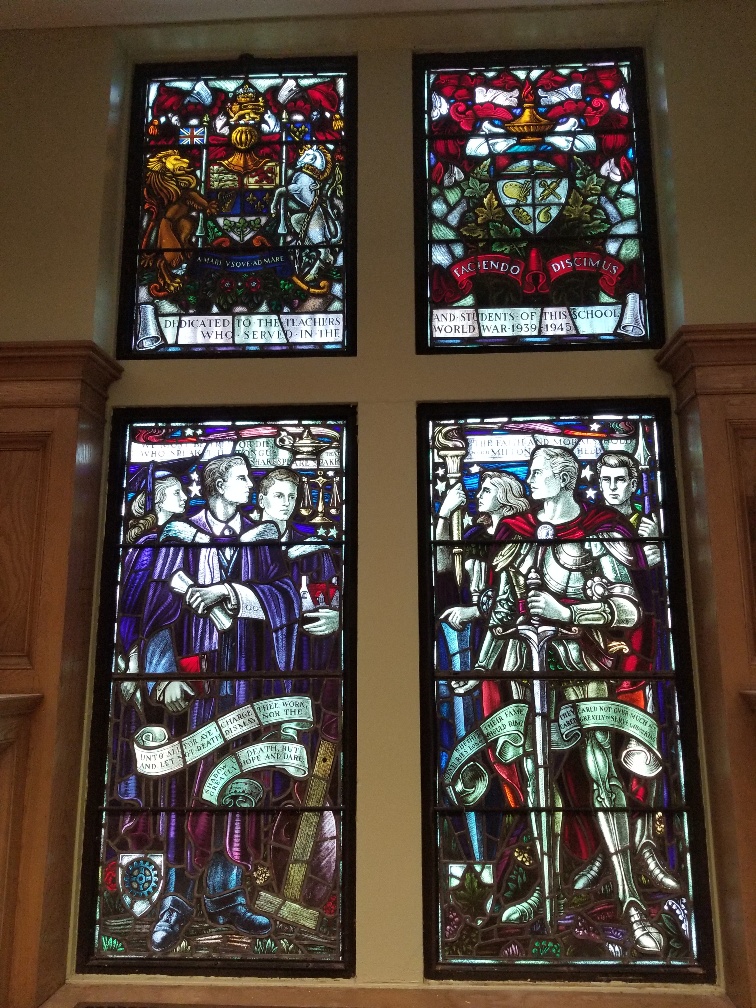
The Canadian Coat of Arms, upper panel of the third window - The Coat of Arms of Canada, in full colour, complete with royal helmet, the crest and mantling. The crest is a lion holding in its paw a red maple leaf, which during the First World War became the symbol of sacrifice. Upon the quartered shield, in the upper right, is a red shield with three golden lions—the original arms of England. In the upper left, is a golden shield with a red lion enclosed in a border of two thin lines—the arms of Scotland. In the lower right, is the golden harp, the arms of Ireland. In the lower left are the three golden fleurs-de-lis.
The sprig of three maple leaves on a silver field are in the lower third of the shield. The draping of the helmet has deeply indented edges, suggestive of the slashings that this covering might be subjected to in battle. Supporting the crest, helmet, and shield is a lion on the right and the unicorn of the Royal Arms on the left. The lion rampant upholds a silver lance from which flies the Union Jack. The unicorn with chain and coronet upholds a lance from which flies a banner bearing the fleur-de-lis. Below the shield upon a wreath composed of roses, thistles, shamrocks and lilies is a scroll inscribed in Latin which translates to "from sea to sea".
The Student as a Mature Citizen, lower panel of the third window - The figure of a student, freshly graduated from university, and symbols: academic robes and scroll, T-square, wheel, book, model home, balances, retort and palette.
The Coat of Arms of the School, upper panel of the fourth window - The crest is the lamp of learning or of truth. The shield in the Coat of Arms depicts the symbols of several departments of the school: open book, palette, scissors and rolling pin, geared wheels and the retort. The maple leaves above the shield are suggestive of a loyalty to Canada.
The Student as a the Soldier in Arms, lower panel of the fourth window - The figure is a student representing the soldier in arms, in righteous anger, ready and alert to defend freedoms. He is clad in shining armour, the symbol of those spiritual convictions which motivate his actions. With him are two comrades-in-arms, equally determined and forthright. The torch, interpreted as the symbol of some high purpose, lofty ideal, or truth. At the feet of the soldiers are flowers of the youth; the stars are symbols of lofty aspirations. Upon the shield is the maple leaf, which provides incentive to loyal service.
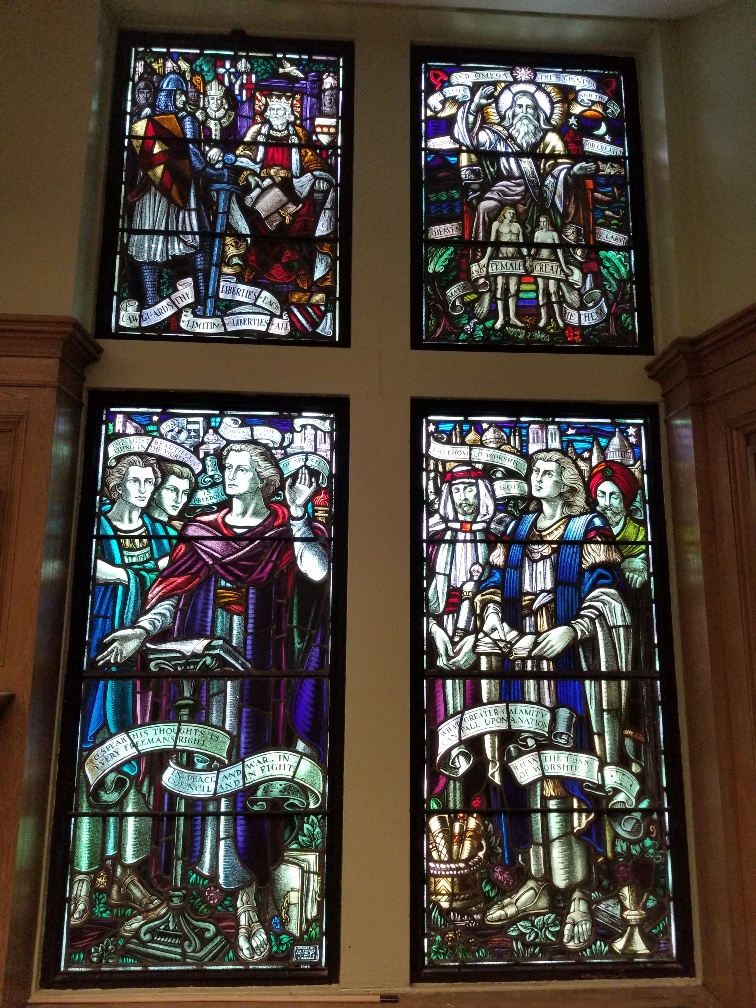
The Signing of the Magna Carta, upper panel of the fifth window - The scene at Runnymede on the 17th of June 1215 when King John set the royal seal to the Great Charter. Fitzwalter with his shield of two red chevrons is spokesman for those seeking redress.
Freedom of Speech, lower panel of the fifth window - A citizen "speaking his thoughts", listened to by those who are critical of his views, yet there is evidence of respect for those views.
God the Creator, upper panel of the sixth window - This Supreme Being is shown as surrounded by the "six days of creation".
Freedom of Religion, lower panel of the sixth window - Three male figures: the man of Christian faith, holding his open Bible and looking upward to the God of his faith in reverent worship; on his right, an Arab holding a copy of the Koran and in an attitude of worship to his "Supreme Being"; on his left an East Indian in an attitude of worship.
240 students and one teacher were killed while serving in the Second World War. Further research over the years indicated there were another 21 names which should have been included. Opened as Riverdale Technical School in 1923, the school’s name was changed to Danforth Technical School in 1932. It has the greatest number of students, graduates, teachers and other staff to have volunteered for military service or the Merchant Navy in the Second World War of any school in the British Commonwealth.