
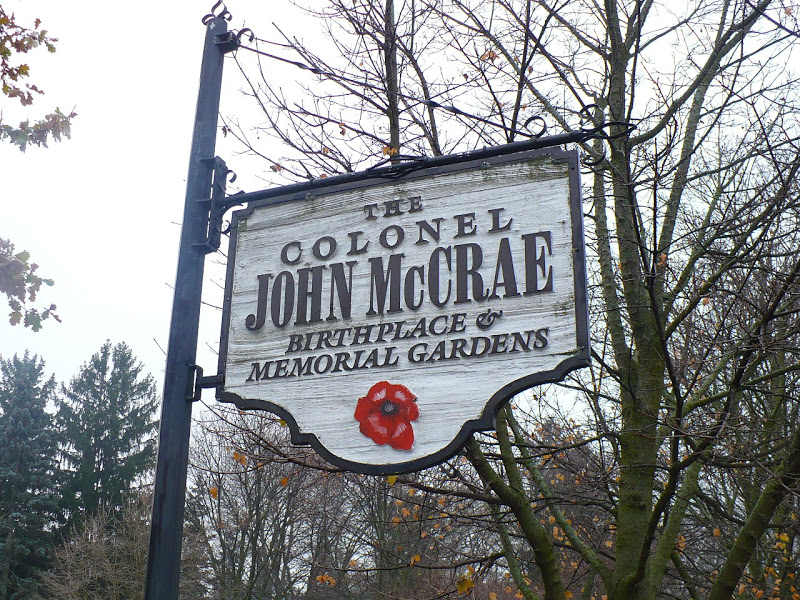

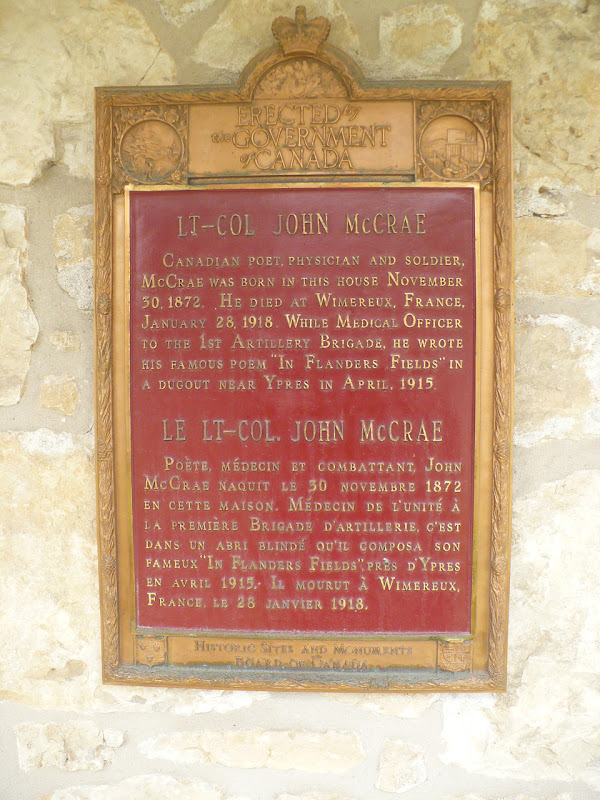
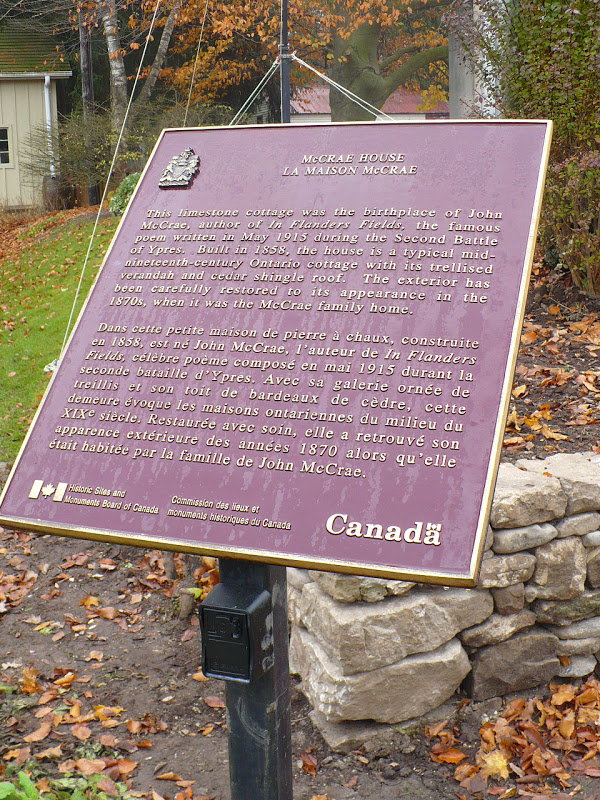
The limestone cottage located within The Colonel John McCrae Birthplace & Memorial Gardens was the birthplace of John McCrae, author of In Flanders Fields, the famous poem written in May 1915 during the Second Battle of Ypres. McCrae House was designated a national historic site of Canada in 1966 for its significance to the history of architecture; and because it is the birthplace of John McCrae.
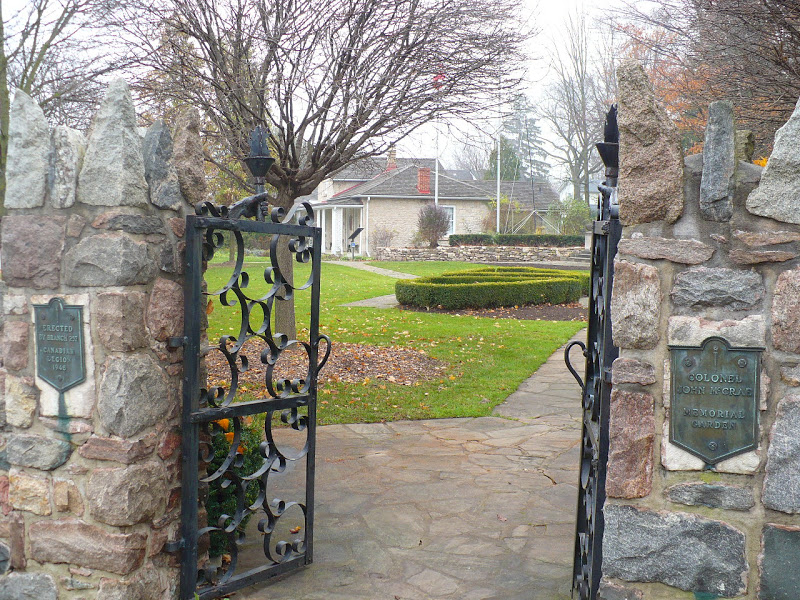
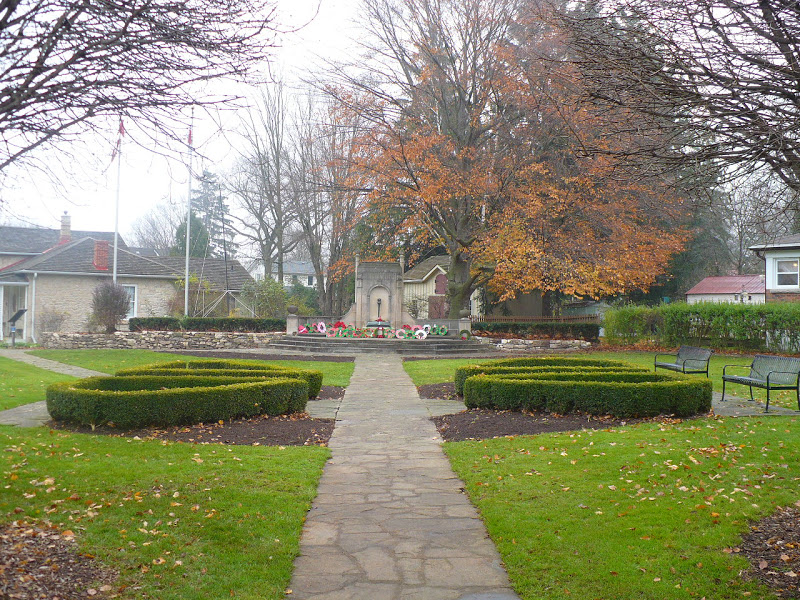
In the early 1940s, W.T. Bedford gave the Canadian Legion Branch 257 this lot on Water Street located immediately adjacent to the home where the late Colonel John McCrae was born. After much discussion as to what purpose the lot should be used for, it was decided on the memorial garden to Colonel John McCrae. This was a large undertaking for a small group of Veterans, but it was successfully completed, paid for, and was officially dedicated on 5 August 1946.
Stone fencing surrounds the garden. The monument is elevated and bordered by several steps. A cast bronze book lays open, on which “In Flanders Fields” is inscribed in full. The book sits atop a section of limestone engraved with the phrase “Lest we forget.” A curved wall of limestone surrounds the book and a bronze torch sits in an alcove in the center of the wall. The architect for the memorial was A.C. Burnett Nicol of Toronto; the contractors for the stone work were from Sharp Brothers Cut Stone Co. of Hamilton; and the contractor for the building work was William Parker of Guelph. The property is now owned by the City of Guelph.
Lieutenant-Colonel John McCrae was born in Guelph, Ontario in 1872, he served with an artillery battery in the South African War and had a successful civilian medical career. When the First World War broke out in 1914, the patriotic 41-year-old enlisted again and would be appointed as a medical officer with the First Brigade of the Canadian Field Artillery.
During the Second Battle of Ypres in the spring of 1915, McCrae was tending to the wounded in a part of Belgium traditionally called Flanders. On May 2, a close friend was killed in action and this painful loss inspired McCrae to write In Flanders Fields the next day. It would be published in Britain’s Punch magazine and quickly became one of the best-known poems of the war, helping make the poppy an international symbol of remembrance. Sadly, Lieutenant-Colonel McCrae would not survive the conflict, dying of illness in January 1918.