
2.1 Employment
Desired outcomes
- Job seekers with disabilities see VAC as a workplace of choice
- Job seekers and public servants with disabilities have access to employment opportunities at VAC and can contribute to their full potential
Employment barriers
- Under representation: persons with disabilities are under-represented in VAC’s hiring, acting appointments and promotions and over-represented in departures
- Complex accommodation process: the process for employees to obtain accommodations needed at work is complex. Managers do not feel equipped to recruit, develop and support persons with disabilities
- Manager considerations: managers may not consider operational requirements and related accessibility barriers when hiring persons with disabilities
Actions to remove employment barriers
2.2 The built environment
Desired outcome
- VAC’s built environments are barrier-free
The built environment barriers
- Commemorative displays: commemorative displays are not always accessible
- Memorial site parking: memorial site parking is not always accessible
- Installed safety equipment: certain installed safety equipment may have unintended negative effects on some people with disabilities
Actions to remove the built environment barriers
2.3 Information and communication technologies (ICT)
Desired outcome
- VAC’s information and communication technology is usable by all
Information and communication technologies barriers
- Web applications: barriers in web applications
- Desktop software: barriers in desktop software
- Mobile applications: barriers in mobile applications
- Artificial intelligence: barriers in artificial intelligence (AI) systems
- Digital documents: barriers in digital documents. This includes, but is not limited to Word and PDF documents
- Transparency: transparency of accessibility status
- Awareness: awareness of accessibility features and tools
- Capacity and capability: capacity and capability to identify, remove and prevent barriers
Actions to remove ICT barriers
2.4 Communication (other than information and communication technologies)
Desired outcomes
- VAC employees are equipped to design and deliver communications that are accessible
- Persons with disabilities are satisfied with the accessibility of VAC’s communications
Communication (other than information and communication technologies) barriers
- Complex language: complex language in executive services unit-client relations unit templates
- Naming conventions: naming conventions for files at VAC are not consistent
- Described video: described video is not available for silent videos at VAC’s visitor centers
Actions to remove communications (other than information and communication technologies) barriers
2.5 The procurement of goods, services and facilities
Desired outcome
- All goods and services procured by VAC are accessible
The procurement of goods, services and facilities barriers
- Departmental awareness: need for a deeper Departmental awareness of accessibility applicable to procured goods and services
Actions to remove the procurement of goods, services and facilities barriers
2.6 The design and delivery of programs and services
Desired outcomes
- VAC employees are equipped to design and deliver programs and services that are accessible
- Persons with disabilities are satisfied with the accessibility of VAC’s programs and services
The design and delivery of programs and services barriers
- Client feedback: Bureau of Pensions Advocates (BPA) does not have direct client feedback on accessibility in its client satisfaction questionnaire
- Disability Benefits application (PEN 923): Disability Benefits application (PEN-923 - Pain and Suffering Compensation/Disability Pension) steps are not clear, concise or easy to understand
- Presentation materials: PIM presentation materials are not fully accessible
- Delivery of programs and services: Service Delivery and Program Management (SDPM) employees would benefit from additional training and support to confidently deliver accessible programs and services
- Digital documents for programs and services: digital documents that are not accessible pose a barrier to people with disabilities
Actions to remove the design and delivery of programs and services barriers
2.7 Transportation
Following a careful review of policies, practices, programs, services, and benefits, no barriers were identified in this area.
2.8 Organizational culture
Desired outcome
- VAC employees understand what accessibility means and why it matters, and they are equipped to make the Department a more accessible and inclusive workplace and service provider
Tracking
As outlined in our Accessibility Action Plan 2022-2025 and subsequent progress reports, we are committed to addressing ableism and fostering a more inclusive and accessible organizational culture.
We are working to shift mindsets to foster a culture that values the lived experiences of persons with disabilities, prevents barriers, and embeds accessibility by design. This work requires us to commit to continuous learning, adopt an intersectional approach, and integrate accessibility in all aspects of our work.
Progress towards the desired outcome will be measured by referencing data sources such as the Public Service Employee Survey and VAC’s Employee Pulse Survey.
Progress on our accessibility culture shift in 2025
VAC’s employee accessibility survey
Over the past 3 years, we have conducted an annual Employee Accessibility Survey to better understand how employees perceive accessibility and its role within our organization. The goal of this survey is to help us assess individual confidence in accessibility-related knowledge and the extent to which accessibility is embedded in our culture and daily practices. Participation results can be seen in Figure 1.
Figure 1: Employee Accessibility Survey participation 2023-2025
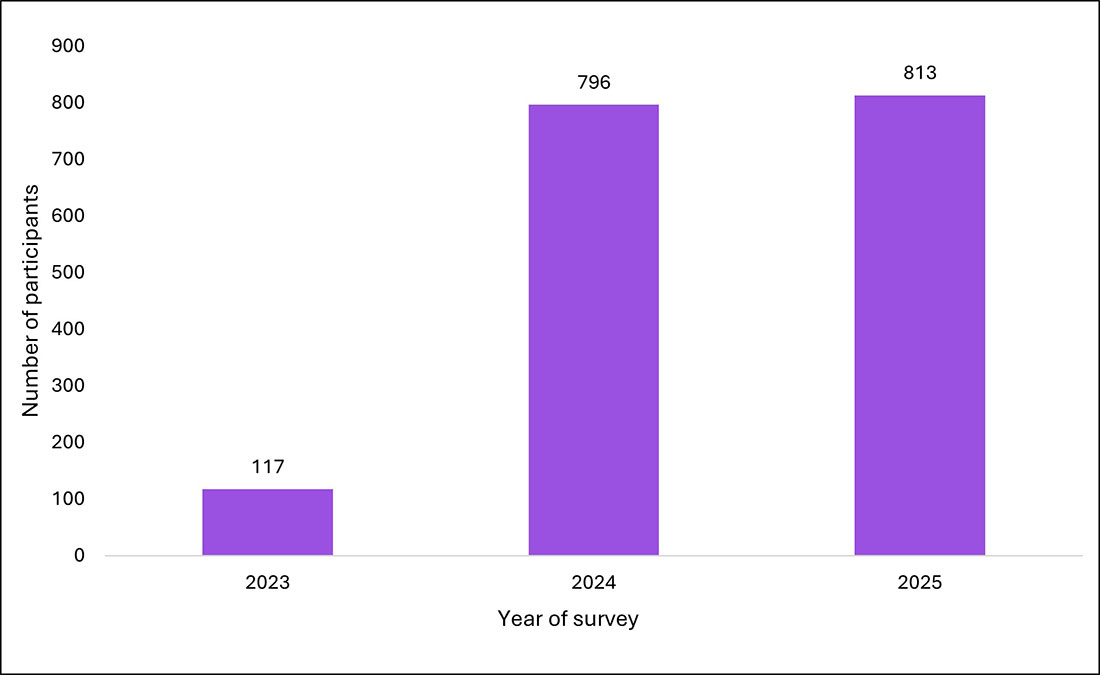
Description of Figure 1: Employee Accessibility Survey participation 2023-2025
- In 2023 there were 117 participants
- In 2024 there were 796 participants
- In 2025 there were 813 participants
Survey participation increased substantially, from 117 respondents in 2023 to 813 in 2025, a 595% increase. This steady growth reflects rising awareness and engagement around accessibility. More on the survey under section 4.
Accessibility@VAC intranet site
In 2024-2025, the content on the Accessibility@VAC intranet site was regularly updated to provide employees with the most recent information, resources, and updates from the Accessibility Network.
The "Accessibility Storytellers" and "Accessibility Adopters" series continue to be a key feature of the site. The Accessibility Storytellers articles share the lived experiences and personal stories of persons with disabilities and their allies, offering valuable insights into accessibility. Meanwhile, the Accessibility Adopters articles recognize and celebrate employees and teams who actively incorporate accessibility into their daily work, highlighting practical steps and inspiring others to do the same.
The Accessibility Network
The most important group for accessibility consultation remains persons with disabilities. At VAC, the Accessibility Network (the Network) plays a foundational role in these types of consultations.
To expand the Network and strengthen its capacity to apply an intersectional lens, we have engaged in targeted recruitment efforts. This includes outreach to other employee resource groups, such as the Indigenous Employees Network, the Positive Space Initiative, and the Visible Minorities Network. We also invited participants from the Federal Student Work Experience Program (FSWEP) to join. More about the Network under section 4.
Accessibility events and presentations
In recognition of NAAW 2025, the Accessibility Network hosted a virtual Departmental event titled "Panel Discussion and Fireside Chat: Closing the Gap on Accessibility," and attracted 631 employees from VAC and VRAB. This event prioritized the lived experience of persons with disabilities and the importance of accommodation.
For IDPD 2024, we celebrated with a Departmental event hosted by the Accessibility Network titled "Beyond Labels – A Call to Action to Shift Perceptions of Disability." The event featured persons with disabilities and highlighted progress made in accessibility across the Department. It drew 609 employees from VAC and VRAB.
After both events, a short survey was sent to participants to collect feedback. Of the 1240 participants for both events, we received a total of 70 survey responses for both events. These responses were overwhelmingly positive, with over 98% of respondents indicating that overall, they were 'satisfied', or 'very satisfied' with the events.
The survey also produced 34 written pieces of feedback. One particularly impactful comment captured the essence of many responses:
"This session gave me a much better understanding of the impacts [on] co-workers when the tools and products we use at VAC are not accessible. It broadened my perspective and has inspired me to make sure the work documents and systems I help improve are accessible from the start. It really helped me to understand the importance of this."
These activities, and other accessibility initiatives, such as National Disability Employment Awareness Month and Indigenous Disability Awareness Month, were promoted through emails to all employees from the Champion of Accessibility, MS Teams postings, articles in VAC’s internal online newsletter Carillon, and the Friday Highlights e-newsletter.
Strengthening accessibility knowledge
In 2025, we took part in several initiatives to deepen our understanding of accessibility.
One key step was enrolling as a contributing organization with the Canadian Accessibility Network. This partnership provides VAC employees with access to valuable resources and learning opportunities.
We also participated in various communities of practice alongside other government departments to exchange best practices and share our progress. These are focused in the Government of Canada and include the:
- Interdepartmental Accessibility Network
- Interdepartmental Accessibility Community of Practice
- Plain Language Community of Practice
- Interdepartmental Network of Disability and Accessibility Chairs
- Persons with Disabilities Champion and Chairs Committee
We will continue to support an accessible organizational culture by:
- collaborating with the Accessibility Network on new and ongoing initiatives
- promoting and expanding the use of accessible templates
- arranging speaking opportunities, panels, and presentations about accessibility
- promoting the internal document "Accessibility Confidence at VAC: A Playbook"
- learning more about and planning accessible meetings and events
- celebrating accessibility events to increase education and awareness
- learning accessibility best practices from other organizations and communities of practice