
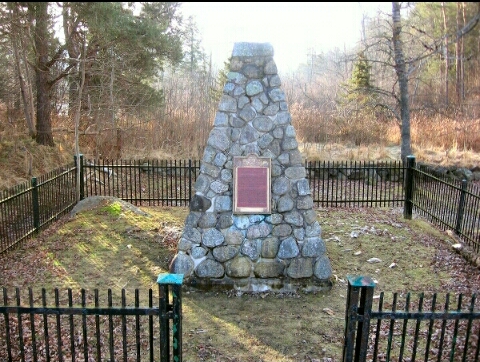

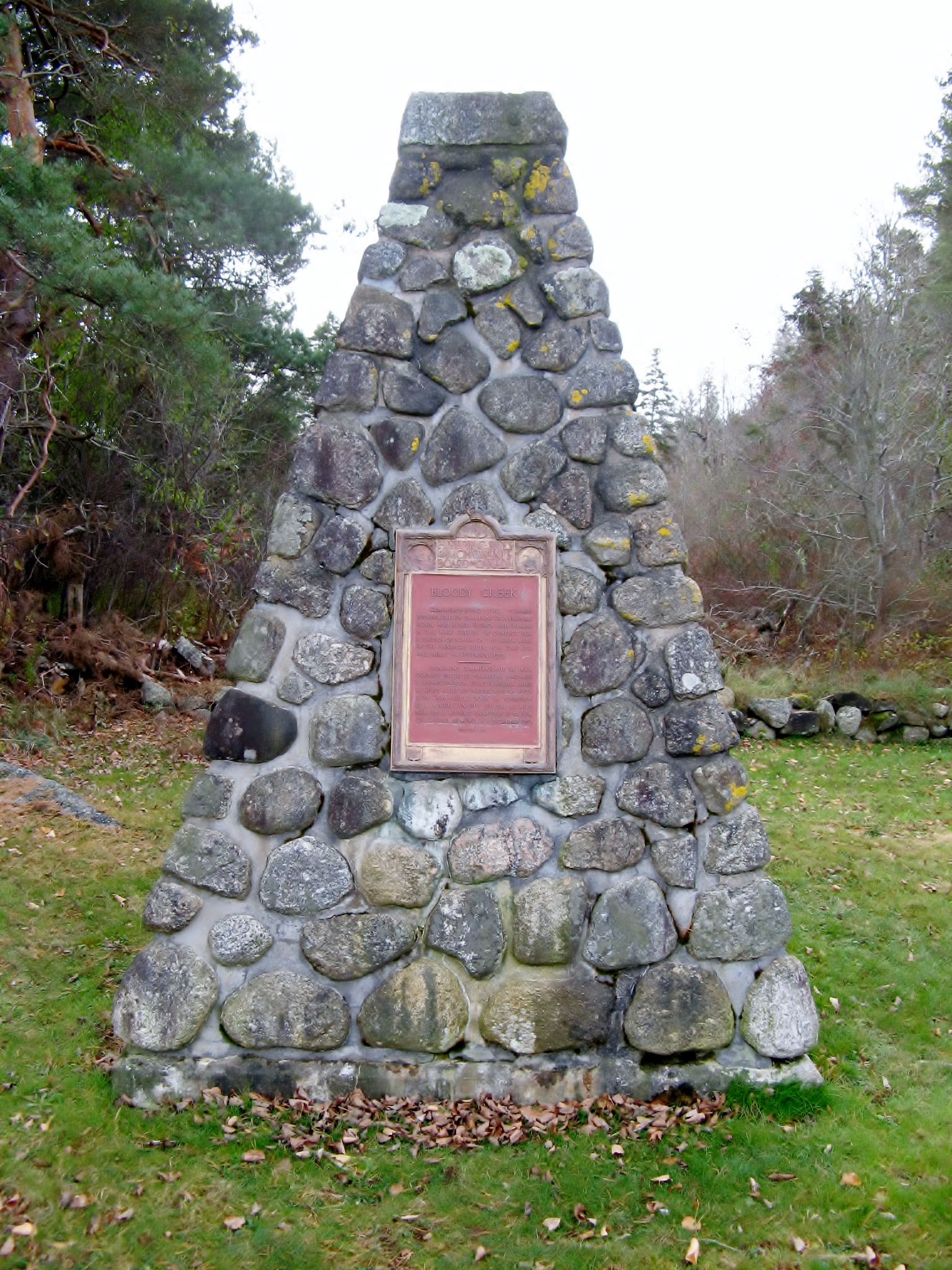
In 1932, the Historic Sites and Monuments Board of Canada erected a plaque to mark the national historic significance of two military encounters in the Bloody Creek area.
Relations between the British administrators and garrison occupying the fort in Annapolis Royal (formerly Port-Royal) and the Acadians living along the Annapolis River were tense during the winter of 1710 - 1711. A three-mile radius around the fort had been surrendered, leaving the Acadians outside the designated area in an ambiguous position. To discourage Acadians from assisting the British garrison, Bernard-Anselme d’Abbadie de Saint-Castin was appointed as leader of the Indigenous and French forces. Saint-Castin and Indigenous fighters, primarily Abenakis and Maliceets, spent the winter of 1710 - 1711 harassing the fort and threatening Acadians who cooperated with the British.
By the spring of 1711, the fort was in bad condition and Acadians along the river were requested to provide 2000 poles and 400 beams for the fort walls. Acadians found themselves in a difficult position, caught between the demands from the fort and threats of retaliation from Indigenous fighters and excommunication from the Catholic Church.
On June 10, a 70-man British detachment intended to show a force to demonstrate to the Acadians’ harassers that the British were forcing them to supply timber. Indigenous fighters attacked one boat and all but one man were killed. The men in the other two boats were killed, wounded or taken prisoner. The wounded were ransomed while the prisoners began a trek to Quebec. The attackers consisted of about 40 Abenakis and their leader Simhouret. No Acadians were known to have taken part.
Father Antoine Gaulin, missionary to the Abenakis, claimed the British had planned to attack Mi'kmaq families on the upper river, remove principal French inhabitants and burn the settlements. Resistance to the British and New Englanders at the fort were mobilized resulting in several weeks of increased tensions which passed without major incident.
In 1755, the government of Nova Scotia had deported the Acadians of Annapolis Royal and other major centres of Acadian settlement. Acadian men who had eluded deportation formed a guerilla force which kept the garrison at the fort closely confined, unable to venture out of town without a covering party.
On December 6, 1757, a party sent out from the fort to cut firewood. A small force of “Frenchmen” killed a grenadier and took several men prisoner. A detachment sent out to rescue the men returned empty-handed. A larger detachment set out the same evening. The British force made its way along the south side of the Annapolis River, searching for a place to cross to the other side, where the Acadians and the prisoners were. After three unsuccessful attempts, the detachment began the trek back to the fort. At eleven o’clock on the morning of December 8, as the British crossed a plank bridge over the René Forest River (now Bloody Creek), the French attacked, killing the commanding officer. The last of the men fought their way across to more fire on the other side. The attackers then fled, pursued briefly by the soldiers. Afraid that they would be attacked again further ahead, the British returned to Annapolis Royal, leaving most of the dead and wounded behind.
Details of the attacks, as told by the prisoners - the attackers of December 6 numbered about 15 while those of December 8 numbered about 56. Seven of the attackers were killed and nine wounded. None of the wounded left behind by the British had been brought back as prisoners, so apparently were killed. William Johnson (Guillaume Jeanson), whose father had been in the British garrison at Annapolis Royal and whose mother was Acadian, was said to have been the leader of the attackers.