
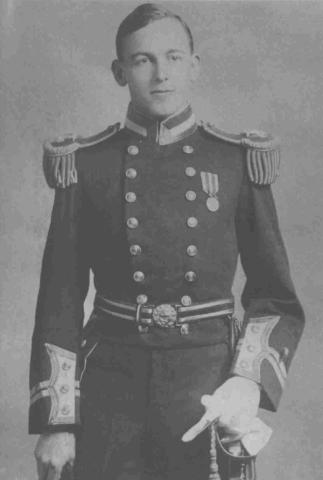
Frederick Thornton Peters was the son of the Attorney General and the first Liberal Premier of Prince Edward Island. He was educated at St. Peter's Private School, later went to school in Victoria, British Columbia, and from there to the Naval School in England.
Peters was nicknamed Fritz by his family because he was obsessed with all things military from his earliest years – like a stereotypical Prussian. In P.E.I. he was keen on a career as a soldier like his grandfather, the Father of Confederation Col. John Hamilton Gray, but in B.C. his interest changed to navy as a result of watching warships of the Royal Navy pass by within sight of his home.
He graduated as a midshipman and three years later he received his commission as a sub-lieutenant. During the First World War he was decorated with the Distinguished Service Order , the first ever given to a Canadian, and the Distinguished Service Cross for gallantry in action.
In 1942 he took charge of the most dangerous mission in the Allied invasion of North Africa – an audacious attack by a mostly American force in two former U.S. Coast Guard cutters to secure Oran harbour in the French colony of Algeria for the invasion. Landings at 1 am on 8 November 1942 on beaches west and east of Oran by American troops had met little resistance from French defenders, but two hours later they reacted with full force from Oran shore batteries and warships moored in the harbour when Peters’ ship HMS Walney along with HMS Hartland broke through a boom of logs, chains and barges and proceeded towards their goal of taking over French warships and port facilities with commandos.
The citation for the Victoria Cross in the London Gazette of 14 May 1943, reads:
“Captain Peters was in the suicide charge" by two little cutters at Oran. The "Walney" and "Hartland" were two ex-American coastguard cutters which were lost in a gallant attempt to force the boom defences in the harbour of Oran during the landings on the North African coast. Captain Peters led his force through the boom in the face of point-blank fire from shore batteries, destroyer and a cruiser - a feat which was described as one of the great episodes of naval history. The "Walney" reached the jetty disabled and ablaze, and went down with her colours flying. Blinded in one eye, he alone of the seventeen Officers and Men on the bridge survived. The Walney reached the jetty disabled and ablaze, and went down with her colours flying."
In his book The Bravest Canadian – Fritz Peters, VC: The Making of a Hero of Two World Wars, the author Sam McBride noted that despite suffering 90% casualties and facing point blank fire from all directions, Peters was able to direct his ship for a mile and a half through the narrow harbour and land Walney beside its target berth. At great personal risk, he assisted with the landing lines in the front and back of the 250 ft. ship. Wounded in the shoulder and blinded in one eye, he was taken prisoner along with fellow survivors. Two days later he was freed by American troops who had captured the city, and carried through the streets of Oran in triumph.
For his part in the action at Oran, Algeria Frederic Peters posthumously received both the Victoria Cross and the U.S. Distinguished Service Cross, the highest honour the United States can bestow on foreigners.
The citation for his US Distinguished Service Cross states:
"The President of the United States of America, authorized by Act of Congress, July 9, 1918, takes pride in presenting the Distinguished Service Cross (Posthumously) to Captain Frederick Thornton Peters, Royal British Navy, for extraordinary heroism in connection with military operations against an armed enemy while in command of the ship carrying Landing Forces of the United States Army into the harbor of Oran, Morocco, in the early morning of 8 November 1942. Captain Peters distinguished himself by extraordinary heroism against an armed enemy during the attack on that post. He remained on the bridge in command of his ship in spite of the fact that the protective armor thereon had been blown away by enemy shell fire and was thereby exposed personally to the withering cross fire from shore defenses. He accomplished the berthing of his ship, then went to the forward deck and assisted by one officer secured the forward mooring lines. He then with utter disregard of his own personal safety went to the quarter-deck and assisted in securing the aft mooring lines so that the troops on board could disembark. At that time the engine room was in flames and very shortly thereafter exploded and the ship turned on its side and sank."
Related information
Naval and Military Museum, CFB Esquimalt