
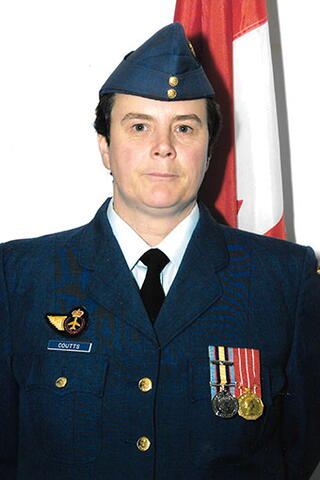

Joined
1981
Master Corporal (retired) Roxanne Coutts and her corporal were on their way to deliver missiles to the F-18 flight line when the alert sounded in Doha, Qatar.
It was the early 1990s, and the eerily familiar whine signalled a possible incoming Scud missile or chemical attack, so they abandoned their truck (with the trailer still hitched) and ran for cover in an abandoned building.
Several military planes waited on the nearby tarmac for their load.
While they sought safety, Coutts realized the truck radio was their only source of information, so they had no way of knowing when the coast was clear.
One of them was going to have to leave their shelter and take the risk to retrieve the vehicle.
“I was going to do it,” Coutts remembers. “But my corporal said, ‘No. I’m the corporal. You tell me to go.’”
She explained to him that she had never been a fan of pulling rank.
“I wouldn’t ask you to do something I wouldn’t do,” she remembers saying to him. “You have a young family. I don’t.”
The corporal insisted and ended up running the 50 feet to unhitch the trailer, start the truck and drive it to the shelter so they could radio their sergeant.
Their brief but important exchange captured the reality of the Gulf War for Canadian service members – it was filled with danger, responsibility and high-pressure decisions.
It was one of many tough decisions Coutts had to make during a military career that spanned nearly 24 years in the Royal Canadian Air Force (RCAF).
Looking beyond small-town life
Coutts grew up in Neil’s Harbour, a tiny fishing village on Cape Breton’s Cabot Trail. She was 19 when she joined the Canadian Armed Forces in 1981.
“I wanted to get out of here,” she said with a laugh. “I didn’t want to marry a fisherman.”
She headed to basic training at Canadian Forces Base (CFB) Cornwallis, Nova Scotia, then on to CFB Borden for trades training. She began her career as an Air Weapons Systems Technician or AWS Tech, later moving into air weapons systems. When air force trades were amalgamated, her occupation became an Aviation Technician.
It was physical, technical work.
Over the years, she travelled on temporary duties to Iceland, Florida and Greece, where she helped train Greek Air Force personnel on the Aim 9 Sidewinder missiles they had purchased from Canada.
She built a reputation as a reliable soldier who knew her stuff.
Her reliability and expertise mattered when she was posted to Cold Lake, Alberta, and assigned to the missile shop. 4 Wing Cold Lake is Canada’s busiest fighter base and home to the CF-18 Hornet fighter squadrons – the missile shop is part of the aircraft armament/weapons support function.
Coutts was part of a team that made sure the CF-18s and other aircraft were armed, safe and ready for military operations by assembling, maintaining and inspecting weapons, and loading and unloading missiles, bombs and ammunition onto jets on the flight line.
The Gulf War
In December 1990, she deployed to Doha, Qatar, as part of Canada’s contribution to the Gulf War. She served as a supervisor in charge of missiles at the airbase, responsible for receiving massive metal containers filled with live munitions.
Her job involved a lot of heavy lifting to prepare missiles for flight: attaching fins and wings and ensuring everything was operational and safe.
“I didn’t have to go to a gym and lift weights. I lifted missiles,” she said.
“It took three people to lift an AIM-9 Sidewinder. For the AIM-7 Sparrow, we had to use a jack.”
The environment was tense and unpredictable with the constant threat of a chemical or Scud missile attack always top of mind.
“You were always in high gear,” she said. “It was scary at times.”
When the war officially began in 1991, and the base moved into a higher state of alert, the stress increased.
“If you heard a siren, you knew something was coming,” she said. “You took cover and put on your mask.”
Coutts and her fellow soldiers were trained to get their gas masks on in under nine seconds. Once suited up, they checked each other carefully to make sure everyone had their Velcro sealed, clasps fastened and everything secure.
“We didn’t want to lose anybody.”
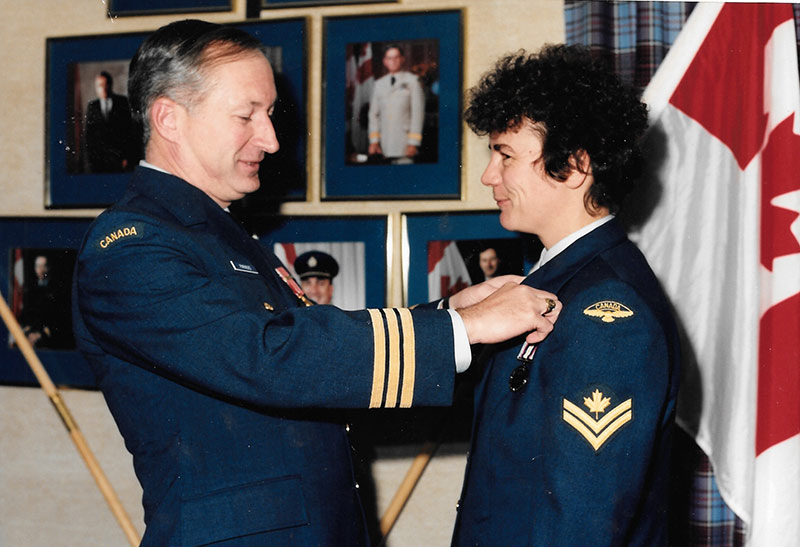
Coutts receives the Gulf and Kuwait Medal.
Looking after each other
Despite the fear, she remembers the deep sense of mutual care among those deployed to the Gulf War.
“We were trained for this stuff,” she said. “And you were never alone. Everybody looked after each other.”
There wasn’t much time to dwell on the danger. Days blurred together in a cycle of work and sleep. When she did get downtime, she played Tetris on a Game Boy her husband had mailed to the desert.
She played it so often that another soldier painted a portrait of her holding it on the wall of the cement culvert they used as a makeshift chemical-attack shelter.
In their downtime, some people liked to go to downtown Doha, but Coutts wasn’t comfortable doing that because the locals weren’t nice, especially to women.
“Men would hiss and spit at us. I would turn and glare and kick sand right back at them.”
In 1989, women in the Canadian Armed Forces filled combat roles for the first time, making Coutts and other women in the Gulf War the first ever allowed to face the same level of risks and dangers as men in a time of war.
“I knew when I signed up there was a possibility I could be sent to war. We were the first women in combat - ever,” she explained emphatically. “It was a pretty big deal.”
She wrote letters to her husband admitting she was scared but her letters to her mother had a different, more reassuring tone.
“I told her not to worry, we were safe.”
When the war ended in February 1991, they started heading home to Canada in groups.
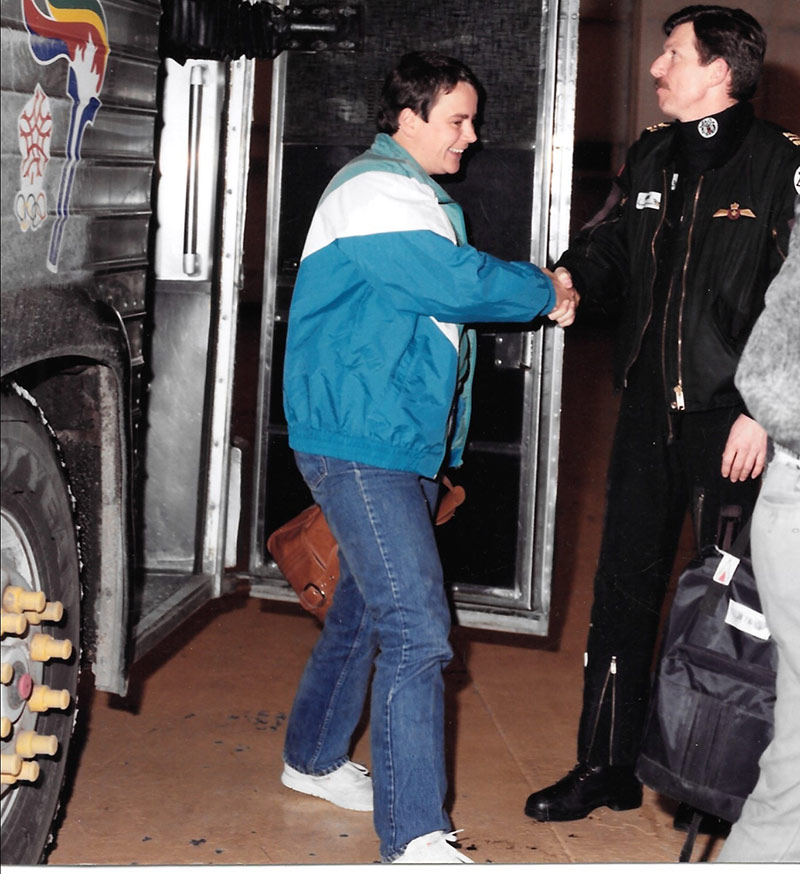
Coutts on the left is welcomed home from the Gulf War on her arrival in Cold Lake, Alberta, on March 9, 1991.
On March 9, her group was greeted on the Ottawa tarmac by a welcoming committee. Then, when they flew from Edmonton back to Cold Lake, there were more welcome signs, flowers, hugs and cheers.
“It was awesome,” Coutts remembers. “I am glad that I was there because I finally got to use my training. I realized I really was a soldier after all.”
Post-service life
In 2005, Coutts retired after almost 24 years of service, saying she “had just had enough.”
She then worked part time as a postmaster with Canada Post.
She and her husband (also a RCAF Veteran she met at CFB Greenwood) bought the home she grew up in, overlooking the Atlantic Ocean in the tiny community she couldn’t wait to leave as a fresh-faced teenager.
She has some mental and physical service-related injuries from her years of service. Certain things cause flashbacks to her time in the Gulf War. For example, when she vacationed in Cuba, the smells brought her right back to Doha “it was a dirty, grungy smell in the heat, it made me panic,” she said.
But she says Veterans Affairs services have helped her get through the tough times by making her aware of programs she could access like physiotherapy, counselling, foot care and disability benefits.
Coutts appreciates the support she has received from Veterans Affairs Canada and will be joining our delegation for the 35th anniversary Gulf War ceremonies in Halifax in February, an event she is looking forward to.
With courage, integrity and loyalty, Roxanne Coutts is leaving her mark. She is a Canadian Armed Forces Veteran. Discover more stories.
The well-being of Canadian Veterans is at the heart of everything we do. As part of this, we recognize, honour and commemorate the service of all Canadian Veterans. Learn more about the services and benefits that we offer.
If you are a Veteran, family member or caregiver, the support of a mental health professional is available anytime at no cost to you. Call 1-800-268-7708.