
Remember Flanders
Age group: 10 - 15
Summary
Students analyze symbolism in the poem In Flanders Fields and consider its call to carry the torch of remembrance. They examine the Remember Flanders Memorial considering what elements the designer included and why, before turning art into action with a remembrance project.
Objectives
Students will:
- understand the historical context and symbolism of In Flanders Fields;
- analyze symbolism in the Remember Flanders Memorial in Ottawa; and
- explain the meaning of the “torch of remembrance” and apply it in a creative task.
Classroom materials
- Poem: In Flanders Fields
- Video: John McCrae Heritage Minute (Historica Canada)
- Video: Decoding Art: Remember Flanders (Heritage Canada)
- Video: In Flanders Fields
- Craft Supplies: Construction paper (red and green), glue and markers.
- Optional: One poem, many voices (video, audio and test translations in more than 25 languages)
Introduction
Begin the lesson by showing students this John McCrae Heritage Minute from Historica Canada.
Explain that Lieutenant-Colonel John McCrae was a Canadian military doctor serving near the front lines in Belgium during the First World War. He wrote the poem In Flanders Fields on May 3, 1915. The day before, one of his closest friends was killed in the fighting. He was buried in a makeshift grave with a simple wooden cross. Wild poppies were already beginning to bloom between the crosses marking the many graves.
The poem was a way for John McCrae to express his sadness. It was first published in a magazine in London, England, in December 1915. It quickly became a symbol of remembrance for the sacrifices made by soldiers from around the world.
Today, we are going to think about how we honour Canada’s war dead by looking at the poem John McCrae wrote to remember them and a memorial built a century later to remember him.
Decoding the In Flanders Fields poem
We've all heard the powerful lines of the poem In Flanders Fields. But what makes this poem so powerful, and why does it still have a message for us over a century later?
Play a video or audio recording of the poem In Flanders Fields so that students can hear the rhythm. One poem, many voices provides a variety of options as well as printable text versions.
Next, read the poem aloud as a class. Start or pause throughout to define key words or phrases. If possible, challenge students to try defining the words based on context:
- Flanders: A region in the country of Belgium where many battles took place during the First World War.
- Blow: The way the flowers move in the wind.
- Larks: Small singing birds.
- Scarce heard: Barely audible
- Amid: In the middle of
- Quarrel: Fight
- Foe: Enemy
- Break faith: Break a promise
Explain that the poem uses symbols to convey meaning. Ask students to identify symbols that stand out to them. Make a list on the board and talk as a class about what each symbol is meant to convey and why it is important. Here are a few examples:
- Poppies
John McCrae saw these bright red flowers growing on the battlefields and beside the crosses marking graves in the cemetery. The bright red poppies were the colour of blood. They were also a sign of life, colour and beauty in the middle of terrible destruction and sadness. They showed that even after all the destruction, life could still go on. This is why the poppy became our symbol of remembrance. - Larks
The poem talks about larks still bravely singing as they fly. The lark is a small bird known for flying high into the sky and singing a beautiful song. In the poem, the birds still sing even while powerful guns are firing loudly below. It is a comforting and hopeful sound. The larks in the poem are a reminder that life and nature continue even in the middle of a war. - Crosses
During the First World War, graves in battlefield cemeteries were marked with wooden crosses. The crosses would be replaced after the war by stone markers. The choice of crosses reflected the dominance of Christian religious values in Canada and other countries in the British Commonwealth. In the poem, the crosses are important because they remind us of the many soldiers who are buried in the fields John McCrae describes. Rows and rows of crosses tell us that many people died. The presence of individual markers for each reminds us that they were not numbers or statistics; they were all individual people just like us. - The torch
The poem is written in the voice of the fallen soldiers as a group. We can see that by use of the words our and we and the phrase ”We are the dead.” Speaking from beyond the grave, they remind us that they have died for their country. One of the poem’s most important lines says: “To you from failing hands we throw / The torch; be yours to hold it high.” The torch is an important symbol. It represents the responsibility to carry forward, the responsibility to protect and freedom. The soldiers are saying that they can no longer fight, so they are passing the job on to the living.
Finish your discussion by asking students to think about this question: What job are those who died asking us to do today?
The soldiers are not just asking for the fighting to continue in the First World War; they are also asking us to continue to defend peace and freedom in our own lives. If we break that promise, they will not be able to rest and their deaths will have been in vain. By carrying forward their “torch” we are making a promise to remember them, to honour their courage and sacrifices, and to continue to work for the peace they died for. This is the promise we make on Remembrance Day.
Decoding the Remember Flanders Memorial
Explain to students that memorials can honour many people or just one. The Remember Flanders Memorial in Ottawa honours John McCrae. Remind students that he was a Canadian poet and army doctor during the First World War. He is the author of the famous poem In Flanders Fields.
Before showing students the memorial, have a class discussion about what symbols or design elements students would include if they were building a memorial to John McCrae.
Watch the Heritage Canada video Decoding Art: Remember Flanders to learn about symbolism found in the Remember Flanders Memorial. Challenge students to look for symbols from the poem and how they are represented in the memorial.
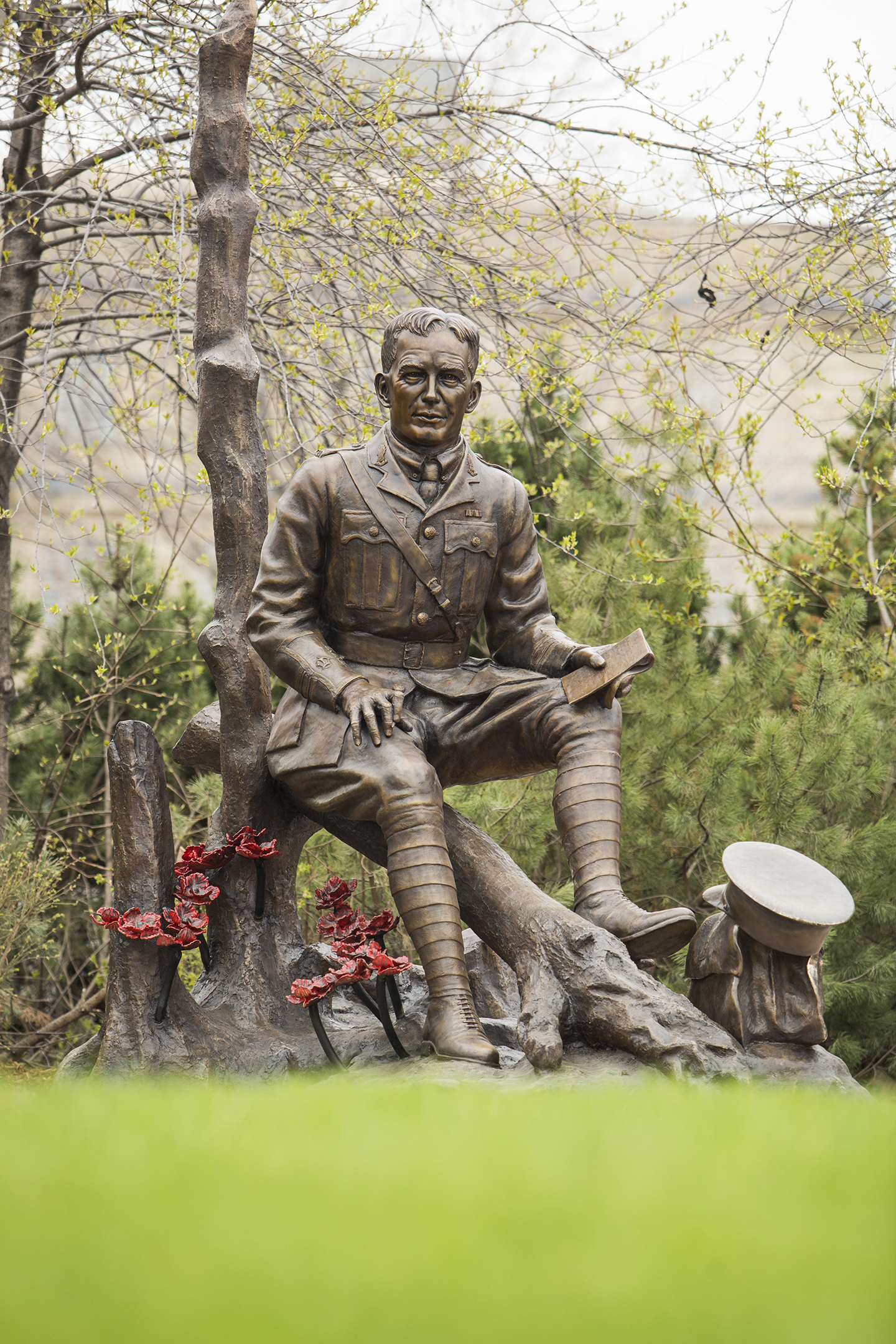
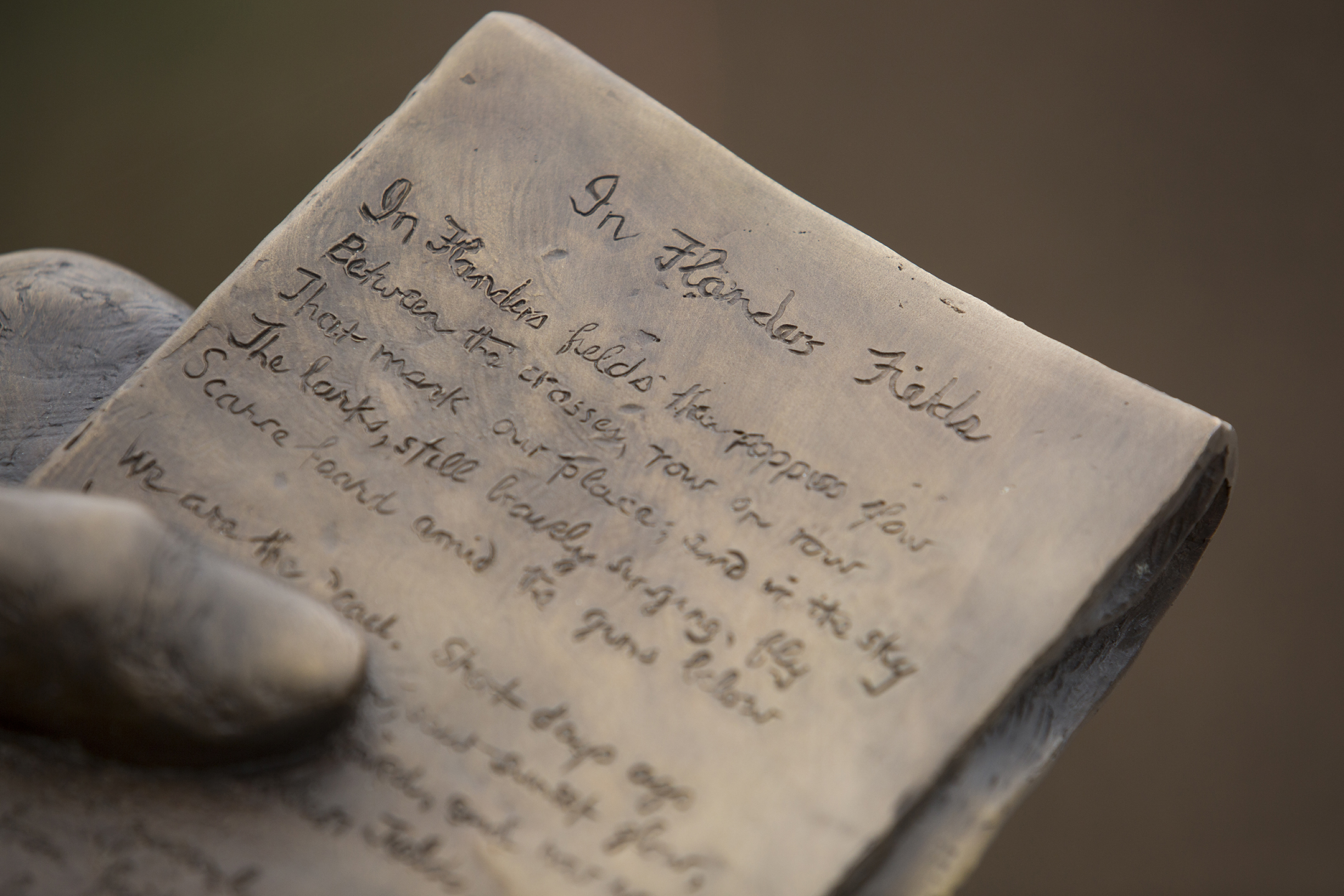
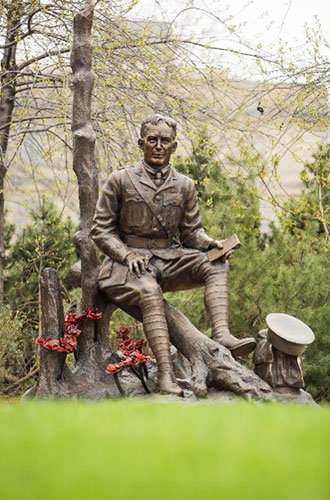
Use these images of the monument to discuss design choices. What symbols do students see? Memorial designers carefully choose each element in their creations. Ruth Abernethy is the Canadian Sculptor who designed the Remember Flanders war memorial. Explain that she created this sculpture to look as though John McCrae was in the middle of writing his famous poem. It is as if he is taking a quiet moment away from the battlefield to write down his thoughts.
Ask: What other design elements do you notice on the sculpture or remember from the video that help tell John McCrae’s story?
Here are a few features you may wish to highlight:
- Pose: The pose and surroundings of the memorial are an important part of its storytelling. It is as if John McCrae is taking a quiet moment to write his poem.
- Poem: The statue holds the poem In Flanders Fields in its hand.
- Bag: A doctor’s bag sits on the ground near the statue’s feet reminding us of McCrae’s important work as a doctor.
- Cap and collar badges: The cap (on the ground) and pins on his uniform lapels have badges reminding us John McCrae was a soldier with the artillery—the section of the army that uses large guns.
- Poppies: Poppies bloom at the base of the sculpture. John McCrae’s description of poppies among the graves of fallen soldiers made the flower an important symbol of remembrance.
From arts to action!
Explain to students that we have explored how John McCrae used powerful symbols in the poem In Flanders Fields to share a message, and how a memorial artist used those same ideas to tell that story in a different way.
Now it’s your turn to carry the torch of remembrance. Teachers may allow students creative freedom or use the instructions below to direct the activity. Plan time for students to share their creations with each other or with another class.
Your task
Create a work of remembrance that uses symbolism to communicate what remembrance means today.
Your work should:
- include at least two symbols inspired by the poem (e.g., poppies, the torch, crosses or larks), and
- include at least one idea or design feature inspired by the Remember Flanders Memorial (e.g., pose, objects, setting, or storytelling through design), and
- Clearly honour and remember a person or people who have served in Canada’s military.
Choose Your Format
Working in groups or individually, you may present your work in one of the following ways:
Memorial Design
Create a drawing, model or sketch of a memorial. Label your symbols and explain their meaning.
Video or Digital Presentation
Combine images, narration or music to bring the poem’s message to life. Audio and translated content at One poem, many voices can be used with credit to Veterans Affairs Canada.
Visual + Written Piece
Create a poster, poem or short written reflection that includes symbolic imagery.
Message of Remembrance
Design a letter or card that uses symbols and words to express gratitude and remembrance. Deliver the messages to Veterans at a community Remembrance Day ceremony, a long-term care facility or a local Veterans organization.
Plan Your Symbols (Think First!)
Take a moment to plan before you begin:
- What symbols will you use?
- What does each symbol represent?
- How did the poem or memorial inspire your choices?
Share and Reflect
Be ready to explain:
- What message you wanted to communicate
- Why you chose your symbols
- How your work helps carry the torch of remembrance today