
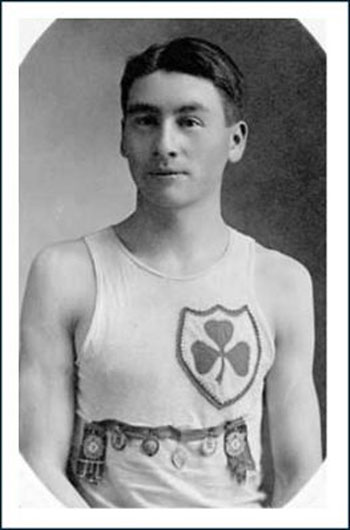
A Run to Remember
Age group: 8 - 11
Lesson duration: 30 minutes
Honour Olympian Alex Decoteau’s military service at Passchendaele with a remembrance run.
Aim
To increase youth awareness of the Battle of Passchendaele in the First World War and to encourage youth to remember the sacrifices and achievements of Canadians during the battle.
Objectives
Youth will be expected to:
- develop a basic understanding of the Canadian efforts in the Battle of Passchendaele;
- develop an awareness of the importance of remembering the sacrifices and achievements of those who served and died;
- develop knowledge about the life of Private Alex Decoteau - an Olympic athlete, Canada’s first Indigenous police officer, and a Canadian soldier; and
- participate in a physical activity.
Target Audience
This activity is suitable for ages 8 to 12.
Sequence of events and anticipated time frame [30 minutes]
(This activity can be modified to fit available time.)
- Introductory discussion [10 minutes]
- Viewing a poster [10 minutes]
- Reading activity [10 minutes]
- Alex Decoteau memorial run [variable]
Materials
- An inspiring runner story
- Battle of Passchendaele poster
- Alex Decoteau dog tags
- World map showing Canada and Belgium
- Alex Decoteau running bib
Introductory Discussion [10 minutes]
Have a brief discussion with your students about what makes a person a friend. Discuss sharing, playing together, helping, etc. Then shift the conversation to what they think a whole country could do to be a friend.
Provide the students with a bit of an understanding about the First World War. Talk about how the war began more than 100 years ago, well before their parents and even their grandparents were born! Look at a world map and locate the continent of Europe. Show them the country of Belgium. Discuss and show them how far away Europe is from Canada. You may ask if any of them have ever visited Europe. See if they can spot their own province or territory, and then show them France and Belgium. Discuss how far away these places are.
Mention that the First World War started in Europe when some of the countries there were “bullying” some other countries. In places like France and Belgium, people and families lost their homes, and many were cold and hungry. Canada decided to help make stop bullying, and they sent thousands of soldiers to help.
Explain that the Canadian soldiers fought in many difficult battles, and one of them was the Battle of Passchendaele. Help your students to pronounce this word: Pa-chen-dale.
Viewing a Poster [10 minutes]
Canadian troops fought in the Battle of Passchendaele in the Fall of 1917. Share the Passchendaele Poster with your students.
This poster was published in 2017, a hundred years after the Battle of Passchendaele. Why do you think it’s important to mark key events in our military history?
Discuss that the scenes depicted on the poster evoke the very real desolation of what was a shattered, muddy battlefield. Amid a landscape marked by countless water-filled shell holes and with the remains of blasted trees looming in the background, a single Canadian soldier stands in the distance, as if contemplating the enormity of the battle.
- What thoughts do you think were going through the soldier’s mind?
- How do you think the soldier was feeling?
Discuss the colours of the poster. The red poppy offers a vivid splash of colour against the sad battlefield and serves as a call to remember those who served and died in those muddy battlefields for the cause of peace and freedom. Do you think a poster is an effective way to remember?
Reading Activity [10 minutes]
Share with your students the handout An inspiring runner to help students understand how young Canadian men served in the Battle of Passchendaele and that, sadly, many soldiers lost their lives.
Following the reading, ask students to consider their own lives, things they are good at like academics, art or sports. Have them try to relate to Alex and the things he sacrificed when he went off to war. Could he have gone on to participate in another Olympics if he hadn’t died at war? Would he have returned to Canada with a career as a police officer? How would his mother have felt hearing of her son’s death and receiving that special watch of his?
Alex Decoteau memorial run, walk or wheel!
Inspire your students to follow in a hero’s footsteps and hold their own Alex Decoteau memorial run, walk or wheel! Student could run five kilometres as Alex did at the Olympics, or even just around the school gym or neighbourhood block. Each student could be presented with an Alex Decoteau remembrance “dog tag” or a running bib. Students could wear the dog tag during the run or receive it at the finish line. Visit the Canadian Virtual War Memorial to learn more about him.
Alex Decoteau is a great role model. He was an athlete, Canada’s first Indigenous police officer and a soldier who served our country in the First World War. This run could be a commemoration surrounding Remembrance Day - a tribute to having the freedom to be fit and active, thanks to soldiers like Alex Decoteau, who sacrificed their lives.