
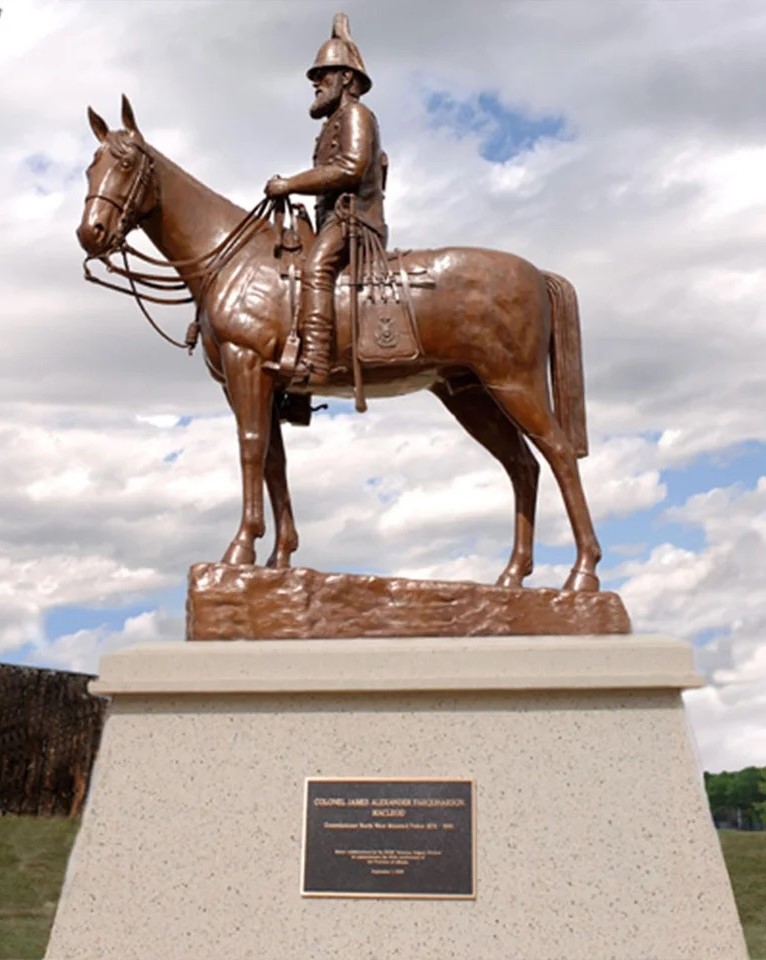
The Colonel James Macleod Statue was conceived by retired Royal Canada Mounted Police officers Gus Buziak and Walter Sedler. They were on their way to an Royal Canadian Mounted Police veterans' meeting when they had the idea of the statue as a centennial gift from former Mounties to Calgary. The Macleod statue was unveiled on September 1, 2005. At the ceremony, Royal Canadian Mounted Police Commissioner Giuliano Zaccardelli announced that a second casting of the statue would be erected in Ottawa. The statue was created by renowned bronze sculptors Don and Shirley Begg of Studio West Bronze Foundry Ltd. Colonel Macleod is depicted in a commissioner uniform of the North-West Mounted Police and sitting on his horse.
Three panels, each telling a story of the land and its people, sit atop the rocks surrounding the statue of Colonel Macleod. Titled Innai'tsiyiyaawa, which is Blackfoot for "They Made Treaty," the exhibit puts Chief Crowfoot and the Blackfoot people at the center of narratives about the lands at Fort Calgary and the signing of Treaty 7. The land was a natural gathering place to hunt, trade and hold ceremonies. With its natural topography and social significance, it was where the North-West Mounted Police built Fort Calgary in 1875. The panels were created by artist Sikapinakii Low Horn.
Colonel James Macleod was born in Scotland, but moved to Canada with his family when he was around nine years old. The Macleods’ friendship with a family of local Ojibwa gave James a lifelong respect and admiration for the Indigenous peoples of Canada. His fairness and compassion shaped the North-West Mounted Police, which eventually became the Royal Canadian Mounted Police, and set the pattern for justice in Western Canada. Historians give him much of the credit for the comparatively peaceful and orderly settlement of the region. He treated Indigenous people as equals, and when he could, blended their traditional justice with the British justice. In those days, a lot of military officers and Mounted Police officers were British. They would buy their commissions and ruled by fear. They didn’t command by respect. Macleod was a man ahead of his time and governed by respect. He had to get past the rigid British traditions to accomplish what he did.
In the summer of 1856, he joined the Volunteer Militia Field Battery of Kingston as a lieutenant. In 1860, James passed his bar examinations at Osgoode Hall. He transferred to the Bowmanville Volunteer Militia Rifle Company in 1862 and was promoted to captain in 1863 and major in 1866. James saw active service during the Trent affair in 1861 and the Fenian raids of 1866. In 1870, Macleod obtained a commission as brigade major with the expedition under Colonel Garnet Joseph Wolseley sent to quell the uprising in the Red River settlement, Manitoba. His leadership during the expedition earned him praise from his commanding officer as well as a CMG. He remained with the Canadian militia force at Lower Fort Garry until the spring of 1871. Macleod was promoted to lieutenant-colonel in the 45th Battalion of Infantry in December 1871. In the spring of 1873, he became the superintendent and inspector in the newly established North-West Mounted Police.
In the summer of 1875, Inspector Éphrem-A. Brisebois travelled to the Bow River to build a second major outpost, Fort Brisebois, subsequently renamed Fort Calgary (Calgary) by Macleod. There’s a Calgary, a hamlet, that exists on the Isle of Mull, Scotland. That Calgary had a nice beach and it drew Macleod there one summer when he was visiting and provided the inspiration for the name in Canada. Fort Macleod in southern Alberta and Macleod Trail, a major road in Calgary were named after Colonel Macleod.
Macleod was assistant commissioner, and later commissioner, of the newly formed North-West Mounted Police. He had a distinguished career as a magistrate and judge, serving first in Fort Macleod. He was appointed a justice of the Supreme Court of the Northwest Territories in 1893, but died a few months after moving to Calgary. He is buried in the city’s Union Cemetery.