
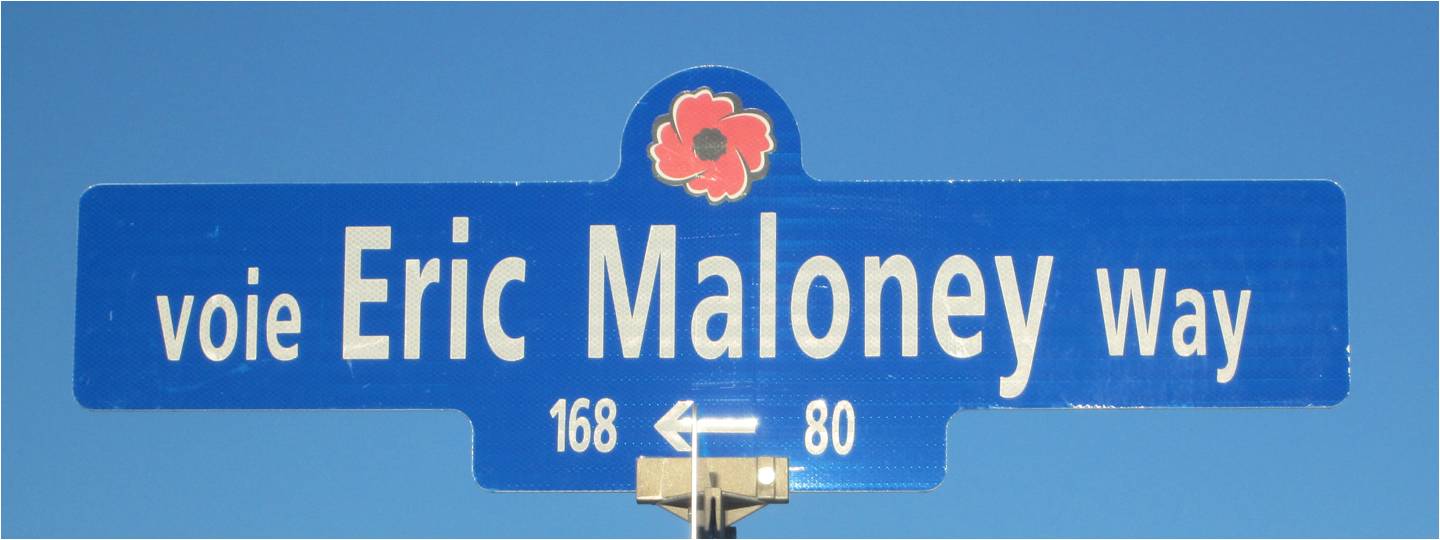
The City of Ottawa named this roadway Eric Maloney Way, in November 2016, in honour of Corporal Eric J. Maloney.
Eric Maloney was born in 1922 in Douglastown near Gaspé, Quebec. He joined the Canadian Army at the onset of the Second World War and was assigned to the 2nd (Reserve) Battalion The Royal Rifles of Canada, based in Québec City. He was then transferred to the Royal Rifles of Canada, Canadian Active Service Force (subsequently renamed 1st Battalion, The Royal Rifles of Canada, Canadian Active Service Force) which had been mobilized in May 1940, and served in Newfoundland on garrison duty until August 1941.
In September 1941, Britain requested Canadian units for garrison duty in Hong Kong. Canada accepted the request and created "C" Force, composed of a brigade headquarters, the 1st Battalion Royal Rifles of Canada and the Winnipeg Grenadiers.
The Royal Rifles left Québec City on 23 October 1941, arriving in Hong Kong on 16 November. Corporal Maloney and his unit spent the next few weeks training but were largely unaware of the movement of Japanese forces in their area. On 7 December the Japanese began their attack of the Hong Kong area, landing on the island on 18 December. After a week of ferocious fighting, the outnumbered Canadians surrendered on Christmas day. 290 Canadians were killed during the battle, 473 were wounded and the remainder were sent to Japanese prisoner of war camps where they endured 44 months of brutal, abusive treatment at the hands of their captures.
Corporal Maloney managed to survive this horrendous ordeal and returned to Canada at the end of the war, becoming a chef, and working on NORAD’s Distant Early Warning line. He retired to the Ottawa area, where he supported many charitable organizations and volunteered at the Nepean Museum. Corporal Eric Maloney died on 11 March 2015.