
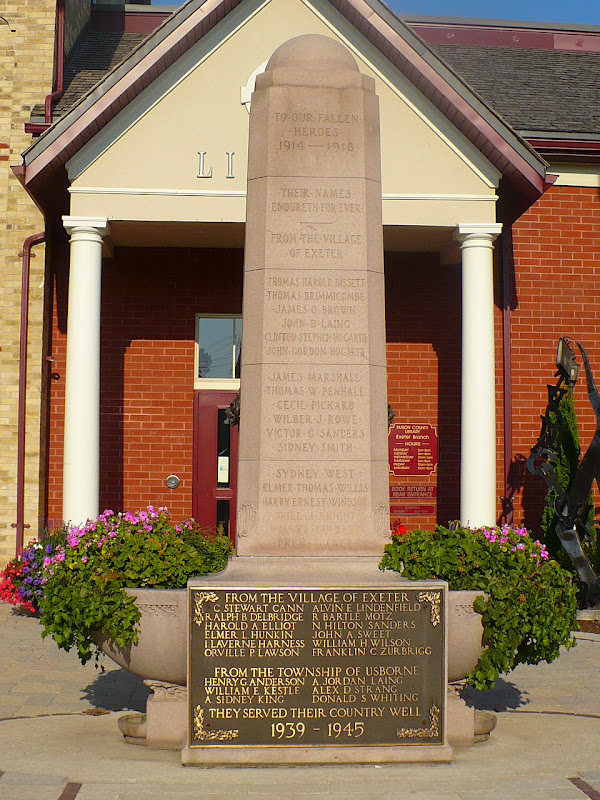


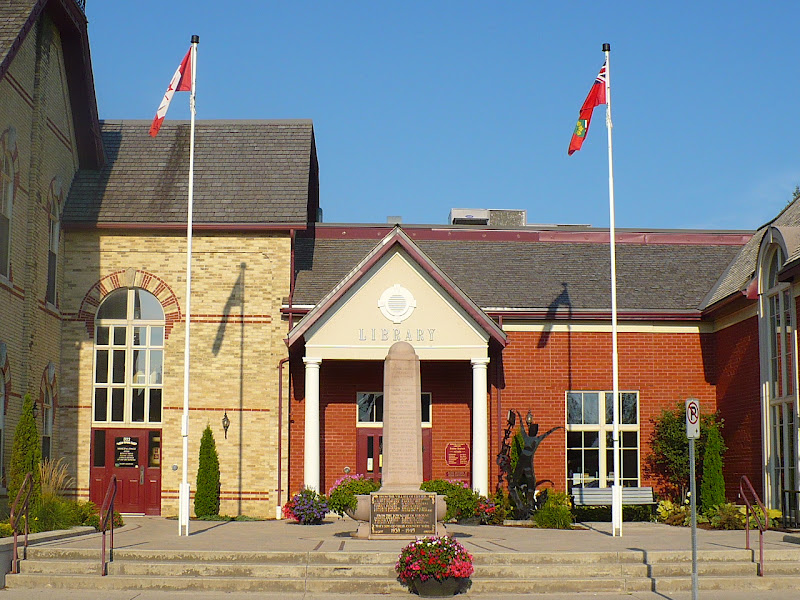
At a Town Council meeting held in November 1918, discussions started about erecting a War Memorial on the grounds surrounding the Town Hall and the Carnegie Library in Exeter. The Municipal Councils of the Township of Usborne and the Village of Exeter attended a meeting held in Reeve Ben Beavers' hardware store on Main Street in Exeter on Friday, November 15, 1918. It was agreed that a monument be erected and fundraising efforts begin.
The Exeter Patriotic League sent a letter to the Reeve along with a donation of $300 to create a trust in perpetuity to make sure the surroundings of the monument be maintained and "kept beautiful" and that "suitable flowers be planted and cared for". The letter was signed by E.V. Pickard, President and M.L. Johns, Secretary.
Mr. Thompson, of Toronto, showed cuts of a number of designs which would be suitable for a memorial. He thought the idea should be one of peace rather than one of war and showing that the men had sacrificed their lives to bring about peace. The design chosen was in the form of a fountain, a spray of water coming from each side as an emblem of life that was given to bring about peace.
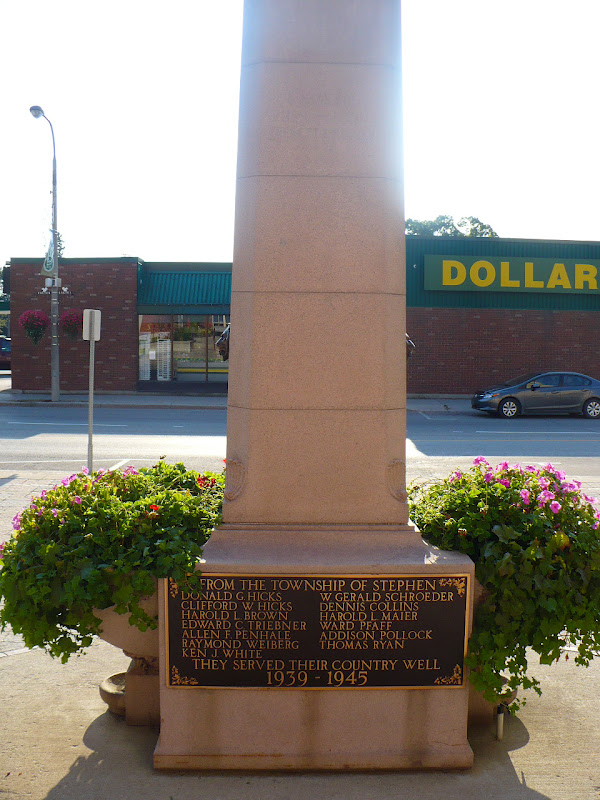
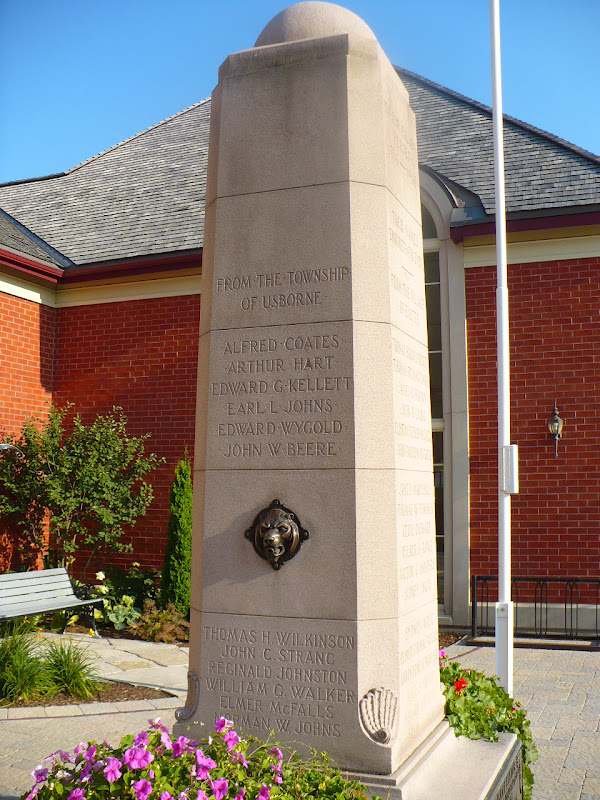
The memorial is eight feet long and five feet wide at the base, and ten feet high. It contains the names of all the fallen heroes of the Village of Exeter and Usborne Township. It is made of Canadian grey granite and was completed by Canadian workmen. The cost was shared equally by the Village of Exeter and Usborne Township. The work was completed by Mr. James Weeks, the local Marble Works owner, and was completed by December 1919.
On January 9, 1920, in spite of the stormy weather an immense number of people gathered in the Village of Exeter to witness the unveiling of the memorial to the fallen heroes of the Village of Exeter and Usborne Township. All the stores, factories, and manufacturers, were asked to close their places of business between three and four p.m. The memorial was constructed with a dove on top, but many citizens questioned whether that dove truly resembled the dove of peace. The dove was removed by the memorial's creator. If the memorial is looked down on from the south windows of the Council Chambers in the Exeter Town Hall, the scars of damage can be seen on the round dome which tops the monument where the dove had been fastened.