



As soon as the First World War ended, discussions began on how to honour Newfoundland and Labrador's war dead and it was felt that a national war memorial was needed. The Patriotic Association and the Great War Veterans' Association worked together to find a way to "give expression to its gratitude and respect for those who during the Great War served King and Empire". In 1920, these associations jointly recommended the building of both a national war monument and a school as memorials.
The Newfoundland National War Memorial represents the war effort of Newfoundlanders who were not part of Confederation during either of the World Wars. Its construction was paid for in part by community fundraising by the Great War Veterans’ Association and its maintenance falls under the responsibility of the Government of Newfoundland and Labrador. The memorial has the famous old harbour as its backdrop, where troops departed and returned from the war. It commemorates all of Newfoundland's wartime achievements on land and sea.
Designed by British artists Gilbert Bayes and Ferdinand Victor Blundstone, the female allegorical sculpture, often referred to as Victory, Liberty, or the Spirit of Newfoundland, sits on a granite pedestal. She holds a flaming torch in her left hand, high above her head. The torch, which symbolizes freedom, is the memorial’s highest point, prioritizing freedom as a central motivation for Newfoundland’s wartime contributions. The flaming torch was originally intended to be a leading light for ships entering St. John’s Harbour through the Narrows, although it was never used as such. In her right hand, she holds a sword which represents both Newfoundland’s willingness to serve during the First World War and their loyalty to the British Empire. The sword is below her waist, but not completely lowered, and poised for battle, and is meant to depict that while the war is over, Newfoundland was, and is, ready and willing to fight for its freedom and liberty.
The female sculpture rises above four lifelike bronze figures of a sailor from the Newfoundland Royal Naval Reserve, a lumberman from the Forestry Corps, a fisherman in oilskins and Wellington boots from the Mercantile Marine, and a soldier from Royal Newfoundland Regiment, providing a tangible connection to Newfoundland and Labrador and those who served overseas and on the home front.
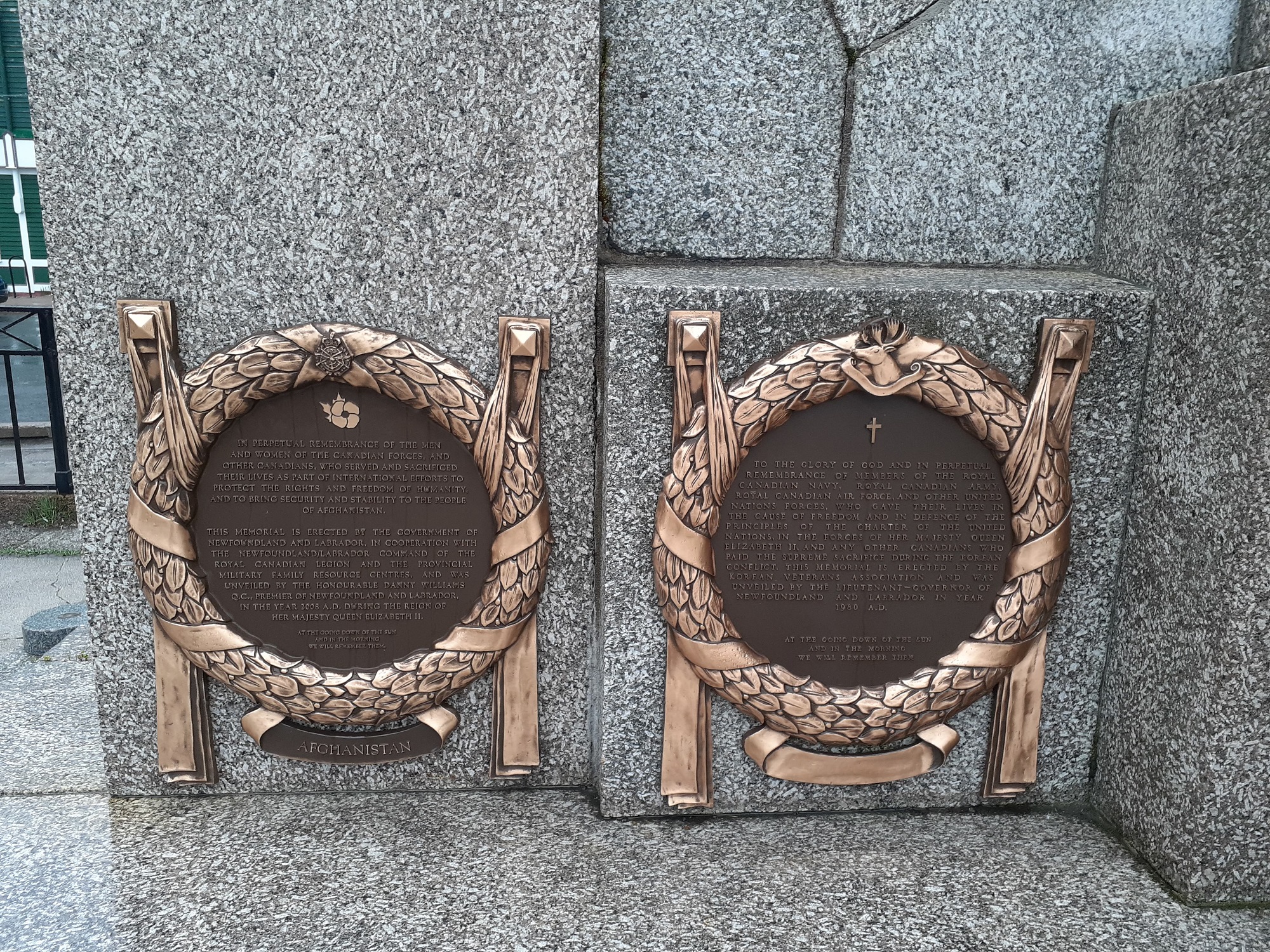
On the front of the monument below the figures are five plaques commemorating Newfoundland and Labrador’s contributions in different conflicts. In the center, the original 1924 plaque honours those killed during the First World War. Plaques dedicated to those fallen in the Second World War, Korean War, Afghanistan, and the War of 1812 were added later. The monument is at the back of a semicircular wall of granite approached by wide stone steps. Flowers in stone urns flank the approach and fine shade trees have been planted about the dais.
In 2019, it was designated a National Historic Site based on the artistic significance and the fact that the memorial was inspired by John McCrae’s famous poem, In Flanders Fields. The Newfoundland National War Memorial was unveiled on July 1, 1924, fifteen years before the National War Memorial was built in Ottawa.
Britain's "oldest colony" sent 8,500 soldiers and sailors abroad in the First World War, out of a population of less than 250,000, over 1,500 gave their lives. The memorial was unveiled by Field Marshall Haig on the anniversary of Newfoundland's great First World War battle at Beaumont Hamel. Since joining Canada in 1949 as the tenth province, Newfoundland not only observes Canada Day on July 1 each year; they also remember Beaumont-Hamel.
The memorial underwent a $6-million refurbishment by the Bay Roberts company Can-Am Platforms and Construction ahead of the 100th anniversary of the cenotaph in 2024. A portion of a tomb arrived on April 9, 2024, that will become the final resting place of an unknown First World War soldier on July 1, 2024. The Tomb of an unknown Newfoundland First World War soldier is the centerpiece of the refurbishment project, which was overseen by the provincial Transportation and Infrastructure Department and is the second of its kind in Canada.